
财富管理

Search documents
信有新知 | 如何选出赚钱好基金,不再“靠运气”发财?
Sou Hu Cai Jing· 2025-12-18 11:57
近期,伴随着A股的上涨行情,基金市场一片火热。截至2025年7月,公募基金规模已突破35万亿元,参与者涵盖了从白领、中产到年轻群体的广泛层 面。随着银行理财净值化转型、房地产投资回报率下降,基金逐渐成为普通投资者的首选理财工具。 然而,基金热度越高,投资者的困惑也越大。为什么有人在基金投资中实现了可观收益,而更多人却"追高杀跌",长期亏损?为什么同样是股票基金,业 绩差距却能拉开数倍?为什么市场上常见的"爆款基金",往往在投资者入场后表现反而平平?这些问题的根源在于:多数普通投资者缺乏系统的投资方法 和风险认知。他们往往凭直觉、凭推荐来做决策,而非基于对基金经理、投资风格、资产配置等关键因素的理性分析。 中信出版集团出版的《手把手教你选出赚钱好基金》一书聚焦这一问题,为普通理财者提供一套"可操作、可落地"的基金投资指南,让投资真正成为普通 人可以学习和掌握的技能,而非"靠运气"的赌博。 认知重构:从"挣钱"到"赚钱" 对大多数人来说,理财的第一步往往始于一个朴素的愿望——如何更快攒到"第一桶金"。书签客在书中指出,这个阶段的核心任务并不是追求复杂的投资 技巧,而是通过开源节流形成基础积累。开源意味着在工作之余 ...


北京市地方金融管理局局长曾林峰:明年将大力支持北交所深化改革,持续助力北交所提质扩容
Zheng Quan Shi Bao Wang· 2025-12-18 07:43
人民财讯12月18日电,12月18日,北京市地方金融管理局局长曾林峰在《财经》年会2026:预测与战略 暨2025全球财富管理论坛上表示,北京凭借独特的市场优势、资源禀赋和政策环境,正致力于打造全球 财富管理中心,市场潜力巨大,需求旺盛。目前北京资管机构资产管理规模约48万亿元,占全国的近 30%。 曾林峰谈到,明年是"十五五"开局之年,将立足北京国家金融管理中心功能定位,着重从四个方面持续 发力:一是高标准推动金融业自身的稳健发展;二是高效能促进金融支持实体经济发展;三是高站位支 持北交所深化改革,明年是北交所开市五周年,将大力支持北交所深化改革,持续助力北交所提质扩 容,进一步发挥服务创新型中小企业主阵地的作用;四是高水平扩大金融对外开放。 ...
锚定四大战略机遇 以“大保险观”服务改革发展大局
Jin Rong Shi Bao· 2025-12-18 00:38
Core Viewpoint - The "14th Five-Year Plan" has set a direction for financial institutions, including insurance companies, to achieve high-quality development, emphasizing the importance of reform and innovation in the insurance industry [1][2]. Industry Opportunities - The insurance industry is poised to benefit from four strategic opportunities: 1. **Pension Finance Opportunity**: The aging population and the continuous release of policy dividends for the third pillar of pension will drive the integration of long-term insurance products with health and wellness services [3]. 2. **Health Insurance Opportunity**: The advancement of the Healthy China strategy and deepening of medical insurance reforms will expand the market for commercial health insurance [3]. 3. **Wealth Management Opportunity**: Insurance products, due to their stable long-term value appreciation and inheritance functions, will become more attractive for wealth management [3]. 4. **National Strategy Service Opportunity**: Insurance funds can support the real economy and strategic emerging industries, focusing on intelligent, green, and integrated development [3]. Company Strategy - The company is committed to the "Big Insurance Concept" and aims to strengthen its position as a state-owned financial enterprise by implementing the "New Ten Policies" of the insurance industry [3]. - The strategic direction includes a customer-centric approach, emphasizing team development and employee partnership [3]. Reform and Development - The company will focus on systematic, professional, and market-oriented reforms, enhancing the "insurance + investment + service" model [4]. - It aims to be a "guardian" of customer service by diversifying its insurance product offerings to meet the full lifecycle needs of customers [4]. Financial Support and Investment - The company plans to leverage its long-term capital advantages to support technological innovation, green transformation, and inclusive finance [5][6]. - Investments in technology sectors such as semiconductors and AI are prioritized, with a target investment balance exceeding 90 billion yuan by Q3 2025, reflecting a 20% year-on-year increase [5]. - In green finance, the company has invested over 100 billion yuan in clean energy and environmental protection projects by Q3 2025 [6]. Health and Pension Services - The company is enhancing its product offerings in health and pension sectors to address the growing societal needs, including innovative solutions for elderly care and integrated health services [7][8]. - It is actively participating in the construction of a multi-tiered pension system, focusing on enterprise annuities and personal pension products [8]. Governance and Leadership - The company emphasizes the importance of high-quality party leadership to guide its development, ensuring alignment with national policies and reforms [9][10]. - A focus on political construction and strict governance is intended to foster a positive political ecology and drive reform [10].


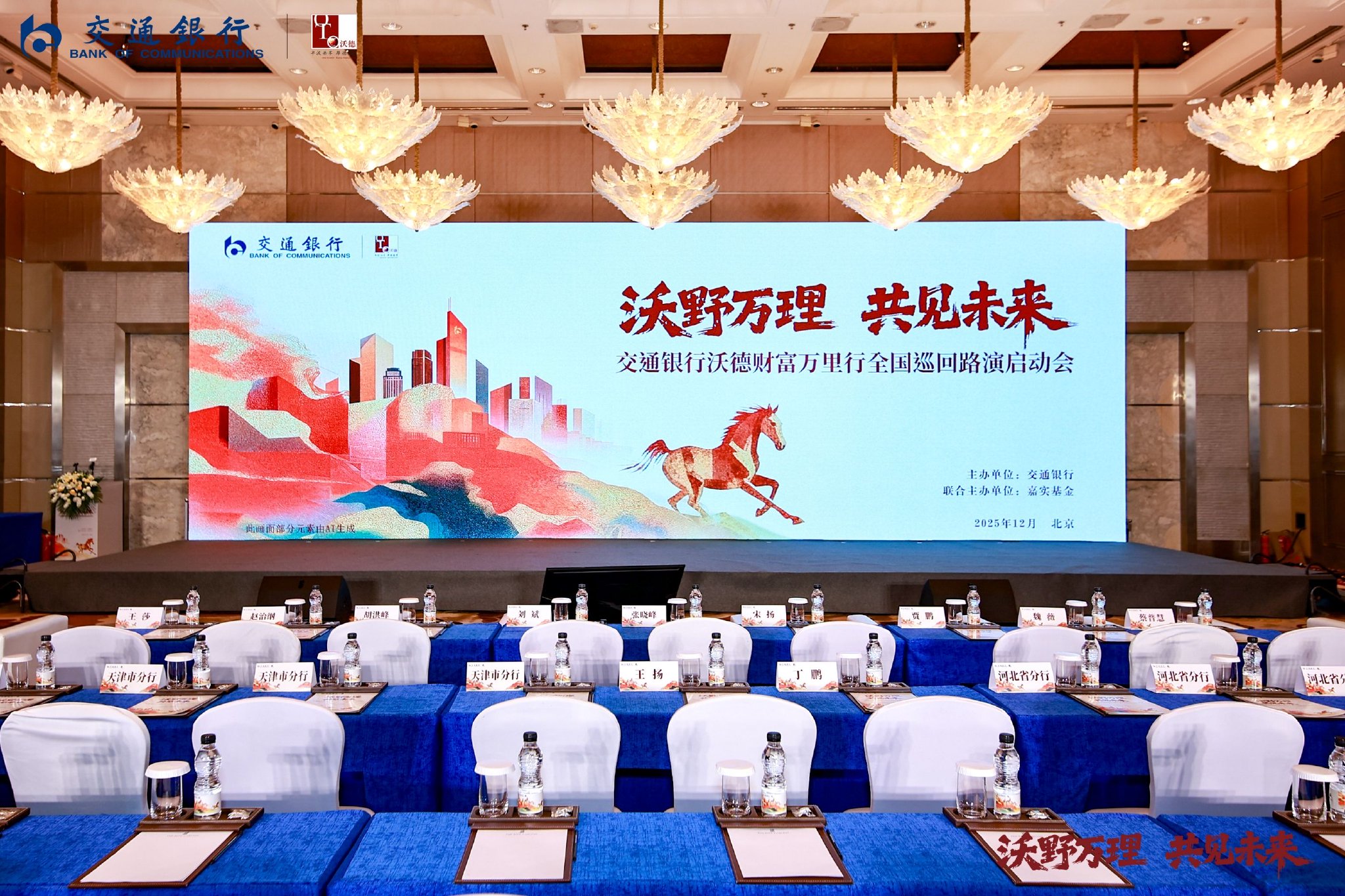
交通银行“沃德财富万里行”全国巡回路演(北京站)启航
Shang Hai Zheng Quan Bao· 2025-12-17 14:42
Group 1 - The core viewpoint of the article is that the Bank of Communications has launched a nationwide roadshow for its wealth management initiative, marking the first major promotional project following the establishment of its Wealth Management Department [1][3] - The "Wode Wealth Journey" is a significant step in the bank's reform of its wealth management business, aimed at enhancing customer service and aligning with national strategies for common prosperity [3] - The initiative is expected to expand from key regions to nationwide, reflecting the bank's commitment to improving wealth management services [3] Group 2 - Wealth management is closely linked to the financial well-being of the public, with recent government meetings emphasizing the importance of boosting domestic demand and increasing residents' income [4] - The bank's efforts in wealth management are seen as crucial for increasing residents' property income and stimulating consumption, aligning with national policy objectives [4] - The "Wode Wealth" brand, established in 2006, is set to undergo a brand upgrade as it approaches its 20th anniversary, with plans to deepen collaborations with leading asset management firms [4] Group 3 - Economic experts at the launch event expressed optimism about the Chinese equity market's performance in 2026, suggesting that there are opportunities arising from the recovery of profit expectations [5] - Current improvements in the underlying mechanisms of the economy and reduced external pressures are seen as positive indicators for long-term investment in Chinese assets [5] - The event included discussions on the role of financial institutions in serving the public, with various firms highlighting their commitment to providing stable returns and enhancing wealth management through technology [6] Group 4 - Over the next six months, the "Wode Wealth Journey" will host more than 50 events nationwide, including product strategy meetings and investment report sessions, aimed at promoting financial products that balance safety, liquidity, and returns [6] - The initiative seeks to foster a positive interaction between residents' wealth accumulation and economic development [6]

泗阳农商银行推动财富业务提质增效
Jiang Nan Shi Bao· 2025-12-16 22:32
同时,该行定期分析阶段性客户需求集中度,有针对性地组织开展主题沙龙,已成功针对有子女教育规 划需求的家庭开展"智慧教育伴成长特色财富助未来"主题沙龙,围绕"教育"与"财富"两类核心需求,特 别邀请青少年教育专家为高净值客户开展专题授课,提供极具针对性和人文关怀的金融解决方案,形成 代销业绩增长、客户黏性提升、理财团队能力提升、客户需求满足等多赢局面。 通过一系列"分层分类、精准滴灌"的营销活动,泗阳农商银行精准对接不同客群需求,成功实现活动当 日代理销售保险产品逾190万元,代理销售贵金属产品超140万元,充分彰显了客户对该行财富管理专业 能力的高度信赖。王彬 该行精心策划的不同系列财富主题活动,将专业的金融知识和贴心的财富服务送到客户身边,实现了与 客户的"零距离"互动。精心打造"农商相伴财富增值"营销沙龙系列活动,满足客户多元化财富增值服务 需求。与保险公司、贵金属公司联动,有计划地在全辖所有网点流动式开展代销保险、贵金属产品金融 服务宣介答疑活动。 今年以来,泗阳农商银行坚持以客户为中心,将财富管理作为零售升级的重要方向,着力打造专业、规 范、有温度的财富管理服务体系,积极应对客户需求转变。 为确保财富 ...
驯服AI来选基 年轻投资者玩转新花样
Zhong Guo Zheng Quan Bao· 2025-12-16 20:19
Core Insights - Young investors are increasingly using AI as a "financial assistant" for investment decisions, with discussions on social platforms gaining traction [1][2] - AI tools are seen as helpful for data processing and information integration, but they have limitations and should not replace thorough personal research [1][3] AI in Fund Selection - The trend of using AI for fund selection is rising, with over 13,000 public fund products available in the market, leading to a demand for AI assistance in choosing suitable funds [1][2] - Users are sharing specific AI input commands that cover various aspects of fund selection, indicating a growing familiarity with AI tools [2] Limitations of AI Tools - AI tools can provide investment suggestions based on current policies and market trends, but their recommendations often rely on outdated marketing materials from fund companies [3] - Investment firms emphasize that AI should be used as a supplementary tool rather than a replacement for personal financial analysis and decision-making [3] AI Wealth Management Landscape - Research indicates that AI wealth management is still in its early stages among individual investors, with common uses including product comparison and market information gathering [4] - Financial institutions are actively exploring AI's role in wealth management, aiming to enhance investor experience through improved data processing and service capabilities [4][5] Future of AI in Wealth Management - The development of AI advisory services is expected to follow a "human-machine collaboration" model, focusing on creating more efficient and empathetic wealth management solutions [5]
证券行业2026年年度策略报告:提质增效,格局优化-20251216
Ping An Securities· 2025-12-16 10:30
Core Viewpoints - The report emphasizes the importance of improving efficiency and optimizing the industry structure in the securities sector, projecting a strong performance relative to the market for 2026 [1] Market Review - The securities sector has demonstrated a prominent Beta attribute, with significant attention on the shift in funding styles. Historical analysis indicates that periods of excess returns for brokerages typically require a confluence of policy, liquidity, and market conditions [4][9] - From January to November 2025, the securities index underperformed the CSI 300 index by 12.9 percentage points, attributed to factors such as technology style preferences and the diversion of funds towards low-valuation H-shares [4][43] - Despite this, the brokerage sector achieved a notable excess return from April to August 2025, particularly H-share brokerages, which saw a cumulative increase of 43.9% for the year, outperforming the CSI 300 index by 25.4 percentage points [4][43] Fundamental Outlook - The equity market is experiencing high prosperity, with a strong certainty of profit growth. In the first three quarters of 2025, listed brokerages reported a year-on-year net profit growth of 63.4% and a revenue increase of 13.0% [4][20] - The revenue structure for the first three quarters of 2025 shows significant growth in brokerage, investment banking, and proprietary trading, with net income growth rates of 68%, 16%, and 42% respectively [4][20] - The wealth management sector is positioned to capitalize on internationalization trends, with Hong Kong emerging as a preferred fundraising destination for Chinese enterprises, leading to a 146% increase in IPO fundraising compared to the entire year of 2024 [4][20] Investment Recommendations - The report suggests that as capital market reforms deepen, the securities industry is expected to maintain steady growth in 2026, benefiting particularly head brokerages through mergers and acquisitions [4][20] - Recommended stocks include CITIC Securities and CICC, which are expected to benefit from their strong comprehensive service capabilities and balanced business structures [4][20] - Other notable mentions include Guosen Securities, Industrial Securities, and Dongfang Securities, which are anticipated to perform well due to their advantages in financial products and services [4][20] Valuation Insights - The current price-to-book (P/B) ratio for the securities industry stands at 1.35x, which is below the historical average of 1.71x, indicating potential for valuation recovery [4][50] - The report highlights that the industry P/B valuation is at the 27.7% historical percentile, suggesting that there is room for improvement in valuations relative to historical performance [4][50]





马云预言怎么回事?2026年,手握存款的人,或将面临三大挑战
Sou Hu Cai Jing· 2025-12-16 09:43
Core Insights - The traditional safety of bank deposits is diminishing as interest rates fail to keep pace with inflation, leading to a sense of financial anxiety among individuals [1][9] - The investment landscape is fraught with risks, and many are falling prey to scams promising high returns, particularly among those less familiar with financial markets [11][15] Group 1: Bank Deposits and Inflation - Bank deposit interest rates have significantly declined from 3.25% in 2021 to below 2.15% by 2024, with some banks offering rates as low as 1.95% [3] - The purchasing power of money is eroding, with essential goods like vegetables and medications experiencing price increases, leading to a phenomenon termed "invisible shrinkage" of wealth [5][7] Group 2: Investment Risks and Scams - Many individuals are seeking higher returns due to low interest rates, making them vulnerable to scams that promise guaranteed profits [11][13] - Financial products from banks are also yielding lower returns, with some investment products dropping by as much as 150 basis points, leading to significant losses for investors [15] Group 3: Economic Environment and Employment - The rise of AI is contributing to a cycle of "technological unemployment," where job losses lead to reduced consumer spending, further exacerbating economic challenges [17] - Historical comparisons, such as the "lost two decades" in Germany and Japan, highlight the importance of stable asset allocation over speculative investments during turbulent times [19][41] Group 4: Entrepreneurship Challenges - The entrepreneurial landscape has become increasingly difficult, with over 80% of new restaurant ventures failing within months due to market saturation and rising costs [24][26] - Successful entrepreneurs are those who adapt to market demands and invest in skills that meet real needs, rather than following trends blindly [28] Group 5: Financial Management Strategies - A shift in wealth management strategies is evident, with individuals prioritizing certainty over high returns, reflecting lessons learned from past financial pitfalls [17][20] - The concept of "stable and detailed" financial management is emphasized, advocating for a balanced approach to savings, investments, and personal development [32][35]
深圳部署!稳妥做好重点企业风险处置
Zhong Guo Zheng Quan Bao· 2025-12-16 04:31
Group 1 - The Shenzhen Municipal Financial Office emphasizes the importance of financial work in Shenzhen, particularly in the context of the 14th Five-Year Plan, and aims to align actions with the central government's economic assessments [1] - The meeting highlights the need to effectively manage financial risks, particularly focusing on key enterprises and real estate companies, while implementing a tailored approach for small financial institutions [2] - There is a strong commitment to enhancing the quality of financial services, particularly in supporting technological innovation and high-quality industrial development, with a focus on creating a globally influential industrial financial center [3] Group 2 - The meeting calls for a robust regulatory framework to prevent financial risks, including strict measures against illegal financial activities and improved collaboration among departments [2] - The financial system's party-building efforts are emphasized, aiming to strengthen the political and organizational functions of grassroots party organizations within the financial sector [3] - The strategic focus for 2026 includes balancing development and safety, with plans to support small and medium-sized enterprises, expand domestic demand, and enhance innovation in capital formation [3]
中国证券:路演反馈-2026 年头部优质券商股价表现普遍向好-China Securities Sector _Roadshow feedback_ Broadly positive on leading high-quality brokerages‘ share performance in 2026
2025-12-16 03:26
Summary of Conference Call Notes Industry Overview - **Sector**: China Securities Sector - **Investor Sentiment**: Broadly positive feedback on leading high-quality brokerages' share performance anticipated in 2026, with increased interest from institutional investors [2][3] Key Points and Arguments 1. **Performance Outlook**: - A-share broker index increased by 3% YTD in 2025, while the CSI 300 rose by 17%, indicating underperformance in the brokerage sector [2] - Investors are optimistic about stock performance due to anticipated capital market reforms [2] 2. **Capital Market Reforms**: - Positive feedback on reforms promoting long-term capital entry from insurers and mutual funds, enhancing market stability [3] - Regulatory changes are expected to improve the intrinsic stability of the capital market [3] 3. **Wealth and Asset Management Focus**: - The securities industry is at an inflection point for wealth and asset management, driven by deposit migration and low deposit rates [4] - Average return of equity-oriented mutual funds reached approximately 30%, with 67% outperforming benchmarks in 2025 [4] 4. **Hybrid Fund Issuance**: - New fund issuance in Q3 2025 reached 53.3 billion shares, a 497% YoY increase, indicating recovery signs in the hybrid fund market [4][17] 5. **Innovative Business Development**: - Concerns about lack of growth drivers in innovative businesses are easing, with emerging positive signals regarding derivatives and financial product innovation [8] - The 15th Five-Year Plan emphasizes the development of derivatives, which could enhance leverage and ROE for leading brokers [8] 6. **Industry Landscape Optimization**: - The industry landscape is expected to continue optimizing, with leading brokerages gaining pricing power due to regulatory support and concentration in wealth management and derivatives [9] 7. **Stock Recommendations**: - Preferred brokerage stocks include Huatai, CITIC, GF Securities, Guotai Haitong, CICC, and Orient Securities, with Huatai and CITIC forecasted to grow at 20% and 25% EPS CAGR from 2024-2030, respectively [10] Additional Important Insights - **Client Deposits**: As of Q3 2025, listed brokers' client deposits totaled RMB 2.9 trillion, reflecting a 40% YoY increase [11] - **Market Risks**: Key risks include market downturns, increased competition, regulatory penalties, and innovation-related failures that could impact earnings [27][28][29] This summary encapsulates the essential insights from the conference call, highlighting the positive outlook for the Chinese securities sector, the impact of capital market reforms, and the focus on wealth and asset management as key growth areas.
