
量化交易

Search documents
DeepSeek母公司亿元腐败案背后:当事人曾是招商证券员工
凤凰网财经· 2025-08-12 14:47
Core Viewpoint - The corruption case involving Huanfang Quantitative and its market director Li Cheng has raised significant concerns about the company's internal controls and its relationship with the AI subsidiary DeepSeek, which has been performing well in the AI sector [1][13][15]. Group 1: Corruption Case Details - Li Cheng, the former market director of Huanfang Quantitative, is accused of colluding with a staff member from China Merchants Securities to embezzle 118 million yuan in trading commissions from 2018 to 2023 [1][5]. - The investigation revealed that Li Cheng and Meng Pengfei, a former manager at China Merchants Securities, arranged for Meng's relatives to act as "exclusive brokers" for Huanfang, allowing them to funnel commissions into personal accounts [5][6]. - Following the exposure of the case, several individuals involved, including Li Cheng and Meng Pengfei, have been handed over to judicial authorities for further action [6]. Group 2: Company Background and Growth - Huanfang Quantitative was founded in 2015 by Liang Wenfeng and has since grown to manage over 60 billion yuan in assets, becoming one of China's top four quantitative private equity firms [7][11]. - The company has achieved a cumulative return of 124% from 2017 to 2022, significantly outperforming traditional investment benchmarks [11][12]. - Liang Wenfeng's vision for Huanfang was to leverage mathematics and AI for quantitative trading, marking a shift from traditional investment strategies [9][11]. Group 3: Impact on DeepSeek - Despite the corruption scandal, DeepSeek, Huanfang's AI subsidiary, appears to be insulated from the fallout due to its operational independence and focus on AI development rather than quantitative trading [13][15]. - However, DeepSeek has faced challenges, including a significant drop in monthly downloads, indicating a potential decline in market interest [15].



3669点!系好安全带,周三,大盘走势分析
Sou Hu Cai Jing· 2025-08-12 12:12
Core Insights - The Shanghai Composite Index is close to breaking new highs, with current market sentiment being a key factor in its movement [1][3][5] - The market is experiencing a shift in retail investor sentiment, with many feeling left out of the recent gains, leading to potential buying pressure [3][5] - The current market dynamics suggest that divergence among investors can lead to significant upward movements in the index [5][7] Market Analysis - The index is expected to break through 3731 points, with a potential for new highs this week [3] - Investors are advised to gradually reduce positions as the index rises above 3700 points, indicating a strategy of "sell on the way up" [3][5] - The current market is characterized by active quantitative trading and strong performance in small-cap stocks, differing from previous market rallies driven by new capital inflows [5] Investor Sentiment - Retail investors are experiencing a shift from pessimism to a more optimistic outlook, as evidenced by their reactions to market commentary [3][5] - The emotional aspect of investing is highlighted, with the notion that fear of missing out (FOMO) can drive investors to enter the market at higher levels [3][5] - Caution is advised against increasing positions, with a recommendation to maintain a balanced approach during this volatile period [7]
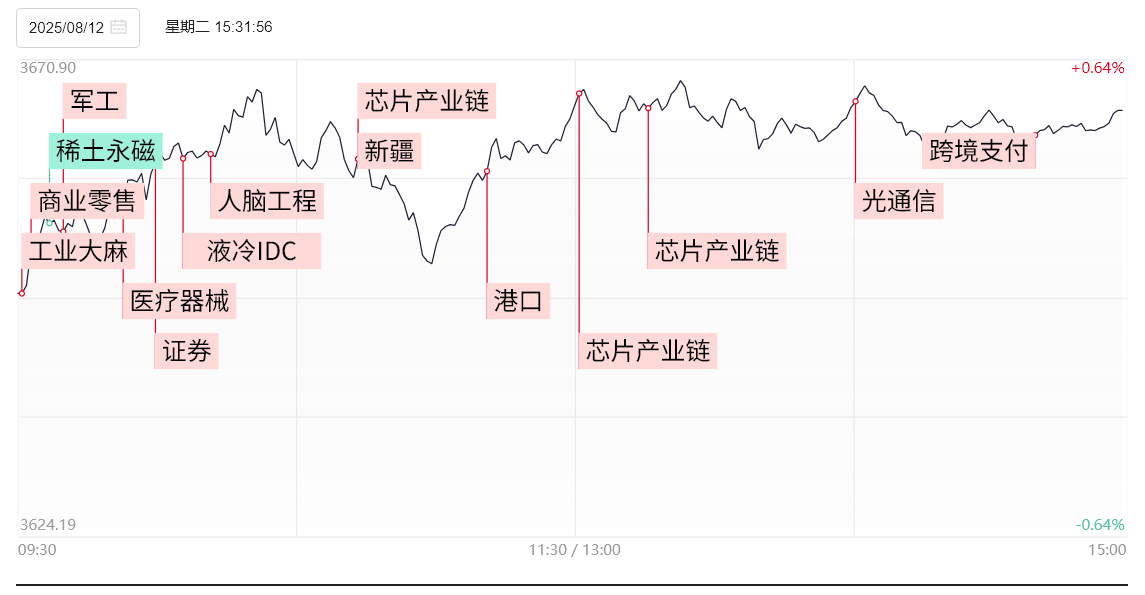
【焦点复盘】高位题材调整,资金聚焦权重,市场风格有切换迹象
Xin Lang Cai Jing· 2025-08-12 09:36
Market Overview - A total of 51 stocks hit the daily limit up, with 19 stocks achieving consecutive limit ups, and 22 stocks failed to maintain their limit up status, resulting in a limit up rate of 70% [1] - The Shanghai Composite Index rose by 0.5%, the Shenzhen Component Index increased by 0.53%, and the ChiNext Index gained 1.24% [1] - The total trading volume in the Shanghai and Shenzhen markets reached 1.88 trillion yuan, an increase of 54.5 billion yuan compared to the previous trading day [1] Stock Performance - Beiwai Technology achieved a limit up for the second consecutive day, marking 7 limit ups in 6 trading days [1] - Xinjiang local stocks remained active, with Hongtong Gas achieving 5 limit ups in 6 days, and Xinjiang Communications Construction and Beixin Road and Bridge both reaching 3 consecutive limit ups [1] - Jishi Media recorded 4 consecutive limit ups, becoming a market highlight [1] Sector Analysis - The semiconductor, port, CPO, and Xinjiang sectors showed strong performance, while sectors such as PEEK, rare earth permanent magnets, military industry, and lithium mining experienced declines [1] - The semiconductor sector saw significant strength, with leading stocks like Haili Co. achieving 4 limit ups in 5 days, and Hanwei Technology hitting a historical high [5][9] - The consumer sector, led by retail, showed notable activity with stocks like Guoguang Chain and He Bai Group performing well [5][32] Investment Trends - There is a noticeable shift in market sentiment, with funds moving towards heavyweight stocks as military, rare earth, and innovative drug sectors lagged [3][6] - Financial stocks such as Guosheng Jinkong and Huijin Co. have shown strong performance, indicating a potential shift in market focus [3][6] - The market is currently characterized by a "weighty platform, thematic performance" phase, suggesting a strong trend in sector rotation [7] Future Outlook - The market indices continue to strengthen, with trading volumes approaching 2 trillion yuan, indicating a bullish trend [7] - The margin trading balance has risen, suggesting that liquidity is driving the current market rally, although it remains at historical average levels [7] - Investors are advised to monitor the ongoing rotation of themes and sectors, as the market remains driven by quantitative factors [7]




活动回顾 | 探索量化交易新机遇,AI驱动金融创新
Refinitiv路孚特· 2025-08-11 08:54
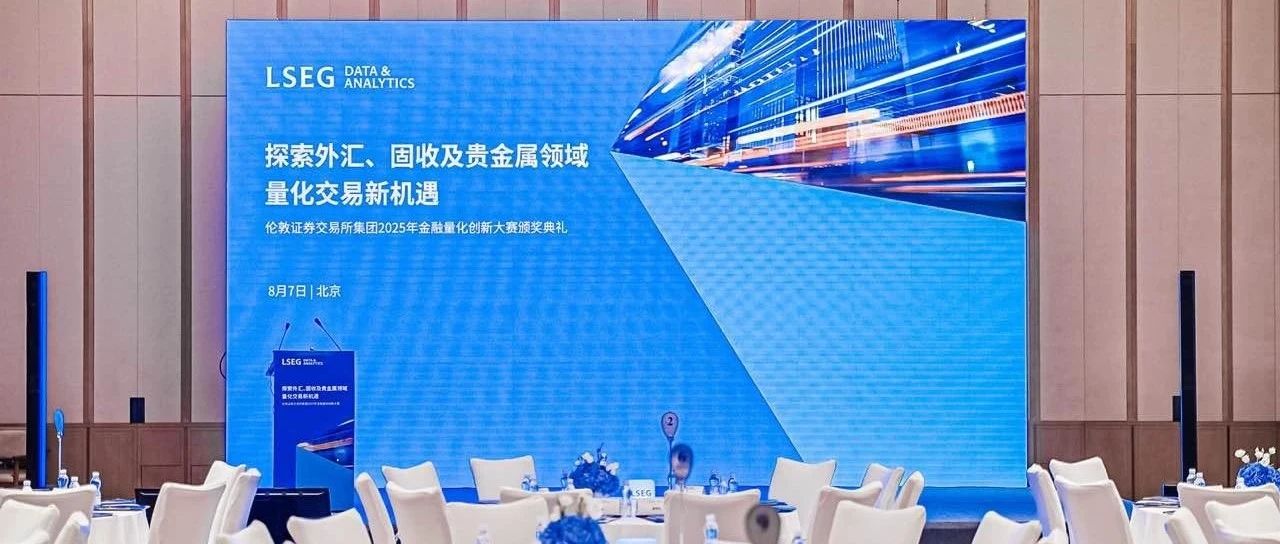
Core Insights - The event hosted by LSEG focused on exploring new opportunities in quantitative trading within the foreign exchange, fixed income, and precious metals sectors, emphasizing the integration of AI technologies [1][8] - LSEG views the Chinese market as a core component of its global strategy, significantly increasing its investment in local innovation, particularly in quantitative trading [3] - The financial quantitative innovation competition showcased China's leading practices in AI and quantitative strategy integration, highlighting deep collaboration between LSEG and both domestic and foreign financial institutions [3][8] Group 1 - LSEG's Asia-Pacific Front Office Solutions Director, Arman Sahovic, emphasized the importance of data and solutions in empowering strategy development and risk analysis [1] - The competition attracted 14 major domestic and foreign banks, resulting in over 30 submissions across various asset classes, generating significant interest in the financial industry [8] - The event featured a roundtable discussion where experts shared experiences in strategy design, data application, and AI technology practices, focusing on AI-driven changes in quantitative trading [11] Group 2 - Professor Zhou Hongsong discussed the fundamental principles and development trends of quantitative investment and trading, highlighting the integration of machine learning and deep learning in quantitative processes [5] - LSEG's global client technology director introduced the competition's design, focusing on price prediction as a core capability, and emphasized the support provided by LSEG's data and tools [13] - Future collaboration suggestions included establishing a "data application experimental environment" to enhance interaction and growth between data providers and financial institutions [14]
量化私募佣金调查:“万1.2”成行业基准
Mei Ri Jing Ji Xin Wen· 2025-08-10 12:42
Core Viewpoint - The quantitative private equity industry is experiencing renewed interest, with trading commission rates and rebate issues becoming focal points [1] Group 1: Trading Commission Rates - The trading commission rates for quantitative private equity firms generally range from 0.01% to 0.015%, with significant variations based on the firm's scale, strategy, and business relationships [1][2] - Larger quantitative firms, due to their high trading frequency and capital scale, often negotiate lower base trading rates, typically between 0.01% and 0.02% [2] - Smaller firms, despite having lower management scales, also engage in high-frequency trading, leading to substantial trading volumes [2] - The commission structure can be viewed as a combination of fixed and variable rates, with the breakeven point for trading commissions generally set around 0.012% [3] Group 2: Cost Implications - A quantitative private equity firm with a scale of 10 billion yuan and an annual turnover rate exceeding 200 times could incur annual trading commission expenses of approximately 200 million yuan, assuming an average commission rate of 0.01% [4] - Recent regulatory changes have significantly increased high-frequency trading costs, compelling firms to reduce trading frequency and turnover rates [4] Group 3: Compliance and Rebate Issues - Commission rebates are explicitly prohibited by regulations, raising compliance concerns within the industry [5] - The return of commissions not only violates regulatory guidelines but also reflects a lack of internal risk control and compliance mechanisms [6] - Various regulations, including the Securities Brokerage Business Management Measures, explicitly forbid the return of commissions or any form of non-compliant incentives to investors [6][7]
量化私募靖奇投资两大创始人内斗 牵出招商证券被投诉举报
Jing Ji Guan Cha Wang· 2025-08-08 11:56
Core Viewpoint - A governance crisis within the quantitative private equity firm Shanghai Jingqi Investment Management Co., Ltd. has exposed underlying issues in the industry, leading to internal conflicts and regulatory complaints against its custodian, China Merchants Securities [2][4]. Group 1: Company Background - Jingqi Investment was established in 2015, managing assets between 1 billion and 2 billion yuan. The major shareholders include Fan Siqi (36.36%), Tang Jingren, and Mao Noping (27.27% each) [3]. - Fan Siqi serves multiple roles including legal representative, chairman, general manager, and fund manager, while Tang Jingren is the risk control officer [3]. Group 2: Recent Developments - On June 10, 2025, Fan Siqi announced his resignation as fund manager, citing significant stress and loss of passion due to management responsibilities [4]. - Following his resignation, a shareholder meeting led to his abrupt removal from all positions, which he described as a betrayal [4][6]. - On August 7, 2025, Jingqi Investment issued a risk warning, highlighting unauthorized actions by personnel and alleging that China Merchants Securities failed to fulfill its basic verification obligations [2][5]. Group 3: Financial Irregularities - Fan Siqi accused Tang Jingren of mismanaging company funds, including receiving commission income through a company owned by Tang, which was not properly accounted for [8]. - Allegations include using company funds for personal expenses and failing to report certain income, raising concerns about financial governance [8][9]. Group 4: Regulatory Context - The issue of commission rebates has been a longstanding concern in the industry, with regulations prohibiting such practices to maintain fair competition [11]. - Recent investigations into other firms, including allegations against senior personnel at China Merchants Securities, highlight ongoing scrutiny in the sector [10][12].

M8+VOL_金,主图指标升级 Version2.0
猛兽派选股· 2025-08-07 19:30
Group 1 - The article emphasizes the importance of low-position buying strategies in the current market environment, suggesting that high-risk chasing in bullish trends can lead to losses [1] - It mentions that recent developments in the market have shifted towards more low-buying strategies, particularly referencing Mark Minervini's approach [1] Group 2 - The article provides a disclaimer about the limitations of trading formulas, stating that while they can optimize trading strategies, they cannot guarantee profits and should not be seen as predictive tools [2] - It highlights that successful trading requires a comprehensive understanding and experience, rather than solely relying on formulas [2] Group 3 - The article includes a data management section that lists various stock and industry rankings based on specific indicators, such as RSV and SSV [3] - It notes that adjustments to the SSV formula have been made to address previous issues reported by users, ensuring that the updated formula will not affect stock selection negatively [3]

老美向下拐点逼近,A股要乘胜追击!
Sou Hu Cai Jing· 2025-08-07 10:51
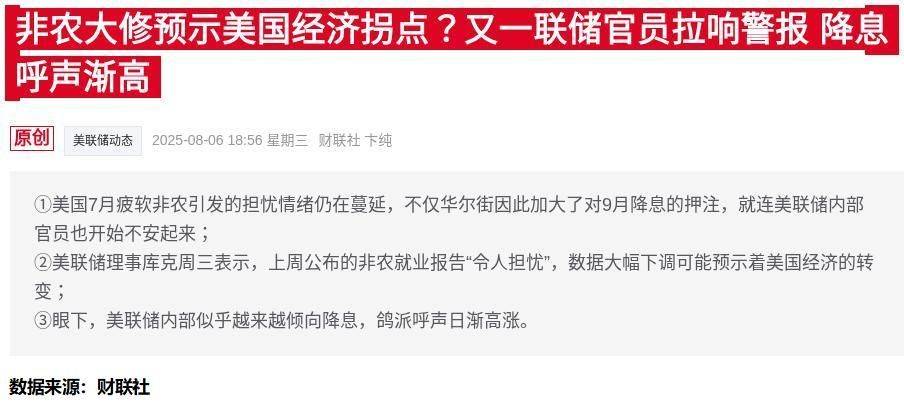
Group 1 - The recent U.S. non-farm employment data for July showed a significant miss in job additions, with the unemployment rate rising and previous months' data being revised downwards, raising concerns about the economic outlook [1][10]. - There is a growing divide within the Federal Reserve, with two officials voting in favor of interest rate cuts, a rare occurrence in the last 30 years, and market expectations for a September rate cut soaring to 93.6% [5][10]. - The market's perception of the weak employment data may be misleading, as it could indicate underlying shifts in institutional trading behavior, suggesting that institutions are positioning themselves ahead of potential market movements [9][10]. Group 2 - The article emphasizes the importance of focusing on actual trading behaviors rather than expert opinions, as institutional actions are more indicative of market trends [3][10]. - A quantitative tool is highlighted as essential for investors to discern market truths, allowing them to analyze trading behaviors and make informed decisions [8][9]. - The advice for ordinary investors includes maintaining independent thinking, filtering out noise, and utilizing quantitative tools to establish objective judgment standards [10][12].
券商竞逐T0算法 恒生电子助力多家机构智能交易能力升级
Zheng Quan Ri Bao Wang· 2025-08-06 13:41
Core Insights - The adoption of T0 algorithm trading tools is accelerating among securities firms, with over 20 brokerages launching app-based T0 algorithm services by 2025, expanding access beyond professional institutions [1][2] - T0 algorithms are designed for intraday trading, helping investors capture price fluctuations, reduce holding costs, and enhance returns, shifting industry competition from availability to quality [1][2] - The integration of advanced technologies and customized deployment of T0 services is enhancing trading capabilities and client experiences, particularly for high-net-worth investors [1][2][3] Group 1 - The "Tian Tian Zhi Tou" brand by Dongbei Securities has significantly improved its smart trading capabilities through the adoption of the Hang Seng i2 high-net-worth T0 service, optimizing system architecture for better performance and scalability [2] - Dongbei Securities has established a comprehensive trust ecosystem from hardware to middleware, enhancing performance while ensuring security, serving as a model for integrating technology and trading strategies [2] - Guosheng Securities' "QUANT X" brand has served over 20 billion-level quantitative private equity firms and thousands of high-net-worth individuals, gaining industry recognition [2] Group 2 - The Hang Seng i2 high-net-worth T0 service has been implemented by over ten brokerages, demonstrating exceptional stability and reliability after two years of real-world testing [3] - Hang Seng Electronics is accelerating the integration of AI and other cutting-edge technologies with smart trading, aiming to provide institutional-level trading tools to a broader investor base [3]
