
个人信息保护

Search documents
违法违规!大同证券、信达期货,被点名!
Shen Zhen Shang Bao· 2025-09-10 23:09
Core Viewpoint - The National Cybersecurity Incident Response Center has identified 69 mobile applications that illegally collect and use personal information, including Datong Securities and Xinda Futures [1] Group 1: Violations by Datong Securities - Datong Securities failed to clearly list the purposes, methods, and scope of personal information collection in its privacy policy, including third-party involvement [2] - The company did not inform users about the recipients of their personal information, nor did it obtain explicit consent for sharing this information with third parties [2][3] Group 2: Violations by Xinda Futures - Similar to Datong Securities, Xinda Futures also did not adequately disclose the purposes, methods, and scope of personal information collection in its privacy policy [3] Group 3: Legal Framework - The violations are in accordance with the Cybersecurity Law and the Personal Information Protection Law, as well as the announcement regarding the 2025 personal information protection initiative [4] Group 4: Specific Violations Identified - 24 applications failed to provide clear prompts for users to read privacy policies upon first use [4] - 31 applications did not list the purposes and methods of personal information collection in their privacy policies [5] - 17 applications shared personal information with third parties without user consent [7] - 3 applications began collecting personal information without user consent [8] - 41 applications did not implement adequate security measures for personal information [11] - 3 applications lacked a privacy policy altogether [12]

当AI大模型遇见人格权:海量数据训练下的侵权风险
Bei Jing Ri Bao Ke Hu Duan· 2025-09-06 00:54
Core Insights - Artificial intelligence is becoming a significant driving force behind a new wave of technological revolution and industrial transformation, fundamentally altering production methods, lifestyles, and social governance [1] - The development of large AI models requires vast amounts of data, which raises concerns about the protection of personal information rights and presents new challenges to the personal rights system [1] Group 1: Protection and Utilization of Publicly Available Personal Information - The protection of publicly available personal information is increasingly important in the training of AI models, as much of the training data comes from such sources [1] - The Personal Information Protection Law in China allows for the processing of publicly available personal information without consent, provided it meets certain conditions, including reasonable scope and significant impact on personal rights [1] - The challenge arises when AI models collect fragmented personal information, potentially leading to the reconstruction of sensitive personal data, which necessitates obtaining consent [1] Group 2: Safeguarding Sensitive Personal Information - The advancement of AI technology enhances data analysis capabilities, posing new threats to personal information security, particularly sensitive data [2] - During the training phase of generative AI, it is crucial to anonymize sensitive personal information to prevent severe consequences from potential leaks [2] - Historical incidents, such as vulnerabilities in ChatGPT, highlight the risks associated with sensitive information exposure and the need for ongoing regulatory measures [2] Group 3: Challenges in Generative AI Operations - Generative AI poses significant challenges to the protection of personal privacy and information, necessitating measures to prevent sensitive data from being included in generated content [3] - The risk of generative AI producing malicious or false content is a concern, as inaccuracies in training data can lead to harmful outputs that may relate to sensitive personal information [3] - The importance of protecting personal identifiers, such as voice, is increasingly recognized due to the potential for deepfake technology to exploit these identifiers [3] Group 4: Protection of Personal Identifiers - The rise of deepfake technology allows for the creation of fraudulent audio and visual content, posing significant risks to individuals [4] - High-profile cases, such as the exploitation of Scarlett Johansson's voice by OpenAI, underscore the urgent need for legal protections against the misuse of personal identifiers [4] - The necessity for stricter regulations to prevent the infringement of personal rights through deepfake technology is becoming more apparent [4] Group 5: Virtual Digital Humans and Personal Rights - The emergence of virtual digital humans presents new challenges to the personal rights system, particularly regarding the use of real individuals' likenesses in creating virtual representations [5] - The commercial viability of virtual digital humans is being explored, but their interaction with the real world raises questions about potential violations of personal rights [5] - The determination of whether a virtual digital human infringes on an individual's rights hinges on the recognizable similarity to the real person, necessitating legal standards for assessment [5] Group 6: New Types of Personal Rights - Virtual digital humans can act as "virtual avatars," extending beyond traditional rights to encompass new forms of personal rights [6] - Legal interpretations are evolving to recognize that the use of real personal information in training AI companions can infringe upon various personal rights, including name and likeness rights [6] - The concept of a "virtual avatar" represents a composite of an individual's identity, necessitating the establishment of new legal protections for these emerging personal rights [6]

替人“刷脸”注册的店铺售卖假冒商品 要承担赔偿责任吗?
Ren Min Wang· 2025-09-05 01:02
Core Points - A university student, Li, was held liable for trademark infringement after lending his personal information to register an online store that sold counterfeit goods [1][2] - The court ruled that Li, despite claiming he was registered without consent, knowingly provided his ID and participated in the registration process, thus facilitating the infringement [2] - The court ordered Li to compensate the trademark owner 200,000 yuan for economic losses and reasonable legal fees [2] Group 1 - The case highlights the risks associated with sharing personal information for job opportunities, especially in the context of online platforms [1][3] - The court emphasized that individuals must be aware of the legal risks when lending their personal information, as it can lead to liability for facilitating illegal activities [2][3] - The ruling serves as a warning to the public about the importance of protecting personal information in the digital age [3]
【网络安全宣传周】没有网络安全,就没有国家安全!这些网络安全知识要牢记!
天天基金网· 2025-09-03 10:34
Core Viewpoint - The article emphasizes the importance of cybersecurity in the digital age, highlighting the potential risks and the need for a robust legal framework to protect against cyber threats [3][12]. Legal Framework - The "Cybersecurity Law of the People's Republic of China" was enacted on June 1, 2017, as the first comprehensive law regulating cybersecurity management in China [5]. - The "Regulations on the Security Protection of Critical Information Infrastructure" came into effect on September 1, 2021, focusing on the protection of critical information infrastructure [6]. - The "Data Security Law" was passed on June 10, 2021, and is a foundational law in the field of data security [7]. - The "Automotive Data Security Management Regulations (Trial)" were implemented on October 1, 2021, to regulate data processing in the automotive sector [8]. - The "Personal Information Protection Law" took effect on November 1, 2021, aimed at protecting personal information rights [9]. - The "Cybersecurity Review Measures" were revised and came into effect on February 15, 2022, to enhance cybersecurity and data security [10]. - The "Interim Measures for the Management of Generative Artificial Intelligence Services" were enacted on August 15, 2023, to regulate AI services [11]. Critical Information Infrastructure - Critical information infrastructure includes essential sectors such as energy, transportation, water resources, finance, and national defense, where damage could severely impact national security and public interest [15]. - The identification of critical information infrastructure is managed by relevant governmental departments, which develop rules based on industry-specific conditions [16]. Security Incidents - Notable cybersecurity incidents include the 2015 Ukraine power grid attack, the 2016 Dyn DNS attack, and the 2021 Colonial Pipeline ransomware attack, all of which highlight the vulnerabilities in critical infrastructure [19]. Security Measures - The "Regulations on the Security Protection of Critical Information Infrastructure" were published on August 17, 2021, to establish a national security protection system [20]. - The national standard for critical information infrastructure security protection was released on November 7, 2022, and implemented on May 1, 2023, providing guidance for security measures [20]. Data Security - Data is categorized into general, important, and core data levels based on the potential harm caused by unauthorized access or breaches [25]. - Organizations are encouraged to implement data security measures such as backup, encryption, and access control to protect sensitive information [26][28]. Cybercrime Prevention - The article discusses various types of cybercrimes, including phishing attacks and telecom fraud, and emphasizes the need for individuals and organizations to adopt preventive measures [21][30]. - Recommendations include protecting personal information, using official channels for transactions, and verifying requests for financial transactions [30][32]. Collective Responsibility - Cybersecurity is portrayed as a collective responsibility, urging society to work together to strengthen defenses and protect the digital environment [34].

保险从业人员因侵犯公民个人信息罪被判罚
Jin Rong Shi Bao· 2025-09-03 00:50
Core Viewpoint - The case involving multiple employees from an insurance company highlights serious violations of personal information privacy, raising concerns about data security in the insurance industry [1][2][3] Group 1: Case Details - Six individuals, including executives from Tianan Insurance and other related companies, were found guilty of purchasing personal information to expand their insurance business [1][2] - The total number of personal information records sold exceeded 200,000, causing significant disruption to the lives of the affected individuals [2] - The court imposed fines ranging from 5,000 to 71,000 yuan on the convicted individuals, with some appealing the decision, but the appeals were ultimately rejected [2] Group 2: Regulatory Environment - The case underscores the increasing scrutiny and regulatory actions against the insurance industry regarding the protection of personal information [3] - Financial regulatory authorities have intensified efforts to combat illegal activities related to personal information, including unauthorized collection and sale [3] - New regulations, such as the Data Security Management Measures for Banking and Insurance Institutions, emphasize the responsibility of institutions to manage data security effectively [3] Group 3: Industry Implications - The incident serves as a warning for the insurance industry, stressing the importance of compliance with personal information protection laws and regulations [3] - Companies are encouraged to enhance internal controls and establish robust customer information management systems to prevent similar violations [3] - The focus should shift towards improving service quality and professional capabilities rather than relying on illegal methods for short-term gains [3]
中国民生银行济南文东支行:个人信息保护宣传,共筑信息安全防线
Qi Lu Wan Bao· 2025-09-02 08:35
Core Viewpoint - The importance of personal information as a critical asset in various aspects of life is emphasized, and the proactive measures taken by China Minsheng Bank's Jinan Wendon Branch to enhance public awareness of personal information protection are highlighted [1][3]. Group 1: Awareness and Education Initiatives - The bank has set up prominently displayed materials on personal information protection at its branches, illustrating the categories of personal information and the risks associated with its leakage, such as fraud, privacy invasion, and financial loss [2]. - Staff members engage with customers during transactions to provide brief introductions on the importance of safeguarding personal information [2]. - The bank organized micro-salons focused on personal information protection, analyzing common leakage pathways and discussing preventive measures [2]. Group 2: Public Response and Future Commitment - The personal information protection campaign has effectively increased public awareness and the importance of personal information security, with participants expressing significant benefits and a commitment to being more cautious in the future [3]. - The bank plans to continuously monitor developments in the field of personal information protection and innovate its educational approaches to contribute to a safer financial environment [3].

超范围收集个人信息 8000万用户平台卡牛信用管家被通报
Zhong Guo Jing Ying Bao· 2025-09-02 07:07
Core Viewpoint - Since the implementation of the Personal Information Protection Law in China, personal information processors have faced strict regulations, with Shenzhen Kaniu Technology Co., Ltd. being recently reported for exceeding the necessary scope of personal information collection through its Kaniu Credit Manager app [1][2]. Company Summary - Kaniu Credit Manager app has over 80 million users as of August 2025, offering services in smart bill management, credit card information, and credit technology [1]. - The app has three main segments: bill management, borrowing services, and personal risk reporting [2]. - Kaniu Technology was founded in 2012 and has received significant investment, including A+ round financing from Sequoia Capital [2]. - The company has previously faced scrutiny for information security issues, including a fine in December 2022 for infringing on personal information rights [3]. Regulatory Context - The National Cybersecurity Center reported that 38 mobile applications, including Kaniu Credit Manager, were found to illegally collect and use personal information [2]. - The issue identified was related to insufficient authorization for clipboard usage, which is considered a violation of privacy rights [4]. Industry Implications - The financial sector is under pressure to comply with the Personal Information Protection Law, with concerns about over-collection of data and lack of transparency in privacy policies [6]. - Financial institutions are advised to enhance their information management practices to protect consumer rights and prevent data breaches [6]. User Awareness - Users are encouraged to be cautious about information leakage when using risk monitoring services and to choose platforms that implement encryption and anonymization measures [7].
看到“新生福利”等字眼打起精神 开学季“钓鱼”套路盘点
Yang Shi Xin Wen· 2025-08-30 06:13
Core Viewpoint - As the holiday season comes to an end, cybersecurity risks are increasing, necessitating practical protective measures to ensure a safe conclusion to the holiday period [1]. Group 1: Types of Cybersecurity Risks - "Back-to-School" traps involve scammers posing as teachers or educational staff, sending messages about "essential school supplies" or "new student discounts" that lead to phishing sites [5]. - "Return Convenience" scams feature fake ticket purchasing platforms offering "low prices" that result in no tickets being provided after payment, and suspicious messages about flight cancellations or delays may also be traps [6]. - "Entertainment" risks arise from unofficial channels offering "cracked" games or "free" streaming apps that may contain viruses and malicious programs, potentially stealing personal data [7]. Group 2: Personal Information Protection - Protecting personal information is crucial, especially at the end of the holiday season [9]. - Cleaning up sensitive information from devices, such as photos of ID cards and bank details, is a primary task [10]. - Cautious sharing of life updates is essential to avoid revealing specific locations or travel plans that could be exploited by criminals [11][12][13]. Group 3: Account and Password Management - Setting complex passwords for social and payment accounts is fundamental, and enabling two-factor authentication enhances security [14]. - Avoiding the sharing of passwords and not writing them down in easily accessible places is critical for account safety [14]. Group 4: Digital Wallet Security - As consumer demand increases towards the end of summer, protecting digital wallets is vital to prevent financial losses [16]. - Choosing reputable platforms for online purchases and verifying merchant credentials before payment is necessary [17][18]. - Regularly checking transaction records and being cautious with payment processes can help mitigate risks [20][21][22]. Group 5: Device Security Measures - Conducting a "security check-up" on electronic devices at the end of the holiday season can effectively prevent security risks [25]. - Updating systems and software regularly is essential to fix known vulnerabilities and protect against potential intrusions [26]. - Installing reputable antivirus software and managing app permissions can significantly reduce risks associated with device usage [27][29].

违规收集使用个人信息,侵害用户权益,5款APP被通报下架
Yang Zi Wan Bao Wang· 2025-08-29 07:38
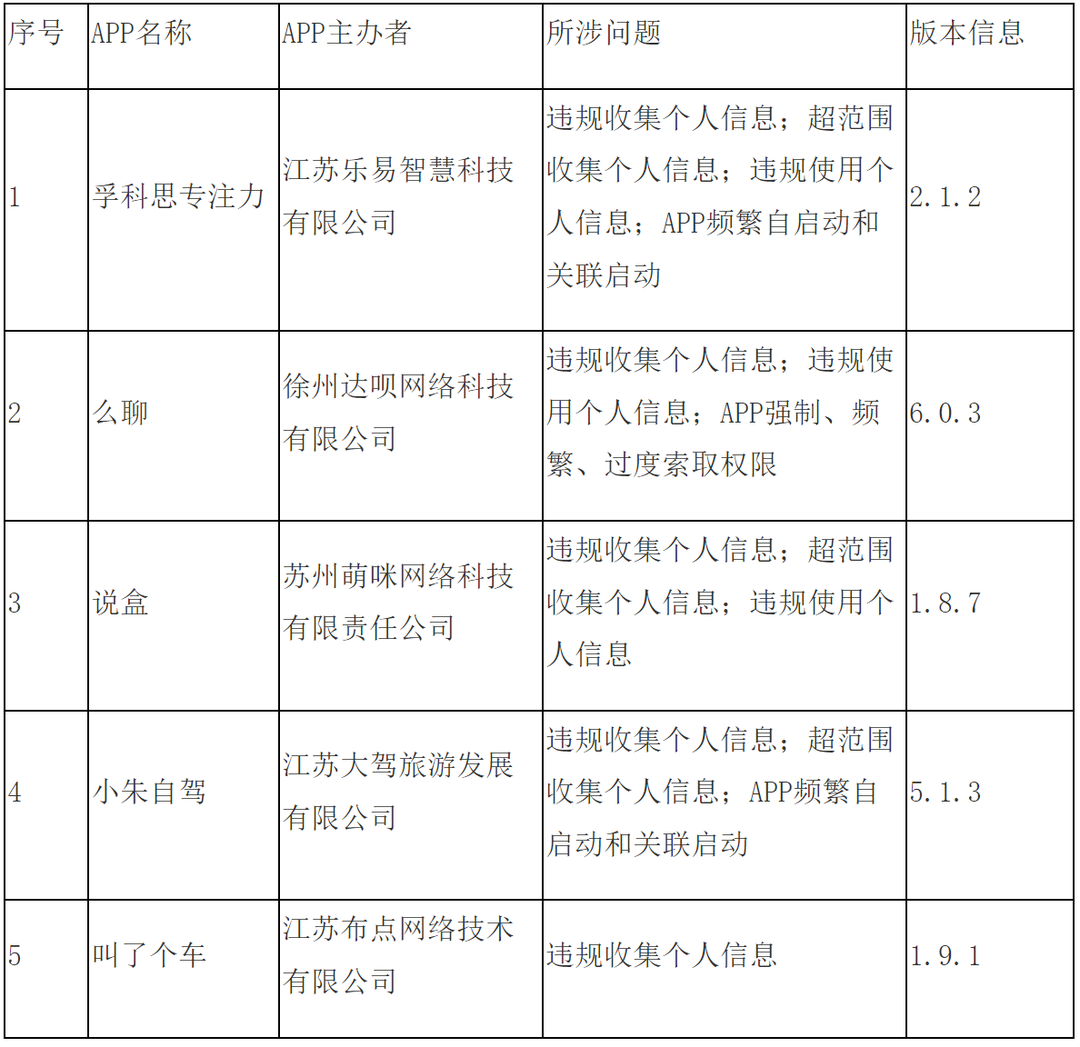
Core Viewpoint - Jiangsu Provincial Communication Administration announced the removal of five apps that infringe on user rights, emphasizing ongoing efforts to protect personal information and ensure compliance with relevant laws [1][2]. Summary by Category Regulatory Actions - Jiangsu Provincial Communication Administration has been conducting a special rectification action against apps that infringe on user rights, having reported 47 apps for violations related to personal information collection and usage [1]. - The administration mandated the immediate removal of five specific apps from application stores following their failure to rectify issues identified in previous inspections [1][3]. Apps Involved - The five apps that were ordered to be removed include: 1. **Focus App (孚科思专注力)** - Operated by Jiangsu Leyi Wisdom Technology Co., Ltd., issues include illegal collection and excessive use of personal information, as well as frequent self-starting and associated launching [2][3]. 2. **MeiLiao (么聊)** - Operated by Xuzhou Dabe Network Technology Co., Ltd., issues include illegal collection and use of personal information, along with forced and excessive permission requests [2][3]. 3. **ShuoHe (说盒)** - Operated by Suzhou Mengmi Network Technology Co., Ltd., issues include illegal collection and excessive use of personal information [2][3]. 4. **XiaoZhu Self-Driving (小朱自驾)** - Operated by Jiangsu Dajia Tourism Development Co., Ltd., issues include illegal collection of personal information and frequent self-starting [2][3]. 5. **Called a Car (叫了个车)** - Operated by Jiangsu Budian Network Technology Co., Ltd., issues include illegal collection of personal information [2][3].
北京法院两案例入选最高人民法院数据权益司法保护专题指导性案例
Bei Jing Ri Bao Ke Hu Duan· 2025-08-28 08:41
Core Viewpoint - The Supreme People's Court of China has released six guiding cases on data rights protection, addressing issues such as data ownership, utilization of data products, personal information protection, and the delivery of online platform accounts, thereby standardizing judicial practices in these areas [1] Group 1: Case Summaries - Case 1: A technology company sued a media company for unfair competition, claiming that the latter unlawfully copied and displayed data from its app, resulting in a court ruling that the media company must compensate the technology company with 5 million RMB [4][9] - Case 2: A user sued a technology company for violating personal information rights by collecting data without consent, leading to a court ruling that the technology company must provide a clear copy of the user's personal information and cease processing it [15][20] Group 2: Legal Framework - The guiding cases reference the Anti-Unfair Competition Law and Copyright Law, emphasizing that data aggregators can seek legal protection for their operational interests when their data collections are unlawfully utilized by competitors [2][6] - The rulings highlight the importance of user consent in personal information processing, indicating that companies must provide options for users to refuse data collection without compromising access to services [17][20]