
利率调整

Search documents
国信期货有色(镍)周报:弱势震荡,反弹空间有限-20251207
Guo Xin Qi Huo· 2025-12-07 02:56
2025年12月07日 研究所 目 录 CONTENTS 1 行情回顾 2 基本面分析 研究所 弱势震荡,反弹空间有限 ——国信期货有色(镍)周报 1.1 行情回顾——期货主力合约价格走势 研究所 0.00 50,000.00 100,000.00 150,000.00 200,000.00 250,000.00 300,000.00 2020/12/31 2021/02/28 2021/04/30 2021/06/30 2021/08/31 2021/10/31 2021/12/31 2022/02/28 2022/04/30 2022/06/30 2022/08/31 2022/10/31 2022/12/31 2023/02/28 2023/04/30 2023/06/30 2023/08/31 2023/10/31 2023/12/31 2024/02/29 2024/04/30 2024/06/30 2024/08/31 2024/10/31 2024/12/31 2025/02/28 2025/04/30 2025/06/30 2025/08/31 2025/10/31 镍期货收盘价(主力合约)( ...
美联储12月或降息25基点,2026年初利率降至3.25%-3.50%
Sou Hu Cai Jing· 2025-12-06 17:26
批判一个事实并不难,难的是看清背后的选择逻辑,有人把降息当作礼物,认为那能救市场,稳定消费,提振投资,这是部分真实,但忽略了 货币政策的滞后性——你今天降息,效果常在数月后显现,时间差里有太多未知;有人把加息当作惩罚,认为它抑制通胀,冷却过热,但高利 率会扼杀借贷,扼杀边缘企业,扼杀某些人的希望,政策就是一把双刃剑,哪一边割到你,那个群体就会跑到街上 complain。 要回到原点,预测是人的行为在做出的解释,学者们给出概率,美联储会用语言管理预期,市场会用交易回应,这是一场长长的棋局,输赢不 在单手牌,而在整个盘子的布局,我们只需清醒一点,多问一句在这场游戏里,你准备好了没有。 12月初,大家在等什么,市场在等什么,美联储在做什么,这三件事像三条线,越拉越紧,到最后你得问一句谁在牵这根线,谁在被拉得喘不 过气来。 100位经济学家,半数说2026年第一季度下调利率到3.25?.50%,几乎一半的专家在押注那条未来的路,另一拨更紧张的人说12月10日先降25个基 点,到3.50?.75%,听起来像两手准备,也像赌局中的中间筹码,而我们在台下看牌;你说这是信号,还是噪音? 市场不是神学,市场是人学,学者们背后藏 ...

Inflation Report Signals December Rate Cut and a Cliffhanger 2026
Barrons· 2025-12-05 16:57
The Fed's preferred inflation gauge slowed down on an annual basis for the first time since April, BEA data for September showed. Core PCE inflation, which excludes food and energy, ran at a 2.8% annual pace in September, a deceleration from August's 2.9% rate. Monthly core inflation came in at 0.2%, in line with August's numbers. Fed officials should be able to focus on the wavering labor market and cut interest rates by another quarter percentage point at their final meeting of the year next week, thanks ...
Fed's preferred inflation gauge gives Jerome Powell green light to cut rates after prices barely budge
New York Post· 2025-12-05 15:53
Inflation Data Summary - The Federal Reserve's preferred measure of inflation showed little change in September, with prices rising 0.3% from August, the same increase as the previous month [1] - Core prices, excluding food and energy, rose 0.2% in September, matching the previous month's pace, which would align inflation closer to the Fed's 2% target if sustained [2] - Overall prices increased by 2.8% year-over-year, slightly up from 2.7% in August, while core prices also rose 2.8%, a small decline from 2.9% the previous month [2] Economic Indicators - The data suggests muted core inflation in September, supporting the case for a potential interest rate cut by the Fed at its upcoming meeting [3] - Despite inflation being above the 2% target, weak hiring and modest economic growth are expected to gradually reduce price gains in the coming months [3] - Consumer spending grew by 0.3% in September, a decrease from 0.5% in August, indicating that Americans are still willing to spend despite high prices and stagnant hiring [6] Consumer Behavior - Recent data indicates an increase in consumer spending during Black Friday and the following weekend, with online spending rising by 7.7% compared to the same period last year [7] - Incomes rose by 0.4% in September for the second consecutive month, contributing to consumer spending capacity [8]

Fed's Favored Inflation Gauge Shows Moderate September Trend
WSJ· 2025-12-05 15:28
The Federal Reserve's preferred measure of inflation held below 3% in September, and indicated a moderate month-over-month increase in prices unlikely to block consideration of an interest-rate cut at the central bank's meeting next week. ...

RBI rate cut lifts markets; Sensex surges 447 points as banking stocks rally
BusinessLine· 2025-12-05 12:11
Market Performance - Indian equity benchmarks experienced strong gains, with the Sensex closing at 85,712.37, up 447.05 points or 0.52 per cent, and the Nifty advancing 152.70 points or 0.59 per cent to settle at 26,186.45 [1] - The Nifty Bank index rose 488.50 points or 0.82 per cent to 59,777.20, while the Nifty Financial Services surged 270.45 points or 0.98 per cent to 27,881.90 [4] Central Bank Actions - The Reserve Bank of India (RBI) cut the repo rate by 25 basis points to 5.25 per cent, marking a total of 125 basis points in cumulative cuts since February 2025, driven by record low retail inflation of 0.25 per cent in October [2] - The RBI also announced ₹1 lakh crore of open market operations in government securities and a three-year dollar-rupee buy-sell swap of 5 billion USD to inject durable liquidity into the system [2] Sector Performance - Banking and financial services stocks led the market advance, with notable gains from Shriram Finance (up 3.04 per cent), State Bank of India (up 2.49 per cent), and Bajaj Finserv (up 2.13 per cent) [4] - The broader market showed mixed results, with the Nifty Midcap 100 index gaining 294.80 points or 0.49 per cent, while the Nifty Smallcap 100 declined 100.10 points or 0.57 per cent [5] Stock-Specific Movements - Kaynes Technologies saw a significant decline of 12 per cent due to potential governance issues, while IndiGo shares fell 1.2 per cent amid operational disruptions [6] Currency and Commodity Markets - The Indian rupee traded marginally weaker at 89.92 against the dollar, influenced by foreign institutional investor selling [7] - Spot gold prices remained above $4,220 per ounce, with WTI crude oil prices steady near $59.70 per barrel amid geopolitical tensions [7] Future Outlook - Markets are expected to focus on December-quarter results and updates on the US Federal Reserve's policy path, with immediate resistance seen around 26,300 and crucial support between 25,950 and 26,000 [8]
India Central Bank Delivers Rate Cut to Boost Economy
WSJ· 2025-12-05 04:52
Core Viewpoint - The recent decision to pause interest rate hikes reflects a response to cooling inflation, allowing for more economic support amid tariff risks [1] Group 1 - The move ended a two-meeting streak of pauses in interest rate adjustments [1] - Cooling inflation is creating an opportunity for the economy to receive additional support [1] - The decision is influenced by the need to mitigate risks associated with tariffs [1]

摩科瑞被曝大举提货,铜市神经紧绷!海外减停产频发,纸浆期价“三连涨”!
Qi Huo Ri Bao· 2025-12-05 00:15
Group 1: Gold Market - The World Gold Council (WGC) predicts that gold prices may rise by 15% to 30% by 2026 due to declining U.S. Treasury yields, heightened geopolitical risks, and increased demand for safe-haven assets [2] Group 2: Copper Market - Mercuria plans to withdraw a significant amount of copper from LME's Asian warehouses, with a record increase in copper withdrawal applications of 50,575 tons, reaching a total of 56,875 tons, which constitutes 35% of LME's total inventory [3] - The supply tightness in the copper market is exacerbated by mine disruptions in Indonesia and Chile, leading to historically low copper inventories in LME-certified warehouses [4] - Recent data indicates a slight retreat in copper prices after a record high, as the panic over supply tightness begins to ease [6] - The U.S. government has classified copper as a critical mineral under the Defense Production Act, aiming to secure domestic copper resources [3] Group 3: Pulp Market - Pulp futures prices have rebounded for three consecutive trading days, with a recent increase of 5.73%, driven by supply disruptions from overseas pulp mills [8] - Domtar announced the permanent closure of its Crofton plant, reducing annual pulp production by approximately 380,000 tons, while other mills are also considering temporary shutdowns [8] - The international market for wood chips remains tight, contributing to rising prices for hardwood pulp [9] - Despite recent price increases, the overall supply-demand situation in the pulp market remains limited, with concerns over downstream paper demand affecting price stability [10] - The market is closely monitoring the price changes of imported softwood and hardwood pulps, as well as the acceptance of price increases by downstream sectors [11]
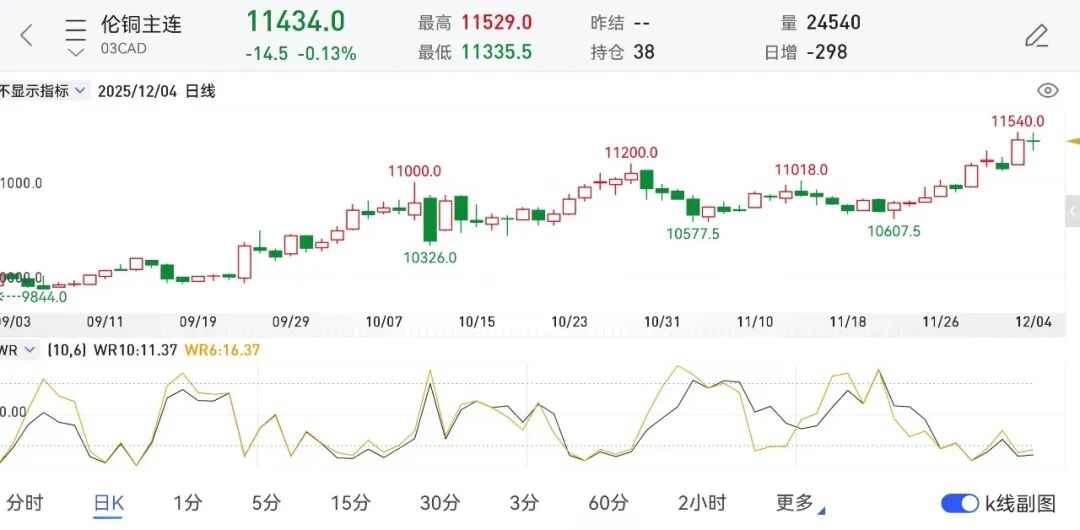
STARTRADER外汇:金价稳守4200美元,就业疲软推升降息预期!
Sou Hu Cai Jing· 2025-12-04 03:53
Group 1 - International gold prices (XAU/USD) are steadily approaching the $4210 mark, showing a mild upward trend influenced by changing market expectations regarding U.S. policy adjustments [2] - The U.S. ADP employment report revealed a decrease of 32,000 jobs in November, significantly below the market expectation of an increase of 5,000, indicating a slowdown in the U.S. labor market [2] - Following the employment data release, the U.S. dollar index faced downward pressure, while gold, priced in dollars, gained support as some funds shifted towards this traditional safe-haven asset [2] Group 2 - The market is currently focused on the upcoming release of the weekly initial jobless claims, which will provide further insights into the labor market's real condition [3] - The delayed release of the U.S. September Personal Consumption Expenditures (PCE) inflation data on Friday is expected to offer critical clues regarding the interest rate path, as it is a key inflation indicator monitored by the Federal Reserve [3] - In November, international gold has achieved a cumulative increase of 5.4%, with strong rebound characteristics towards the end of the month, supported by ongoing central bank gold purchases and geopolitical tensions [3]

美联储闲谈:12 月版-Fed Chatterbox_ December Edition
2025-12-04 02:22
Summary of Key Points from the Conference Call Industry Overview - The conference call primarily discusses the Federal Reserve's monetary policy outlook and its implications for the labor market and inflation. Core Insights and Arguments 1. **Monetary Policy Adjustments**: - New York Fed President Williams advocates for a "further adjustment [to the funds rate] in the near term" due to increased downside risks to employment and reduced upside risks to inflation [2][5] - A consensus among several FOMC members suggests a potential 25 basis point cut at the December meeting, with some members expressing caution about further cuts [2][5] 2. **Labor Market Conditions**: - The labor market is described as "weak and near stall speed," with several officials acknowledging downside risks to employment [2][7] - President Williams notes a gradual softening in labor demand and supply indicators, indicating a balanced but cooling labor market [7] 3. **Inflation Dynamics**: - Officials, including Williams and Jefferson, assert that tariffs are not contributing to ongoing inflationary pressures, viewing their impact as a one-time price level shift rather than a persistent issue [9] - Despite a decrease from post-pandemic peaks, inflation remains a concern, with some officials worried about its trajectory and the risk of it becoming entrenched above the 2% target [9] 4. **Policy Restrictiveness**: - Most participants view the current monetary policy as "somewhat restrictive," with varying opinions on its appropriateness given the economic context [10] - Some officials, like Miran, argue that the policy is "too restrictive," while others, like Collins, see it as mildly restrictive and appropriate for the current economic environment [10] Additional Important Insights 1. **Economic Risks**: - Several officials express concerns about the balance of risks, with a shift towards increased downside risks to employment compared to inflation [5][10] - The potential for a "nonlinear change" in the labor market is highlighted, indicating that conditions could deteriorate rapidly if not monitored closely [7] 2. **Future Outlook**: - The consensus suggests that inflation is expected to return to the 2% target by 2027, contingent on maintaining appropriate monetary policy [9] - The labor market's gradual cooling is viewed as orderly, but officials remain vigilant for signs of more significant deterioration [7] 3. **Caution in Policy Decisions**: - Officials emphasize the need for caution in monetary policy adjustments, balancing the risks of inflation against employment concerns [5][10] - The importance of clear evidence before making further cuts is stressed, particularly in light of the uncertain economic environment [5][10] This summary encapsulates the key themes and insights from the conference call, focusing on the Federal Reserve's monetary policy, labor market conditions, and inflation dynamics.