双碳目标

Search documents
坚守金融报国使命 全力建设中国一流服务型投资银行
Zhong Guo Zheng Quan Bao· 2026-02-11 20:23
Core Viewpoint - The company emphasizes its commitment to serving the nation and aligning with the times, aiming for high-quality development during the "14th Five-Year Plan" period while leveraging its unique advantages in comprehensive finance and cross-border operations [1][2]. Group 1: Political and Governance Commitment - The company maintains a strong political foundation, emphasizing the importance of the Party's leadership and governance, which has been strengthened through internal audits and a focus on compliance [2]. - Since 2022, the company has focused on enhancing its service to the real economy and national strategies, transitioning from merely facilitating IPOs to providing comprehensive support for listed companies [2][3]. Group 2: Business Development and Innovation - During the "14th Five-Year Plan" period, the company is committed to deepening internal reforms and business innovations, enhancing governance effectiveness, and improving management capabilities [3]. - The company aims to become a leading service-oriented investment bank, with a target of achieving a 10% year-on-year increase in financing for the real economy by 2025, and a 44% increase in financing for technology industries [3][5]. Group 3: Risk Management and Compliance - The company prioritizes risk management and compliance, establishing a comprehensive risk management system that covers various operational aspects, ensuring adherence to regulatory requirements [4][5]. - By 2025, the company plans to implement over 20 new and revised regulations to enhance its risk management framework [4]. Group 4: Talent Development and Corporate Culture - The company is focused on building a high-quality talent pool, implementing training programs to enhance professional skills and organizational capabilities [5][6]. - It promotes a unique corporate culture that integrates financial ethics and operational excellence, aiming to strengthen its competitive edge in the industry [6][7]. Group 5: Social Responsibility and Community Engagement - The company is committed to fulfilling its social responsibilities by supporting rural revitalization and public welfare initiatives, aligning its operations with the needs of the community [8]. - It aims to enhance its influence in the financial sector by promoting positive narratives and engaging in community support projects [8].

十万亿千瓦时用电量背后——源网荷储聚力守护能源安全
Zheng Quan Ri Bao· 2026-02-11 16:28
Group 1 - In 2025, China's total electricity consumption surpassed 10 trillion kilowatt-hours for the first time, driven by a significant increase in renewable energy capacity and advancements in energy infrastructure [1] - The State Council's recent implementation plan aims to establish a unified national electricity market, promoting efficient connectivity and dynamic balance between supply and demand [1][2] - The integration of source, grid, load, and storage (source-grid-load-storage) is key to addressing challenges in the energy sector, transitioning to a smart and efficient energy internet [2][3] Group 2 - By the end of 2025, China's total installed power generation capacity reached 3.89 billion kilowatts, with wind and solar power capacity exceeding 1.84 billion kilowatts, accounting for 47.3% of the total [3] - The number of integrated source-grid-load-storage projects has increased significantly, with 38 projects making progress in 2025, and 27 of these being grid-connected [5] - The investment in power grid infrastructure is expected to peak in 2026, with the State Grid Corporation planning a total fixed asset investment of 4 trillion yuan, a 40% increase from the previous five-year period [5] Group 3 - The deep integration of source-grid-load-storage is essential for enhancing energy supply resilience and efficiency, aligning with carbon neutrality goals [4][6] - Companies are actively engaging in the source-grid-load-storage sector, with various firms developing comprehensive strategies across the entire energy value chain [8] - The collaborative efforts among different market participants, including power generation, grid, and storage companies, are fostering a sustainable ecosystem for the energy industry [9] Group 4 - The future of China's energy sector is focused on technological innovation, with advancements in hydropower, nuclear technology, and renewable energy equipment driving the transition towards an energy powerhouse [7] - The successful implementation of integrated source-grid-load-storage models is leading to the development of replicable and scalable energy solutions across various sectors [9][10] - The collaboration among government, industry, and academia is crucial for achieving high-quality development and low-carbon transformation in the energy sector [10]
“双碳”政策专家电话会
2026-02-11 15:40
Summary of Conference Call on Carbon Neutrality and Chemical Industry Industry Overview - The conference focused on the chemical industry in the context of China's dual carbon goals, specifically the 14th Five-Year Plan (14th FYP) and the transition towards carbon neutrality by 2060 [1][2]. Key Points and Arguments 1. **Carbon Peak and Neutrality Goals**: - China aims to reach carbon peak by 2030 and achieve carbon neutrality by 2060, with a specific target of reducing total carbon emissions by 7% to 10% after reaching the peak [2][4]. - The transition from intensity-based targets to total emission reduction is a significant shift in policy [4][6]. 2. **Policy Implementation**: - The 14th FYP emphasizes a comprehensive green transformation across all industries, moving from energy consumption control to carbon emission control [5][6]. - A carbon emission budget mechanism will be established at provincial and municipal levels, with specific targets allocated to each region [6][7]. 3. **Inclusion of Industries in Carbon Market**: - Currently, eight major industries, including power, cement, aluminum, and steel, are included in the carbon market, which accounts for 65% of national carbon emissions [7][8]. - By 2027, additional sectors such as petrochemicals, chemicals, paper, and construction materials will be integrated into the carbon market [7][8]. 4. **Carbon Management and Monitoring**: - Companies will be required to incorporate carbon management into their operational frameworks, with carbon emissions data becoming a prerequisite for project approvals [8][9]. - A product carbon footprint database will be established to track and certify carbon emissions associated with products [9][10]. 5. **Development of Zero-Carbon Facilities**: - The government plans to establish 100 national-level zero-carbon parks by 2030, with ongoing efforts to create zero-carbon factories in high-emission industries [9][10]. 6. **Market Mechanisms and Cost Implications**: - The introduction of paid carbon allowances is anticipated, with a gradual shift from free allocation to auction-based distribution [11][12]. - The carbon market will also facilitate voluntary emission reduction projects, allowing non-regulated companies to participate [12][13]. 7. **Impact on Chemical Industry**: - The chemical industry faces significant pressure due to its reliance on coal, which constitutes over 40% of its emissions [16][17]. - The projected carbon emissions from the chemical sector are expected to increase slightly, posing challenges for compliance with future carbon reduction targets [16][17]. 8. **Technological Innovations**: - The industry is encouraged to adopt renewable resources and improve production processes to reduce carbon emissions, including the use of Carbon Capture, Utilization, and Storage (CCUS) technologies [17][18]. Additional Important Content - The transition to a carbon-neutral economy will require a comprehensive understanding of the carbon footprint across various production processes, particularly in the chemical sector [17][18]. - The government is expected to monitor and adjust carbon emission allowances based on real-time data, although the current monitoring system is still under development [45][46]. - The dual carbon goals will necessitate a balance between maintaining industrial competitiveness and achieving environmental sustainability, particularly in coal-dependent sectors [38][39]. This summary encapsulates the critical discussions and insights from the conference call regarding the implications of China's carbon neutrality goals on the chemical industry and related sectors.
西高院:持续推进产能提升与效率优化工作
Zheng Quan Ri Bao· 2026-02-11 11:40
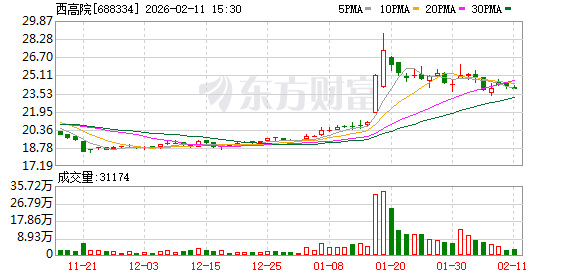
Core Viewpoint - The company is actively enhancing its production capacity and efficiency in response to strong market demand, particularly in the fields of ultra-high voltage, renewable energy, and smart grid technologies, which are expected to experience sustained growth due to the "dual carbon" goals and the development of new power systems [2] Group 1: Production Capacity and Efficiency - The company is implementing intelligent upgrades to existing production lines to improve experimental efficiency [2] - The company is advancing project construction and technological upgrades to expand production capacity in an orderly manner [2] - The company is optimizing experimental resource allocation through multi-regional collaboration and resource integration, leveraging its industrial layout across various regions [2] Group 2: Market Opportunities - The ultra-high voltage, renewable energy, and smart grid sectors are projected to grow rapidly, providing long-term and certain market space for the testing industry [2] - The company is expected to benefit significantly from industry expansion and technological iteration [2]

仅仅一个西藏,就能满足中国现在与未来,几乎所有的能源需求
Sou Hu Cai Jing· 2026-02-11 10:27
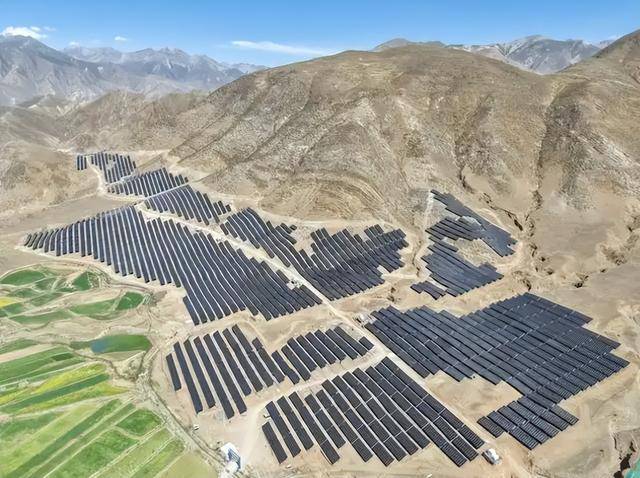
Core Insights - Tibet's energy development is entering a new phase with significant advancements in renewable energy projects, including solar, hydro, and wind power, which align with China's carbon neutrality goals [4][5][10] Group 1: Solar Energy Development - The solar project in Hode Village, with a capacity of 100,000 kilowatts, has significantly alleviated local electricity issues, allowing residents to access clean and affordable energy [1][7] - Tibet's unique geographical advantages, such as high altitude and abundant sunlight, make it an ideal location for solar energy development, contributing to the local economy and improving living standards [7][10] Group 2: Hydropower and Wind Energy Potential - The newly launched hydropower project in the Yarlung Tsangpo River basin marks a milestone in Tibet's energy development, with a potential hydropower capacity of 178 gigawatts and wind energy potential exceeding 100 gigawatts [3][9][10] - The vast solar energy potential in Tibet, estimated at 10,000 gigawatts, positions the region as a critical resource for meeting China's future energy demands [10][12] Group 3: Economic and Social Impact - Energy development in Tibet is closely linked to economic growth, with a reported GDP growth rate of 7.2% in the first half of 2025, driven by energy projects [14] - The hydropower project is expected to create 100,000 jobs, enhancing local employment opportunities and skill development [16] Group 4: Strategic Importance - Tibet is becoming a strategic hub for energy transmission, connecting domestic energy markets with South Asia and Central Asia, thus enhancing its geopolitical significance [18] - The region's energy resources are crucial for supporting China's "East Data West Computing" strategy, which requires substantial clean and stable electricity supply [23] Group 5: Environmental Considerations - Tibet's energy development emphasizes ecological protection, ensuring that resource extraction does not compromise the region's natural environment [25] - The balance between energy development and ecological preservation is vital for sustainable growth in Tibet, transforming it from a marginal area to a core energy hub for China [25]
乘联分会:2月1-8日全国乘用车新能源市场零售11.9万辆 同比增长42% 环比增长41%
智通财经网· 2026-02-11 08:52
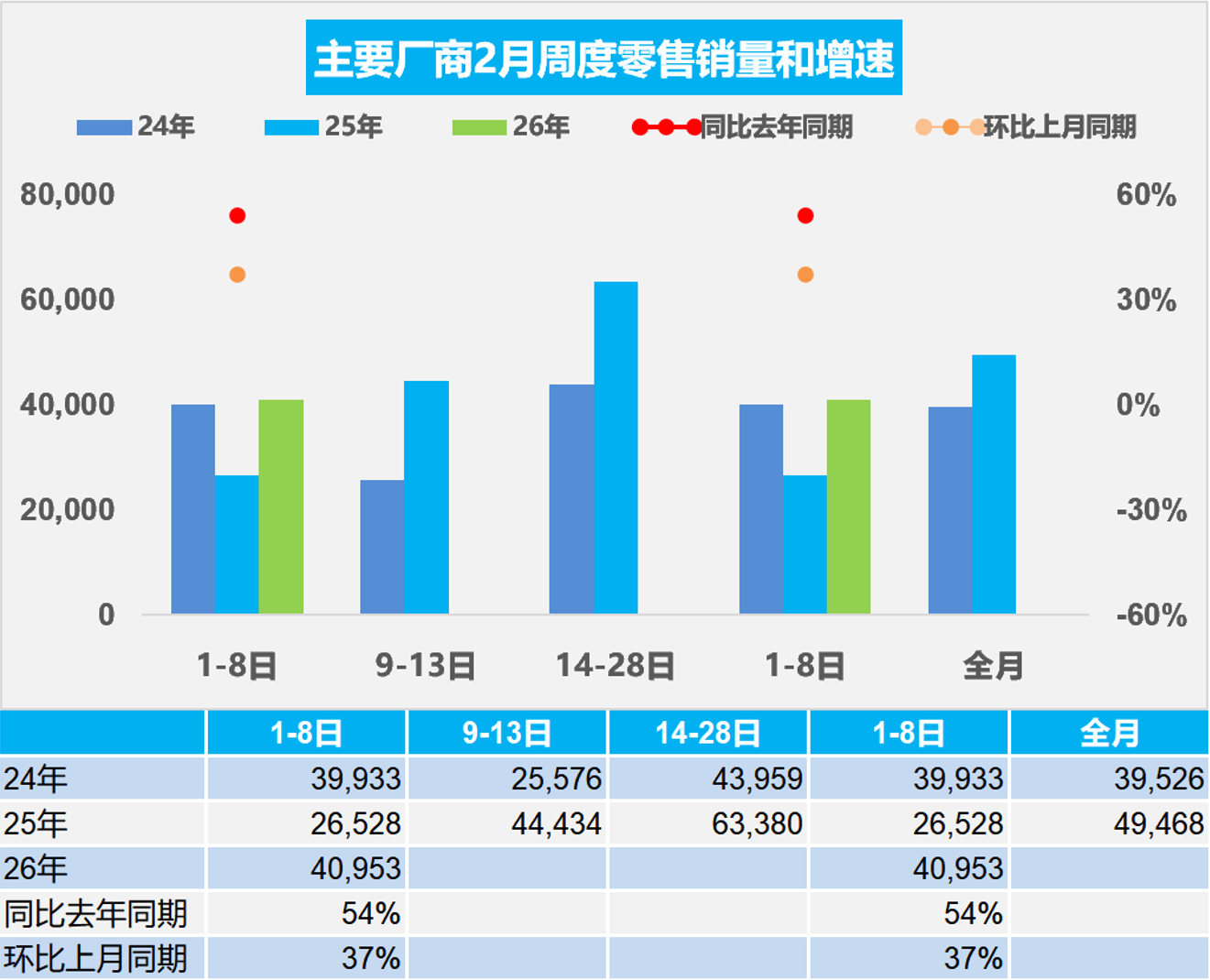
Group 1: Market Performance - From February 1-8, the retail sales of new energy vehicles in the national passenger car market reached 119,000 units, a year-on-year increase of 42% and a month-on-month increase of 41%. Cumulative retail sales for the year so far are 715,000 units, down 14% year-on-year [1] - During the same period, wholesale sales of new energy vehicles by manufacturers reached 125,000 units, a year-on-year increase of 39% and a month-on-month increase of 3%. Cumulative wholesale sales for the year are 989,000 units, up 1% year-on-year [1] - The retail penetration rate of new energy vehicles in the passenger car market was 36.4%, while the wholesale penetration rate was 43.9% [1] Group 2: Production Insights - In the first week of February, production of pure fuel light vehicles was 158,000 units, a year-on-year increase of 276% and a month-on-month increase of 139% [1] - Production of hybrid and plug-in hybrid vehicles totaled 73,000 units, a year-on-year increase of 70% but a month-on-month decrease of 28% [1] Group 3: Sales Trends and Seasonal Factors - The first week of February saw an average daily retail of 41,000 units, a year-on-year increase of 54% and a month-on-month increase of 37% [4] - The sales performance in February is expected to be strong due to the extended sales period before the Spring Festival, which falls on February 10 this year, providing a favorable environment for sales [4] - The pre-Spring Festival sales period typically sees lower sales for manufacturers due to longer transportation times and potential weather disruptions, impacting dealer sales [8] Group 4: Pricing and Promotions - Since 2025, the promotion and discount strategies in the passenger car industry have returned to rationality, with a noticeable improvement in market order [12] - In January 2026, the average price reduction for new energy vehicles was 25.3 million yuan, with an average reduction of 3.8 million yuan, representing a significant reduction of 14.8% [12] - The overall promotion pressure for conventional fuel vehicles and hybrid vehicles is relatively low, while the promotion for pure electric vehicles has decreased significantly due to price reductions [13] Group 5: Used Car Market - In 2025, the national used car market saw a transaction volume of 20.11 million units, a year-on-year increase of 2.5%, with a transaction value of 128.98 billion yuan, up 0.4% [9] - The transaction volume of used new energy vehicles reached 169,000 units in December 2025, a month-on-month increase of 8.7% and a year-on-year increase of 36.5% [9] - The potential for the used car market in China is significant, especially with the rise of new energy vehicles, providing consumers with lower-cost options for car ownership [10] Group 6: Energy and Charging Infrastructure - The rapid growth of electric vehicle ownership in China has led to a significant increase in distributed mobile energy resources, enhancing the load control capabilities of charging stations [14] - The new pricing mechanism for time-of-use electricity is driven by the energy contribution of electric vehicles, facilitating a dual empowerment model for energy consumption and grid management [14]
关于举办源网荷储及微电网投资建设培训的通知丨系列培训
中国能源报· 2026-02-11 06:45
Core Viewpoint - The integrated development of source-grid-load-storage is essential for the high-quality development of the power system and is a necessary choice for enhancing the consumption of renewable energy and non-fossil energy [2] Group 1: Training Overview - The training on source-grid-load-storage and microgrid investment construction is organized by China Energy News and aims to deepen understanding of related issues [2][3] - The training will take place from March 6 to 7 in Hangzhou [3] Group 2: Target Audience - The training is aimed at large energy groups, power companies, generation groups, local energy groups, key parks, factories, and various energy-consuming institutions [3] - It also targets new energy enterprises (wind, solar, storage), power design institutes, and integrated design units [3] Group 3: Course Modules - The training will cover policy interpretation, current development status, application scenarios, technical analysis, and profit models related to source-grid-load-storage and microgrids [3][4] Group 4: Development Directions - The training will discuss the differences and connections between green electricity direct connection and source-grid-load-storage [4] - It will also cover the application of microgrids in zero-carbon parks and provide guidelines for industrial green microgrid construction [4] Group 5: Training Fees - The training fee is set at 3,900 yuan per person, which includes the training cost, while transportation and accommodation are self-managed [4]

全固态电池产业化加速 材料和设备端寻求新突破
Zhong Guo Jing Ying Bao· 2026-02-11 06:08
Core Viewpoint - The third China All-Solid-State Battery Innovation Development Summit highlighted that all-solid-state batteries are a crucial development direction for next-generation power battery technology, with an accelerating industrialization process but facing significant challenges in materials, engineering, manufacturing processes, and core equipment [1]. Group 1: Industry Insights - The Chinese battery industry is experiencing rapid growth and technological iteration, expanding application scenarios from automobiles and energy storage to robotics and low-altitude aircraft [1]. - The demand for batteries is surging under the "dual carbon" goals, making all-solid-state batteries an important development direction, yet challenges remain in electrolyte performance, solid-solid interface compatibility, and high specific energy electrode matching [1]. - The penetration rate of all-solid-state batteries is currently low, but increasing collaboration between academia and industry is leading to more battery companies and automakers announcing timelines for all-solid-state battery deployment [4]. Group 2: Technological Developments - Key innovations in materials are being explored, including high-capacity high-voltage positive electrodes, stable negative electrodes, and electrolytes with high ionic conductivity [2]. - Research advancements include microcrystallization of high-nickel ternary materials, lithium-boron framework lithium metal anodes, and interface regulation of iodine ions, which provide new pathways for achieving high energy density and long cycle life in all-solid-state batteries [2]. - The development of solid electrolytes is focusing on sulfide routes and composite routes, with discussions on low-cost production, wide temperature applications, and high energy density cell systems [3]. Group 3: Company Initiatives - Companies like Rongbai Technology are improving the kinetics of high-nickel ternary materials through precursor design and wet coating, achieving a production capacity of 10 tons [2]. - Sichuan Huayi Qing Innovation Materials Technology is addressing silicon-based anode industrialization bottlenecks with new technologies that effectively solve expansion and pressure issues [2]. - Zhejiang Geely Holding Group plans to debut prototype vehicles with solid-state batteries in 2026, with small-scale industrialization by 2027 and mass production of high-end models by 2030 [4].
重点排放单位应积极融入碳市场
Zhong Guo Huan Jing Bao· 2026-02-11 05:31
Group 1 - A recent case in Ningxia highlights that some key emission units lack a deep understanding of the carbon emission trading market and the importance of timely and full compliance with carbon emission quota payments [1] - The national carbon emission trading market aims to achieve China's "dual carbon" goals by enforcing mandatory emission reduction responsibilities among key emission units, promoting greenhouse gas reduction at the lowest social cost [1] - Since its launch in 2021, the national carbon market has completed three compliance submissions, maintaining a high overall compliance rate, although some key emission units have failed to meet their quota obligations on time [1] Group 2 - The "Interim Regulations on Carbon Emission Trading Management," effective from May 1, 2024, impose fines on key emission units that fail to comply with quota payments, with penalties ranging from five to ten times the average market transaction price of the unpaid quotas [2] - The regulations also outline requirements for carbon emission data quality and the supervision of technical service institutions, clarifying the penalties for violations [2] - The carbon market currently includes 3,378 key emission units and aims to cover major industrial sectors by 2027, with ongoing efforts to enhance the market structure and combat data fraud [2] Group 3 - The recent carbon emission penalty case serves as a reminder for key emission units to continuously understand and adapt to the evolving rules of the carbon market, emphasizing the need for legal awareness and proactive compliance [3] - Companies are encouraged to improve their carbon emission and asset management capabilities to contribute to sustainable development and the green transformation of the economy and society [3]
深地数智协同破局 产学共振筑基能源未来
Zhong Guo Neng Yuan Wang· 2026-02-11 05:02
构建"人机环"协同的数智开采体系 ——访煤炭开采无人化数智技术全国重点实验室学术委员会主任陈湘生 1月11日,煤炭开采无人化数智技术全国重点实验室第一届学术委员会、战略指导委员会第二次会议暨教育部协同创新中心2025年年会在北京召开。作为学 术委员会主任,陈湘生教授深耕煤炭开采与数智技术融合领域,见证并引领了我国煤炭工业从机械化到智能化的跨越式发展。围绕大会核心议题,陈湘生院 士就行业战略转型、技术创新突破、协同发展路径等关键问题,分享了深刻见解与前瞻思考。 锚定国家需求破解行业痛点 本次大会的召开恰逢煤炭行业智能化转型的关键节点,实验室作为行业创新策源地,其战略定位始终紧扣国家重大需求。陈湘生院士强调,煤炭作为我国能 源安全的基石,在"双碳"目标与新质生产力培育的双重背景下,转型不是"去煤化"而是"优煤化",核心是通过数智技术实现绿色低碳安全开采,这与此次大 会提出的"地质透明化+无人化开采"双主线高度契合。 "当前行业面临的深部开采极端环境、安全防控压力、资源利用效率等痛点,正是实验室的攻关方向,而本次大会发布的'矿井地质透明化与水灾数智化防控 技术创新及应用'等10项创新成果。其中3项标志性成果已通过国 ...