
自由贸易

Search documents
与天下同利 为世界注入稳定性正能量 李强出席第八届中国国际进口博览会开幕式并发表主旨演讲
Jie Fang Ri Bao· 2025-11-06 01:46
Core Viewpoint - The China International Import Expo (CIIE) serves as a vital bridge connecting the Chinese economy with the global market, showcasing the vitality of China's large-scale market as participation reaches a historical high this year [1][2]. Group 1: Economic Cooperation and Trade - The CIIE emphasizes the importance of "mutual benefit" in international trade, countering unilateralism and protectionism that disrupt global economic order [2]. - Three key principles for international economic activities were shared: 1. Upholding equality and mutual benefit to solidify common interests [2]. 2. Maintaining moral integrity to ensure international fairness and justice [2]. 3. Promoting governance reform to enhance the international trade rule system [2]. Group 2: China's Economic Development - The recent approval of the "14th Five-Year Plan" by the Communist Party's Fourth Plenary Session injects certainty into China's economic and social development [3]. - China is committed to high-quality development and will contribute significantly to global economic growth [3]. - The country will continue to pursue high-level opening-up and expand institutional openness, particularly in the service sector [3]. Group 3: International Participation - The opening ceremony was attended by representatives from 155 countries, regions, and international organizations, highlighting the global interest in the CIIE [3]. - Foreign leaders expressed that the CIIE plays a crucial role in promoting open cooperation and shared development opportunities with China [5].

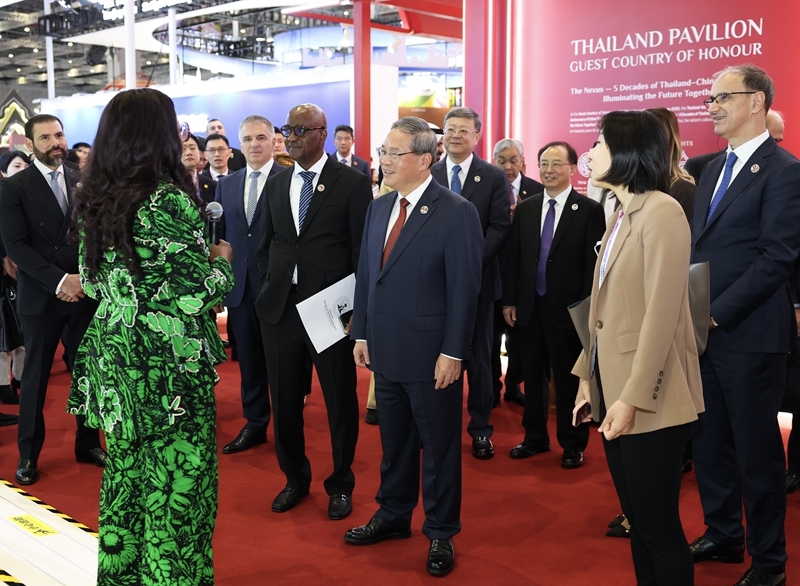
李强出席第八届进博会开幕式并发表主旨演讲
Qi Huo Ri Bao Wang· 2025-11-06 00:45
Core Viewpoint - The China International Import Expo (CIIE) serves as a vital bridge connecting the Chinese economy with the global market, showcasing China's robust market vitality and the importance of international cooperation in the face of rising protectionism and unilateralism [1][2]. Group 1: Economic Development - The 20th Central Committee of the Communist Party of China has approved the "14th Five-Year Plan," which aims to inject more certainty into China's economic and social development, focusing on high-quality growth and contributing significantly to global economic growth [2]. - China is committed to maintaining a central focus on economic construction and will steadily expand its high-level opening-up, particularly in the service sector [2]. Group 2: International Cooperation - The CIIE has attracted participation from representatives of 155 countries and regions, with around 1,500 attendees, highlighting its role in promoting open cooperation and global economic development [2]. - Foreign leaders and international organization heads have expressed their willingness to deepen cooperation with China in areas such as trade, connectivity, innovation, and green development, emphasizing the importance of maintaining free and fair trade [2]. Group 3: Event Highlights - Premier Li Qiang visited the enterprise exhibition before the opening ceremony and later toured the exhibition halls with foreign leaders [3]. - The "Shared Big Market · Export to China" initiative was launched, indicating a focus on enhancing export opportunities [4].
新闻1+1丨从“产品出海” 到 “产业出海” 中国为全球贸易注入信心
Yang Shi Xin Wen Ke Hu Duan· 2025-11-05 23:30
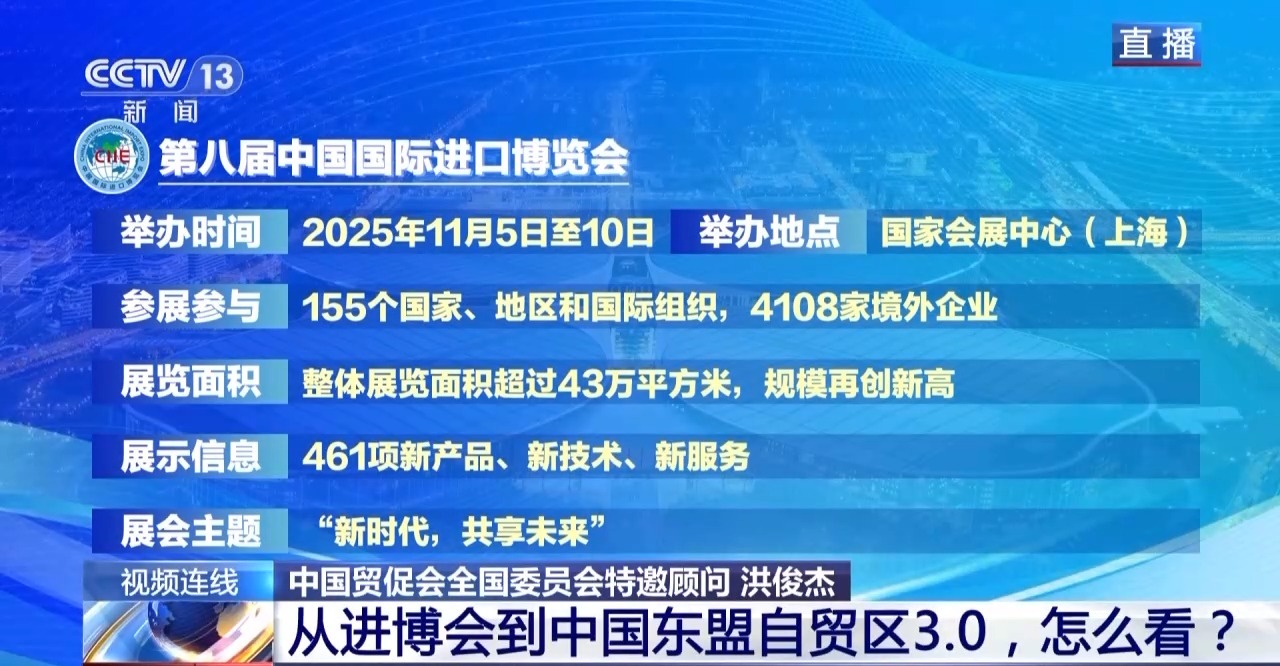
Core Viewpoint - China is actively promoting its openness to the world through initiatives like the upcoming China International Import Expo (CIIE) and the recent signing of the China-ASEAN Free Trade Area 3.0 upgrade protocol, aiming to instill confidence and stability in an uncertain global environment [1]. Group 1: Importance of CIIE - The CIIE is recognized as a significant event in global trade, being the only national-level expo focused on imports, symbolizing China's commitment to expanding its openness and supporting global trade [6]. - International observers increasingly view the CIIE as playing a crucial role in promoting globalization and free trade, especially in light of rising unilateralism and protectionism [5][6]. Group 2: New Trends in International Trade - The evolution of international trade has led to the emergence of new models and business formats, shifting focus from traditional border measures to institutional openness that includes rules, regulations, and management standards [9]. - The CIIE will showcase trends such as digital economy and green economy initiatives, reflecting the growing importance of institutional openness in trade [9]. Group 3: Regional Cooperation and Future Opportunities - The development of international trade necessitates the inclusion of new fields and business formats in negotiations, moving from traditional goods trade to services, digital, and green trade [12]. - China and ASEAN, as key components of the Asian manufacturing landscape, have high complementarity in trade, with 60% of their trade being intermediate goods, indicating strong potential for future collaboration in both trade and industry [15].
推进务实合作 促进共同发展
Ren Min Ri Bao· 2025-11-05 22:11
Core Points - The APEC 32nd Leaders' Informal Meeting concluded with China taking over as the host, marking the beginning of the "China Year" for APEC, with expectations for enhanced cooperation in the Asia-Pacific region [2][3] - International figures emphasize the importance of open development and mutual benefits, advocating for the advancement of the Asia-Pacific Free Trade Area and connectivity [2][3] Group 1: Economic Cooperation and Trade - APEC has played a significant role in promoting inclusive growth and maintaining a free and open trade order in the region since its establishment over 30 years ago [3] - The chair of the APEC Business Advisory Council, Lee Geun-ho, highlighted the need for multilateral cooperation based on trust to address global challenges such as climate change and aging populations [3] - The APEC platform facilitates trade facilitation and enhances digital and logistics capabilities, particularly benefiting small and medium-sized enterprises [5] Group 2: China's Role and Initiatives - China's development achievements and economic vitality are recognized as providing valuable lessons for other economies, particularly in infrastructure and poverty alleviation [6][7] - The upcoming APEC meeting in 2026, hosted by China, is expected to inject new momentum into cooperation in digital economy, green transformation, and supply chain resilience [3][6] - China's initiatives, including the Belt and Road Initiative and various global governance proposals, align with APEC's principles of open cooperation and mutual benefits [7][9] Group 3: Regional Stability and Multilateralism - The importance of multilateralism in promoting stability and development is emphasized, with APEC seen as a crucial platform for dialogue and cooperation among member economies [8][9] - The rise of protectionism highlights the need for APEC to maintain its commitment to open regionalism and cooperative spirit [6][8] - APEC's role in addressing economic fragmentation and fostering consensus among major economies is critical for regional prosperity [7][9]
李强出席第八届中国国际进口博览会开幕式并发表主旨演讲 坚持“与天下同利” 进博会越办越好
Zheng Quan Shi Bao· 2025-11-05 21:48
Group 1 - The core message emphasizes the importance of the China International Import Expo (CIIE) as a bridge connecting the Chinese economy with the world, showcasing China's vast market potential and vitality [1] - The number of participating companies at this year's expo reached a historical high, reflecting the robust growth of China's super-large market [1] - The speech highlighted three key principles for international economic cooperation: maintaining equality and mutual benefit, upholding fairness and justice, and promoting governance reform to improve the international trade rules system [1] Group 2 - The Chinese government is committed to high-quality economic development and will contribute significantly to global economic growth [2] - China will continue to pursue a high level of openness and expand institutional openness, particularly in the service sector [2] - The event was attended by representatives from 155 countries and regions, with around 1,500 attendees, indicating strong international interest in cooperation and trade with China [2]
第八届进博会|李强出席第八届中国国际进口博览会开幕式并发表主旨演讲
Shang Wu Bu Wang Zhan· 2025-11-05 16:47
格鲁吉亚总理科巴希泽、塞尔维亚总理马楚特、尼日利亚众议长塔杰丁、斯洛文尼亚国民委员会主席洛 特里奇、阿联酋总统特别代表齐亚布亲王、联合国工发组织总干事穆勒等出席开幕式并致辞,联合国贸 发会议秘书长格林斯潘视频致辞。来自155个国家、地区和国际组织及政商学界代表约1500人出席开幕 式。 外方领导人和国际组织负责人表示,进博会为推动开放合作、促进全球经济发挥重要作用,展示了中国 与世界共享机遇、共谋发展的大国担当。各方愿深化同中方在经贸、互联互通、创新、绿色发展等领域 合作,维护自由公平贸易,共促发展繁荣。 (原标题:第八届进博会|李强出席第八届中国国际进口博览会开幕式并发表主旨演讲) 11月5日,国务院总理李强在上海出席第八届中国国际进口博览会暨虹桥国际经济论坛开幕式,并发表 主旨演讲。 李强表示,正如习近平主席指出,中国经济是一片大海,世界经济也是一片大海,世界大海大洋都是相 通的。进博会是世界经济通向中国经济的入海口,也是中国联结世界的重要桥梁。今年进博会的参展企 业数量再创历史新高,充分彰显中国超大规模市场的蓬勃生机和活力。 李强指出,进博会越办越好,很重要的是因为坚持"与天下同利"。反观当前国际上一些 ...
从“全球秀场”走向“超级卖场”
Bei Jing Shang Bao· 2025-11-05 15:40
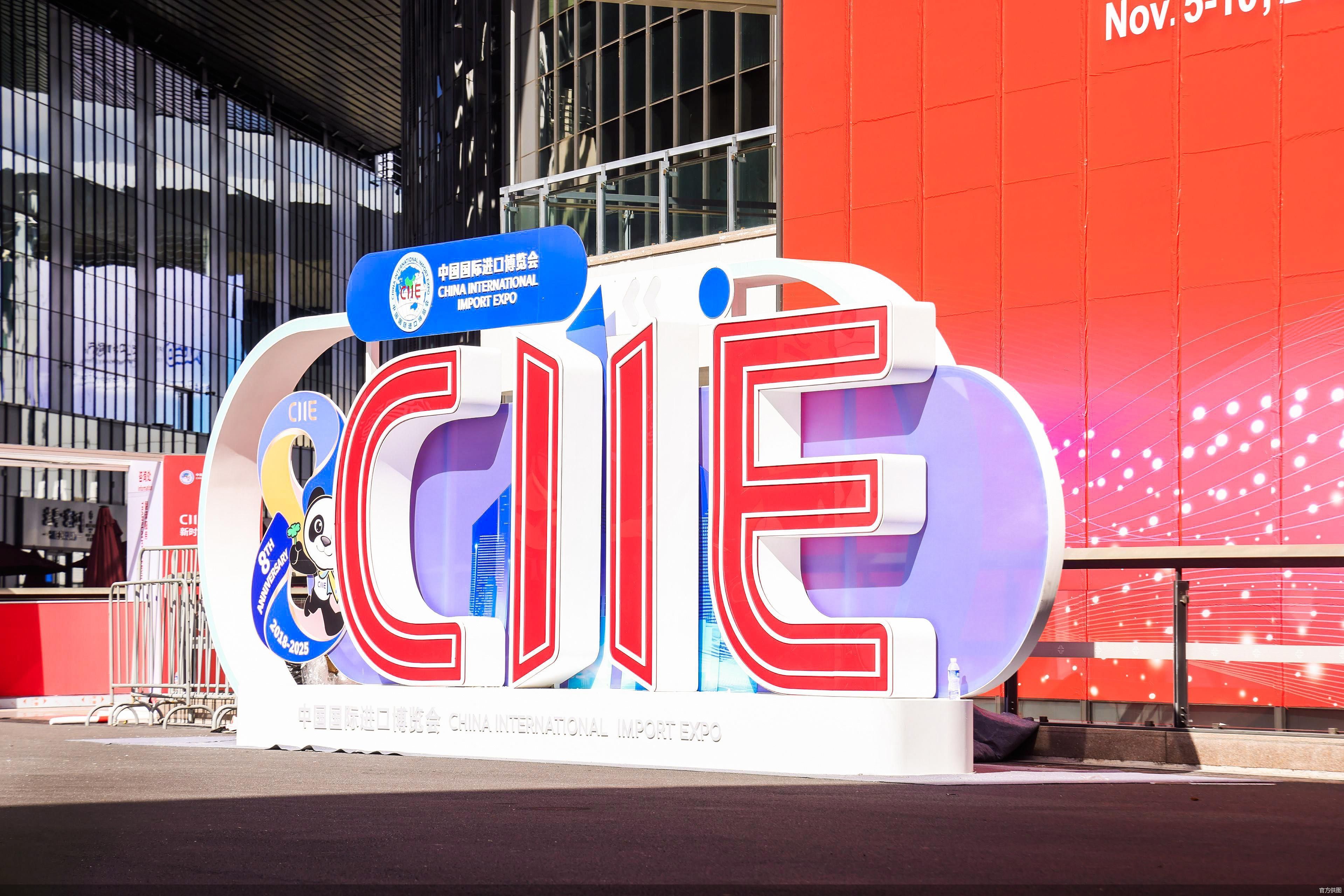
Core Points - The 8th China International Import Expo (CIIE) opened on November 5, 2023, in Shanghai, showcasing China's commitment to high-level opening-up and global cooperation [1][4][6] - This year's expo features a record number of participating companies, highlighting the vitality of China's large-scale market [1][4][6] - The expo serves as a "catalyst" for high-quality development in China and a "firewall" against anti-globalization trends, providing certainty to the global economy [1][10][12] Group 1: Event Overview - The CIIE is themed "Open Cooperation for New Opportunities and Shared Future," emphasizing its role as a bridge between the world economy and China's economy [1][4] - The exhibition area exceeds 367,000 square meters, with over 4,100 participating companies, including 290 Fortune 500 and industry-leading firms [6][10] - The event runs from November 5 to 10, 2023, and includes six major exhibition areas and an innovation incubation zone [6][8] Group 2: Key Themes and Innovations - The expo focuses on innovation, with 461 new products, technologies, and services being showcased, making China a testing ground for global innovation [6][7] - Notable global companies are participating, including those in the medical field, highlighting advancements in chronic and rare disease treatments [7] - The introduction of a "cross-border e-commerce preferred platform" and enhanced digital services aims to create new business models and improve visitor experience [7][10] Group 3: International Participation - A total of 67 countries and international organizations are participating, with six countries serving as guest countries for the first time [8] - Countries like the UAE and Nigeria are showcasing their unique cultural and economic contributions, enhancing international cooperation [8][9] - The event also features bilateral cooperation achievements and celebrations of diplomatic anniversaries with several countries [9] Group 4: Economic Impact - The CIIE is positioned as a significant platform for observing China's high-level opening-up and experiencing its vast market advantages [10] - China has been the world's second-largest import market for 16 consecutive years, with imports expected to exceed $15 trillion during the 14th Five-Year Plan [10] - The expo has generated over $500 billion in intended transaction value over its first seven editions, reinforcing its role in trade facilitation and investment [10][11]
新华财经晚报:国务院关税税则委员会停止实施对原产于美国的部分进口商品加征关税措施
Xin Hua Cai Jing· 2025-11-05 10:07
Key Points - Premier Li Qiang attended the opening ceremony of the 8th China International Import Expo and emphasized the importance of mutual benefit and cooperation in international trade, especially in the face of rising unilateralism and protectionism [1] - The State Council Tariff Commission announced the suspension of additional tariffs on certain imported goods from the United States, maintaining a 10% tariff while suspending a 24% tariff starting from November 10, 2025 [2] - The National Energy Administration reported that by the end of September, China's new energy storage capacity exceeded 100 million kilowatts, representing a growth of over 30 times compared to the end of the 13th Five-Year Plan, accounting for over 40% of the global total [4] Domestic News - The service sector PMI for China in October was reported at 52.6, slightly down from 52.9 in the previous month, while the manufacturing PMI was at 50.6, down from 51.2 [5] - In October, retail sales of new energy vehicles reached 1.4 million units, a year-on-year increase of 17%, with cumulative retail sales for the year reaching 10.27 million units, up 23% [6] International News - The U.S. federal government has entered its longest shutdown in history, now in its 36th day [7] - The Eurozone's service sector PMI for October was finalized at 53, exceeding expectations, while Germany's service sector PMI was at 54.6, also above expectations [7]
李强出席第八届中国国际进口博览会开幕式并发表主旨演讲
证监会发布· 2025-11-05 06:43
Core Views - The China International Import Expo (CIIE) serves as a vital bridge connecting the Chinese economy with the global market, showcasing the vitality of China's large-scale market [2] - The event highlights the importance of adhering to principles of equality and mutual benefit in international trade, especially in the face of rising unilateralism and protectionism [2] - China is committed to high-quality development and expanding its openness to the world, which will contribute positively to global economic growth [3] Summary by Sections - **CIIE Significance**: The CIIE is recognized as a key platform for global economic cooperation, with participation from representatives of 155 countries and regions, emphasizing China's role in promoting open collaboration [4] - **International Cooperation**: Foreign leaders and international organization heads expressed their willingness to deepen cooperation with China in areas such as trade, connectivity, innovation, and green development [4] - **Government Commitment**: The Chinese government, through the 14th Five-Year Plan, aims to provide certainty in economic development and openness, focusing on high-quality growth and expanding service sector openness [3] - **Event Participation**: Approximately 1,500 representatives from various sectors attended the opening ceremony, indicating strong international interest in the CIIE [3]
第八届进博会|李强出席第八届中国国际进口博览会开幕式并发表主旨演讲
Xin Hua She· 2025-11-05 06:39
新华社上海11月5日电(记者王永前、邵艺博)11月5日,国务院总理李强在上海出席第八届中国国 际进口博览会暨虹桥国际经济论坛开幕式,并发表主旨演讲。 李强表示,正如习近平主席指出,中国经济是一片大海,世界经济也是一片大海,世界大海大洋都 是相通的。进博会是世界经济通向中国经济的入海口,也是中国联结世界的重要桥梁。今年进博会的参 展企业数量再创历史新高,充分彰显中国超大规模市场的蓬勃生机和活力。 李强指出,进博会越办越好,很重要的是因为坚持"与天下同利"。反观当前国际上一些单边主义、 保护主义的行为,严重冲击国际经贸秩序,扰乱世界经济运行。在国际经贸活动中应当秉持什么样的价 值理念,越来越成为重要而现实的问题。李强同大家分享3点看法:一是坚持平等互利,夯实正当的共 同利益基础。越是世界经济发展放缓、国际纷争加剧,越要坚持平等互利合作、拥抱自由贸易,在携手 发展中推动化解矛盾和问题。二是始终坚守道义,切实维护国际公平正义。当今世界各国命运紧密相 连,应当义利兼顾、同舟共济、守望相助。三是推进治理改革,完善国际经贸规则体系。中方愿同各方 积极推动全球治理倡议在国际经贸领域落地实践,改革完善以世贸组织为核心的多边贸易 ...