
报行合一

Search documents
财险行业“反内卷”初战告捷:综合成本率显著下降,高质量发展路径渐明
Guan Cha Zhe Wang· 2025-09-02 07:09
Core Insights - The domestic property insurance industry has shown significant improvement in its performance, with major companies like PICC, Ping An, and Taikang reporting a collective decrease in comprehensive cost ratios, particularly in auto insurance, indicating a successful phase in the ongoing "anti-involution" efforts [1][2] Group 1: Comprehensive Cost Ratio Improvement - In the first half of 2025, PICC's comprehensive cost ratio fell to 95.3%, a decrease of 1.5 percentage points year-on-year; Ping An's ratio was 95.2%, down 2.6 percentage points; and Taikang's ratio improved to 96.3%, a reduction of 0.8 percentage points, marking the lowest levels in nearly five years [2] - The improvement in comprehensive cost ratios is attributed to the dual control of loss and expense ratios, with auto insurance, which accounts for over 50% of the industry, seeing its expense ratio drop from 38.2% in 2023 to 34.7%, a decline of 3.5 percentage points [2] Group 2: Regulatory Changes in Non-Auto Insurance - A new round of regulatory upgrades is being developed for non-auto insurance sectors, with the "reporting and implementation" policy expected to be officially launched in the fourth quarter of 2025, targeting health, agricultural, and liability insurance [3] - The non-auto insurance market has long suffered from high costs and low quality, with some products exceeding a 40% actual expense ratio, leading to a cycle of premium growth but declining profitability [3] - If the new regulations are implemented, non-auto insurance expense ratios could decrease by 5-8 percentage points, potentially releasing over 20 billion yuan in profit space [3] Group 3: Industry Transformation and Competitive Landscape - The success of the "anti-involution" efforts is a result of regulatory guidance and proactive transformation by market participants, with major companies moving away from cost wars to focus on service upgrades and technological empowerment [4] - Major insurers have reported improved customer satisfaction and reduced claims costs through innovative services and technology, with renewal rates for the three leading companies exceeding 80%, a 5 percentage point increase from 2023 [4] Group 4: Challenges Ahead - Despite significant progress, the property insurance industry faces challenges, particularly for smaller companies struggling with transformation due to insufficient technology investment and weak service networks [5] - The risk management capabilities in non-auto insurance need enhancement, especially as policy-driven businesses increase, leading to potential adverse selection risks [5] - Economic fluctuations may impact underwriting profits, necessitating the establishment of more flexible risk hedging mechanisms [5] Group 5: Future Investments and Innovations - Ping An plans to invest 5 billion yuan over the next three years in green sectors such as new energy vehicle insurance and carbon sink insurance; PICC is collaborating with the National Rural Revitalization Bureau to launch comprehensive agricultural insurance solutions [6] - Taikang is developing "insurance + IoT" risk reduction services in collaboration with Huawei, already implemented in industries like chemicals and construction [6]


车险“反内卷”初见成效 非车险或于明年改善
Zheng Quan Shi Bao Wang· 2025-09-01 23:17
Core Viewpoint - The property insurance industry has made initial progress in "anti-involution," leading to improved underwriting profitability and business quality among major insurers [1][2]. Group 1: Financial Performance - Major property insurance companies, including PICC, Ping An, and Taikang, have reported significant growth in underwriting profitability, with comprehensive cost ratios showing notable declines [3]. - PICC achieved an underwriting profit of 11.699 billion yuan, a year-on-year increase of 53.5%, with a comprehensive cost ratio of 95.3%, the best level in nearly a decade, down 1.5 percentage points year-on-year [3]. - Ping An's underwriting profit surged by 125.9% to 7.978 billion yuan, with a comprehensive cost ratio of 95.2%, improving by 2.6 percentage points year-on-year [3]. - Taikang reported an underwriting profit of 3.55 billion yuan, a year-on-year increase of 30.9%, with a comprehensive cost ratio of 96.3%, down 0.8 percentage points year-on-year [3]. Group 2: Cost Ratio Optimization - The optimization of comprehensive cost ratios is attributed to a decrease in expense ratios, with PICC's cost ratio primarily benefiting from reduced expenses, while Ping An and Taikang experienced declines in both claims and expense ratios [3]. - Ping An's Vice President noted that the effective control of expenses and claims, along with the application of technology and AI in underwriting and claims processing, has laid a solid foundation for cost ratio optimization [3]. Group 3: Regulatory Changes and Future Outlook - The implementation of "reporting and operation unity" in auto insurance has helped standardize market order, with PICC's auto insurance comprehensive cost ratio at 94.2%, down 2.2 percentage points year-on-year [4]. - The non-auto insurance sector is expected to see the rollout of "reporting and operation unity" policies, which could positively impact financial performance in 2025 and significantly improve results in 2026 [5]. - If effectively implemented, the non-auto insurance "reporting and operation unity" policy will guide the industry back to its core insurance functions, promoting rational competition and enhancing underwriting capabilities [6]. Group 4: Industry Transformation - The "anti-involution" trend across various sectors is expected to create a more stable pricing basis for property insurance and foster a rational market environment [7]. - This shift will encourage insurance companies to focus resources on product, service, and technological innovation rather than price competition, leading to high-quality development [7]. - Long-term, the effective execution of regulatory policies will help the industry return to its core functions, enabling better risk assessment and management, thus supporting economic stability and growth [7].
车险“反内卷”初见成效非车险或于明年改善
Zheng Quan Shi Bao· 2025-09-01 18:45
Core Viewpoint - The property insurance industry has made initial progress in "anti-involution," leading to a significant decrease in comprehensive cost ratios among major listed insurance companies, particularly in auto insurance [1][3]. Group 1: Industry Performance - The comprehensive cost ratios of the three major property insurance companies have significantly decreased, with auto insurance expense ratios showing notable declines [1][3]. - China Pacific Insurance, Ping An Property & Casualty, and People’s Insurance Company of China all reported substantial growth in underwriting profits, with comprehensive cost ratios below 100%, indicating profitability [3]. - Specifically, People’s Insurance Company achieved an underwriting profit of 11.699 billion yuan, a year-on-year increase of 53.5%, with a comprehensive cost ratio of 95.3%, the best level in nearly a decade [3]. - Ping An Property & Casualty's underwriting profit surged by 125.9% to 7.978 billion yuan, with a comprehensive cost ratio of 95.2%, improving by 2.6 percentage points year-on-year [3]. - China Pacific Insurance reported an underwriting profit of 3.550 billion yuan, a year-on-year increase of 30.9%, with a comprehensive cost ratio of 96.3%, down 0.8 percentage points [3]. Group 2: Cost Ratio Optimization - The optimization of comprehensive cost ratios is attributed to a decrease in expense ratios, with People’s Insurance Company benefiting from expense reductions, while Ping An and China Pacific achieved improvements through both claims and expense ratio reductions [3][4]. - Ping An's report highlighted that the decline in cost ratios was primarily due to optimized auto insurance expenses and the turnaround of guarantee insurance [4]. - The implementation of the "reporting and execution consistency" reform in auto insurance has effectively regulated market order, contributing to the reduction in comprehensive cost ratios [4]. Group 3: Future Outlook - The non-auto insurance sector is expected to implement the "reporting and execution consistency" policy, which is anticipated to positively impact financial performance in 2025 and significantly improve results in 2026 [5]. - The industry is expected to shift focus from price competition to product, service, and technological innovation, promoting high-quality development [6]. - The long-term execution of the "reporting and execution consistency" policy is projected to help the industry return to its core insurance functions, enhancing risk assessment and management services [6].
专访中国平安郭晓涛:多渠道+分红险战略打造新增长曲线
2 1 Shi Ji Jing Ji Bao Dao· 2025-09-01 09:06
Core Viewpoint - China Ping An's life insurance segment is entering a golden development period, serving as a cornerstone for wealth management among the middle class and above in China [1] Performance Summary - In the reporting period, China Ping An achieved total operating revenue of 500.076 billion yuan, a year-on-year increase of 1.03% [1] - Despite a 26.9% year-on-year decline in first-year premiums from the agent channel, new business value grew by 17.0%, indicating improved channel quality [1] - The bancassurance channel saw first-year premiums and new business value increase by 77.6% and 168.6% respectively, becoming a new growth engine [1] Channel Performance - The agent channel remains the foundation of Ping An's life insurance, with new business value growing by 17% [2] - The bancassurance channel experienced explosive growth, with overall growth exceeding 170% across both Ping An Bank and other banks [2] - Community finance, although currently small in scale, achieved a growth rate of 160% [2] Regulatory Impact - The implementation of the "reporting and operation integration" policy has led to a 17.3% year-on-year decline in average monthly income for agents, reflecting a temporary negative impact [3][4] - The company is committed to complying with regulatory requirements, having developed and filed fifty new individual insurance products since the policy's implementation [4][5] Product Transformation - As of the first half of the year, the proportion of participating insurance products reached approximately 40% [6] - The shift from traditional insurance to participating insurance is a response to market demand and macroeconomic factors, with regulatory pressures to lower preset interest rates [6] - The company plans to adjust product pricing rates, with maximum preset rates for ordinary, participating, and universal products set at 2.0%, 1.75%, and 1.0% respectively [6][7] Competitive Strategy - Despite the reduction in preset interest rates, the company believes that the competitive edge of its participating insurance products will remain strong due to effective asset-liability matching and the added value of its insurance plus service model [7] - The focus for the second half of the year will be on enhancing the "insurance plus service" model, particularly in medical services, to address customer needs in a diversifying healthcare landscape [7]
中国人寿 上半年实现净利润同比增长6.9%
Jin Rong Shi Bao· 2025-09-01 01:57
Core Insights - The company reported a strong performance in the first half of 2025, focusing on high-quality development and adapting to market changes [1][2] - Total premium income reached 525.09 billion yuan, marking a 7.3% year-on-year increase, achieving the highest level for the same period in history [1] - New business value grew by 20.3% year-on-year to 28.546 billion yuan, continuing to lead the industry [1] - The company emphasized cost reduction and efficiency improvement, enhancing operational quality and efficiency [1] - Total assets and investment assets both exceeded 7 trillion yuan, with total assets at 7.29 trillion yuan and investment assets at 7.13 trillion yuan [1] - The company increased its public market equity scale by over 150 billion yuan since the beginning of the year, supporting capital market development [1] Financial Performance - Net investment income for the first half was 96.067 billion yuan, with a net investment yield of 2.78% [2] - Total investment income reached 127.506 billion yuan, with a total investment yield of 3.29% [2] - Net profit attributable to shareholders was 40.931 billion yuan, reflecting a 6.9% year-on-year growth [2] - The board proposed a mid-term cash dividend of 2.38 yuan per 10 shares, totaling 6.727 billion yuan in cash dividends [2]

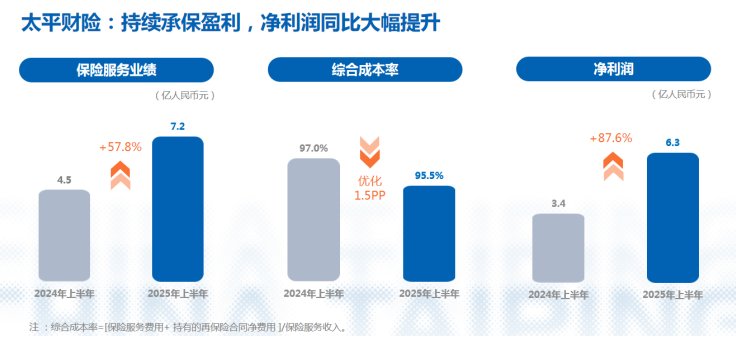
太平财险2025上半年综合成本率优化至95.5% 承保盈利创历史新高 四大核心举措筑牢盈利根基
智通财经网· 2025-08-31 14:55
Core Viewpoint - The company, China Taiping Insurance, reported impressive mid-year results for 2025, with a comprehensive cost ratio of 95.5%, a 1.5 percentage point improvement year-on-year, and a net profit increase of 87.6% to 630 million yuan [1][3] Group 1: Financial Performance - The company's underwriting profit reached a historical high, with insurance service revenue of 15.78 billion yuan, a year-on-year growth of 4.3% [1] - The comprehensive cost ratio of Taiping Insurance was 1.2 percentage points better than the industry average of 96.7% for Q1 2025, which is the lowest in nearly five years [3] - The company achieved a significant increase in customer retention, with a 2.1 percentage point rise in auto insurance renewal rates [8] Group 2: Business Strategy - The company focused on optimizing business quality by controlling risks at the entry point and shifting business structure towards high-yield areas [4][8] - A comprehensive cost management strategy was implemented, resulting in a 1.7 percentage point decrease in the comprehensive expense ratio [8][9] - The company enhanced claims efficiency through technology and mechanisms, achieving a claims ratio that outperformed the industry average by 3.1 percentage points [9] Group 3: Risk Management and Regulatory Compliance - The company maintained an A-level regulatory rating for six consecutive quarters, ensuring a solid compliance foundation for sustained profitability [9] - A focus on risk prevention and management was emphasized, with the implementation of a risk reduction information system and proactive measures against high-risk clients [9][10] Group 4: Future Outlook - For the second half of 2025, the company anticipates opportunities arising from the integration of reporting and operations in both auto and non-auto insurance sectors, aiming to further optimize business structure and maintain underwriting profitability [10]

保险产品预定利率调整进行时:百款产品下架
财联社· 2025-08-31 03:00
Core Viewpoint - The insurance industry is undergoing a significant transition with the adjustment of the guaranteed interest rates for various insurance products, leading to a shift in consumer behavior and product offerings [1][3][4]. Group 1: Product Adjustments and Market Reactions - Many insurance companies are rapidly switching products, with numerous old products being phased out by August 31, leading to a surge in sales activity as agents push for last-minute purchases [1][4]. - The guaranteed interest rates for ordinary and participating insurance products are set to decrease, with ordinary products dropping from 2.5% to 2.0%, and participating products from 2.0% to 1.75% [3][4]. - The adjustment in rates is expected to increase premiums for critical illness insurance, with adult policies rising by approximately 13% and children's policies by up to 29% [3]. Group 2: Consumer Behavior and Sentiment - Consumer sentiment has stabilized despite the frequent adjustments in insurance product rates, with many customers now accustomed to the reality of lower guaranteed rates [6][7]. - Old customers are more likely to increase their coverage during the transition period, while those who were previously hesitant are not likely to make impulsive purchases due to the rate changes [7][8]. - The focus for insurance agents is on existing customers and those who have previously shown interest in purchasing insurance, particularly critical illness coverage [7][8]. Group 3: Industry Trends and Future Outlook - The insurance industry is expected to shift towards more flexible products like participating insurance, which can better adapt to changing market conditions and consumer needs [9][10]. - Companies are encouraged to enhance their product structures and focus on providing stronger protection features rather than relying solely on investment returns [2][10]. - The transition to a lower interest rate environment is seen as a critical turning point for the industry, prompting a move from scale expansion to quality development [8][10].

新华保险(601336):NBV和利润增速超预期 中期DPS增速行业领跑
Xin Lang Cai Jing· 2025-08-30 16:47
Core Viewpoint - Xinhua Insurance reported strong performance in 1H25, exceeding expectations with significant growth in net profit and new business value (NBV) [1][2] Financial Performance - The company achieved a net profit of 14.8 billion yuan, a year-on-year increase of 33.5%, showing a notable acceleration from 19% growth in Q1 2025 [1] - The net asset value stood at 83.4 billion yuan, down 13.3% year-to-date but up 4.5% quarter-on-quarter [2] - The NBV reached 6.18 billion yuan, reflecting a year-on-year growth of 58.4% [1][2] - The company maintained a dividend per share (DPS) of 0.67 yuan, up 24.1% year-on-year, with a dividend payout ratio of 14.1% [1] Premium Growth - The company reported a significant increase in regular premium income, totaling 25.53 billion yuan, a year-on-year rise of 64.9% [2] - Individual insurance and bank insurance channels contributed 14.25 billion yuan and 11 billion yuan respectively, with growth rates of 72.5% and 55.4% [2] Investment Returns - The annualized net, total, and comprehensive investment returns were 3.0%, 5.9%, and 6.3% respectively, with total investment return being the highest among listed insurance companies [1][3] - The company's stock investment scale reached 199.2 billion yuan, up 10.2% year-to-date, with stocks accounting for 11.6% of total investment assets [3] Future Outlook - The company is expected to maintain strong growth in NBV and premium income, with projected net profits of 32.4 billion, 37.1 billion, and 40.5 billion yuan for 2025-2027, reflecting growth rates of 23.7%, 14.5%, and 9.2% respectively [4] - The projected NBV for the same period is 8.15 billion, 9.44 billion, and 10.58 billion yuan, with growth rates of 30.3%, 15.8%, and 11.0% [4]

港险版“报行合一”,能否治理违规卖保险乱象 |银行与保险
清华金融评论· 2025-08-30 10:48
Core Viewpoint - The article highlights the increasing attention on the illegal sale of Hong Kong insurance products, driven by a surge in demand and regulatory changes that have created a "last chance" effect among consumers [2][4][5]. Group 1: Market Trends - The Hong Kong insurance market has seen a significant rise in new single premiums, reaching HKD 93.4 billion in Q1 2025, a 43.1% increase compared to HKD 65.2 billion in the same period of 2024 [2]. - The adjustment of the demonstration interest rate cap for Hong Kong insurance policies has led to a surge in market activity, with many intermediaries promoting high rates as a "last window" opportunity [2][5]. Group 2: Regulatory Issues - There are increasing reports of insurance intermediaries in mainland China engaging in illegal sales of Hong Kong insurance products, which poses legal and financial risks due to regulatory differences between the two regions [4][8]. - The Hong Kong Insurance Authority has implemented new regulations to curb irrational competition in the insurance market, particularly regarding the demonstration interest rates that have deviated from market fundamentals [5][13]. Group 3: Consumer Behavior - The policy changes have created a "last train" effect among consumers, leading to panic buying of insurance products. For instance, a typical policy with a demonstration interest rate drop from 7% to 6.5% could result in a projected income reduction of USD 320,000 over 30 years [5]. - The influx of mainland visitors purchasing insurance in Hong Kong has resulted in new policy premiums of HKD 62.8 billion in 2024, a 6.5% increase year-on-year, indicating a growing trend in cross-border insurance purchases [7][11]. Group 4: Commission Structures - The upcoming "reporting and commission integration" policy will limit the first-year commission for dividend insurance to 70%, with the remaining 30% to be distributed over at least five years, aiming to create a more sustainable commission structure [11][13]. - The disparity in commission rates between agents and brokers has led to market distortions, with brokers often receiving commissions up to 2.5 times higher than agents, exacerbating the issue of commission-driven sales [12][13].

中国人保:适时加大投资力度 增加OCI股票配置
2 1 Shi Ji Jing Ji Bao Dao· 2025-08-29 14:34
Core Viewpoint - China People's Insurance Group Co., Ltd. (China PICC) reported strong financial performance for the first half of 2025, with significant growth in premium income and net profit, indicating a positive outlook for the insurance sector in China [1][2][10]. Financial Performance - In H1 2025, China PICC achieved original insurance premium income of CNY 454.625 billion, a year-on-year increase of 6.4% [1]. - Net profit reached CNY 35.888 billion, reflecting a year-on-year growth of 17.8% [1]. - Total assets amounted to CNY 1.87 trillion, up 6.3% from the beginning of the year [1]. - Investment assets exceeded CNY 1.7 trillion, growing by 7.2% year-to-date, with total investment income of CNY 41.478 billion, a 42.7% increase year-on-year [1][10]. Strategic Focus - The company emphasized three strategic areas: enhancing insurance protection functions, improving development quality, and deepening reforms [2][3]. - Insurance liability amounts reached CNY 178 trillion, with claims payments of CNY 233.5 billion, marking increases of 6.9% and 14% respectively [2]. Business Segments - Non-auto insurance "reporting and execution" policy is expected to be implemented by Q4 2025, which aims to stabilize the market and improve underwriting capabilities [5]. - In the life insurance segment, premium income was CNY 90.513 billion, up 14.5%, with new business value increasing by 71.7% [6]. - Health insurance is projected to grow, driven by rising demand for long-term care and disability insurance due to an aging population [7]. Market Position and Stock Performance - China PICC's stock prices reached record highs, with A-shares at their highest in nearly six years and H-shares at their highest in 13 years [8]. - The company attributes stock price increases to favorable economic conditions, improved development environments, and strong fundamentals [9]. Investment Strategy - The company plans to increase its allocation to high-dividend stocks, particularly in a declining interest rate environment [10]. - Future investments will focus on high-potential targets aligned with national strategic directions, utilizing methods such as private placements and strategic investments [11].
