
失能险

Search documents
商保支付在京破局:十八条新政打通数据壁垒与产业协同
Bei Jing Shang Bao· 2026-02-13 02:04
Core Viewpoint - The release of the "Beijing Commercial Health Insurance Eighteen Measures" aims to enhance the quality and development of commercial health insurance in Beijing, addressing long-standing issues in the industry and promoting data sharing and innovation in insurance products [1][2]. Group 1: Policy Measures - The "Eighteen Measures" include six main areas: strengthening product innovation, deepening collaboration with the pharmaceutical industry, enhancing service capabilities, optimizing settlement models, reinforcing regulatory cooperation, and strengthening organizational support [3]. - The measures encourage the inclusion of elderly and chronic disease patients in insurance coverage, aiming to better meet the health insurance needs of diverse groups [6][7]. Group 2: Data Sharing and Innovation - The establishment of a data-sharing mechanism for medical expenses and health records is a key focus, which is expected to address the lack of actuarial data in product design [2][4]. - The new policy allows for commercial insurance to cover innovative drugs without being restricted by existing regulations, facilitating better access to high-value treatments [4][8]. Group 3: Market Dynamics - The commercial health insurance market is projected to reach CNY 997.3 billion by 2025, with a significant shift towards medical insurance products that cater to innovative drugs, which are expected to see a compound annual growth rate of 70% over four years [5][6]. - The measures aim to break down barriers for high-risk groups, allowing for a broader range of potential insured individuals, including those with pre-existing conditions [6][7]. Group 4: Future Directions - The industry is transitioning towards a "3.0 era," characterized by a balanced product structure and a shift from traditional reimbursement models to value-based insurance that integrates health management services [8][9]. - Insurers are encouraged to leverage data platforms for optimizing actuarial models and to develop innovative insurance products targeting specific health conditions, enhancing user engagement and risk management capabilities [9].
万亿元门槛前的健康险
Sou Hu Cai Jing· 2026-02-04 02:18
Core Insights - The health insurance sector in China achieved a premium income of 997.3 billion yuan in 2025, falling short of the anticipated trillion yuan milestone, indicating a significant challenge for the industry in terms of growth and transformation [1][2] - The slowdown in growth is primarily attributed to the declining sales of critical illness insurance, which has historically been the main driver of health insurance growth, while medical insurance is now taking the lead [2][5] Group 1: Premium Income and Growth Trends - In 2025, the health insurance premium income reached 997.3 billion yuan, a mere 2% increase from the previous year, significantly lower than the 8% growth in 2024 [2] - The health insurance market's growth is far from the target set by the former China Banking and Insurance Regulatory Commission, which aimed for a market size exceeding 2 trillion yuan by 2025 [2] Group 2: Challenges in Critical Illness Insurance - The primary reason for the stagnation in critical illness insurance sales is attributed to rising premiums and decreasing coverage, leading to reduced consumer interest [3][4] - The complexity of product design has increased costs for insurance companies, as critical illness insurance now covers a wider range of conditions, raising the average premium [3] Group 3: Medical Insurance as a Growth Driver - Medical insurance is expected to maintain a high growth rate, driven by innovations in payment methods and the introduction of new insurance products [5][6] - The commercial health insurance sector is projected to see a total payout of 14.7 billion yuan for innovative drugs and devices by 2025, reflecting a compound annual growth rate of 70% [5] Group 4: Future Directions and Market Competition - The competition in the health insurance market is shifting towards the integration of medical resources and health service ecosystems, moving beyond just pricing and policy terms [7][8] - The upcoming regulatory frameworks and guidelines are expected to guide the industry towards high-quality development and the creation of differentiated products tailored to various consumer needs [7][8]
万亿元门槛前的健康险:“一冷一热”背后 价值坐标重塑
Zhong Guo Zheng Quan Bao· 2026-02-03 20:27
Core Insights - The health insurance sector fell short of the long-anticipated "trillion yuan premium" milestone in 2025, achieving a total premium income of 997.3 billion yuan, just shy of the target [1] - The growth rate of health insurance premiums has slowed significantly, with a mere 2% increase in 2025 compared to 8% in 2024, indicating a shift in the growth dynamics of the insurance industry [1][2] - The decline in the sales of critical illness insurance, which has historically been a major driver of growth, has led to a stagnation in the overall health insurance market [2][3] Premium Growth and Market Dynamics - In 2023, health insurance premiums surpassed 900 billion yuan, reaching 903.5 billion yuan, and increased to 977.4 billion yuan in 2024, but the growth has significantly decelerated in 2025 [1] - The primary reason for the slowdown is attributed to the declining sales of critical illness insurance, which has seen stagnant or even shrinking premium scales, adversely affecting the overall market growth [2] - Rising premiums and decreasing coverage for the same premium amount have led consumers to forgo purchasing critical illness insurance [2] Shift to Medical Insurance - As critical illness insurance growth stagnates, medical insurance is expected to take the lead in the health insurance sector, with anticipated high growth rates driven by innovations in payment methods and product offerings [3][4] - The current trend in medical insurance is evolving from standard hospitalization coverage to more comprehensive plans that include outpatient services, special needs, and health management [3] - The commercial health insurance sector is projected to see a total payout of 14.7 billion yuan for innovative drugs and devices by 2025, reflecting a compound annual growth rate of 70% [3] Future Growth Engines - The aging population and the associated risks of "longevity but disability" are expected to drive the growth of nursing insurance, which is shifting from savings-type to protection-type products [4] - Industry experts emphasize the need for continuous innovation to address specific consumer needs, with medical and nursing insurance becoming key growth drivers [4][5] - The competitive landscape is shifting towards not just pricing and policy terms but also the integration of medical resources and health service ecosystems [4][5] Strategic Directions - The health insurance sector is moving towards a model where a competitive policy is not just a contract but a comprehensive health solution that includes various services and benefits [4][5] - The upcoming regulatory frameworks, such as the "Guiding Opinions on Promoting High-Quality Development of Health Insurance," are expected to provide new directions for specialized development in the industry [5] - Companies are encouraged to develop differentiated products tailored to various demographics and scenarios, enhancing collaboration with medical institutions to create a holistic health management service [5][6]
近万亿规模!这一险种迎来突破口
Zhong Guo Zheng Quan Bao· 2026-02-03 15:02
Core Insights - The health insurance sector is experiencing significant growth, with medical insurance emerging as a new growth engine, while critical illness insurance is facing stagnation [1][4][5] - In 2025, the cumulative premium income for health insurance from life and property insurance companies is projected to reach 997.3 billion yuan, nearing the one trillion yuan mark [3] Group 1: Market Trends - Health insurance premium income surpassed 900 billion yuan in 2023, reaching 903.5 billion yuan, and increased to 977.4 billion yuan in 2024, showing an 8% growth [3] - The growth rate for health insurance premiums slowed to 2% in 2025, indicating a shift in market dynamics [3] Group 2: Product Dynamics - The internal structure of health insurance is changing, with critical illness insurance losing its dominant position as medical insurance gains traction [4][5] - Medical insurance is expected to maintain a high growth rate, driven by innovations in product offerings and reforms in payment methods [5] Group 3: Competitive Landscape - Future competition in the health insurance market will focus on the integration of medical resources, the construction of health service ecosystems, and the application of technology [7] - A competitive health insurance policy should encompass comprehensive health solutions, including specialized coverage, convenient medical services, and access to quality medications [7][8] Group 4: Strategic Recommendations - Insurance companies are encouraged to develop differentiated products for various demographics and scenarios, such as elderly care insurance and specific disease insurance [8] - There is a need for collaboration with medical institutions to establish a comprehensive health management service system, providing clients with preventive care, health consultations, and rehabilitation services [8]
中国人寿:以保障之力护民生安康 深耕健康保险高质量发展新路径
Zhong Guo Xin Wen Wang· 2026-01-28 06:53
Core Viewpoint - The article emphasizes the ongoing development of China's multi-level medical security system during the "14th Five-Year Plan" period, highlighting the expanding role of commercial health insurance in meeting public health needs and enhancing service quality [1][2]. Group 1: Health Insurance Development - Since the "14th Five-Year Plan," the company has established a collaborative health insurance development framework, including medical insurance, nursing insurance, disability insurance, and critical illness insurance, launching over 350 health insurance products [2]. - The company has extended coverage to non-healthy populations and chronic disease groups, focusing on expanding coverage for the elderly, children, and newlyweds, ensuring comprehensive protection [2]. - A tiered medical insurance matrix has been formed, including inclusive medical, million medical, mid-range medical, and high-end medical insurance, catering to diverse protection needs [2]. Group 2: Service Innovation - The company has innovated a "health insurance + health management" service model, providing a full range of services including health consultation, medical assistance, health promotion, and rehabilitation care [3]. - By 2025, the company aims for health insurance claims to exceed 78.8 billion yuan, with a focus on improving claims efficiency and customer service through digital transformation [3]. - The introduction of a "critical illness one-day claim" green channel ensures that eligible claims are processed on the same day, with over 1.06 billion yuan in claims serviced for 234,000 customers by 2025 [3]. Group 3: Future Outlook - Looking ahead to the "15th Five-Year Plan," the company plans to focus on enhancing the multi-level medical security system, emphasizing the supplementary role of commercial insurance and implementing health-first development strategies [4]. - The company aims to enrich product offerings, enhance service experiences, and strengthen digital operations and risk management capabilities to provide warmer health insurance services [4]. - The company remains committed to the principle of "insurance for the people," responding to industry development challenges and public health expectations, contributing to the health of the nation [4].

万亿商业健康险结构重置究竟多“逆天”?财险公司医疗险暴涨11%,重疾险承压难见“第二波繁荣”
Sou Hu Cai Jing· 2026-01-14 16:18
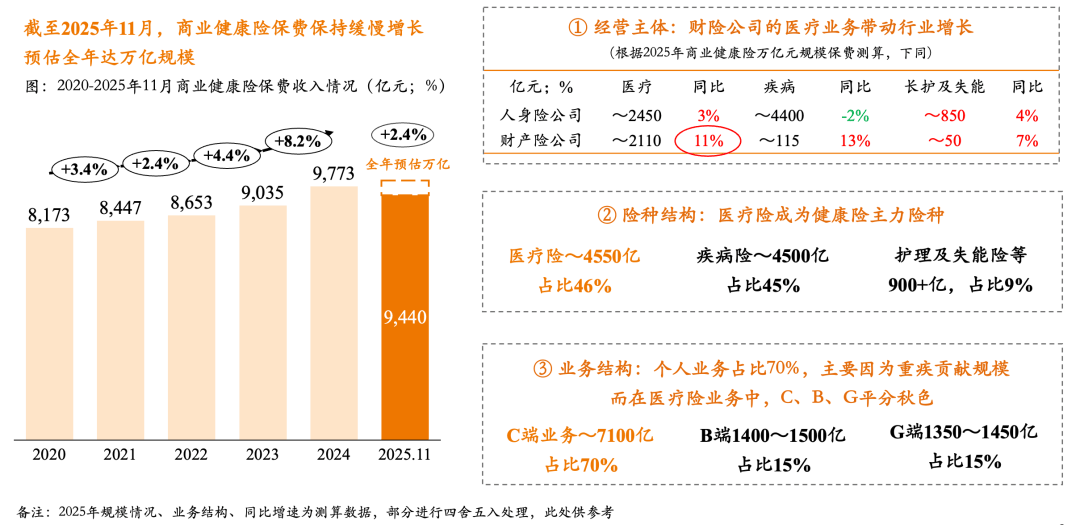
Core Insights - The Chinese commercial health insurance market is at a crossroads, experiencing both low premium growth and high demand driven by policy support [1][2][3] Group 1: Market Overview - As of November 2025, the commercial health insurance premium reached 944 billion yuan, with a year-on-year growth of 2.39%, marking the lowest growth rate in five years [8] - The medical insurance segment continues to dominate, accounting for approximately 46% of the total premiums, with a growth rate of nearly 7% [8] - The industry is expected to surpass the trillion yuan mark in total premiums for the first time in 2025, despite the low growth rate [8] Group 2: Product and Business Types - Medical insurance remains the primary growth driver, while long-term care and disability insurance are experiencing stable growth [9] - The C-end (individual) business dominates the market, accounting for nearly 70% of the total, while B-end (enterprise) and G-end (government) businesses make up about 14% to 16% [12] - The online health insurance market is growing rapidly, with a scale of 77 billion yuan and a year-on-year growth rate of approximately 16% as of September 2025 [12] Group 3: Regulatory Environment - 2025 is a significant year for policy releases aimed at promoting commercial health insurance, with multiple departments introducing various supportive measures [17] - Key policy documents include the "Guiding Opinions on Promoting High-Quality Development of Health Insurance," which emphasizes the need for collaboration between group and individual insurance [17][18] - The establishment of a long-term care insurance system is set to be fully implemented, with expectations for the national long-term care fund to exceed 250 billion yuan in revenue over the next five years [19] Group 4: Growth Drivers - The demand for high-quality medical services is expected to rise, driven by the aging population and increasing healthcare costs [16] - Medical and long-term care insurance are identified as the main growth points, with a focus on product innovation and service integration [20][21] - The trend of "payment + service" integration is accelerating, with hospitals increasingly embracing commercial insurance [33] Group 5: Technological Impact - AI is reshaping industry efficiency, with significant developments in health management applications that enhance user engagement and data collection [35][36] - The integration of electronic health records and AI-driven solutions is seen as a key factor in improving healthcare delivery and insurance services [35][36] Group 6: Future Outlook - The health insurance market is expected to navigate uncertainties while anchoring on five key growth points, including the demand for high-quality medical services and the integration of health payment and services [37]

复杂经济金融形势下保险资产负债管理与逆周期调节研究
Sou Hu Cai Jing· 2026-01-13 07:51
Core Viewpoint - The article discusses the significant challenges and changes faced by the Chinese insurance industry due to complex economic and financial conditions, emphasizing the need for improved asset-liability management and regulatory measures to ensure sustainable development [2][20]. Economic and Financial Context - The current global and domestic economic landscape is marked by geopolitical conflicts, trade wars, and macroeconomic policy adjustments, leading to increased financial pressure on China [2]. - Internal factors such as population aging, declining capital formation, and rising debt levels contribute to a downward trend in potential economic growth [2]. - The insurance industry faces challenges including insufficient effective demand, rising debt risks, and deflationary pressures, exacerbated by the impacts of the pandemic and real estate adjustments [2][6]. Asset-Liability Management Issues - There is a widespread recognition among Chinese insurance institutions of the importance of asset-liability management, which involves managing interest rate, credit, and liquidity risks [3]. - The industry has historically struggled with duration mismatches between assets and liabilities, leading to significant potential interest rate risk [3][8]. - Recent regulatory measures have aimed to enhance the standardization and professionalism of asset-liability management within the insurance sector [3][5]. Current Challenges and Future Directions - The insurance industry is experiencing intensified competition, with some companies adopting aggressive asset-driven liability strategies, which have led to increased risks [8]. - The need for a clear definition of leading insurance products is highlighted, with a focus on developing pension annuities and health insurance to better match liabilities [8][20]. - The article suggests that improving asset-liability management could involve increasing the proportion of floating return products and diversifying fixed-income asset investments [9][20]. Empirical Analysis of Asset-Liability Management - The analysis indicates that the insurance industry exhibits pro-cyclical behavior, with net asset growth rates closely tied to economic growth rates and financial cycles [10][12]. - The study found that higher leverage in insurance companies correlates with lower net asset growth rates, particularly in life insurance companies [12][13]. - The impact of interest rates on the development of the insurance industry is significant, with life insurance companies being more sensitive to financial cycles compared to property insurance companies [13][14]. Policy Recommendations - The article recommends that national policies should focus on enhancing fiscal support for the economy and adjusting government debt durations to improve the insurance industry's resilience [20][22]. - Insurance institutions are encouraged to develop more protection-oriented products to reduce reliance on interest rate spreads and enhance asset-liability linkage [20][22]. - Regulatory measures should include dynamic adjustments of guaranteed interest rates in line with market rates and increased support for capital replenishment to maintain solvency [20][22].
170亿“险资航母”入鲁,山东上演寿险“三国杀”
Jin Rong Jie· 2025-12-17 02:58
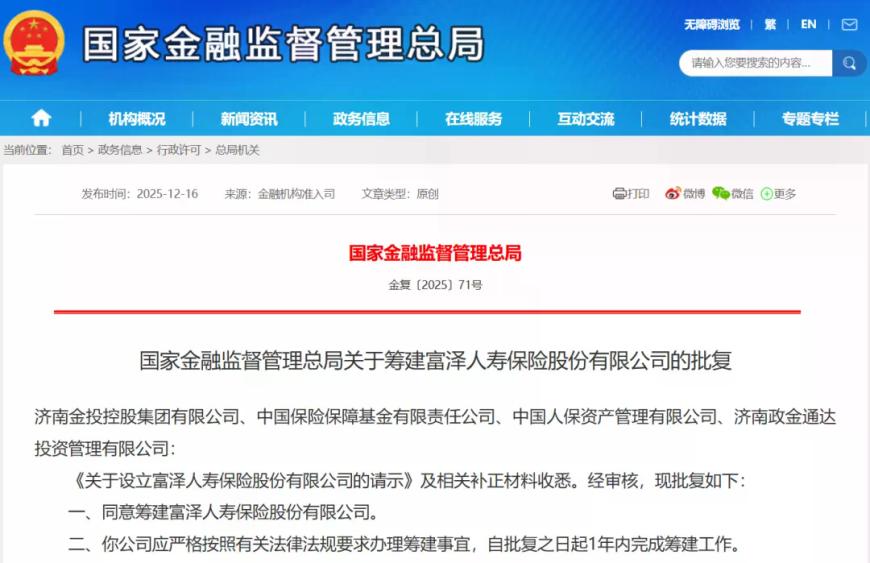
Core Viewpoint - The establishment of Fuzhou Life Insurance, with a registered capital of 17 billion yuan, marks a significant development in China's insurance industry, particularly in risk disposal mechanisms, as it takes over the troubled business of Jun Kang Life Insurance [1][3][4]. Group 1: Company Formation and Structure - Fuzhou Life Insurance was approved for establishment by the National Financial Supervision and Administration on December 16, 2025, and is based in Jinan [1]. - The company is structured with a shareholder composition of 53.24% from local state-owned assets, 35.29% from the China Insurance Security Fund, and 11.47% from People’s Insurance Asset Management [6]. - This structure aims to balance risk disposal with local financial stability, leveraging the strengths of state-owned enterprises and professional insurance management [6]. Group 2: Risk Disposal Mechanism - The creation of Fuzhou Life Insurance is a key practice in the risk disposal mechanism of the Chinese insurance industry, following the model of new entities taking over existing risks [3][7]. - The company is required to fulfill all existing insurance contract obligations from Jun Kang Life Insurance, ensuring consumer rights are protected during the transition [7]. Group 3: Market Position and Competition - With a registered capital of 17 billion yuan, Fuzhou Life Insurance ranks among the top ten in the life insurance industry, significantly surpassing local competitors like Dehua Angu Life Insurance and Hetai Life Insurance [15][16]. - The entry of Fuzhou Life Insurance shifts the competitive landscape in Shandong from a binary competition to a triadic structure, enhancing local market dynamics [15][17]. Group 4: Business Strategy and Channels - Fuzhou Life Insurance focuses on a dual-channel strategy of "bank insurance + group insurance," leveraging local resources and government projects to enhance its market presence [19]. - The company has already received approval for multiple provincial branches and service centers, establishing a nationwide service network [8]. Group 5: Management and Expertise - The management team of Fuzhou Life Insurance emphasizes both market-oriented and professional expertise, with leadership experienced in regional financial ecosystems and insurance management [9][13]. - This approach aims to enhance operational efficiency and decision-making capabilities compared to previous risk disposal entities [13]. Group 6: Future Challenges and Opportunities - Fuzhou Life Insurance faces the immediate challenge of smoothly transitioning the existing business of Jun Kang Life Insurance, which includes nearly 200,000 clients [23]. - Long-term success will depend on building a differentiated competitive advantage in a market characterized by intense competition and asset allocation pressures [23].
水滴公司2024年ESG报告:持续关注保险创新与普惠 带病体保险理赔超3800万
2 1 Shi Ji Jing Ji Bao Dao· 2025-09-25 09:40
Core Insights - Waterdrop Inc. released its 2024 ESG report, showcasing its achievements in governance, technology innovation, product responsibility, talent development, environmental protection, and sustainable ecology, maintaining an A rating in the industry [1] Group 1: Technology Innovation - The company has focused on AI technology innovation, with over 100 AI-related patents and an annual R&D investment of 217 million yuan [1] - The "Waterdrop Water Guardian Model" provides professional and understandable advice for insurance agents and users, capable of natural dialogue for up to 50 minutes and covering over 10,000 medical insurance-related questions [2] - In 2024, the company launched 174 inclusive insurance products, addressing the differentiated needs of elderly, sick, and female groups [2] Group 2: Social Responsibility - Waterdrop has actively participated in building a multi-level medical security system, raising over 67.5 billion yuan in donations to assist 3.4 million patients with severe illnesses [3] - The company has established 30 rural clinics in 2024, benefiting over 500,000 individuals, and has built a comprehensive service system covering insurance protection, severe illness assistance, and medical innovation [4] - The report disclosed greenhouse gas emissions data, showing a reduction of 33.32% in the company's operational emissions to 402.22 tons of CO2 equivalent [4] Group 3: Recognition and Validation - Experts have praised the ESG report for its rich content and detailed data, highlighting the integration of sustainable business strategy and social responsibility [5]

水滴公司2024年ESG报告:持续深化AI技术创新 全年打造保险普惠产品174款
Sou Hu Cai Jing· 2025-09-25 06:48
Core Insights - Waterdrop Inc. released its 2024 ESG report, showcasing its achievements in governance, technology innovation, product responsibility, talent development, environmental protection, and sustainable ecology, maintaining an A rating in the industry [1] Group 1: Technology Innovation - Waterdrop has focused on AI technology innovation, with over 100 AI-related patents and an annual R&D investment of 217 million yuan [1] - The "Waterdrop Water Guardian Model" provides professional and understandable advice for insurance brokers and users, capable of natural dialogue for up to 50 minutes and covering over 10,000 medical insurance-related questions [2] Group 2: Social Responsibility - Waterdrop has actively participated in building a multi-level medical security system, raising over 67.5 billion yuan in donations to assist 3.4 million patients with severe illnesses [3] - The company has constructed 30 rural clinics in 2024, benefiting over 500,000 individuals, and has developed a comprehensive service system covering insurance protection, severe illness assistance, and medical innovation [4] Group 3: Environmental Impact - The report disclosed greenhouse gas emissions and waste management data, with the company's operational emissions at 402.22 tons of CO2 equivalent, a 33.32% decrease year-on-year [4] - The report emphasizes the integration of sustainable business strategies with social responsibility, highlighting efforts in technology innovation and ecosystem development [5]