普惠金融

Search documents
【智库圆桌】深耕普惠金融促发展惠民生
Xin Lang Cai Jing· 2026-01-25 00:45
Core Viewpoint - The development of inclusive finance in China reflects a people-centered approach, emphasizing the importance of financial services for all social strata, particularly small and micro enterprises, to promote social equity and inclusive growth [2][3]. Group 1: Importance and Achievements of Inclusive Finance - Inclusive finance is defined as providing appropriate and effective financial services at affordable costs to all social groups, focusing on equal opportunities and commercial sustainability [2]. - Since the concept was introduced by the UN in 2005, China has made significant progress in inclusive finance, with policies established since 2013 to support its development [2][3]. - The 2023 State Council's implementation opinions highlight the need for high-quality development of inclusive finance to promote common prosperity for all [2]. Group 2: Support for Micro and Small Enterprises - Inclusive finance is crucial for enhancing the vitality of micro and small enterprises, which play a vital role in stabilizing employment and promoting innovation [3]. - Challenges such as high financing costs and difficulties in obtaining subsidies persist for these enterprises, necessitating improved financial services [3][4]. - Financial institutions are innovating products and services tailored to the unique needs of small enterprises, leading to increased loan volumes and reduced costs [5]. Group 3: Policy and Service System Development - China has established a comprehensive policy and service system for inclusive finance, significantly improving service coverage, accessibility, and satisfaction [4]. - By the end of 2024, there will be an average of 1.62 bank outlets per 10,000 people, with nearly 98% coverage in rural areas [4]. - The development of digital financial services has led to a substantial increase in mobile payment transactions in rural areas, reaching 339.33 billion transactions in 2024, a 33.03% increase year-on-year [4]. Group 4: Technological Empowerment - The integration of advanced technologies such as big data and artificial intelligence is transforming the operational model of inclusive finance, addressing challenges of high costs and risks [6]. - Digital banks are innovating lending models that significantly enhance loan application efficiency, such as the "310" model, which allows for quick loan processing [6]. Group 5: Reform Pilot Zones and Innovations - Various pilot zones for inclusive finance reform have been established, focusing on different regional needs and challenges, such as supporting rural revitalization and small enterprises [7][8]. - Innovations in credit information sharing and risk-sharing mechanisms have been implemented to enhance financial support for rural areas and small businesses [8][9]. Group 6: Enhancing Financial Services for Vulnerable Groups - Inclusive finance targets five key groups: micro enterprises, agricultural workers, new urban residents, the elderly, and flexible employment individuals, each facing unique financial challenges [12]. - Efforts are being made to improve the quality of financial services in the livelihood sector, ensuring that financial products are better suited to the needs of these groups [12][13]. Group 7: Future Directions and Recommendations - Continued emphasis on policy coordination and incentive mechanisms is necessary to support financial resources in underserved areas [15]. - The development of a national integrated financing credit service platform is recommended to enhance data sharing and improve financial service delivery [15]. - Financial institutions are encouraged to innovate products that cater to the specific cash flow characteristics of small enterprises and flexible employment [15].
于涛:持续提升民生领域金融服务质量
Xin Lang Cai Jing· 2026-01-25 00:45
Core Viewpoint - Improving the quality of financial services in the livelihood sector is a key task for promoting structural reforms in financial supply and achieving common prosperity, reflecting the political and people-oriented nature of financial work [1] Group 1: Target Groups for Inclusive Finance - The main groups served by inclusive finance include small and micro enterprises, agricultural workers, new urban residents, the elderly, and flexible employment individuals, each facing unique financial challenges [1] - Small and micro enterprises require short-term, small-scale, frequent, and urgent financing, which traditional financial services often fail to cover [1] - Agricultural workers often lack qualified collateral and face long production cycles and significant natural risks [1] - New urban residents have limited credit information and require enhanced comprehensive financial services [1] - The elderly have diverse needs for wealth preservation, medical payments, and property inheritance, while facing challenges such as the digital divide [1] - Flexible employment individuals experience significant income volatility and need adaptable insurance and credit support [1] Group 2: Progress in Inclusive Finance - Since the 18th National Congress of the Communist Party, significant progress has been made in the development of inclusive finance in China, with improvements in service coverage, accessibility, and satisfaction [1] - Local initiatives have successfully integrated inclusive financial services with the production and living scenarios of key groups [1] Group 3: Strategies for Enhancing Financial Services - Establishing an online and offline linked rural financial service system can effectively extend service reach and improve efficiency, as demonstrated by the "Yunong Tong" service points [2] - Utilizing digital technology can assist small and micro enterprises by creating a digital product matrix and optimizing risk control, as seen with the "Dayan System" identifying over 21 million small enterprises [2] - Developing a credit transformation mechanism tailored to local conditions can help improve the rural credit environment and facilitate financial access for farmers [3] Group 4: Future Directions and Challenges - There are challenges in balancing profitability and sustainability in inclusive finance, as well as the need for improved precision and adaptability of financial products and services [3] - Future efforts should focus on enhancing the quality of financial services from mere availability to effectiveness, ensuring that development benefits the people [3] Group 5: Policy Recommendations - Strengthening policy coordination and incentive mechanisms is essential for supporting financially underserved regions and groups [4] - Promoting data sharing and technological empowerment can enhance the development of embedded financial products [4] - Encouraging product innovation and precise management in various consumption scenarios can better meet the needs of flexible employment and small enterprises [5] - Building a comprehensive financial service capability and consumer rights protection system is crucial for safeguarding consumer interests and ensuring financial stability [5]
李学峰:深入推进普惠金融改革试验区建设
Xin Lang Cai Jing· 2026-01-25 00:45
Core Viewpoint - Inclusive finance is crucial for supporting the sustainable development of small and micro enterprises and effectively implementing rural revitalization in China [1] Group 1: Development of Inclusive Finance Pilot Zones - The People's Bank of China initiated the construction of inclusive finance reform pilot zones in 2016, with Lankao County in Henan Province being the first [1] - Multiple pilot zones have been approved, focusing on different regional characteristics, such as traditional agricultural areas, private economy support, and poverty alleviation in revolutionary old areas [1] Group 2: Mechanism Innovation and Risk Sharing - Pilot zones have achieved significant results by innovating mechanisms, such as establishing a multi-level risk-sharing and credit enhancement system [2] - In Ganzhou City, a "whole village guarantee" financing model was created to encourage banks to increase credit support for rural revitalization, integrating government risk compensation and bank credit resources [2] Group 3: Industry-Specific Financial Services - Pilot zones are innovating financial service models that align with local industry characteristics, such as the development of agricultural supply chain finance in Linyi City [2] - Specific financial products like "breeding loans" and "Yimeng food development loans" have been introduced to support local agricultural industries, with loan amounts up to 10 million yuan and terms up to 10 years [2] Group 4: Digital Empowerment in Financial Services - Digital technologies are being utilized to enhance the efficiency and accessibility of inclusive financial services in rural areas [3] - The Tianfu Credit Platform, guided by the People's Bank of China, integrates various agricultural data to support credit cultivation and financing for agricultural entities [3] Group 5: Green Finance Integration - Pilot zones are promoting the integration of green finance with inclusive finance to support the green transformation of small and micro enterprises [3] - Initiatives in Jiangxi Province include the establishment of a green inclusive finance mechanism and the introduction of various green credit products to promote sustainable practices [3] Group 6: Collaborative Governance and Modernization - Pilot zones emphasize policy guidance and collaborative governance to enhance the business environment and infrastructure [4] - Initiatives in Ganzhou City involve collaboration between local banks and community organizations to embed financial services into grassroots governance [4] Group 7: Future Directions and Replication - The results of these pilot zones are regionally specific, and there is a need to transform local experiences into widely applicable models [4][5] - The government aims to further promote inclusive finance practices in rural and underdeveloped areas, ensuring the continuity of poverty alleviation and rural revitalization efforts [5]
罗煜:普惠金融是激发微观主体活力的重要支撑
Xin Lang Cai Jing· 2026-01-25 00:45
Core Viewpoint - Inclusive finance is essential for promoting social equity and sustainable growth, particularly for small and micro enterprises and low-income urban populations, as emphasized by China's government policies and frameworks since 2013 [1][2][3] Group 1: Policy Framework and Development - China has established a comprehensive policy framework for inclusive finance, enhancing the willingness and capability of financial institutions to serve small and micro enterprises and rural areas [3][4] - The implementation of the "National Financing Guarantee Fund" and a multi-level risk-sharing system has improved financial support for small and micro enterprises and agriculture [3] Group 2: Financial Service Accessibility - By the end of 2024, there will be an average of 1.62 bank outlets per 10,000 people, with nearly 98% coverage of township bank outlets and 100% coverage of insurance services in rural areas [3][4] - The mobile payment transaction volume in rural areas reached 33.933 billion, marking a 33.03% year-on-year increase, indicating a significant advancement in digital financial services [3] Group 3: Service Innovation and Technology Integration - Financial institutions are innovating products and services tailored to the characteristics of small and micro enterprises, such as flexible loan repayment options and supply chain financing [4][5] - The integration of advanced technologies like big data, AI, and blockchain is enhancing the efficiency and effectiveness of inclusive finance, exemplified by the "310" loan model that allows for rapid loan processing [5]
保山:2025年储蓄国债销量破亿元
Xin Lang Cai Jing· 2026-01-24 14:29
2025年,人民银行保山市分行组织完成储蓄国债发行凭证式8期、电子式8期,推动辖内国债销量实现跨 越式增长。截至12月底,保山市全年总销量达1.07亿元,同比增长21.06%,创历史新高。 保山市严格贯彻落实各项国债工作部署,制定《保山市中心支库2025年国债下乡工作方案》,建立以农 业银行、邮储银行为重点,工行、中行、建行、交行、浦发银行协同参与的发行网络,依托全市120个 承销网点,持续优化"网点+乡村服务站"立体布局。 2025年,保山市辖内共有77个乡镇国债销售网点,其中,48个网点成功售出国债,占比达到62.34%, 较上年增加29个网点,国债销售覆盖面大幅提高。 云南网记者 李建国 通讯员 张妍 保山市依托乡镇、社区、街道等组织开展国债知识讲座和培训活动,增强群众对国债的认知度,促进信 息透明,为销售工作奠定基础,助力业务流程规范化、标准化建设。充分发挥"国债下乡标准服务站"的 带动作用,集成宣传讲解、意向登记、专人对接等功能,提供一站式服务,切实保障居民"愿买能买"。 2025年,保山市储蓄国债乡镇销量超2500万元,占比突破20%。 为推动普惠金融"进万家",保山市依托各网点开展常态化宣传,通 ...
兴业银行合肥政务区支行焕新启航 打造金融服务新标杆
Zhong Guo Jin Rong Xin Xi Wang· 2026-01-24 08:04
转自:新华财经 2026年1月22日,兴业银行合肥政务区支行以全面升级的3.0版本网点形象正式亮相。新网点围绕"便民、智能、温馨"三大核心,通过科学规 划与功能融合,致力于为客户提供更优质、便捷、贴心的金融服务。 焕新后的网点布局清晰、动线流畅,设有接待服务区、现金业务区、对公业务区、理财咨询区、金融培训区及休息洽谈区等多个专业区域, 在提升业务办理效率的同时,进一步优化了客户体验。 开业当日,兴业银行合肥分行党委书记、行长王惠斌实地察看了政务区支行网点功能布局、智能设备运行及服务流程,详细了解首日运营情 况。他对政务区支行在网点转型与服务提升方面取得的成效表示肯定,并指出新网点应立足区域特点,发挥示范作用,重点推进以下工作: 一是聚焦科技型中小企业与民生消费,深化普惠金融服务;二是依托智能平台,优化服务流程,推动线上线下协同;三是加强团队建设,打 造专业强、服务暖的人才队伍,持续提升客户满意度与品牌影响力。 以此次升级为起点,兴业银行合肥政务区支行将继续扎根区域、服务地方,围绕客户需求,丰富产品体系,优化服务体验,积极履行社会责 任,努力成为市民与企业身边可信赖的金融伙伴。(江海燕) 编辑:胡晨曦 ...



中国银行业理财市场年度报告(2025年)
银行业理财登记托管中心· 2026-01-24 02:10
Investment Rating - The report does not explicitly provide an investment rating for the industry Core Insights - The banking wealth management market in China reached a total scale of 33.29 trillion yuan by the end of 2025, reflecting an 11.15% increase from the beginning of the year, with 3.34 million new wealth management products issued, raising 76.33 trillion yuan in funds [6][20] - The report emphasizes the importance of the wealth management industry in supporting the real economy, with approximately 21 trillion yuan allocated to support various sectors [6] - The number of investors holding wealth management products reached 143 million, a growth of 14.37% year-on-year, generating returns of 730.3 billion yuan for investors throughout the year [6] Summary by Sections Development Environment of the Wealth Management Industry - The report highlights the complex changes in the development environment, including global geopolitical tensions and domestic economic challenges, while emphasizing the resilience and potential of China's economy [8] - The "14th Five-Year Plan" and the upcoming "15th Five-Year Plan" outline the strategic direction for the financial sector, focusing on technology finance, green finance, inclusive finance, pension finance, and digital finance [8][9] Wealth Management Products - By the end of 2025, the total number of wealth management products in the market was 46,300, with a total scale of 33.29 trillion yuan, marking a 14.89% increase in the number of products [21][24] - The report indicates a shift from single-asset driven strategies to multi-asset allocation, with a focus on risk management and dynamic adjustments to enhance portfolio resilience [26][27] - Fixed income products dominate the market, accounting for 97.09% of the total scale, while mixed and equity products remain relatively small [32][33] Investor Profile - The report notes that the wealth management industry has seen a significant increase in the number of investors, with a focus on enhancing investor protection and appropriate management of wealth management products [19][40] - The risk management framework is emphasized, with a focus on compliance and transparency to safeguard investor interests [14][16] Market Institutions and Services - The report discusses the establishment of various wealth management companies and the importance of digital financial services, including the use of AI and big data in wealth management [10][12] - It highlights the role of wealth management companies in supporting the pension finance sector and the ongoing development of a centralized data exchange platform for wealth management products [7][12]
深耕债券市场沃土 浇灌实体经济之花
Zhong Guo Zheng Quan Bao· 2026-01-23 21:02
Group 1: Core Insights - The bond market in China is experiencing significant growth, with an average annual compound growth rate of 8.46% from 2021 to 2025, and a projected market size increase of 70.61% by the end of 2025 compared to 2020 [2][3] - Financial institutions, particularly state-owned enterprises like Caixin Securities, are committed to supporting national strategies and local economic development through innovative bond financing [4][5] Group 2: Market Structure Changes - The proportion of interest rate bonds has increased to 70.03% by the end of 2025, up by 7.64 percentage points from 2020, highlighting their role as a stabilizing force in the capital market [3] - The credit bond market is undergoing a transformation, with a shift away from high-leverage real estate financing towards new credit bond varieties that support emerging economic drivers, such as technology innovation [3][4] Group 3: Innovations in Bond Issuance - Caixin Securities has issued nearly 300 billion yuan in bonds during the "14th Five-Year Plan" period, ranking 23rd in the market for company bonds [5] - The company has been a leader in green finance, issuing nine green low-carbon transition bonds totaling over 2 billion yuan, including the first rural revitalization low-carbon transition bond in China [6] Group 4: Risk Management and Compliance - The company emphasizes a robust risk management framework, achieving an A-class rating for bond business quality from the China Securities Association for six consecutive years [7] - A comprehensive internal control system is in place to manage risks throughout the entire bond issuance process, from project initiation to ongoing management [8] Group 5: Future Development Strategies - The company plans to focus on high-growth technology innovation enterprises and major R&D projects, aiming for significant growth in technology bond issuance during the "15th Five-Year Plan" [8][9] - There is a commitment to enhancing digital capabilities and expanding service stations to improve financing services and better meet local economic needs [8][9]
以金融高质量发展助力“十五五”规划实施
Xin Lang Cai Jing· 2026-01-23 20:58
Core Viewpoint - The financial industry in China has made significant progress during the "14th Five-Year Plan" period, enhancing its comprehensive strength and improving the quality and efficiency of services to the real economy, while also strengthening risk prevention capabilities [1][6]. Group 1: Financial Development Principles - The "Six Persistences" principle outlined by the 20th National Congress of the Communist Party of China emphasizes the importance of the Party's leadership in financial reform and development [2]. - Financial services should prioritize the people's interests, focusing on high-quality development and supporting the optimization of economic structures [2]. - A combination of effective markets and proactive government is essential for achieving a well-functioning financial system that supports economic growth while managing risks [2]. Group 2: Financial System and Innovation - The financial system, primarily dominated by banks, must adapt to support technological innovation and the development of new productive forces, providing comprehensive financial services throughout the lifecycle of technology enterprises [3][4]. - Banks are encouraged to innovate their services to support technology and emerging industries, ensuring they provide comprehensive financial services tailored to different stages of enterprise development [4]. Group 3: Domestic Market and Consumption - Strengthening the domestic market is crucial for China's modernization, with a focus on expanding domestic demand and improving living standards [5]. - Financial institutions should enhance their support for small and micro enterprises and low-income groups through inclusive finance, thereby stimulating consumption and economic growth [5]. - Optimizing the consumer credit system is necessary to promote consumption while managing risks associated with excessive debt [5]. Group 4: Strategic Importance of Finance - The "15th Five-Year Plan" period is a critical time for China to advance towards a modern socialist state, with the financial sector playing a vital role in supporting national strategies and the real economy [6]. - The financial industry must maintain a commitment to high-quality development and structural reforms to enhance resource allocation and service efficiency [6].
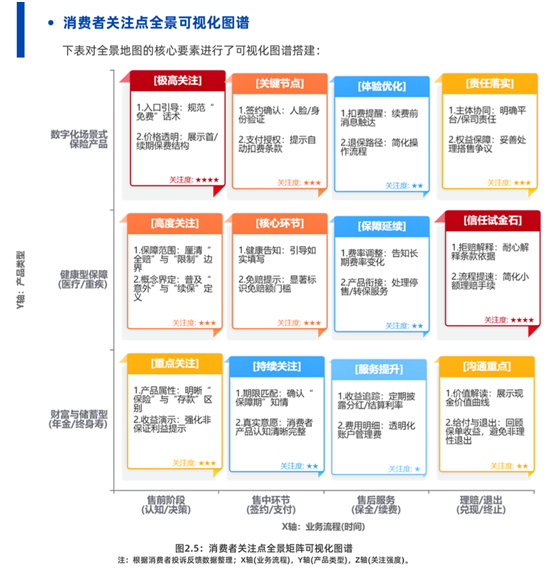
《2025保险数字信任蓝皮书》:“消费者关注点全景地图”发布,蚂蚁保等入选优秀行业案例
Zhong Guo Xin Wen Wang· 2026-01-23 14:50
Core Insights - The "2025 Insurance Digital Trust Blue Book" released by Fudan University highlights the importance of consumer rights protection and information disclosure in the rapidly growing internet insurance sector [1][2] Group 1: Consumer Focus and Service Comparison - The Blue Book presents a "Consumer Attention Panorama" that systematically analyzes consumer concerns across various insurance stages, identifying key issues in sales, claims, and service [1] - Ant Financial's insurance platform, Ant Insurance, is recognized as an exemplary service case, showcasing effective pre-sale and post-sale management techniques [2] Group 2: Technological Advancements and Consumer Trust - The report indicates that advancements in AI and technology are breaking down traditional barriers in the insurance market, enhancing transparency and consumer understanding [2] - Ant Insurance's traceable management technology ensures that the information consumers view is accurate and consistent, achieving a traceability success rate of over 99.8% in 2024 [2] Group 3: Regulatory Trends and Industry Growth - The frequency of keywords like "compliance," "traceability," and "consumer rights" in regulatory documents has increased over the past five years, indicating a shift from encouraging innovation to promoting regulated development [4] - The internet insurance sector is expected to experience an average annual growth rate of 15% to 20% over the next five years, with total premiums projected to exceed one trillion [4] Group 4: Ecosystem Development and Digital Transformation - Internet insurance platforms are evolving into crucial connectors and amplifiers within the insurance ecosystem, contributing to digital upgrades across the industry [4] - Ant Insurance is leading the way in driving digital transformation, benefiting both large and small insurance companies, and enhancing market transparency and inclusive finance [4]