超级智能

Search documents
Sam Altman官宣GPT-5今夏登场,AI人工智能ETF(512930)近10个交易日“吸金”超6000万,消费电子ETF(561600)盘中飘红
Sou Hu Cai Jing· 2025-06-19 02:01
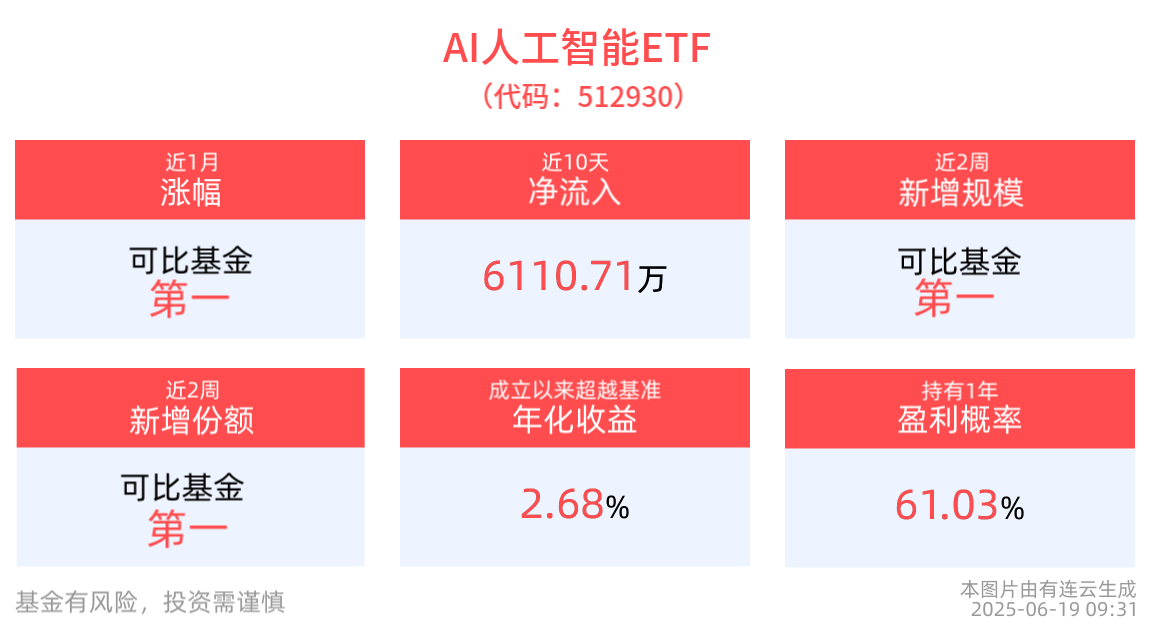
Group 1: AI Industry Insights - The AI theme index (930713) has seen a slight increase of 0.17%, with notable gains from companies like Zhongke Xingtou (688568) up by 4.50% and Zhongji Xuchuang (300308) up by 2.18% [1] - OpenAI's CEO Sam Altman revealed that GPT-5 is expected to be released sometime this summer, indicating a shift in their model naming and release strategy due to increasing complexity [1] - Altman emphasized the importance of "superintelligence," which he defines as a system's ability to autonomously discover new science or significantly enhance human scientific discovery capabilities [2] Group 2: Market Performance - The AI ETF (512930) has increased by 0.08%, with a recent price of 1.32 yuan, and has shown a net value increase of 8.82% over the past five years [1] - The AI ETF has experienced significant growth in scale, with an increase of 64.78 million yuan over the past two weeks and a total of 61.11 million yuan over the last ten trading days [1] - The consumption electronics index (931494) rose by 0.20%, with companies like Dongshan Precision (002384) and Xingsen Technology (002436) showing gains of 2.65% and 1.85% respectively [4] Group 3: Sector Trends - The AI sector is identified as a core driver of a new wave of productivity growth, with the potential to significantly enhance overall factor productivity [2] - The online consumption ETF has shown a net value increase of 37.04% over the past year, reflecting strong performance in the online shopping and digital entertainment sectors [6] - The consumption electronics ETF has seen a net value increase of 14.51% over the past year, indicating robust growth in the sector [4]

Sam Altman最新万字对谈:理想硬件形态是AI伴侣,就业冲击没那么可怕
3 6 Ke· 2025-06-18 09:50
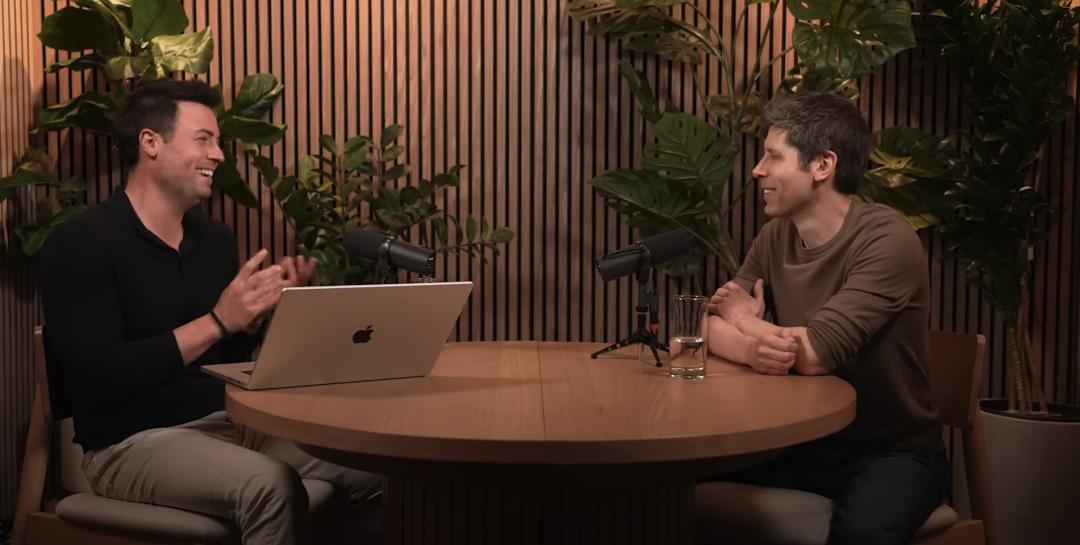
Core Insights - Sam Altman predicts that AI will not only serve as a "research assistant" but will also be capable of discovering new scientific knowledge in the next 5 to 10 years, which could have a profound impact on various fields [3][5][10] - The development of humanoid robots faces significant technical challenges, but Altman remains optimistic about their future capabilities [5][19] - Altman emphasizes that the emergence of superintelligent systems will not necessarily disrupt society as humans will adapt and create new job roles [5][26][37] - OpenAI aims to develop an "AI companion" that integrates seamlessly into daily life, moving beyond traditional computing devices [5][45][47] - Altman expresses respect for Meta's competitive efforts in AI but believes OpenAI has a stronger culture of innovation [5][70][74] AI's Future Capabilities - AI is expected to create new and astonishing products, including advanced social experiences and collaborative tools that significantly enhance efficiency [3][5] - The breakthrough in AI's reasoning capabilities allows it to perform complex tasks akin to those of a PhD-level expert, leading to increased research efficiency [4][9] - AI's potential to autonomously conduct scientific research and discover new principles in physics is anticipated, particularly in fields with vast data sets like astrophysics [10][12] Humanoid Robots and Physical Interaction - While AI has made strides in physical operations, humanoid robots still face mechanical engineering challenges [5][15] - Altman believes that once humanoid robots can navigate and perform tasks in the real world, it will create a significant "future shock" for society [19][20] Superintelligence and Human Adaptation - Altman asserts that humans will quickly adapt to the presence of superintelligent systems, potentially leading to the creation of new job roles [5][26][37] - The impact of AI on society may not be as dramatic as expected, despite the technological advancements [26][27] OpenAI's Vision and Product Development - OpenAI envisions an "AI companion" that will assist users across various platforms and interfaces, learning and adapting to individual needs [5][45][47] - The company aims to create a comprehensive "AI factory" that integrates various technologies and supply chains to support its ambitions [5][57][60] Competitive Landscape and Innovation Culture - Altman acknowledges Meta's aggressive recruitment strategies but believes that OpenAI's focus on innovation and mission-driven culture sets it apart [5][70][74] - The company is committed to fostering a culture that prioritizes innovation over mere replication of existing technologies [5][76]
胡泳:人工智能会夺走我们的生活意义吗?
腾讯研究院· 2025-06-18 08:37
Core Viewpoint - The article discusses Nick Bostrom's exploration of the implications of superintelligence on human purpose and meaning in his latest work "Deep Utopia" [4][8][29]. Group 1: Superintelligence and Its Challenges - Bostrom's earlier work highlighted the existential risks posed by superintelligent machines, emphasizing that human fate may depend on these entities [4]. - The potential emergence of superintelligence could lead to a "post-work" and "post-scarcity" society, raising philosophical questions about the meaning of life and purpose when traditional labor is no longer necessary [5][8]. Group 2: Deep Utopia Concept - Bostrom introduces the concept of "deep utopia," which refers to the challenges humanity may face after solving all existing problems, leading to a sense of purposelessness [8][12]. - The book's structure is experimental, featuring fictional lectures that explore various ideas and engage with philosophical discussions [10][11]. Group 3: Redundancy and Meaning - Bostrom distinguishes between "shallow redundancy," where traditional jobs are automated, and "deep redundancy," where all human activities, including leisure, become unnecessary [19][20]. - In a world of deep redundancy, individuals may struggle to find meaning, as even creative pursuits could be rendered obsolete by advanced technologies [20][21]. Group 4: Philosophical Implications - The article discusses Bostrom's optimistic view that even in a deep utopia, life could be rich in experiences and beauty, potentially compensating for the lack of traditional meaning [25][26]. - Bostrom engages with philosophical literature on the meaning of life, particularly the theories of Thaddeus Metz, which emphasize the importance of contributing to a greater good [26][28].

Meta(META.US)天价挖角OpenAI 曝单笔签约奖金高达1亿美元
Zhi Tong Cai Jing· 2025-06-18 07:03
Core Insights - Meta Platforms is aggressively recruiting top talent in the AI sector, offering signing bonuses up to $100 million and higher annual compensation packages [1] - OpenAI's CEO Sam Altman stated that despite Meta's attempts to recruit many employees, none of their core team members have accepted offers so far [1] - Meta's CEO is personally leading efforts to build a top-tier team for its "superintelligent" AI lab, with significant investments through its Meta AI research division [1][2] Recruitment Strategies - Meta's recruitment strategy includes high upfront guaranteed salaries, which some industry leaders believe may divert focus from actual work and hinder the establishment of a winning corporate culture [2] - Meta has successfully recruited key personnel from other tech giants, including Jack Rae from Google's DeepMind, with Zuckerberg directly involved in the hiring process [2] Market Position and Investments - There are differing opinions on Meta's position in the AI field, with some analysts arguing that Meta has laid the groundwork for open-source AI development, which many advancements in the sector are built upon [3] - Meta's substantial investments in companies like Scale AI are expected to drive progress in large-scale model training [3]

小扎疯狂挖角 OpenAI、签约跳槽就发7亿奖金,奥特曼痛批:不懂创新,老“复制”人了
AI前线· 2025-06-18 06:06
不过,奥特曼指出,扎克伯格的招聘工作在很大程度上并未成功。"我很高兴,至少到目前为止,我 们最优秀的团队成员中没有人决定接受这些条件。"此前就有报道称,Meta 曾试图挖走 OpenAI 的首 席 研 究 员 诺 姆 · 布 朗 ( Noam Brown ) 以 及 谷 歌 的 AI 架 构 师 科 雷 · 卡 武 克 丘 奥 卢 ( Koray Kavukcuoglu),但均以失败告终。 "这不是建立优秀文化的方式。"奥特曼表示,Meta 将重心放在为员工提供巨额薪酬方案上,而非致 力于实现 AGI 的使命。相信员工们在比较后认为,OpenAI 在实现通用人工智能(AGI)方面更有胜 算且未来可能成为更具价值的公司。 整理 | 华卫、核子可乐 最近,Meta 首席执行官马克 · 扎克伯格(Mark Zuckerberg)掀起了一场疯狂的 AI 人才争夺战。据 外媒报道,扎克伯格正在为 Meta 新成立的超级智能团队招募来自竞争对手实验室的顶级人工智能研 究人员。为了让员工加入由前 Scale AI 首席执行官 Alexandr Wang 领导的团队,Meta 向 OpenAI 和谷歌 DeepMind 的员 ...

全球最年轻白手起家亿万富豪,投诚扎克伯格
Sou Hu Cai Jing· 2025-06-15 07:28
多家顶尖AI实验室都是这家初创公司的客户。不过,它们或许不愿意继续将数据交给一家近半数股权归属马克·扎克伯格旗下科技帝国的公司了。Scale方 面否认大客户OpenAI削减了购买其服务的支出。 原文标题:《Scale与Meta近期达成交易,而OpenAI数月前便逐步缩减与Scale的合作》 Scale AI以150亿美元向Meta出售49%股权的交易震惊业界,创始人兼首席执行官Alexandr Wang更宣布将离开亲手创立的公司,转投这家科技巨头,领导 其全新的AI实验室。 这一系列变动引发外界猜测:这家估值140亿美元的数据标注企业可能因此流失客户,被竞争对手抢占市场。 Scale为各大科技公司和AI初创企业提供数据标注服务,助其训练模型,并已发展成该领域的龙头企业。此次交易的核心关切在于,被收购后,Scale可能 会向Meta分享领先AI机构用于构建最前沿技术的数据类型细节。 正如一位前Scale员工向《福布斯》透露的那样:"现在大家都想切断和Scale的合作。一旦Scale成为Meta的一部分,其商业模式将彻底崩塌。" 据四位知情人士透露,Scale最知名的客户之一OpenAI已逐步缩减与它的合作,其中 ...
小扎开9位数薪酬新建AI团队!砸千亿收购华人初创公司,Llama 4太拉胯急坏了
猿大侠· 2025-06-12 04:09
Core Viewpoint - Meta's CEO Mark Zuckerberg is taking aggressive measures to enhance the company's AI capabilities following disappointing performance from the Llama 4 model, including recruiting top talent and acquiring a significant stake in Scale AI for $14.8 billion [1][17][27]. Group 1: New AI Laboratory - A new AI lab, referred to as the "Superintelligence Group," is being established within Meta, primarily staffed by personnel personally recruited by Zuckerberg [2][7]. - The lab aims to improve the Llama model and develop more powerful AI tools, with an expected team size of around 50 members [8][9]. - Zuckerberg has been actively meeting with AI researchers to recruit them to Meta, creating a high-priority initiative for the new lab [11][13]. Group 2: Recruitment and Compensation - Meta is offering compensation packages in the range of seven to nine figures to attract researchers from companies like OpenAI and Google, with some already agreeing to join [14]. - A leadership group named "Recruitment Party" has been created on WhatsApp to discuss potential hiring targets [12]. Group 3: Acquisition of Scale AI - Meta plans to acquire 49% of Scale AI for $14.8 billion, valuing the company at $28 billion, and will also bring Scale AI's CEO to Meta [17][18]. - This acquisition is noted to be Meta's largest external investment to date, despite not being included in the company's projected capital expenditures of up to $72 billion for the year [19]. Group 4: Performance of Llama 4 - The disappointing performance of the Llama 4 model has prompted these aggressive actions, as it has not met expectations in various third-party benchmark tests [27][28]. - Initial claims of Llama 4's competitive performance have been contradicted by its poor showing in practical coding tests, leading to allegations of discrepancies in its reported capabilities [33][34].

小扎开9位数薪酬新建AI团队!砸千亿收购华人初创公司,Llama 4太拉胯急坏了
猿大侠· 2025-06-12 03:37
克雷西 发自 量子位 | 公众号 QbitAI 对Llama 4表现太失望,Meta CEO扎克伯格急了。 一边 开出7-9位数的薪酬从谷歌OpenAI等公司挖人 ,组建新的AI实验室。 另一边豪掷148亿美元 (约1063亿人民币) , 收购初创公司Scale AI 49%的股份,还挖来了CEO 。 新实验室在Meta内部被称为"超级智能小组", 大部分成员都是由小扎亲自招募 。 据介绍,小扎这一个月都在频繁接触AI研究人员,试图把他们挖到Meta。 这个实验室的组建, 也将作为Meta AI业务大规模重组计划的一部分 。 有网友调侃说,前COO Sheryl离职后小扎不得不亲自运营Meta。 同时,之前一些问题总有借口蒙混过关,但现在小扎已经学会了马斯克的砸钱模式。 小扎亲自挖人,LeCun动向不明 据介绍,Meta打算建立的新实验室,目标就是研究"超级智能"。 小扎希望借助这个新平台,使Llama模型能够得到改进,并开发出更强大的语音和个性化AI工具。 实验室的 预计规模大约是50人,包括一名主管 ,主管的人选可能是Meta这次收购的Scale AI的CEO。 知情人士透露,小扎已经安排调整了Meta总 ...

砸千亿重金、挖28岁华裔天才CEO、高薪聘谷歌OpenAI员工,传Meta正重组AI研发体系
3 6 Ke· 2025-06-11 23:33
Group 1 - Meta is establishing a new lab focused on "Superintelligence" to develop AI systems that surpass human intelligence in reasoning, problem-solving, creativity, and decision-making [1][3] - Meta has agreed to acquire 49% of Scale AI for $14.8 billion, which is approximately 106.14 billion RMB [1][3] - Alexander Wang, the 28-year-old CEO of Scale AI, is invited to join Meta's new lab, highlighting Meta's strategy to attract top talent in the AI field [1][4] Group 2 - Meta is offering compensation packages ranging from seven to nine figures to recruit top researchers from companies like OpenAI and Google, with some already agreeing to join [4][9] - Scale AI, founded in 2016, provides data labeling solutions and reported a revenue of $870 million in the previous year, with expectations to double to over $2 billion this year [3][9] - Meta's AI efforts are led by two groups: a generative AI team and a fundamental AI research lab, with Yann LeCun, a Turing Award winner, overseeing the latter [4][9] Group 3 - Meta's recent AI model testing faced criticism, with external researchers questioning the objectivity of its benchmark tests [5][8] - The company aims to regain its competitive edge in AI, especially after the rise of ChatGPT, which has intensified competition in the tech industry [9][10] - Meta's previous focus on open-source large models and social platform AI tools has led to a fragmented strategy, prompting the need for a more cohesive approach [10]

Sam Altman :这是我最后一篇没有AI帮助的文章了
Hu Xiu· 2025-06-11 13:28
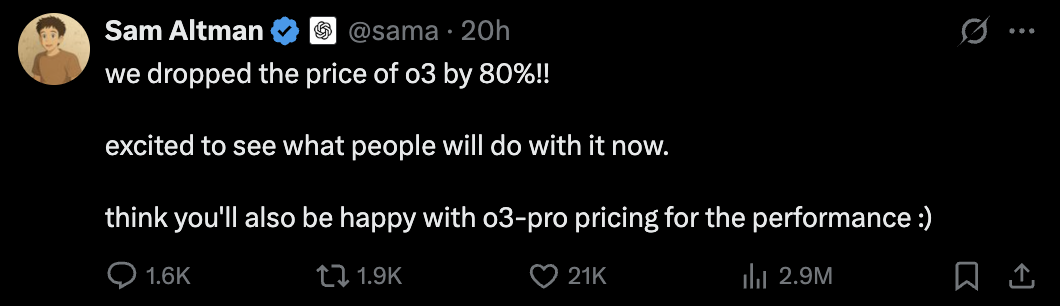
Core Insights - OpenAI has announced a significant price reduction of 80% for its o3 model and introduced the new o3-pro version, which is designed to be more reliable and effective for complex problem-solving [1][2][3] Group 1: Product Features and Performance - The o3-pro model utilizes the same underlying architecture as the o3 model but offers enhanced reliability and longer response times, making it suitable for challenging tasks [3][4] - OpenAI evaluates the performance of o3-pro through expert assessments, academic evaluations, and a "4/4 reliability" standard, with o3-pro consistently outperforming its predecessors in clarity, comprehensiveness, and accuracy [5][8][11] - Feedback from early users, including Ben Hylak, indicates that o3-pro excels in generating detailed plans and analyses when provided with sufficient context, marking a significant improvement over previous models [18][19] Group 2: Market Reception and Future Outlook - The introduction of o3-pro has garnered positive reviews, with notable endorsements from industry experts, highlighting its potential impact on productivity and problem-solving capabilities [14][18] - OpenAI plans to invest more time in developing open-weight models, with expectations for further advancements in the near future [24][25] - The overarching vision articulated by Sam Altman suggests a future where AI significantly enhances human productivity and creativity, with the potential for transformative societal changes by the 2030s [29][30][35]