
指数化投资

Search documents
策略月报:指数化投资策略月报(2025 年10 月)-20251009
Jin Yuan Tong Yi Zheng Quan· 2025-10-09 06:00
Group 1: Market Overview - The risk premium percentile for the CSI All Share Index is 45.07%, indicating that the market is generally in a normal return area [1][5] - The current risk premium value for the CSI 300 is 5.17%, suggesting a high return level that warrants attention [1][6] - The price-to-book ratio percentile for the CSI All Share Index is 41.77%, indicating a normal valuation state for the market [1][10] - The price-to-book ratio percentile for the Shanghai Composite Index is 22.68%, reflecting a relatively low valuation level that deserves focus [1][11] - The deviation rate for the CSI All Share Index is 18.59%, suggesting that the overall price level of the market is in a normal strong area [1][15] - The Sci-Tech 50 and ChiNext 50 are in an overbought state, indicating a need for caution regarding short-term risks [1][16] Group 2: Market Style Rotation - The growth style has significantly outperformed over the past six months, suggesting a focus on growth-style targets moving forward [1][22] - The high valuation style has also shown notable outperformance in the last six months, recommending attention to high valuation style targets [1][25] - Small-cap style has continued to record negative excess returns, while large-cap style has gradually outperformed over the past three months, indicating a focus on large-cap style targets [1][27] Group 3: ETF Rotation - The report tracks the performance of a dual momentum rotation strategy for ETFs, which selects securities that show strong time-series and cross-sectional momentum [1][31] - Reference targets for the dual momentum rotation strategy include various ETFs such as the Gold Stocks ETF and Green Energy ETF [1][33] Group 4: Convertible Bond Strategy - Convertible bonds, which combine debt and equity characteristics, are highlighted as a valuable investment option, particularly for risk-averse investors [1][35] - The report focuses on the performance enhancement of equity-oriented convertible bonds, providing a list of specific convertible bonds to consider [1][38]
ETF总规模再创历史新高,7只“巨无霸”诞生
Jing Ji Wang· 2025-10-09 02:19
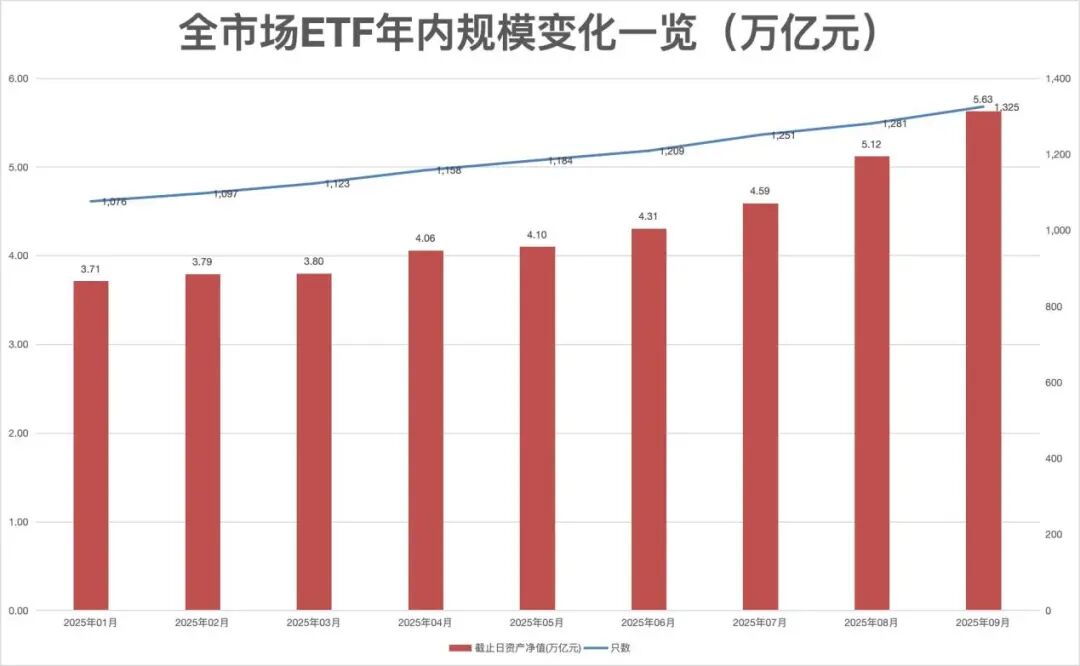
Core Insights - The total scale of ETFs in the A-share market has reached a historic high of 5.63 trillion yuan as of September 30, with stock ETFs surpassing 3.7 trillion yuan and bond ETFs exceeding 690 billion yuan [1][2][4] - The ETF market has experienced significant growth this year, with total shares increasing by 362.78 billion shares and total scale growing by 1.84 trillion yuan, marking year-on-year increases of 13.72% and 48.47% respectively [4] - The rise in ETF scale is attributed to institutional investments from insurance, annuities, and pension funds, as well as individual investors seeking diversified and efficient investment tools [1][9] ETF Market Growth - The number of ETFs has increased to 1,325, with 274 new ETFs launched this year [5] - The trading volume of ETFs has also surged, with a total trading amount of 554.88 billion yuan on September 30, representing a year-on-year increase of 139.32% [5] - Seven ETFs have now surpassed the 100 billion yuan mark, with the addition of one new member compared to 2024 [6][8] Performance of Specific ETFs - The top three ETFs by share growth this year are the Hong Kong Stock Connect Internet ETF, the Securities Company ETF, and the Chemical ETF, with increases of 59.59 billion shares, 38.18 billion shares, and 23.06 billion shares respectively [4] - The largest ETFs by scale include the Huatai-PB CSI 300 ETF at 425.58 billion yuan, followed by the E Fund CSI 300 ETF at 304.80 billion yuan [8] - ETFs tracking the Hong Kong Stock Connect Innovative Drug Index have shown the best performance, with several achieving a net value growth rate exceeding 110% this year [4] Future Outlook - The trend towards index-based investment is expected to continue, driven by supportive policies and increased allocations from both institutional and individual investors [9] - The potential for more ETFs to enter the "trillion yuan club" is high, particularly those linked to the STAR Market and ChiNext indices, as market reforms are anticipated to enhance the attractiveness and competitiveness of the capital market [8][9]

再创新高!7只千亿级“巨无霸”诞生
天天基金网· 2025-10-09 01:35
Core Viewpoint - The A-share market is experiencing significant growth, leading to a record high in the total scale of ETFs, which reached 5.63 trillion yuan as of September 30, 2023 [3][5][4]. ETF Market Overview - The total scale of ETFs in the market has reached 5.63 trillion yuan, with stock ETFs exceeding 3.7 trillion yuan and bond ETFs surpassing 690 billion yuan, both marking historical highs [3][5][4]. - Year-to-date, the ETF market has seen a dual growth in both share and scale, with total shares increasing by 362.78 billion shares and total scale growing by 1.84 trillion yuan, representing increases of 13.72% and 48.47% respectively [7]. - The stock ETF segment has seen the largest scale growth, increasing by 820.82 billion yuan, while bond ETFs have experienced nearly a threefold increase, making them the fastest-growing segment [7]. Performance of Individual ETFs - The top three ETFs in terms of share growth are the Hong Kong Stock Connect Internet ETF from Fuguo Fund, the Securities Company ETF from Huabao Fund, and the Chemical ETF from Penghua Fund, with respective increases of 59.59 billion shares, 38.18 billion shares, and 23.06 billion shares [7]. - The largest scale increases were also seen in the same ETFs, with the Hong Kong Stock Connect Internet ETF growing by 75.46 billion yuan, followed by the CSI 300 ETF from Huatai Baichuan Fund and the CSI 300 ETF from Huaxia Fund, which grew by 65.95 billion yuan and 64.05 billion yuan respectively [7]. Trading Activity and New Issuances - The trading volume of ETFs has surged, with a total trading amount of 554.88 billion yuan as of September 30, 2023, reflecting a year-on-year increase of 32.30 billion yuan, or 139.32% [8]. - A total of 274 new ETFs have been issued this year, bringing the total number of ETFs in the market to 1,325 [8]. Emergence of Large-scale ETFs - The number of ETFs with a scale exceeding 100 billion yuan has increased to seven, with one additional ETF joining this category compared to 2024 [10]. - The largest ETF is the CSI 300 ETF from Huatai Baichuan Fund, with a scale of 425.58 billion yuan, followed by the CSI 300 ETF from Fuguo Fund at 304.80 billion yuan [12]. Future Outlook - The growth of the ETF market is supported by institutional investments from insurance, pensions, and individual investors, with ETFs becoming a key tool for wealth management and long-term investment strategies [3][7]. - The ongoing reforms in the capital market, particularly regarding the Sci-Tech Innovation Board and the Growth Enterprise Market, are expected to further enhance the attractiveness and competitiveness of the market, potentially leading to more ETFs entering the 100 billion yuan club [13].

再创新高!7只“巨无霸”诞生
中国基金报· 2025-10-08 16:10
Core Viewpoint - The total scale of ETFs in China has reached a historical high of 5.63 trillion yuan, driven by increasing market participation from institutional and individual investors [2][3][6]. Market Overview - As of September 30, the total scale of ETFs in the market reached 5.63 trillion yuan, with stock ETFs exceeding 3.7 trillion yuan and bond ETFs surpassing 690 billion yuan, both marking historical highs [6][7]. - Year-to-date, the total number of ETF shares has increased by 362.78 billion shares, with a total scale growth of 1.84 trillion yuan, reflecting a year-on-year increase of 13.72% in shares and 48.47% in scale [7]. ETF Performance - Stock ETFs have seen the largest scale growth this year, increasing by 820.82 billion yuan, while bond ETFs have experienced nearly a threefold increase, marking the fastest growth among ETF categories [8]. - The top three ETFs in terms of share growth are the Hong Kong Stock Connect Internet ETF, the Securities Company ETF, and the Chemical ETF, with respective increases of 59.59 billion shares, 38.18 billion shares, and 23.06 billion shares [8]. Trading Activity - The trading volume of ETFs has also surged, with a total trading amount of 554.88 billion yuan as of September 30, representing a year-on-year increase of 323.03 billion yuan, or 139.32% [9]. Growth of Large-Scale ETFs - There are currently seven ETFs with scales exceeding 100 billion yuan, an increase of one compared to 2024 [12][14]. - The largest ETF is the Huatai-PB CSI 300 ETF, with a scale of 425.58 billion yuan, followed by the E Fund CSI 300 ETF at 304.80 billion yuan [14][15]. Future Outlook - The increasing scale of ETFs is expected to continue, supported by favorable policies and a growing inclination towards index-based investment strategies among investors [15].

债券ETF市场爆发式增长 总规模逼近7000亿元
Huan Qiu Wang· 2025-10-05 00:55
Core Insights - Bond ETFs have emerged as one of the fastest-growing asset classes in the ETF sector, with a total scale reaching 695.05 billion yuan by the end of September, marking an increase of over 500 billion yuan since the beginning of the year, representing a nearly 300% growth [1] Group 1: Growth Trends - The growth of bond ETFs is not coincidental, as they have experienced rapid development for three consecutive years since the end of 2022, with the scale increasing from 23.96 billion yuan to 52.94 billion yuan in 2022, a growth rate of 121% [3] - By the end of 2023, the scale is expected to surpass 80 billion yuan, and by May 2024, it is projected to exceed 100 billion yuan, reaching 173.97 billion yuan by year-end [3] - The growth rate accelerated further in 2025, with the scale surpassing 200 billion yuan in February, crossing the 500 billion yuan milestone in July, and successfully reaching the 600 billion yuan mark in September [3] Group 2: Market Dynamics - The market has seen a continuous influx of bond ETFs with over 32 products exceeding 10 billion yuan in scale as of the end of September, with Hai Futong Short-term Bond ETF leading at 63.15 billion yuan, followed closely by Bosera Convertible Bond ETF at 60.57 billion yuan [3] - The emergence of Sci-tech Bond ETFs is reshaping the market landscape, with a total of 24 existing products and a cumulative scale of 252.30 billion yuan, of which 14 products exceed 10 billion yuan [3] Group 3: Institutional Participation - Leading institutions are accelerating their market presence, with Hai Futong Fund becoming the first company to have bond ETFs exceeding 100 billion yuan in scale, offering a complete product matrix covering credit bonds, interest rate bonds, and convertible bonds [4] - Bosera Fund joined the "100 billion club" in August 2023, with five bond ETFs totaling over 100 billion yuan [4] - Other institutions such as Huatai-PB Fund, Yongying Fund, Wanji Fund, Taikang Fund, and Morgan Asset Management are also entering the market as new participants [4] Group 4: Future Outlook - The industry is optimistic about the future development of bond ETFs, with expectations that ongoing reforms in bond fund fee structures and the popularization of index-based investment concepts will make bond ETFs a more significant tool for asset allocation, attracting more capital inflows [4]

总规模逼近7000亿元!这类ETF持续扩容
证券时报· 2025-10-04 01:07
Core Viewpoint - The bond ETF market has experienced explosive growth in 2023, becoming the most notable asset class within the ETF sector, with total assets nearing 700 billion yuan, reflecting a nearly 300% increase since the beginning of the year [1][2]. Group 1: Market Growth - As of September 30, 2023, the total scale of bond ETFs reached 695.05 billion yuan, up from 239.64 billion yuan at the end of 2022, marking a growth of 121% [3]. - The bond ETF market is projected to continue its rapid expansion, with expectations to surpass 1 trillion yuan by the end of 2024 and 2 trillion yuan by early 2025 [3]. Group 2: Product Development - There are currently 32 bond ETF products with assets exceeding 10 billion yuan, including leading products such as Hai Futong Short-term Bond ETF at 63.15 billion yuan and Bosera Convertible Bond ETF at 60.57 billion yuan [2][3]. - The market for Sci-tech Bond ETFs is reshaping the bond ETF landscape, with 24 existing products totaling 252.30 billion yuan, and 14 of these exceeding 10 billion yuan in scale [4]. Group 3: Institutional Participation - Multiple public fund companies are actively entering the bond ETF market, with Hai Futong Fund being the first to surpass 100 billion yuan in bond ETF assets, followed by Bosera Fund [8]. - The increasing participation of institutions is expected to enhance liquidity and trading volume in the bond ETF market, with average daily trading volume rising from 38.4 billion yuan in January to over 220 billion yuan since September [6][8]. Group 4: Comparative Analysis - The current market share of domestic bond index funds in pure bond funds is approximately 15%, while the share of bond ETFs within bond index funds is around 34%, indicating significant growth potential compared to the U.S. market, where these figures exceed 40% and 60% respectively [9].
社保基金、养老基金2024年均设立复制指数产品
Zheng Quan Shi Bao Wang· 2025-09-30 00:17
Group 1 - The core viewpoint of the article emphasizes the acceleration of index investment initiatives by the National Social Security Fund Council, aiming to establish index replication products to enhance the quality and efficiency of stock investments [1] - The report released on September 29 highlights the establishment of new index replication products in response to changes in the domestic stock market, further improving investment operation quality to secure long-term favorable returns [1]
视频|嘉实基金:指数化投资策略分享
Xin Lang Ji Jin· 2025-09-29 09:30
Core Viewpoint - The article discusses the high-quality development of public funds in Beijing, emphasizing the new era, new funds, and new values in the investment landscape [1] Group 1: Industry Insights - The MACD golden cross signal has formed, indicating a positive trend for certain stocks [1]
天相投顾:公募基金,未来能安心地长期持有吗?
Xin Lang Ji Jin· 2025-09-29 02:30
Group 1 - The core issue in the market is that while funds have achieved positive returns, many investors have not, often due to buying at high points and experiencing significant losses, particularly in equity funds [1][2] - The phenomenon of investors, referred to as "small fish," making emotional and biased decisions leads to poor investment outcomes, while "sharks" capitalize on these mistakes for excess returns [2][3] - The volatility of the CSI 300 ETF has made it challenging for investors to hold onto their investments long-term, despite the ETF's recovery of 36% since 2024 [2][3] Group 2 - The risk-return mismatch in the past decade for the CSI 300 ETF indicates that investors have not received adequate risk premiums for the high volatility they endured [3][4] - Regulatory policies are being implemented to enhance corporate governance, increase financial transparency, and encourage higher dividend payouts to improve potential returns for investors [4] - The push for public fund fee reforms aims to lower transaction and holding costs, thereby directly increasing actual investor returns [4][5]
增超28% 年内公募基金分红超1800亿元
Bei Jing Shang Bao· 2025-09-28 15:23
Core Viewpoint - The total dividend distribution from public funds has reached 181.2 billion yuan as of September 28, 2025, marking a year-on-year increase of 28.33% [1][2]. Group 1: Dividend Distribution Overview - A total of 2,873 funds have distributed dividends this year, with the majority being ETFs, particularly the CSI 300 ETF, which dominates the top four dividend distributions [2]. - The top dividend-paying product is the Huatai-PineBridge CSI 300 ETF, with a total dividend of 8.394 billion yuan, reflecting a significant year-on-year growth of 236.57% [2]. - Other notable ETFs include E Fund CSI 300 ETF and Huaxia CSI 300 ETF, with dividends of 5.558 billion yuan and 5.554 billion yuan, respectively [2]. Group 2: Dividend Frequency and Types - The Western Asset Central Enterprise Preferred Stock A/C has the highest number of dividend distributions this year, totaling 14 times [3]. - Bond funds remain the primary contributors to total dividends, accounting for 73.14% of the total with 132.5 billion yuan, showing a year-on-year growth of 10.2% [4]. - Passive index products have seen a remarkable increase in dividend distribution, totaling 31.4 billion yuan, which is a 225.75% increase compared to the previous year [4]. Group 3: Future Outlook - Analysts predict that total dividends may continue to expand, with a structural differentiation expected in the market [5]. - While bond funds will maintain a high share of total dividends, the growth rate is expected to slow down [5]. - The preference for passive index funds is anticipated to increase, driven by market improvements and a higher willingness to distribute dividends [5].