
博时可转债ETF

Search documents
投资者微观行为洞察手册3月第2期:地缘波动之下:全球外资流出美国,南水大幅买入港股
GUOTAI HAITONG SECURITIES· 2026-03-17 15:04
Market Pricing Status - The market transaction activity has slightly decreased, while the profit effect has increased, with the average daily trading volume for the entire A-share market dropping to 2.5 trillion yuan and the proportion of stocks rising to 34.9% [5][9][10] - The trading concentration has risen, with 10 industries having turnover rates above 90%, including oil and petrochemicals, and coal [5][19] A-Share Liquidity Tracking - Financing funds have seen a slight inflow, while ETF funds have experienced a small outflow, with public equity funds' new issuance increasing to 22.62 billion yuan [5][29] - Private equity confidence index has decreased by 0.1% compared to February, while the overall position has marginally increased [5][36] - Foreign capital has exited the A-share market, with a net outflow of 1.035 billion USD [5][41] - The IPO fundraising for the current period is 290 million yuan, with a private placement scale of 1.15 billion yuan [5][29] A-Share Industry Allocation Tracking - Foreign capital has generally exited various primary industries, with electronics and power equipment seeing the largest outflows of 160.4 million USD and 91.7 million USD respectively [5][40] - Financing funds have seen net inflows in power equipment (+6.05 billion yuan) and basic chemicals (+4.07 billion yuan), while outflows were noted in non-ferrous metals (-4.04 billion yuan) and defense industry (-1.22 billion yuan) [5][29] - ETF funds have shown a net outflow in sectors like oil and petrochemicals (-4.15 billion yuan) and pharmaceuticals (-2.15 billion yuan), while public utilities saw a net inflow of 2.61 billion yuan [5][29] Hong Kong Stock Market and Global Fund Flow - Significant inflow of southbound funds, with net purchases rising to 52.44 billion yuan, marking the 96th percentile since 2022 [5][29] - Global foreign capital has marginally flowed into Japan and South Korea, with inflows of 1.57 billion USD and 2.57 billion USD respectively [5][41]
【债券日报】:转债市场月度跟踪20260313-20260313
Huachuang Securities· 2026-03-13 14:51
1. Report Industry Investment Rating No information about the industry investment rating is provided in the report. 2. Core Viewpoints - The convertible bond market continued to be weak today, with valuations compressing on a month - on - month basis. The trading sentiment in the convertible bond market heated up, but the overall market showed a downward trend [1]. - The central price of convertible bonds decreased, and the proportion of high - price bonds declined. The valuation of convertible bonds compressed, with different types of convertible bonds showing different trends in price and premium rate [2]. - Most of the underlying stock industry indices declined, and the convertible bond market also had more declining industries. Different industries had different performance in terms of closing price, conversion premium rate, conversion value, and pure bond premium rate [3]. 3. Summary by Relevant Catalogs Market Main Index Performance - The CSI Convertible Bond Index decreased by 1.04% month - on - month, the Shanghai Composite Index decreased by 0.82%, the Shenzhen Component Index decreased by 0.65%, the ChiNext Index decreased by 0.22%, the SSE 50 Index decreased by 0.50%, and the CSI 1000 Index decreased by 1.46%. The large - cap growth style was relatively dominant, with large - cap growth decreasing by 0.06%, large - cap value decreasing by 0.16%, mid - cap growth decreasing by 1.06%, mid - cap value decreasing by 1.28%, small - cap growth decreasing by 0.87%, and small - cap value decreasing by 0.66% [1][7]. Market Fund Performance - The trading volume of the convertible bond market was 71.943 billion yuan, a month - on - month increase of 14.73%. The total trading volume of the Wind All - A Index was 2.417276 trillion yuan, a month - on - month decrease of 1.76%. The net outflow of the main funds in the Shanghai and Shenzhen stock markets was 4.0095 billion yuan, and the yield of the 10 - year Treasury bond increased by 0.91bp to 1.81% [1]. Convertible Bond Price and Valuation - The weighted average closing price of convertible bonds was 139.51 yuan, a month - on - month decrease of 0.88%. Among them, the closing price of equity - biased convertible bonds was 199.31 yuan, a month - on - month increase of 2.06%; the closing price of debt - biased convertible bonds was 121.96 yuan, a month - on - month decrease of 0.35%; the closing price of balanced convertible bonds was 132.14 yuan, a month - on - month decrease of 0.81%. The proportion of high - price bonds above 130 yuan was 73.41%, a month - on - month decrease of 2.22pct. The price median was 137.91 yuan, a month - on - month decrease of 0.93% [2]. - The fitted conversion premium rate of 100 - yuan par value was 37.90%, a month - on - month decrease of 1.58pct; the overall weighted par value was 106.98 yuan, a month - on - month decrease of 0.51%. The premium rate of equity - biased convertible bonds was 14.43%, a month - on - month increase of 1.01pct; the premium rate of debt - biased convertible bonds was 89.32%, a month - on - month increase of 1.39pct; the premium rate of balanced convertible bonds was 25.22%, a month - on - month decrease of 0.97pct [2]. Industry Performance - In the A - share market, the top three industries with the largest declines were non - ferrous metals (-2.70%), computer (-2.70%), and national defense and military industry (-2.69%); the top three industries with the largest increases were food and beverage (+0.87%), building decoration (+0.60%), and banking (+0.38%). In the convertible bond market, 26 industries declined, with the top three industries with the largest declines being communication (-7.15%), national defense and military industry (-3.67%), and machinery and equipment (-2.75%); only two industries rose against the trend, namely petroleum and petrochemicals (+0.73%) and banking (+0.21%) [3]. - In terms of closing price, the large - cycle decreased by 0.84%, manufacturing decreased by 2.08%, technology decreased by 3.37%, large - consumption decreased by 1.00%, and large - finance decreased by 0.16%. In terms of conversion premium rate, the large - cycle decreased by 0.45pct, manufacturing decreased by 0.85pct, technology increased by 0.27pct, large - consumption decreased by 1.5pct, and large - finance decreased by 0.26pct. In terms of conversion value, the large - cycle decreased by 0.27%, manufacturing decreased by 1.22%, technology decreased by 3.40%, large - consumption decreased by 0.67%, and large - finance decreased by 0.12%. In terms of pure bond premium rate, the large - cycle decreased by 1.3pct, manufacturing decreased by 3.4pct, technology decreased by 5.4pct, large - consumption decreased by 1.3pct, and large - finance decreased by 0.2pct [3][4]. Industry Rotation - Food and beverage, building decoration, and banking led the rise. The daily increase rates of food and beverage, building decoration, and banking in the underlying stocks were 0.87%, 0.60%, and 0.38% respectively; the daily increase rates in the convertible bond market were - 0.30%, - 1.09%, and 0.21% respectively [53].
【财经分析】节后转债市场全景透视:高估值还能持续多久?
Xin Hua Cai Jing· 2026-02-26 14:33
Core Viewpoint - The convertible bond market has experienced a strong start in 2026, driven by expectations of a "slow bull" market in equities and a "scarcity of assets" environment, with analysts predicting continued strong performance post-Spring Festival, despite high valuations and structural differentiation being notable market characteristics [1][5]. Market Characteristics - The convertible bond market in 2026 has exhibited four core characteristics: strengthening indices, high valuations, active trading, and structural differentiation [2]. - In January, the market saw a significant performance boost, with the China Convertible Bond Index maintaining a growth rate comparable to the broader A-share market, supported by increased capital allocation needs [2]. - As of January 30, the premium rate for convertible bonds reached 35.0%, up 4.45 percentage points from December 2025, indicating a high valuation level [2]. Demand Dynamics - Since January 2026, the demand for convertible bonds has increased, with a notable rise in ETF shares, reflecting a bullish sentiment among investors [3]. - The total number of convertible bond ETFs increased by 656 million shares to 4.45 billion shares, indicating strong demand [3]. Structural Differentiation - The market is witnessing structural differentiation, with lower-rated, small-cap, and low-priced convertible bonds likely to yield excess returns ahead of the "Two Sessions" [4]. - High-priced and small-cap convertible bonds are expected to lead the market post-Spring Festival, while large-cap and "double low" convertible bonds may underperform [4]. Policy and Funding Support - Multiple favorable factors are converging to support the convertible bond market, including a slow bull market in equities and a loose liquidity environment [5]. - The supply-demand balance remains tight, with expectations that the first half of 2026 will see a peak in "fixed income+" allocations to convertible bonds, providing a resilient foundation for high valuations [5]. - Significant net subscriptions for convertible bond ETFs in January, such as 9.538 billion yuan for the Bosera Convertible Bond ETF, reflect strong market confidence [5]. Policy Incentives - The release of policy dividends and institutional optimizations are expected to further enhance the upside potential of the convertible bond market, particularly in sectors like technology and high-end manufacturing [6][7]. - New convertible bond issuances are likely to focus on high-quality technology enterprises, which will be favored by the market [7].
两市ETF两融余额减少94.83亿元丨ETF融资融券日报
2 1 Shi Ji Jing Ji Bao Dao· 2026-02-24 02:45
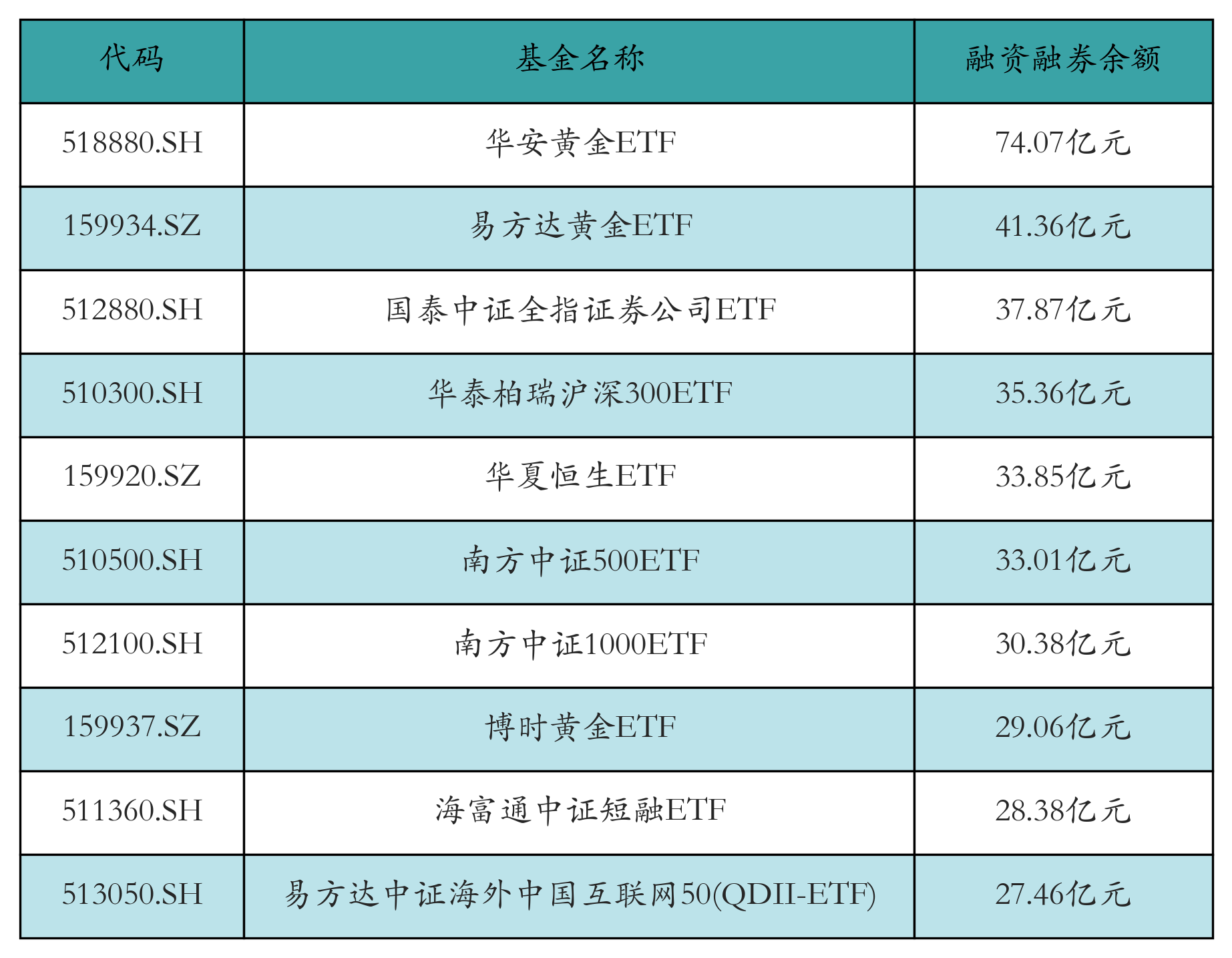
Market Overview - On February 13, the total ETF margin balance in the two markets was 115.864 billion yuan, a decrease of 9.483 billion yuan from the previous trading day [1] - The financing balance was 108.367 billion yuan, down by 9.454 billion yuan, while the securities lending balance was 7.497 billion yuan, a decrease of 29.625 million yuan [1] - In the Shanghai market, the ETF margin balance was 80.922 billion yuan, a decrease of 8.662 billion yuan, with a financing balance of 74.354 billion yuan, down by 8.657 billion yuan [1] - In the Shenzhen market, the ETF margin balance was 34.942 billion yuan, a decrease of 0.822 billion yuan, with a financing balance of 34.013 billion yuan, down by 0.796 billion yuan [1] ETF Margin Financing and Securities Lending - The top three ETF margin balances on February 13 were: Huaan Gold ETF (7.407 billion yuan), E Fund Gold ETF (4.136 billion yuan), and Guotai CSI All-Share Securities Company ETF (3.787 billion yuan) [2] - The top three ETF financing buy amounts were: Hai Futong CSI Short Bond ETF (1.683 billion yuan), Hang Seng Technology ETF (909 million yuan), and Bosera Convertible Bond ETF (874 million yuan) [4] - The top three ETF financing net buy amounts were: Dachen Hang Seng Technology ETF (31.3105 million yuan), Huaan Gold ETF (30.3682 million yuan), and Huatai-PB CSI 300 ETF (27.6497 million yuan) [5] ETF Securities Lending - The top three ETF securities lending sell amounts were: Southern CSI 500 ETF (1.27 billion yuan), Southern CSI 1000 ETF (283.781 million yuan), and Bosera Convertible Bond ETF (229.007 million yuan) [7]

超长春节假期闲置资金盲目买入债券ETF 集合竞价惊现8%溢价
Sou Hu Cai Jing· 2026-02-13 14:00
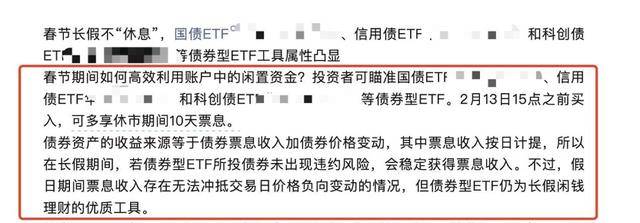
Group 1 - The core issue revolves around the volatility of the government bond ETF, which saw a significant price drop after an initial surge, leading to substantial losses for early investors [1][3] - The surge in interest for bond ETFs was driven by various institutions and influencers promoting them as attractive investment options for idle cash during the pre-holiday period, highlighting their potential for stable income [3][4] - On February 12, the government bond ETF attracted a notable inflow of 90.92 million yuan, significantly exceeding its previous buying amounts, indicating a strong speculative interest [4][6] Group 2 - The bond market is experiencing upward pressure on yields, with 5Y to 30Y government bond yields rising collectively, reflecting a market reaction to the influx of funds [6][8] - Regulatory bodies are taking steps to standardize investor education and risk disclosures related to bond trading, aiming to mitigate misleading information and ensure compliance [10][11] - The convertible bond market is facing risks due to high valuations and potential liquidity issues, with a significant portion of the market being held in ETFs, which could exacerbate sell-off scenarios during market downturns [12]
【债券日报】:转债市场日度跟踪 20260210-20260210
Huachuang Securities· 2026-02-10 15:32
1. Report Industry Investment Rating No relevant content provided. 2. Core Viewpoints of the Report - The convertible bond market showed a volume - shrinking correction today, with valuations rising month - on - month. The trading sentiment in the convertible bond market weakened, and the median price of convertible bonds decreased slightly. The proportion of high - price bonds above 130 yuan decreased, while the proportion of bonds in the 110 - 120 yuan range increased [2][3]. - In the A - share market, the decline in the positive - stock industry index accounted for more than half, while in the convertible bond market, 18 industries rose. Different industries had different performances in terms of closing price, conversion premium rate, conversion value, and pure bond premium rate [4]. 3. Summary by Relevant Catalogs Market Main Index Performance - The CSI Convertible Bond Index decreased by 0.23% month - on - month, the Shanghai Composite Index increased by 0.13%, the Shenzhen Component Index increased by 0.02%, the ChiNext Index decreased by 0.37%, the SSE 50 Index increased by 0.18%, and the CSI 1000 Index increased by 0.20%. Among market styles, mid - cap value was relatively dominant [2]. - The weighted average closing price of convertible bonds was 142.67 yuan, a 0.32% decrease from yesterday. The closing prices of partial - equity, partial - debt, and balanced convertible bonds changed by +2.17%, - 0.05%, and +0.22% respectively. The proportion of high - price bonds above 130 yuan decreased by 0.12 pct, and the proportion of bonds in the 110 - 120 yuan range increased by 0.29 pct [3]. Market Capital Performance - The trading volume in the convertible bond market was 72.799 billion yuan, a 9.88% decrease month - on - month; the total trading volume of the Wind All - A Index was 2.124745 trillion yuan, a 6.41% decrease month - on - month. The net outflow of the main funds in the Shanghai and Shenzhen stock markets was 32.204 billion yuan, and the yield of the 10 - year treasury bond decreased by 0.20 bp to 1.81% [2]. Industry Performance - In the A - share market, the top three declining industries were real estate (-1.40%), food and beverage (-1.31%), and commerce and retail (-0.87%); the top three rising industries were media (+4.27%), household appliances (+1.11%), and coal (+0.88%). In the convertible bond market, the top three rising industries were communication (+2.29%), automobile (+2.25%), and media (+1.44%); the top three declining industries were textile and apparel (-2.17%), environmental protection (-1.56%), and non - bank finance (-0.90%) [4]. - In terms of different industry categories: the closing price of the large - cycle category decreased by 0.17%, manufacturing increased by 0.99%, technology increased by 0.80%, large - consumption decreased by 0.39%, and large - finance decreased by 0.41%. The conversion premium rate of the large - cycle category increased by 0.86 pct, manufacturing increased by 0.75 pct, technology decreased by 2.3 pct, large - consumption increased by 0.56 pct, and large - finance decreased by 0.22 pct. The conversion value of the large - cycle category decreased by 0.77%, manufacturing increased by 0.59%, technology increased by 1.91%, large - consumption decreased by 0.34%, and large - finance decreased by 0.43%. The pure bond premium rate of the large - cycle category decreased by 0.36 pct, manufacturing increased by 1.6 pct, technology increased by 1.4 pct, large - consumption decreased by 0.54 pct, and large - finance decreased by 0.48 pct [4][5]. Industry Rotation - Media, household appliances, and coal led the rise. The media industry had a daily increase of 4.27% in the positive - stock market and 1.44% in the convertible bond market; household appliances had a daily increase of 1.11% in the positive - stock market and 0.19% in the convertible bond market; coal had a daily increase of 0.88% in the positive - stock market and 0.85% in the convertible bond market [55].
可转债周报(2026.1.26-2026.2.1):小盘风格承压之下,转债估值仍有支撑-20260202
Dong Fang Jin Cheng· 2026-02-02 07:53
1. Report Industry Investment Rating - There is no information provided regarding the report industry investment rating in the given content. 2. Core Viewpoints of the Report - Last week, the equity market style switched, with the small - cap style continuing to weaken. The convertible bond market adjusted with reduced volume, showing anti - decline properties, and the Wind Convertible Bond Weighted Index outperformed the Wind Convertible Bond Underlying Stock Weighted Index by 0.43 pcts. Convertible bond ETFs had a net subscription of 2.545 billion yuan, supporting the convertible bond valuation. [2] - In the short term, convertible bonds are expected to follow the underlying stocks in volatile consolidation, maintaining a structural market with rapid rotation. Large - cap and dividend convertible bonds are expected to continue to dominate. However, during the wide - range volatility period, convertible bonds have an asymmetric advantage. After the performance announcements, the risk - aversion sentiment in small - and micro - cap stocks will gradually ease, and the regulatory attitude will warm up. Before the Spring Festival, a new round of favorable and policy - game market is expected to start, with the market style switching back to small - cap dominance, which will drive the convertible bond market. [2] 3. Summary by Relevant Catalogs Policy Tracking - On January 27, the State Council issued the "Regulations for the Implementation of the Drug Administration Law of the People's Republic of China", which will come into force on May 15, 2026. It supports the development of new industrial formats, promotes the implementation of pharmaceutical innovation results, and improves various aspects of drug management. [3] - On January 29, the State Council issued the "Guidelines on Performance Comparison Benchmarks for Publicly Offered Securities Investment Funds", proposing 12 policy measures and identifying key service consumption areas such as transportation and household services, and strengthening support for cultivating new growth points in service consumption. [2][3] Secondary Market - **Equity Market**: Last week, major equity market indices closed down. The Shanghai Composite Index, Shenzhen Component Index, and ChiNext Index fell 0.44%, 1.62%, and 0.09% respectively. Overseas, the Fed's hawkish nomination and the sharp adjustment in the precious metal market affected the global capital market. Domestically, although the profits of industrial enterprises above designated size increased in 2025, the January PMI index declined, and the market risk preference decreased. The small - and micro - cap stocks weakened, and the large - cap dividend stocks strengthened. [6] - **Convertible Bond Market**: Major convertible bond market indices followed the decline. The CSI Convertible Bond Index, Shanghai Convertible Bond Index, and Shenzhen Convertible Bond Index fell 2.61%, 2.56%, and 2.61% respectively, with an average daily trading volume of 9.0209 billion yuan, a marginal decrease of 308.6 million yuan from the previous week. Convertible bond ETFs showed differentiation, with a net subscription of 2.545 billion yuan in total, supporting the valuation. [7] - **Structural Analysis**: The large - cap style in the convertible bond market was dominant due to its anti - decline property. The median prices of convertible bonds and their underlying stocks were still at a high level, the conversion value quantile decreased, and the median valuation level increased slightly. The trading activity of underlying stocks decreased, while that of convertible bonds increased. [9] - **Industry Analysis**: All industries' convertible bonds fell. Construction materials, agriculture, forestry, animal husbandry, and fishery, food and beverage, and public utilities had relatively small average declines, while national defense and military industry and computer industries had larger average declines. The valuation of convertible bonds in different industries was differentiated. [10] - **Individual Bond Analysis**: Most convertible bonds rose. Baichuan Convertible Bond 2 led the rise with an increase of over 12%, while high - position convertible bonds such as Xinzhi Convertible Bond and Hangyu Convertible Bond had significant declines. [13] - **Price and Valuation**: The arithmetic average and median of convertible bond prices decreased. The arithmetic average of the conversion premium rate increased, and the median decreased. The arithmetic average and median of the pure - bond premium rate decreased. [24] Primary Market - **Issuance and Listing**: No new convertible bonds were issued last week. Lianrui Convertible Bond and Naipu Convertible Bond 02 were listed, and several convertible bonds were redeemed early and delisted. As of last Friday, the convertible bond market's outstanding scale was 55.2588 billion yuan, a decrease of 4.596 billion yuan from the beginning of the year and 3.682 billion yuan from the previous week. [30] - **Conversion**: Ten convertible bonds had a conversion ratio of over 5%, one more than the previous week. Some bonds had announced early redemption or were about to trigger the strong - redemption condition. [33] - **Approval Progress**: Star Semiconductor's convertible bond issuance was approved by the exchange. One convertible bond passed the review of the Issuance Examination Committee, with a total scale of 1.5 billion yuan. As of last Friday, eight convertible bonds were approved by the CSRC to be issued, with a total scale of 6.164 billion yuan. [34] - **Clause Tracking**: One convertible bond announced a downward revision of the conversion price, and two announced early redemption. Some bonds announced not to revise the conversion price downward or were about to trigger the downward - revision condition, and many bonds were expected to trigger the early - redemption condition. [35]
【债券日报】:转债市场日度跟踪20260128-20260128
Huachuang Securities· 2026-01-28 14:46
Report Summary 1. Report Industry Investment Rating The document does not mention the industry investment rating. 2. Core Viewpoints - Most industries rose today, with valuations increasing month - on - month. The convertible bond market showed mixed trends in different aspects, such as price, valuation, and industry performance [1]. - The convertible bond price center increased, and the proportion of high - price bonds rose. Valuations also went up, with changes in different types of convertible bonds and price ranges [2]. - In the industry performance, more than half of the underlying stock industry indices declined, and there were differences in the rise and fall rankings between the A - share market and the convertible bond market [3]. 3. Summary by Relevant Catalogs Market Main Index Performance - The CSI Convertible Bond Index rose 0.85% month - on - month, the Shanghai Composite Index rose 0.27%, the Shenzhen Component Index rose 0.09%, the ChiNext Index fell 0.57%, the SSE 50 Index rose 0.27%, and the CSI 1000 Index rose 0.21% [1]. - In terms of market style, mid - cap value stocks were relatively dominant. Mid - cap growth rose 1.80%, mid - cap value rose 2.56%, while large - cap value fell 0.01% [1]. Market Fund Performance - The trading sentiment in the convertible bond market weakened. The trading volume of the convertible bond market was 81.463 billion yuan, a 4.34% month - on - month decrease. The total trading volume of the Wind All - A Index was 2.992289 trillion yuan, a 2.42% month - on - month increase [1]. - The net outflow of the main funds in the Shanghai and Shenzhen stock markets was 27.487 billion yuan, and the yield of the 10 - year treasury bond decreased by 1.47bp to 1.82% [1]. Convertible Bond Valuation - The weighted average closing price of convertible bonds was 143.85 yuan, a 0.55% increase from the previous day. The closing price of equity - biased convertible bonds was 211.16 yuan, a 2.87% increase; that of bond - biased convertible bonds was 123.26 yuan, an 0.85% increase; and that of balanced convertible bonds was 135.08 yuan, a 1.16% increase [2]. - The proportion of high - price bonds above 130 yuan was 78.46%, a 2.19pct month - on - month increase. The proportion of bonds in the 120 - 130 yuan range decreased by 2.44pct [2]. - The 100 - yuan parity fitted conversion premium rate was 38.14%, a 0.38pct increase from the previous day. The overall weighted parity was 106.15 yuan, a 0.57% decrease [2]. Industry Performance - In the A - share market, the top three declining industries were Media (- 1.77%), National Defense and Military Industry (- 1.68%), and Beauty and Personal Care (- 1.65%); the top three rising industries were Non - Ferrous Metals (+ 5.92%), Petroleum and Petrochemical (+ 3.54%), and Coal (+ 3.42%) [3]. - In the convertible bond market, 24 industries rose. The top three rising industries were Coal (+ 3.32%), Petroleum and Petrochemical (+ 2.69%), and Non - Ferrous Metals (+ 2.50%); the top three declining industries were Household Appliances (- 2.63%), Machinery and Equipment (- 0.97%), and National Defense and Military Industry (- 0.92%) [3]. - In terms of closing price, large - cycle rose 1.34%, manufacturing rose 0.51%, technology rose 0.33%, large - consumption rose 0.25%, and large - finance rose 0.81% [3]. - The conversion premium rate of large - cycle rose 0.95pct, manufacturing rose 1.9pct, technology rose 1.9pct, large - consumption rose 3.1pct, and large - finance rose 1.1pct [3]. - The conversion value of large - cycle rose 0.59%, manufacturing fell 0.49%, technology fell 1.02%, large - consumption fell 1.11%, and large - finance rose 0.65% [3]. - The pure bond premium rate of large - cycle rose 2.0pct, manufacturing rose 0.62pct, technology rose 0.54pct, large - consumption rose 0.32pct, and large - finance rose 0.96pct [4]. Industry Rotation - Non - Ferrous Metals, Petroleum and Petrochemical, and Coal led the rise. Non - Ferrous Metals had a daily increase of 5.92% in the underlying stock and 2.50% in the convertible bond; Petroleum and Petrochemical had a 3.54% increase in the underlying stock and 2.69% in the convertible bond; Coal had a 3.42% increase in the underlying stock and 3.32% in the convertible bond [53].
融资盘突发降温!部分赛道恐短期承压,要不要撤?
Sou Hu Cai Jing· 2026-01-15 08:40
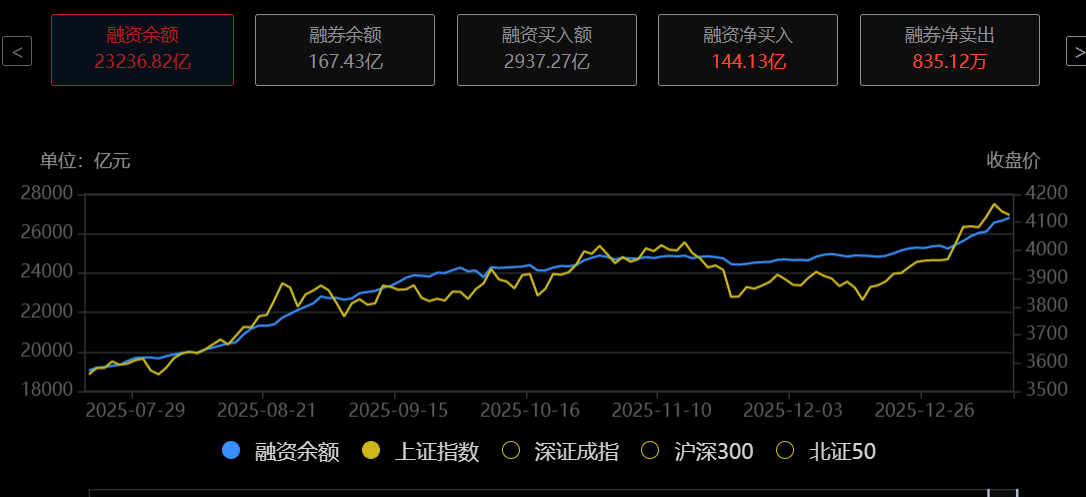
Market Overview - On January 14, a sudden announcement from three major exchanges raised the minimum margin requirement for financing from 80% to 100%, effective immediately, leading to a significant market downturn after an initial rally [1] - The A-share market's margin balance reached a historical high of 2.67 trillion yuan, with net financing inflow nearing 140 billion yuan in just the first seven trading days of 2026 [1][4] - Trading activity has been notably high, with daily transaction volumes exceeding 3 trillion yuan on multiple occasions, indicating elevated market sentiment [1] Impact of Margin Requirement Adjustment - Historical data suggests that previous increases in margin requirements in November 2015 and May 2017 resulted in a decrease of 6.3% and 4.1% in margin balances within a week, with the Shanghai Composite Index experiencing declines of 5% to 8% [4] - On January 14, the most affected sectors included TMT (Technology, Media, and Telecommunications) and non-bank financials, with the CSI 2000 index dropping by 4.6% and the number of stocks hitting the daily limit increase from 3 to 58 [4] - Northbound capital also reacted negatively, with a net outflow of 6.2 billion yuan, marking the largest single-day outflow in January [4] Sector Analysis - High Beta sectors such as TMT and non-bank financials, which have high financing balances and volatility, are expected to face immediate pressure due to the margin increase [4] - Key industries like electronics, power equipment, and computing, which are significant players in margin financing, may see a slowdown in capital inflow in the short term [4] - Despite the margin increase, existing investors are not required to add additional margin, which helps maintain stability in the over 2 trillion yuan of existing margin balances [4] ETF Market Insights - Certain ETFs, such as the Hai Fu Tong CSI Short Bond ETF and the Bosera Convertible Bond ETF, have seen active margin trading, although their overall contribution to total margin trading remains limited due to their large scale [6] - ETFs with high margin trading ratios, like the Hang Seng Technology ETF and the Huaxia Hang Seng Internet Technology ETF, should be approached with caution as forced liquidations could lead to significant price drops [6] Long-term Outlook - The adjustment of margin requirements is viewed as a "counter-cyclical fine-tuning," primarily affecting new contracts while leaving existing ones intact, suggesting limited long-term impact on market dynamics [10] - Historical patterns indicate that after initial emotional reactions, funds will likely return to selecting stocks based on fundamentals and valuations, minimizing the long-term effects of margin adjustments [10] - Despite short-term pressures, sectors such as AI applications and commercial aerospace continue to attract significant capital, indicating ongoing interest in certain growth areas [10] Future Projections - Analysts expect continued structural differentiation in the A-share market, driven by technological innovation and concentrated corporate performance, with a projected net profit growth rate for the CSI 300 index of 7.2% and 8.4% for 2026 and 2027, respectively [12][13]
新年首只新券亮相 可转债发行有望加快
Zhong Guo Zheng Quan Bao· 2026-01-08 20:50
Core Viewpoint - The issuance of the Lianrui convertible bond marks the beginning of a potential acceleration in the convertible bond market, driven by seasonal capital inflows, policy expectations, and industry trends [1][2][4] Market Performance - On January 8, the Lianrui convertible bond was launched with a total issuance of 695 million yuan, aimed at funding high-performance materials projects and enhancing production capacity [1] - The China Convertible Bond Index rose by 0.39% to 509.26, reaching a new high since 2016, while the Bosera and Shanghai Stock Exchange convertible bond ETFs also hit historical highs [1][3] - As of January 8, the total outstanding convertible bonds in the market was 5,561.39 billion yuan, with 411 bonds currently in circulation [2] Supply and Demand Dynamics - The convertible bond market is expected to continue facing a contraction in scale due to an imbalance between supply and demand, with an estimated exit scale of around 1,600 billion yuan for 2026 [3] - Six companies have received approval for convertible bond issuance totaling 7.338 billion yuan, while five others are expected to issue bonds worth 2.911 billion yuan [2] Market Trends and Future Outlook - The recent rise in convertible bonds is significantly driven by the performance of underlying stocks, with notable gains in sectors such as aerospace, AI computing, and robotics [4] - Analysts predict that convertible bonds may experience strong performance due to the positive influence of underlying stocks and returning capital, with institutional investors likely to seek allocations at the beginning of the year [4]