
资源循环利用

Search documents
出海拓展垃圾焚烧产能,助推公司盈利能力提升
Xinda Securities· 2025-07-05 09:54
Investment Rating - The industry investment rating is "Positive" [2] Core Viewpoints - The report emphasizes the expansion of waste incineration capacity overseas, which is expected to enhance the profitability of companies in the sector. As the domestic waste incineration power generation industry approaches saturation, Southeast Asia is becoming a preferred destination for Chinese waste incineration enterprises due to rapid economic development, dense population, and increasing waste management needs. Chinese companies possess significant competitive advantages in overseas markets due to their mature technology, strong cost control, and complete industrial chain [3][16][20]. Summary by Sections Market Performance - As of July 4, the environmental protection sector rose by 0.81%, underperforming the broader market, which increased by 1.40%. The top-performing sub-sectors included water governance (up 2.12%) and environmental equipment (up 3.14%), while the air treatment sector fell by 1.16% [3][9][10]. Industry Dynamics - Recent developments include the introduction of a one-way bidding trading method in the national carbon emissions trading market and the approval of new ecological standards aimed at enhancing water pollution management and promoting green development [22][23]. Company Announcements - Notable company activities include the signing of contracts for various overseas waste incineration projects by companies such as China Tianying and Wangneng Environment, indicating a strategic focus on international expansion [19][21][26]. Investment Recommendations - The report suggests that the "14th Five-Year Plan" will maintain high demand for energy conservation, environmental protection, and resource recycling. It recommends focusing on companies like Huanlan Environment, Xingrong Environment, and Hongcheng Environment, while also suggesting attention to Wangneng Environment and Junxin Co. [29][30].
见证历史!又一只,超2000元
Zheng Quan Shi Bao· 2025-07-04 08:16
Group 1 - The price of Huicheng Convertible Bond has surpassed 2000 yuan, becoming the second convertible bond in history to do so, driven by the strong performance of its underlying stock, Huicheng Environmental [1][2] - Huicheng Environmental specializes in hazardous waste disposal services in the petrochemical industry and has seen its stock price rise over 4% recently, contributing to a nearly 12% increase in the convertible bond price [2] - The company's revenue for 2024 is projected to be 1.149 billion yuan, a year-on-year increase of 7.33%, while its net profit is expected to decline by 69.25% to 43 million yuan due to increased competition and rising operational costs [2][3] Group 2 - Despite the decline in performance, several brokerages remain optimistic about Huicheng Environmental's growth prospects, particularly with the launch of a new project aimed at reducing carbon emissions [4] - The company is also expanding its operations with new production facilities in Jiangxi Province, which are expected to provide additional growth opportunities [4] - The recent surge in Huicheng Convertible Bond prices has raised concerns about speculative trading, as the bond's latest conversion premium exceeds 30% and its small circulation makes it susceptible to concentrated speculation [5][6]
江苏省南京市红山森林动物园推进节能减排 探索绿色转型 一座动物园的减碳细节(美丽中国)
Ren Min Ri Bao· 2025-07-03 21:43
Core Viewpoint - Jiangsu Nanjing Hongshan Forest Zoo is actively exploring green carbon reduction and striving for low-carbon and sustainable development through various initiatives [1][6]. Waste Management and Recycling - The zoo processes solid waste, including fallen leaves, animal waste, and visitor trash, to produce organic fertilizer, which is used for soil improvement and animal feed [2][3]. - The zoo generates approximately 2 cubic meters of garden waste daily, which is repurposed into animal bedding and organic fertilizer through a fermentation process [2][3]. Water Resource Management - The zoo incorporates water conservation strategies, such as permeable pathways that allow rainwater to infiltrate and replenish groundwater, thereby maintaining soil moisture and supporting local ecosystems [4][5]. - The design of the zoo aims to minimize human intervention and create a natural ecosystem, emphasizing the importance of water in sustaining biodiversity [4][5]. Renewable Energy Initiatives - The zoo has installed solar photovoltaic panels, generating over 80,000 kWh of green electricity annually, which significantly reduces carbon emissions by approximately 60.8 tons [6]. - A "zero-carbon" coffee machine in the zoo utilizes locally sourced ingredients and solar power, demonstrating the zoo's commitment to sustainability [5][6]. Overall Sustainability Goals - The zoo aims to achieve zero waste and promote resource recycling and energy conservation, serving as a model for urban waste management and sustainable practices [6].
河北万销资源循环有限公司成立,注册资本300万人民币
Sou Hu Cai Jing· 2025-06-30 11:05
Core Insights - Hebei Wanxiao Resource Recycling Co., Ltd. has been established with a registered capital of 3 million RMB, primarily owned by Zhenghe Wanhu Resource Recycling (Handan) Co., Ltd. with a 92% stake [1][1][1] - The company focuses on various aspects of resource recycling, including the recovery and processing of waste resources, technology development for resource regeneration, and waste management services [1][1][1] Company Overview - Company Name: Hebei Wanxiao Resource Recycling Co., Ltd. [1] - Legal Representative: Zhao Weiwei [1] - Registered Capital: 3 million RMB [1] - Shareholding Structure: - Zhenghe Wanhu Resource Recycling (Handan) Co., Ltd.: 92% - Handan Supply and Marketing Environmental Technology Co., Ltd.: 8% [1][1] Business Scope - The company’s business activities include: - Recycling of renewable resources (excluding production waste metals) - Processing of renewable resources - Research and development of resource regeneration technologies - Waste management and recycling services [1][1][1] - Additional services include: - New energy technology research - Waste battery recovery and reuse - Water resource management and sewage treatment [1][1][1] Industry Context - The company operates within the manufacturing sector, specifically in the comprehensive utilization of waste resources, focusing on metal waste processing [1][1][1] - The establishment of this company aligns with growing trends in environmental sustainability and resource recycling in China [1][1][1]
探秘肥西“无废工厂”:每天能“吞”掉3900吨垃圾,如何变废为宝?
Xin Hua Cai Jing· 2025-06-26 09:00
Core Viewpoint - The article highlights the innovative practices of China Energy Conservation and Environmental Protection Group's subsidiary, Feixi Company, in promoting green low-carbon development and solid waste resource utilization through advanced waste-to-energy projects [1][2]. Group 1: Waste Management and Energy Generation - Feixi Company processes 2,000 tons of municipal solid waste daily, converting it into clean electricity, which is integrated into the power grid, thus transforming waste into green energy [2]. - The company has reduced carbon dioxide emissions by approximately 260,000 tons annually, equivalent to saving 96,000 tons of standard coal [2]. - By May 2025, Feixi Company is expected to have processed over 4.1 million tons of waste and generated 1.34 billion kilowatt-hours of electricity, addressing the "garbage siege" issue in Hefei City [2]. Group 2: Environmental Impact and Technological Innovation - Feixi Company has been recognized as a "waste-free factory" in Hefei, reflecting its commitment to environmental sustainability and innovation in the field of environmental technology [3]. - The company has applied for 32 patents and 10 software copyrights, establishing a range of core technologies with independent intellectual property rights [3]. - The company actively engages with the community by addressing environmental concerns and promoting public participation in ecological protection through educational initiatives [3].
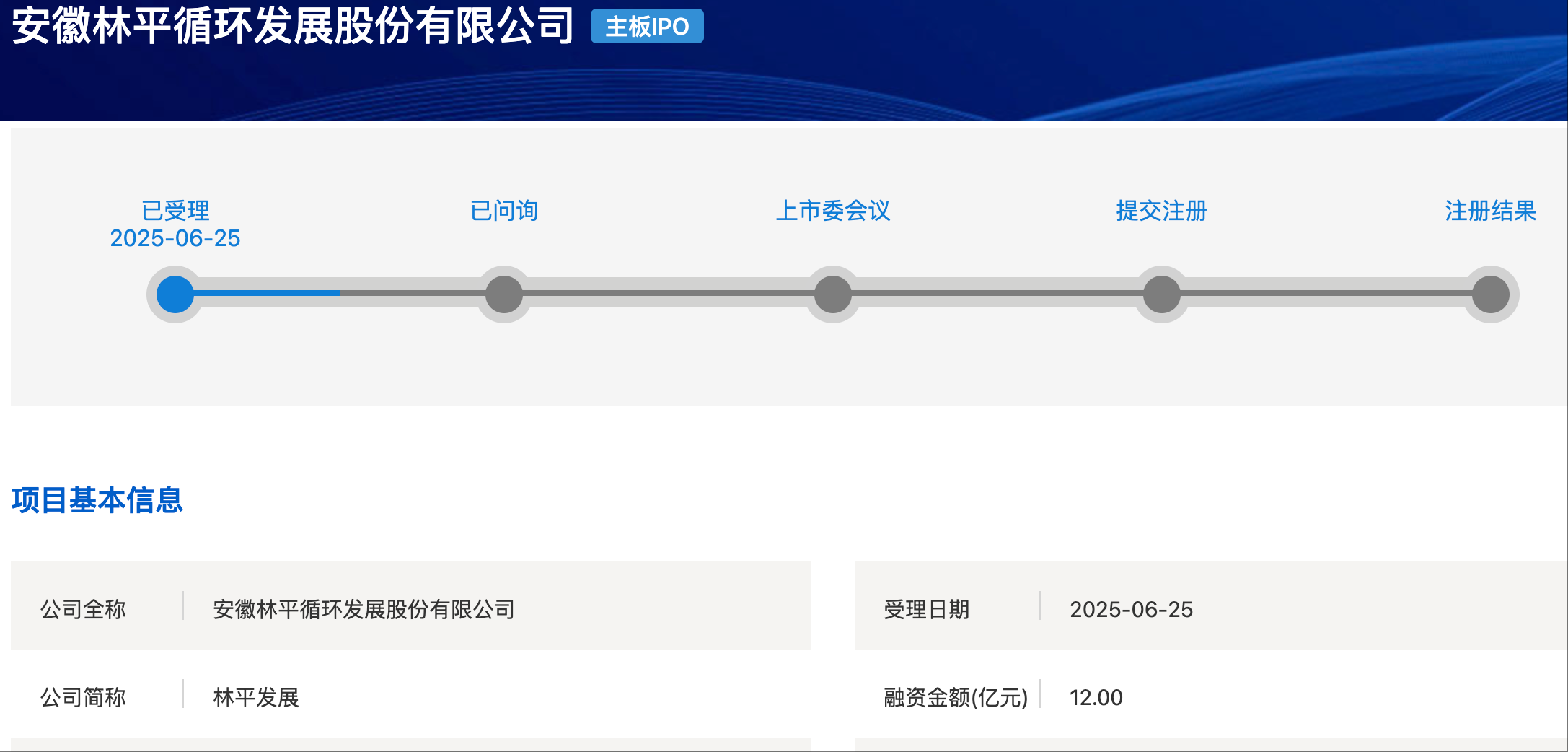
林平发展沪主板IPO获受理 拟募资12亿元
Zheng Quan Shi Bao Wang· 2025-06-25 13:54
Core Viewpoint - Anhui Linping Circular Development Co., Ltd. is seeking to raise 1.2 billion yuan through an IPO on the Shanghai Stock Exchange, focusing on the production of packaging paper products [1][5]. Company Overview - Linping Development specializes in the research, production, and sales of corrugated paper and boxboard, recognized as a high-tech enterprise with independent R&D capabilities [3]. - The company integrates waste paper utilization, cogeneration, and green paper-making, emphasizing environmental protection and resource recycling [3]. Market Position - Linping Development has a current production capacity of 1.2 million tons and ranks among the top 30 paper production companies in China, with a projected output of 1.0197 million tons in 2024 [4]. - The company holds a significant market share in Anhui Province, accounting for 35.65% of the province's paper and board production and 0.75% of the national total [4]. Financial Performance - The company reported revenues of 2.879 billion yuan, 2.8 billion yuan, and 2.485 billion yuan for the years 2022 to 2024, with net profits of 154 million yuan, 212 million yuan, and 153 million yuan respectively [5]. Future Growth Plans - The IPO proceeds will be allocated to projects aimed at producing 900,000 tons of green intelligent manufacturing materials and 600,000 tons of bio-based fiber materials [5]. - The investment projects are expected to enhance product upgrades, production capacity, and market share, thereby improving profitability [6]. - The company plans to phase out outdated production lines and invest in new intelligent production lines to enhance efficiency and product quality [6].

中再资环: 中再资环关于子公司变更名称及经营范围暨完成工商变更登记的公告
Zheng Quan Zhi Xing· 2025-06-23 08:16
Core Viewpoint - The company has announced changes in the names and business scopes of several subsidiaries to enhance brand recognition and comply with regulatory requirements [1][4]. Group 1: Name Changes - The company has changed the names of several subsidiaries, including: - Heilongjiang Zhongzai Sheng Waste Household Appliances Dismantling Co., Ltd. to Zhongzai Sheng (Suihua) Electronic Waste Recycling Co., Ltd. - Ningxia Yinen Solid Waste Resource Development Co., Ltd. to Zhongzai Sheng (Ningxia) Electronic Waste Recycling Co., Ltd. - Hubei Qichun Xinfeng Waste Household Appliances Dismantling Co., Ltd. to Zhongzai Sheng (Huanggang) Solid Waste Disposal Co., Ltd. [1][4]. Group 2: Business Scope Changes - The subsidiaries have adjusted their business scopes to comply with regulatory requirements, including: - General projects such as recycling of renewable resources (excluding production waste metals), office services, and sales of metal materials. - New additions include the recycling and secondary utilization of used power batteries from new energy vehicles, and sales of photovoltaic equipment and components [2][3][4]. Group 3: Impact on the Company - The changes in names and business scopes are aimed at improving brand recognition and do not result in significant changes to the company's main business operations. The company anticipates no adverse effects on its future development [4].

宏达股份: 四川宏达股份有限公司向特定对象发行股票募集说明书(注册稿)
Zheng Quan Zhi Xing· 2025-06-20 09:37
Core Viewpoint - Sichuan Hongda Co., Ltd. is issuing shares to specific investors to raise funds for debt repayment and working capital supplementation, with a total fundraising amount of approximately 285.29 million yuan [5][6]. Group 1: Company Overview - The company is primarily engaged in phosphate chemicals and non-ferrous metal zinc smelting, with main products including phosphate series products, compound fertilizers, synthetic ammonia, zinc ingots, and zinc alloys [2][3]. - The company lacks supporting phosphate and zinc mineral resources, making its operations highly susceptible to macroeconomic policies, external environments, and national industrial policies [2][3]. Group 2: Financial Performance - The company's net profits for recent periods were 60.16 million yuan, -95.84 million yuan, 36.11 million yuan, and -35.93 million yuan, indicating significant volatility in profitability [4]. - The gross profit margins for the main business were 9.93%, 5.89%, and 7.29% over the reporting periods, reflecting fluctuations influenced by economic cycles and market conditions [3][4]. Group 3: Share Issuance Details - The type of shares being issued is domestic listed ordinary shares (A shares) with a par value of 1.00 yuan per share [5]. - The issuance will be conducted through a specific target offering to Shudao Group, with a share price set at 4.68 yuan per share, which is not less than 80% of the average trading price over the previous 20 trading days [5][6]. - A total of 609.6 million shares will be issued, accounting for no more than 30% of the total share capital prior to the issuance [6]. Group 4: Industry Characteristics - The phosphate chemical industry is subject to national macro-control and self-regulation, with oversight from various governmental departments including the National Development and Reform Commission and the Ministry of Industry and Information Technology [14][15]. - The industry is characterized by significant regulatory scrutiny, particularly concerning product quality, safety production, and environmental protection [14][15]. - The non-ferrous metal industry, particularly zinc smelting, is regulated by the Ministry of Natural Resources and the Ministry of Industry and Information Technology, focusing on resource management and industry standards [24][25].

新华视点|科技、创新、绿色激发产业新动能
Xin Hua She· 2025-06-20 06:53
Group 1: Fitness Equipment Industry in Ningjin County - Ningjin County, with an area of less than 900 square kilometers, hosts 2,986 fitness equipment companies, accounting for 70% of China's commercial fitness equipment market, exporting to over 170 countries and regions [1] - The fitness equipment industry cluster in Ningjin covers over 5 million square meters and employs more than 45,000 people, with a localization rate of over 95% for components [1] - The development of the fitness equipment industry relies on a complete local industrial chain and the "digital intelligence" management level of local enterprises, which have increased R&D investment to enhance production efficiency and product competitiveness [1] Group 2: Trade and Exhibition - The annual Ningjin Fitness Equipment Exhibition features over 300 participating companies, showcasing more than 1,000 varieties across 400 series, attracting over 1,000 professional buyers for procurement [1] Group 3: Water Resource Management in Shandong - Shandong is accelerating the layout of a seawater desalination industry chain, utilizing dual-membrane desalination and concentrated saltwater pipeline transportation to promote resource recycling and support the blue economy [2] - The region has built 53 seawater desalination projects, with a daily production capacity of 867,000 tons, ranking among the top in the country [3] Group 4: Green Shipping Industry - In Qingdao, ship power companies are rapidly constructing a product system covering multiple fuel types and power ranges, promoting the high-end and internationalization of green low-carbon ship power equipment [3] - A notable project includes the construction of an ammonia fuel engine for a 210,000-ton bulk carrier, aiming to achieve breakthroughs in ammonia fuel power systems and provide a "Chinese solution" for global green shipping [3]
泰达股份: 关于投资设立参股子公司的进展公告
Zheng Quan Zhi Xing· 2025-06-19 11:00
证券代码:000652 证券简称:泰达股份 公告编号:2025-60 天津泰达股份有限公司 本公司及董事会全体成员保证信息披露的内容真实、准确、完整,没 有虚假记载、误导性陈述或重大遗漏。 三、备查文件 (一)《天津邦普泰达循环科技有限公司营业执照》 特此公告。 天津泰达股份有限公司 董 事 会 资子公司泰达碳资管增资并投资设立参股子公司的公告》 二、 进展情况 目前,合资公司已完成工商注册登记手续,并取得了由天津经济技术开发区 市场监督管理局颁发的《营业执照》。合资公司的具体信息如下: 池回收及梯次利用(不含危险废物经营);再生资源加工;生产性废旧金属回收; 非金属废料和碎屑加工处理;再生资源回收(除生产性废旧金属);再生资源销 售;电子专用材料制造;电子专用材料研发;电子专用材料销售;合成材料销售; 资源循环利用服务技术咨询;技术服务、技术开发、技术咨询、技术交流、技术 转让、技术推广。(除依法须经批准的项目外,凭营业执照依法自主开展经营活 动) 一、对外投资概述 天津泰达股份有限公司(以下简称"公司")于 2024 年 12 月 30 日召开第 十一届董事会第十二次(临时)会议,审议通过了《关于对全资子 ...
