氢能产业

Search documents
研判2025!中国车载储氢瓶行业发展背景、市场现状及企业格局分析:车载储氢瓶销量下滑,市场格局呈现高度集中的特点[图]
Chan Ye Xin Xi Wang· 2025-07-26 02:26
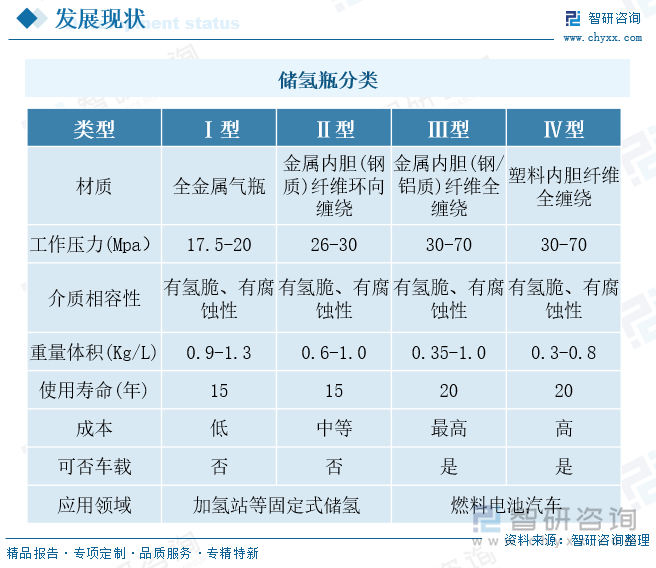
Core Viewpoint - The hydrogen fuel cell vehicle industry in China is currently in its early commercialization stage, with production and sales experiencing growth from 2021 to 2023, but facing a decline in 2024 due to the expiration of supportive policies and high industry costs [12][13]. Group 1: Overview of Hydrogen Storage Bottles - Hydrogen storage bottles are essential components of hydrogen fuel cell vehicles, primarily categorized into four types: Type I (all-metal), Type II (metal liner with fiber winding), Type III (metal liner with full fiber winding), and Type IV (non-metal liner with full fiber winding) [2][3]. - The majority of hydrogen storage bottles used in vehicles are Type III and IV, with Type III bottles currently dominating the market at 98% share in 2024 [19]. Group 2: Market Trends and Sales - The market for hydrogen storage bottles in China saw an increase in shipments from 2021 to 2023, but is projected to decline in 2024, with an estimated shipment of approximately 43,000 units, a year-on-year decrease of 12% [17]. - In the first five months of 2025, production and sales of hydrogen fuel cell vehicles were 1,176 and 1,122 units respectively, reflecting a year-on-year decline of 25% and 26.14% [13][15]. Group 3: Industry Structure and Competition - Over 20 companies are engaged in the research and production of hydrogen storage bottles in China, with a highly concentrated market structure where the top three companies hold 69% of the market share, an increase of 2 percentage points from 2023 [21]. - The leading companies in the hydrogen storage bottle market include Zhongcai Technology, Aoyang Green Energy, and Guofu Hydrogen Energy, each with a market share exceeding 20% [23]. Group 4: Future Development Trends - The industry is expected to see a shift towards higher pressure hydrogen storage bottles, with 70 MPa bottles becoming more common, while Type IV bottles are anticipated to gain traction due to their advantages in weight, pressure, and hydrogen storage efficiency [25]. - The development of standards for hydrogen storage bottles is expected to be enhanced, ensuring safety and reliability, which will facilitate the commercialization of hydrogen fuel cell vehicles [25].




B轮融资不及预期?质子汽车欲IPO,陕汽集团上市路径或已改变
Mei Ri Jing Ji Xin Wen· 2025-07-25 11:22
Group 1 - Proton Auto has completed a B-round financing of several hundred million yuan, with plans for an IPO aiming to raise approximately 200 million USD [1][2] - The company is backed by Shaanxi Automobile Group, which has faced challenges in its own capital market ambitions, leading to a strategy of listing subsidiaries like Proton Auto [1][6] - Proton Auto's B-round financing amount is reportedly lower than expected, with estimates around 400 million yuan, compared to the previously announced 550 million yuan [2][3] Group 2 - Proton Auto is positioned as a leader in the hydrogen fuel heavy truck market, with plans to be the first IPO in this sector, despite facing significant industry challenges [4][5] - The hydrogen fuel cell vehicle market remains small, with only 1,915 units sold in the first half of the year, indicating limited support for multiple IPOs in this space [5] - Shaanxi Automobile Group has shifted its listing strategy from a whole-group approach to individual subsidiaries, with Proton Auto being a key focus for future capital market entry [6][7]
氢动三秦 破壁新局 陕西全链攻坚锻造千亿氢能产业
Ke Ji Ri Bao· 2025-07-24 01:36
Core Insights - The hydrogen energy industry in Shaanxi is rapidly developing, with over 100 hydrogen enterprises established in the province, and the total industry chain output value expected to exceed 4 billion yuan this year [1][4] - The 2025 Hydrogen Energy Specialized Competition is being held in Shaanxi, showcasing the collaboration of government, industry, academia, and finance to accelerate hydrogen technology transformation and industrial upgrading [1][5] Industry Development - The hydrogen fuel cell stack production line in Shaanxi has achieved autonomy in materials, research, and production, with a capacity of 2,000 units per year and a potential output value of approximately 300 million yuan [2][3] - The cost of traditional high-pressure hydrogen storage is 23.3 yuan per kilogram, while new technology can reduce this to below 11 yuan, facilitating safer transportation of hydrogen [3] Policy and Infrastructure - Shaanxi's "14th Five-Year" hydrogen industry development plan aims to establish a complete supply chain and industry system by 2025, with a target industry scale exceeding 100 billion yuan [4][7] - The establishment of hydrogen energy standardization committees in Shaanxi and Xi'an is intended to coordinate technological resources and promote the application of hydrogen energy [3][7] Collaborative Initiatives - The international hydrogen energy joint laboratory involving Shaanxi Hydrogen Energy, Xi'an Jiaotong University, and Serbia aims to research new hydrogen storage materials and AI-assisted hydrogen energy systems [5] - The development of a complete hydrogen energy industry chain in Yulin, Shaanxi, is underway, focusing on hydrogen production, storage, refueling, and application [5][6] Future Projections - By 2025, Shaanxi is expected to have a hydrogen production capacity of 50,000 tons per year and over 200 hydrogen enterprises, with the core components of the hydrogen energy industry projected to generate an output value of 1 billion yuan [7]
亿华通牵头组建河北首个省级氢能学术组织
势银能链· 2025-07-23 09:05
Core Viewpoint - The establishment of the Hebei Hydrogen Energy Society marks a significant step in promoting the hydrogen energy industry in Hebei Province, integrating resources from universities, enterprises, and research institutions to enhance research and application of hydrogen technologies [2][4][5]. Group 1: Establishment of Hebei Hydrogen Energy Society - The Hebei Hydrogen Energy Society was officially established with approval from the Hebei Provincial Civil Affairs Department and the Hebei Provincial Association for Science and Technology, led by Yihua Tong and involving key local universities and enterprises [2][4]. - The society aims to serve the overall development of the hydrogen energy industry in Hebei, integrating intellectual resources from local universities and research institutions to create a high-level research and communication platform [5]. Group 2: Leadership and Objectives - Zhang Guoqiang, Chairman of Yihua Tong, was elected as the first president of the society, which will coordinate the development of the hydrogen energy industry and promote the commercialization of hydrogen fuel cell vehicles in Zhangjiakou [4][5]. - The society is expected to play a crucial role in the transformation of hydrogen energy technology and its application, leveraging Hebei's strong industrial base and policy advantages [4].

大冶市2.75亿氢车大单背后
势银能链· 2025-07-22 03:39
Core Viewpoint - The article highlights the significant developments in the hydrogen energy industry in Daye City, Hubei Province, focusing on the procurement of hydrogen vehicles and the establishment of a comprehensive hydrogen energy ecosystem [2][3][4]. Group 1: Hydrogen Vehicle Procurement - Daye City plans to procure 294 hydrogen vehicles, including 20 9-ton dump trucks, 228 31-ton dump trucks, 18 hydrogen loaders, and 28 hydrogen excavators, with a maximum budget of 275 million yuan [2]. - This procurement aligns with Daye's strategy to transition from a raw material industrial base to a national clean energy low-carbon application demonstration base [2]. Group 2: Key Developments in Hydrogen Industry - In July 2025, the Daye underground hydrogen storage tunnel project, constructed by China First Metallurgical Group, entered full construction, marking a significant advancement in domestic underground hydrogen storage technology [3]. - The project will be the first underground geological hydrogen storage project in China and will serve as a national energy strategic reserve base and a provincial-scale hydrogen storage hub [3]. Group 3: Infrastructure and Application - In April, 12 hydrogen fuel cell buses were put into operation in Daye, marking the beginning of hydrogen bus services in the region, with hydrogen refueling taking only 10 minutes at the Daye East Comprehensive Energy Station [3]. - The Daye East Comprehensive Energy Station, which integrates hydrogen refueling, gasoline refueling, and charging services, officially opened in April, supporting the local hydrogen bus fleet and other vehicles [4]. - A new project, jointly invested by E. Dong Fund and Beijing Hydrogen Puhua Energy Technology Co., with a total investment of 300 million yuan, focuses on fuel cell stack and system production, aiming for sales of at least 300 million yuan within three years [4]. Group 4: Ecosystem Development - Daye City is progressively building a complete hydrogen energy ecosystem, from infrastructure development to end-user applications and core technology investments, with the recent vehicle procurement expected to further enhance this ecosystem [4].

供需两端支撑 铂金价格年内涨超五成
Zheng Quan Ri Bao· 2025-07-21 16:29
Group 1: Platinum Price Trends - Platinum, referred to as the "golden alternative," has seen a significant price increase of 52.84% this year, with the latest price at 342.02 CNY per gram as of July 21, compared to 223.77 CNY per gram at the end of 2024 [1] - The primary reason for the price surge is a contraction in supply due to reduced capital expenditure in upstream mining over the past few years, leading to an expected year-on-year decrease in global platinum production [1] - Demand for platinum is anticipated to rise due to its role as a catalyst material in hydrogen fuel cells, with the hydrogen energy industry expected to drive future demand [1] Group 2: Demand and Supply Factors - South Africa, a key producer of platinum and palladium, is facing extreme weather conditions that may impact global supply [1] - In the automotive sector, a modest year-on-year growth of 2% to 4% in demand for platinum group metals is expected by the second half of 2025 [1] - The jewelry sector is projected to see a 15% increase in global platinum jewelry demand in 2025, driven by rising gold prices creating a substitution effect [1] Group 3: Industry Developments - The hydrogen energy sector is gaining policy support and investment globally, with platinum accounting for about half of the catalyst costs in hydrogen fuel cells, indicating a long-term increase in demand for platinum [2] - Young consumers are increasingly attracted to platinum jewelry due to its unique characteristics and relatively lower price compared to gold, enhancing its market appeal [2] - Several A-share listed companies are strategically positioning themselves in the platinum industry, such as CITIC Metal, which has interests in the Platreef platinum group metals project, expected to commence production in Q4 2025 [2] Group 4: Market Outlook - Companies like Mingpai Jewelry are leveraging their early advantages in the platinum market to explore new growth opportunities amid a recovering market [3] - The supply-demand dynamics are likely to continue supporting price increases in the near term, although challenges and uncertainties remain [3]
跨越储运“最后一公里” 氢能产业蓄势腾飞
Zheng Quan Ri Bao· 2025-07-21 16:29
Core Insights - The hydrogen energy industry is rapidly developing under the "dual carbon" goals, with significant projects underway, including the world's largest green hydrogen and ammonia integration project in Songyuan, Jilin Province, and a large-scale green hydrogen to methanol project in Inner Mongolia [1][2] - The Chinese government is actively promoting hydrogen energy through various policies and pilot programs, which has instilled confidence in industry stakeholders and accelerated development [2][3] - Companies are increasingly focusing on hydrogen energy, forming strategic partnerships and investing in technology to enhance production, storage, and transportation capabilities [3][4] Policy and Capital Support - The National Energy Administration has initiated hydrogen energy pilot projects to explore diverse development paths and promote the entire hydrogen energy supply chain [2] - Local governments, such as Fujian and Wuhan, have released long-term plans and action schemes to support hydrogen energy development [2] - The industry is experiencing a surge in favorable policies, which are boosting confidence among stakeholders [2] Technological Advancements - Electrolysis of water is a primary method for hydrogen production, with significant advancements in technology leading to a projected increase in production capacity by approximately 62% in 2024 [4] - Various electrolysis technologies, including alkaline, proton exchange membrane (PEM), and solid oxide (SOEC), are being developed to enhance efficiency and reduce costs [4] - Companies are investing heavily in research and development, with some allocating over 20% of their revenue to R&D efforts [4] Industry Collaboration and Challenges - The hydrogen energy sector faces challenges in achieving commercial viability, particularly in storage and transportation [5][7] - A significant project for long-distance hydrogen transportation via pipeline has been approved, which is expected to lower transportation costs compared to liquid hydrogen [5][7] - Industry stakeholders are encouraged to collaborate across the supply chain to optimize technology, cost control, and infrastructure development [5][6][7] Market Dynamics - The focus of capital investment is shifting from application to supply, emphasizing the importance of cost-effective hydrogen sources for market scalability [3] - The green hydrogen projects require substantial investment and a comprehensive assessment of the entire supply chain to ensure economic viability [7] - The hydrogen industry is still in its early stages, with many companies being relatively small, necessitating collaboration to address market demands and drive growth [7]

江苏神通(002438) - 2025年7月16日—7月17日调研活动附件之投资者调研会议记录
2025-07-20 05:46
Group 1: Company Overview and Strategy - The company provides various valve products for nuclear power plants, with a single nuclear power unit's valve order value exceeding 8,000,000 RMB [5] - The company emphasizes compliance with commitment letters and information disclosure regulations [2] - Future R&D investments will focus on meeting the growing demand for valves and flanges in domestic nuclear power construction [6] Group 2: Product Lifecycle and Maintenance - Nuclear valves have a design lifespan of up to 60 years, but require preventive maintenance and replacement due to environmental factors [3] - Metallurgical valves typically need maintenance or replacement every 2 to 3 years due to harsh operating conditions [3] - Chemical valves, often cast, also require regular maintenance and replacement under extreme conditions [3] Group 3: Market Position and Product Development - The company has developed a comprehensive product matrix for nuclear-grade valves, including butterfly valves, ball valves, and filter valves [7] - The domestic nuclear valve market has a localization rate of 85%-90%, indicating significant progress in the industry [17] - The company aims to enhance its market share through technological innovation and market expansion [17] Group 4: Certification and Competition - All nuclear-grade valves must undergo rigorous testing and certification, typically taking about two years [8] - The company has established a competitive edge in the nuclear valve market, with over 150,000 nuclear valves currently in operation [9] - Continuous innovation and product iteration are key strategies to maintain competitiveness in the nuclear valve sector [13] Group 5: Energy Efficiency and New Markets - The subsidiary, Shentong New Energy, focuses on high-pressure hydrogen valves, covering the entire hydrogen energy supply chain [12] - The energy-saving service model of the subsidiary Ruifan Energy involves contract energy management, providing stable returns over 5 to 8 years [14] - The company is actively participating in marine engineering projects, leveraging its production capabilities to meet current order demands [10]

吕梁:“氢”装上阵逐绿新赛道
Sou Hu Cai Jing· 2025-07-20 03:18
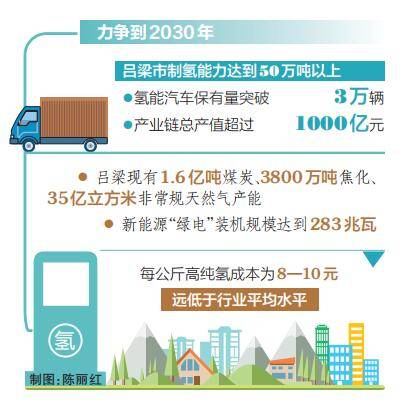
Core Viewpoint - Luliang is transitioning from coal dependency to a green, low-carbon economy by focusing on the hydrogen energy industry as a key driver for development [2][3]. Group 1: Hydrogen Industry Development - Luliang has established hydrogen energy as a priority in its "985" key industrial chain, with 15 supportive measures and an annual special fund of at least 100 million yuan [2]. - The city aims to achieve a hydrogen production capacity of over 500,000 tons by 2030, with more than 30,000 hydrogen vehicles and a total industrial output value exceeding 100 billion yuan [2]. - The region has a rich resource base for hydrogen production, including 160 million tons of coal, 38 million tons of coke, and 3.5 billion cubic meters of unconventional natural gas [3]. Group 2: Technological Advancements and Infrastructure - The first batch of 100 hydrogen heavy-duty trucks was launched in November 2022, with a second batch expected in December 2023, showcasing advancements in fuel cell technology and safety measures [3]. - Luliang has implemented a hydrogen fuel cell bus demonstration line, with the first five buses capable of a range exceeding 300 kilometers and zero carbon emissions [4]. - The city has established 11 hydrogen refueling stations and is accelerating the production of 300,000 hydrogen fuel cell vehicles annually [5]. Group 3: National Recognition and Future Prospects - Luliang was recently approved to join the national fuel cell vehicle demonstration city cluster, marking a significant milestone for the hydrogen industry in Shanxi province [4][5]. - The city’s hydrogen energy initiatives are expected to provide a model for collaborative industrial development across the country, enhancing the overall growth of the fuel cell vehicle sector [5].
身家暴跌253亿,“煤老板”姚俊良失守山西首富
创业家· 2025-07-19 09:43
Core Viewpoint - The wealth of the Yao Junliang family has significantly declined, losing the title of Shanxi's richest family, with their fortune dropping from 329.1 billion to 76 billion yuan, a decrease of 253.1 billion yuan over recent years [6][15][20]. Group 1: Wealth Decline - The Yao Junliang family's wealth has shrunk by 253.1 billion yuan, falling to 76 billion yuan in the 2025 New Fortune 500 list, marking a significant decline from their previous high [6][15]. - The family has been overtaken by Wang Guangxi and Guo Tianshu of Yongtai Energy, as well as Yang Xia of Jinbo Biological, dropping to third place among Shanxi's wealthy [6][15]. - The family's wealth has been on a downward trend since 2022, when they reached a peak of 329.1 billion yuan [6][15]. Group 2: Business Performance - Meijin Energy, the family's main business, has faced declining revenues, with a peak revenue of 24.6 billion yuan in 2022, followed by a drop of 15.4% and 8.55% in subsequent years, leading to a revenue of 19.03 billion yuan in 2024 [15][20]. - The company's net profit has also plummeted, recording a loss of 1.143 billion yuan in 2023 after a profit of 2.541 billion yuan in 2021 [15][20]. - The hydrogen energy business, which the company has heavily invested in, has not yet become a significant revenue contributor, accounting for only 4.16% of total revenue [15][20]. Group 3: Historical Context - The Yao family has a long history in the coal industry, starting with Yao Junliang's father, Yao Juhuo, who founded Meijin Energy in the 1980s [10][12]. - The family has transitioned through three generations, with Yao Junliang currently leading the business and his son Yao Jinlong taking on significant roles [12][20]. - Meijin Energy has evolved into one of the largest independent producers of coking coal and has made strides into the hydrogen energy sector, although it remains heavily reliant on traditional coal and coke operations [12][20]. Group 4: Market Challenges - The company has faced significant challenges, including a structural imbalance between the prices and costs of coal and coke, leading to reduced profit margins [16][20]. - The steel industry's downturn has negatively impacted demand for coking coal, contributing to increased inventory levels and reduced production [18][20]. - The company's gross margin has declined sharply from 30.25% in 2021 to just 0.14% in the first quarter of 2025, indicating severe financial strain [20].