
上市公司监管

Search documents
直面上市公司监管痛点 新条例构建全链条闭环
Zhong Guo Jing Ying Bao· 2025-12-07 10:23
Core Viewpoint - The China Securities Regulatory Commission (CSRC) has released the draft of the "Regulations on the Supervision and Administration of Listed Companies," which aims to enhance corporate governance, strengthen information disclosure, regulate mergers and acquisitions, protect investors, and combat illegal activities in the capital market. This regulation is seen as a significant step towards improving the quality and transparency of listed companies and enhancing investor confidence [1][2]. Group 1: Key Aspects of the Regulations - The draft regulation addresses the persistent issues of violations by major shareholders and internal personnel, which have undermined investor confidence [2]. - It emphasizes the need for a modern corporate governance system in China, which is crucial for building world-class enterprises and achieving modernization [2]. - The regulation aims to create a closed-loop system around corporate governance, information disclosure, capital operations, investor protection, and enforcement penalties [1][4]. Group 2: Governance and Disclosure - The regulation specifies mandatory items for company charters, the roles of independent directors and audit committees, and sets clear standards for directors' diligence obligations [3][4]. - It establishes a multi-party accountability mechanism for financial fraud and requires audit committees to review financial reports before submission to the board [3][5]. - The regulation prohibits major shareholders from engaging in fund occupation and illegal guarantees, enhancing the identification and accountability of actual controllers [6][7]. Group 3: Mergers and Acquisitions - A dedicated chapter on mergers and acquisitions outlines a negative list for acquirers and requires performance commitments from transaction parties [8][9]. - It mandates that acquirers must not have significant debts or recent legal penalties, ensuring that only qualified entities can engage in acquisitions [8]. - The regulation aims to prevent misleading restructurings and high-premium arbitrage through comprehensive oversight of the entire transaction process [9][10]. Group 4: Investor Protection - The regulation includes a specific chapter on investor protection, mandating companies to focus on investment value and establish cash dividend and share buyback requirements [11]. - It introduces a mechanism for coordinating bankruptcy restructuring and emphasizes the need for companies to protect investors during the delisting process [11]. - The regulation aims to systematize investor return mechanisms, making cash dividends a priority over stock dividends and allowing multiple dividends within a year [11][12]. Group 5: Recommendations for Improvement - Experts suggest that the regulation should enhance legal deterrents against violations and provide clearer decision-making authority for audit committees to avoid supervisory vacuums [13][14]. - There is a call for more substantial rights for minority shareholders in dividend policies, delisting arrangements, and major transaction votes [14]. - Recommendations also include clarifying standards for related party transactions and refining the responsibilities of independent directors to prevent excessive accountability [15].
上市公司治理再迎升级 我国将迎来首部专门的上市公司监管行政法规
Yang Guang Wang· 2025-12-07 04:51
Core Viewpoint - The China Securities Regulatory Commission (CSRC) has released the draft of the "Regulations on the Supervision and Administration of Listed Companies," marking the first specialized administrative regulation for listed company supervision in China's capital market, aimed at enhancing information disclosure regulation and protecting investor rights [1][2]. Group 1 - The draft regulation consists of eight chapters and seventy-four articles, focusing on improving corporate governance requirements and regulating the behavior of key stakeholders such as controlling shareholders, actual controllers, directors, and senior executives [1]. - The regulation aims to combat illegal activities and specifies penalties for behaviors such as asset occupation and collusion in financial fraud [1]. - The regulation emphasizes three key themes: risk prevention, strengthened regulation, and promotion of development, indicating a new phase of systematic and legal oversight for listed companies [1]. Group 2 - The draft explicitly prohibits listed companies from fabricating financial reports through fictitious transactions or abuse of accounting policies, introducing an innovative system for recovering profits from fraud [2]. - It states that related parties, customers, suppliers, and service institutions of listed companies are prohibited from assisting in the preparation of false financial reports, with fines ranging from 1 million to 10 million yuan for violations [2]. - For securities service institutions that fail to perform due diligence, fines can reach up to five times their business income, with a minimum fine of 500,000 to 2.5 million yuan for those with insufficient income, and severe cases may lead to suspension or prohibition from engaging in securities services [2].
我国将迎来首部专门的上市公司监管行政法规 有何“亮点”?具体解读来了↓
Yang Shi Wang· 2025-12-07 03:43
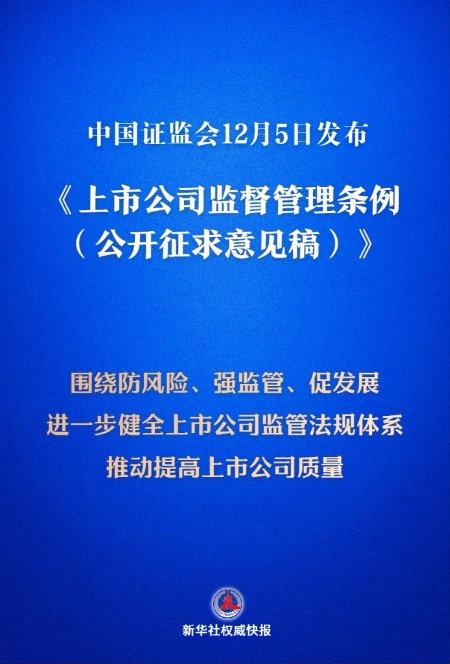
央视网消息:12月5日,中国证监会发布《上市公司监督管理条例(公开征求意见稿)》,这意味着我国将迎来首部专门的上市公司监管 行政法规。专家表示,这部《上市公司监督管理条例(公开征求意见稿)》就像资本市场的升级版规则手册,将从制度层面切断造假链条。来 看具体解读。 专家表示,《条例》将近些年监管执法的有益经验上升固化为法规,切实解决监管实践面临的难点痛点,为严监严管提供有力支撑。 华夏基金首席策略分析师轩伟称:"首次在行政法规层面设专章重点规范上市公司治理问题,明确了从上市后到退市前公司治理、信息披 露、并购重组、分红回购、市值管理、破产重组、股票退市等各项与资本市场活动相关的监管要求。" 专家表示,《条例》征求意见稿中每一项举措都直击市场的痛点。特别强调了对控股股东、实际控制人、董事、高级管理人员等"关键少 数"的规范和约束,进一步健全上市公司监管法规。 吴清:A股市场总体活跃 总市值超过100万亿元 针对上市公司财务造假顽疾,《条例》征求意见稿构建"源头防控+过程监测+事后追责"全链条机制,从制度层面切断造假链条。 中国银河证券首席策略分析师杨超称:"若上市公司基于虚假财报进行利润分配或支付薪酬,董事会需收 ...

对话北大郭雳:上市公司监管条例有哪些亮点?有何影响?
Di Yi Cai Jing· 2025-12-07 03:33
Core Viewpoint - The newly proposed "Regulations on the Supervision and Administration of Listed Companies" by the China Securities Regulatory Commission (CSRC) aims to enhance corporate governance, improve investor protection, and strengthen market discipline in China's capital market [1][2][6]. Group 1: Regulatory Framework - The regulations will serve as a foundational legal framework for listed companies, positioned below the Company Law and Securities Law but above the rules set by the CSRC and exchanges [1][6]. - The regulations are designed to systematically define corporate governance for listed companies, addressing previously scattered operational requirements found in various regulatory documents [2][6]. Group 2: Corporate Governance Enhancements - The draft includes detailed provisions on corporate governance across four dimensions: solidifying organizational foundations, regulating the "key minority" (controlling shareholders), strengthening fiduciary duties, and improving safeguarding mechanisms [3][4]. - By delineating boundaries for controlling shareholders and enhancing the responsibilities of directors and senior management, the regulations aim to reduce governance loopholes and improve risk management capabilities [4]. Group 3: Investor Protection Measures - The regulations enhance the quality of information disclosure and prohibit market manipulation, which will improve the conditions for investors to assess the value of listed companies [5]. - Institutional arrangements for cash dividends and share buybacks are included to elevate investor expectations for long-term returns, encouraging a shift from short-term trading to long-term investment [5]. - The regulations strictly regulate the delisting process, preventing interference with the stock exchange's decisions, thereby promoting a market mechanism that favors high-quality companies [5]. Group 4: Impact on Market Stability - By reinforcing the legal framework for mergers and acquisitions, the regulations will support listed companies in optimizing their business structures through resource integration, thereby enhancing their core competitiveness [4]. - The regulations aim to establish a robust foundation for market integrity by intensifying the crackdown on fraudulent activities, which will foster compliance and improve the overall market environment [5][6]. Group 5: Role in Regulatory System - The regulations will act as a crucial link in the regulatory framework, connecting the Company Law, Securities Law, and the rules of the CSRC and exchanges, thereby enhancing the clarity and effectiveness of the regulatory system [6][7]. - They provide a more direct legal basis for the CSRC's detailed regulatory requirements, facilitating a more coherent and efficient regulatory chain [7].
证监会发布首部上市公司监管行政法规,资本市场迎重大制度升级!
Sou Hu Cai Jing· 2025-12-06 04:48
Core Viewpoint - The China Securities Regulatory Commission (CSRC) has released the first administrative regulations specifically for the supervision of listed companies, marking a significant upgrade in the regulatory framework of the capital market, aimed at promoting high-quality development [3][4]. Policy Background - The regulations address persistent issues such as financial fraud, major shareholder misappropriation, and illegal guarantees, with over 3,000 cases investigated in 2024, highlighting existing institutional shortcomings [4]. - The need for a unified regulatory framework has arisen as the number of listed companies surpasses 5,000 amid deepening registration system reforms [4]. Core Breakthroughs - **Corporate Governance**: Transitioning from "formal compliance" to "substantive constraints" with clear responsibilities for controlling shareholders and executives, requiring independent directors to constitute over half of the audit committee [5]. - **Information Disclosure**: Enhanced measures against financial fraud, including significant penalties for third-party collusion and mandatory accountability for audit committees regarding financial report authenticity [5]. - **Mergers and Acquisitions**: Mandatory hiring of independent financial advisors for major asset restructurings, with stricter standards for their independence and professionalism [6]. - **Investor Protection**: New policies for voluntary delisting, requiring cash options for shareholders and mandating a minimum of 30% profit distribution for profitable companies over three consecutive years [7]. - **Law Enforcement Upgrade**: Comprehensive measures against illegal activities, including severe penalties for financial fraud and the establishment of a "red-black list" for listed companies [8]. - **Delisting Mechanism**: New standards for delisting based on stock price and market capitalization, with regulations to prevent evasion of delisting through bankruptcy restructuring [9]. Industry Impact - **Compliance Companies**: Expected to benefit from value reassessment, with examples of companies experiencing stock price increases and higher trading volumes post-regulation [10]. - **High-Risk Sectors**: Anticipated deep restructuring, particularly for ST stocks, with an expected expansion of the delisting list [11]. - **Intermediary Institutions**: Facing both challenges and opportunities, with increased responsibilities for audit firms and rising legal service fees for compliance consulting [12]. Deep Challenges - **Regulatory Efficiency vs. Market Vitality**: Striking a balance between simplifying processes and maintaining strict oversight to prevent misleading restructurings [13]. - **Central Regulation vs. Local Protection**: Establishing cross-province inspection cooperation mechanisms to enhance regulatory effectiveness [14]. - **International Alignment vs. Local Characteristics**: Clarifying cross-border regulatory frameworks while retaining flexibility for local innovations [15]. Future Outlook - **Technological Empowerment**: Plans to establish an "intelligent regulatory brain" by 2026 for real-time monitoring of over 100,000 listed companies [16]. - **Investor Education**: Mandatory updates from listed companies on their operations through short video accounts [16]. - **Global Collaboration**: Joining international regulatory frameworks to combat cross-border financial fraud [16].
首部!证监会重磅发布!
天天基金网· 2025-12-06 02:49
Core Viewpoint - The article discusses the release of the "Regulations on the Supervision and Administration of Listed Companies (Draft for Public Comment)" by the China Securities Regulatory Commission (CSRC), marking the introduction of the first dedicated administrative regulations for the supervision of listed companies in China [4]. Group 1: Improvement of Corporate Governance Requirements - The regulations aim to enhance corporate governance by specifying the basic structure of governance for listed companies, detailing the roles and responsibilities of shareholders, boards, audit committees, and independent directors [5]. - It establishes clear qualifications for directors and senior management, emphasizing their duties of loyalty and diligence, and outlines the responsibilities of the board secretary [5]. - The regulations also impose strict rules on controlling shareholders and actual controllers, prohibiting actions that harm the interests of listed companies, such as fund occupation and illegal guarantees [5]. Group 2: Strengthening Information Disclosure Supervision - The regulations focus on preventing financial fraud in information disclosure, mandating that financial reports be accurate and complete, and requiring the establishment of robust internal control systems [6]. - It assigns responsibilities to the audit committee for the prior review and post-investigation of financial reports, enhancing internal oversight [6]. - The regulations clarify the obligations of controlling shareholders and other parties in relation to information disclosure, balancing shareholder rights with fair disclosure principles [6]. Group 3: Regulation of Mergers and Acquisitions - The regulations provide detailed definitions and requirements for mergers and acquisitions, aiming to reduce market disputes and stabilize expectations [8]. - It specifies the roles and independence requirements for financial advisors in the context of mergers and acquisitions, ensuring they act as gatekeepers [8]. - The regulations also emphasize the obligation of listed companies to focus on investment value and establish basic requirements for cash dividends and share buybacks [8]. Group 4: Legal Responsibilities and Supervision - The regulations outline supervisory measures for regulatory bodies, including the authority to mandate corrections and suspend mergers and acquisitions in cases of violations [7]. - Specific penalties are established for actions such as fund occupation and collusion in fraud, increasing the crackdown on illegal activities [7]. Group 5: Enhancing Legal Framework for High-Quality Development - The introduction of these regulations is seen as a necessary step to enhance the legal framework supporting the quality of listed companies, addressing issues such as governance deficiencies and non-compliance in information disclosure [9]. - The CSRC emphasizes the importance of a regulatory approach that is politically and socially responsible, focusing on risk prevention and high-quality development [9]. - Future amendments to the regulations will be based on public feedback, ensuring a democratic and scientific legislative process [9].

“防风险、强监管、促发展” !首部上市公司监管条例为资本市场高质量发展护航
Yang Shi Wang· 2025-12-06 02:45
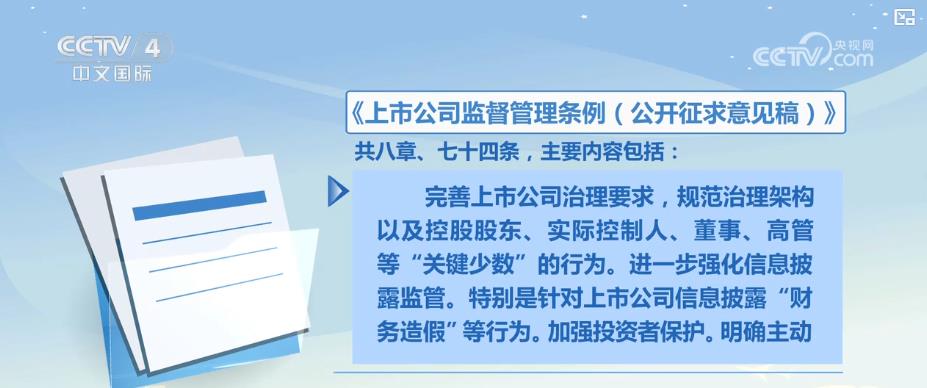
Core Viewpoint - The China Securities Regulatory Commission (CSRC) has released the draft of the "Regulations on the Supervision and Administration of Listed Companies," marking the introduction of the first dedicated regulatory framework for listed companies in China's capital market [1][3]. Group 1: Key Content of the Regulations - The regulations consist of eight chapters and seventy-four articles, focusing on improving corporate governance requirements, standardizing governance structures, and regulating the behavior of key stakeholders such as controlling shareholders, actual controllers, directors, and senior executives [3]. - There is an emphasis on strengthening information disclosure regulations, particularly targeting fraudulent financial disclosures by listed companies [3]. - The regulations aim to enhance investor protection by clarifying arrangements for protecting investors during voluntary delisting and preventing companies from evading delisting or harming investor interests through bankruptcy restructuring [3]. Group 2: Regulatory Objectives - The regulations are centered around three main themes: risk prevention, enhanced regulation, and promotion of development, indicating a shift towards a more systematic and rule-based approach to the regulation of listed companies [5]. - The regulations include strict penalties for illegal activities, detailing specific measures that the State Council's securities regulatory body can take in the enforcement of these regulations, including penalties for behaviors such as misappropriation of guarantees and collusion in fraud [3].
上市公司监督管理条例征求意见稿发布 投资者保护再加码
Yang Shi Xin Wen· 2025-12-06 01:21
Core Points - The China Securities Regulatory Commission (CSRC) has released the "Regulations on the Supervision and Administration of Listed Companies (Draft for Public Comment)", marking the first specialized administrative regulation for listed company supervision in China [1][3] - The regulation consists of eight chapters and seventy-four articles, focusing on improving corporate governance, regulating the behavior of key stakeholders, enhancing information disclosure supervision, and strengthening investor protection [1][3] Group 1: Corporate Governance - The draft emphasizes the regulation and constraints on key stakeholders such as controlling shareholders, actual controllers, directors, and senior management [3][5] - It mandates that the board of directors must establish an audit committee, with a majority of independent directors and the chairperson being a professional accountant [3][7] - The audit committee will take on the responsibilities of the supervisory board, overseeing financial disclosures, internal and external audits, and internal controls [3][5] Group 2: Financial Fraud Prevention - The draft establishes a comprehensive mechanism for preventing financial fraud, including source prevention, process monitoring, and post-event accountability [8] - It prohibits listed companies from fabricating transactions or misusing accounting policies to create false financial reports, requiring that financial reports be approved by the audit committee before submission to the board [8][10] - Penalties for third parties involved in assisting the fabrication of false financial reports range from 1 million to 10 million yuan [8][10] Group 3: Investor Protection - The draft enhances investor protection mechanisms during the delisting process, requiring companies to provide cash options or other legal measures for dissenting shareholders [10] - It mandates that the board and senior management communicate with investors through performance briefings and consider investor interests in major decisions [10]
新华鲜报|我国将迎来首部专门的上市公司监管行政法规
Xin Hua Wang· 2025-12-06 00:52
Core Viewpoint - The China Securities Regulatory Commission has released the draft of the "Regulations on the Supervision and Administration of Listed Companies," marking the introduction of the first dedicated administrative regulations for listed company supervision in China [1][3]. Group 1: Regulatory Framework - The new regulations are based on existing company and securities laws, further detailing and clarifying legal systems related to corporate governance and information disclosure [1][3]. - The regulations aim to enhance the quality of listed companies, which have seen rapid growth and structural optimization, with over 5,000 companies forming the foundation of the capital market [3]. Group 2: Mergers and Acquisitions - Mergers and acquisitions are highlighted as crucial for fostering new growth points and improving quality within listed companies, with the regulations establishing basic normative requirements for these activities [3][4]. Group 3: Investor Protection - A dedicated chapter in the regulations focuses on investor protection, mandating that listed companies enhance their profitability and return levels while prohibiting market manipulation and other illegal activities [3][4]. - The regulations also aim to improve cash dividend and share buyback mechanisms to encourage companies to be more aware of investor returns [4]. Group 4: Corporate Governance - Corporate governance is emphasized as a key area of regulation, with specific provisions to standardize company charters and governance structures, ensuring accountability among directors and senior management [4]. - The regulations include measures to prevent financial fraud, enhance oversight of related party transactions, and establish penalties for collusion in fraudulent activities [4][5]. Group 5: Overall Impact - The introduction of these regulations is expected to solidify the legal foundation for high-quality development of listed companies, thereby strengthening the capital market [5].
上市公司监管条例征求意见,四个“突出”透视万字长文
Di Yi Cai Jing· 2025-12-06 00:52
Core Viewpoint - The China Securities Regulatory Commission (CSRC) has released a draft of the "Regulations on the Supervision and Management of Listed Companies" for public consultation, marking a significant step in enhancing the regulatory framework for listed companies and promoting high-quality development in the capital market [1][2]. Group 1: Company Governance - The draft establishes a dedicated chapter on "Company Governance," comprising 24 articles and over 4,400 words, which accounts for one-third of the entire document [3]. - It aims to refine governance requirements, regulate the behavior of controlling shareholders and executives, and enhance the effectiveness of governance structures [3]. - Key provisions include the standardization of company charters, governance structures, and the responsibilities of independent directors and board secretaries [3]. Group 2: Mergers and Acquisitions - The draft clarifies the definitions and basic requirements for mergers and acquisitions, aiming to stabilize market expectations [4]. - It enhances the regulations surrounding financial advisors, detailing their independence and responsibilities in the context of mergers and acquisitions [4]. - The goal is to optimize corporate equity and asset structures through regulated mergers and acquisitions, supporting industrial integration and upgrading [4]. Group 3: Anti-Fraud Measures - The draft strengthens regulations against financial fraud, emphasizing the fairness and compliance of related party transactions [5]. - It mandates the establishment of internal control systems within companies and outlines the responsibilities of audit committees regarding financial reports [5]. - The draft also prohibits controlling shareholders from misappropriating company funds and sets legal responsibilities for such actions [5]. Group 4: Investor Protection - The draft emphasizes the protection of investors by requiring companies to enhance cash dividends and share buyback mechanisms [6]. - It aims to prevent companies from evading delisting and mandates that companies provide cash options or other legal measures to protect dissenting shareholders [6]. - The regulations also prohibit any interference with the stock exchange's delisting decisions, reinforcing the commitment to investor rights [7].