中国—东盟自贸区3.0版

Search documents
专访泰国开泰研究中心首席经济学家布林:中泰供应链合作持续深化
2 1 Shi Ji Jing Ji Bao Dao· 2025-10-31 11:29
Group 1 - Renewable energy is a key area for China-ASEAN economic cooperation, with China leading in clean technology, which will attract more investments into Thailand and other ASEAN countries [1][4] - The China-ASEAN Free Trade Area 3.0 upgrade is expected to significantly change business operation models, particularly through the establishment of a unified "single window" system to enhance trade flow [1][3] - The upgrade of the free trade area, which began negotiations in November 2022 and concluded in October 2024, aims to address not only traditional tariff issues but also new areas such as digital economy rules and green economy [2][3] Group 2 - China has been ASEAN's largest trading partner for 16 consecutive years, while ASEAN has been China's largest trading partner for 5 years, indicating strong trade dynamics [2] - The report from the China Financial Forty Forum and the Krung Thai Research Center highlights a continuous increase in China's exports to Thailand and a record high in greenfield investments from China in sectors like automotive manufacturing and electronics [2][3] Group 3 - The cooperation between China and Thailand is evolving from a complementary relationship to strategic integration, with a focus on creating a "win-win model" for regional collaboration [3][13] - The potential for cooperation in renewable energy and food safety is significant, providing more export opportunities for Thailand and the entire ASEAN region [4][11] Group 4 - Thailand's investment environment has unique competitive advantages despite challenges in capital gains and dividend taxes compared to Singapore, particularly in attracting foreign direct investment (FDI) [5][6] - The Thai government is expected to implement measures to enhance transparency and digitize government processes to attract more foreign investments [6][9] Group 5 - Geopolitical risks and trade tensions are prompting companies to adjust their supply chain strategies, with many global firms considering Thailand for diversified production locations to mitigate risks [11][12] - The integration of China and ASEAN is expected to enhance long-term competitiveness, although it may also increase competition for local businesses [13][14]
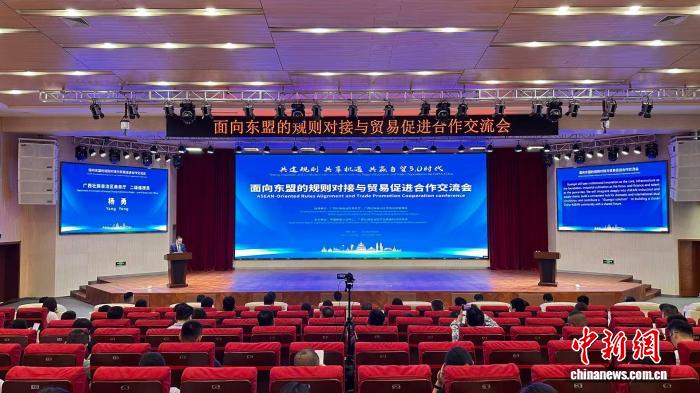
面向东盟的规则对接与贸易促进合作交流会在南宁举办
Zhong Guo Xin Wen Wang· 2025-10-29 06:22
Core Points - The conference focused on the opportunities brought by the upgrade of the China-ASEAN Free Trade Area 3.0, aiming to build a professional platform for regional economic and trade cooperation [1][4] - The event emphasized the importance of deepening rule alignment and strengthening industrial chain integration as part of the 3.0 version's core direction [3] Group 1 - The conference featured policy interpretation, results release, and practical sharing to help enterprises adapt to ASEAN compliance requirements [3] - Key breakthroughs of the China-ASEAN Free Trade Area 3.0 were analyzed, highlighting new cooperation areas in digital and green economies, marking a shift from "mutual tariff reduction" to "joint standard regulation" [3] - The China Quality Certification Center launched a sustainable value evaluation system for supply chain enterprises, focusing on compliance, green production, and circulation efficiency [3] Group 2 - The Guangxi Product Quality Inspection Research Institute shared its efforts in promoting high-end quality certification for Guangxi's specialty products in the Guangdong-Hong Kong-Macao and international markets [3] - The conference reinforced Guangxi's role as a gateway for China's open cooperation with ASEAN, providing full-chain services for the implementation of the China-ASEAN Free Trade Area 3.0 [4]

广西助力企业把握自贸区3.0版发展机遇
Guang Xi Ri Bao· 2025-10-29 04:21
Core Viewpoint - The event "Embrace Free Trade 3.0, Co-create a New Future" marks the launch of activities related to the signing of the China-ASEAN Free Trade Area 3.0 upgrade protocol in Guangxi, aimed at enhancing regional economic cooperation and seizing new market opportunities in ASEAN [1] Group 1: Event Overview - The launch ceremony took place in Nanning on October 28, focusing on deepening Guangxi's integration with the China-ASEAN Free Trade Area 3.0 [1] - The event aims to assist enterprises in leveraging the new round of regional trade rule upgrades for development opportunities [1] Group 2: Government Initiatives - The Guangxi Autonomous Region's Commerce Department plans to introduce supporting measures to enhance policy interpretation and training for enterprises [1] - There will be a focus on improving companies' ability to apply new trade rules, particularly for small and medium-sized enterprises [1] Group 3: New Services and Support - The China-ASEAN Free Trade Area 3.0 Guangxi Enterprise Outbound Service Station was inaugurated to provide comprehensive consulting services, including policy interpretation and market expansion [1] - Following the launch, a seminar titled "Decoding the New Dividends of Free Trade 3.0 to Empower Guangxi Enterprises in Expanding into ASEAN" was held, featuring expert insights on new opportunities and changes [1]
刘均胜:中国—东盟自贸区进入新发展阶段
Jing Ji Ri Bao· 2025-10-29 00:09
Core Points - The signing of the China-ASEAN Free Trade Area 3.0 agreement during the 47th ASEAN Summit on October 28 aims to enhance economic cooperation and support multilateral free trade amidst global uncertainties [1][2] - The 3.0 version introduces significant upgrades in nine areas, marking a shift from previous agreements and indicating a new phase in the development of the China-ASEAN Free Trade Area [1][3] Summary by Sections Trade Value Chain - The original goal of the China-ASEAN Free Trade Area was to eliminate all tariffs and non-tariff barriers on goods trade, achieving over 90% zero tariffs by 2010 [2] - The 2.0 version aimed for a bilateral trade volume of $1 trillion and mutual investment of $150 billion by 2020, focusing on further liberalizing goods trade [2] Supply Chain Connectivity - The 3.0 version emphasizes supply chain connectivity, addressing issues like the free flow of key products and services, infrastructure connectivity, and collaborative responses to supply chain disruptions [3] - It includes provisions related to digital economy, customs procedures, and trade facilitation, which are crucial for enhancing trade and economic growth [3] Emerging Topics - New areas of cooperation in the 3.0 version include digital economy and green economy, moving beyond traditional trade topics [4][5] - Digital economy provisions cover measures for seamless digital trade, data management, and cybersecurity, aiming to enhance participation of SMEs and address the digital divide [4] - Green economy initiatives focus on environmental products and services, promoting sustainable economic growth and regional energy transition [5][6] Institutional Level Enhancement - The 3.0 version introduces separate chapters on standards and regulations, competition, and consumer protection, reflecting the need for higher institutional standards in trade agreements [7] - It aims to unify standards and technical regulations while protecting consumers and promoting fair competition in the market [7]
中国—东盟自贸区进入新发展阶段
Jing Ji Ri Bao· 2025-10-28 22:25
Core Points - The signing of the China-ASEAN Free Trade Area 3.0 upgrade protocol during the 47th ASEAN Summit signifies a new phase in the China-ASEAN community building, injecting new momentum into regional integration and demonstrating support for global multilateral free trade [1][2][3] Summary by Sections Trade Value Chain - The China-ASEAN Free Trade Area aims to eliminate all tariffs and non-tariff barriers on goods trade, achieving over 90% zero tariffs by 2010 with the completion of the 1.0 version [2] - The 2.0 version, signed in 2015, focused on enhancing the liberalization of goods trade, with a target of reaching a bilateral trade volume of $1 trillion and $150 billion in mutual investment by 2020 [2] Supply Chain Connectivity - The 3.0 version includes a focus on supply chain connectivity, addressing issues such as the free flow of key products and services, infrastructure connectivity, and collaborative responses to supply chain disruptions [3] - It encompasses nine areas related to supply chain topics, including digital economy, customs procedures, and small and medium enterprises, which are expected to double trade and economic growth benefits when supported by trade facilitation [3] Emerging Topics - The 3.0 version introduces cooperation in the digital economy and green economy, moving beyond traditional trade topics to include next-generation trade issues [4][5] - In the digital economy, it includes measures for seamless digital trade, data management, and cybersecurity, aiming to enhance participation from small and medium enterprises and address the digital divide [4] - The green economy section focuses on environmental products and services, promoting sustainable economic growth and regional energy transition through cooperative frameworks [5] Institutional Level Enhancement - The 3.0 version establishes separate chapters for standard and regulatory integration, as well as competition and consumer protection, reflecting efforts to enhance the institutional level of the free trade area [6] - It emphasizes the need for unified standards and regulations, encouraging joint development of compliance assessment procedures and protecting online consumers [6]
中国—东盟自贸区迈入3.0时代,数字经济、绿色经济合作迎新机
2 1 Shi Ji Jing Ji Bao Dao· 2025-10-28 14:04
Core Points - The China-ASEAN Free Trade Area (CAFTA) has officially entered its 3.0 version with the signing of the upgrade protocol during the 47th ASEAN Summit in Malaysia, marking a significant step in regional economic integration [2][3] - The upgrade protocol expands cooperation into nine key areas, including digital economy, green economy, supply chain connectivity, and standards and regulations, reflecting a mutual commitment to lead international rule-making and promote cooperation in emerging fields [2][4][5] Group 1: Economic Significance - The CAFTA is China's first free trade agreement and plays a crucial role in China-ASEAN economic cooperation, evolving from version 1.0 to 3.0, showcasing efforts towards regional economic integration [3][4] - The signing of the 3.0 upgrade protocol is seen as a vital measure for high-quality open cooperation between China and ASEAN amid global economic uncertainties [4][5] Group 2: Areas of Cooperation - The upgrade protocol covers nine areas, including digital economy, green economy, supply chain connectivity, and technical standards, indicating a shift from traditional trade to a focus on rules and standards [5][7] - The cooperation in digital and green economies is particularly emphasized, with potential benefits for both parties in terms of technology transfer and industry upgrades [8][9] Group 3: Trade Statistics - In the first three quarters of the year, the total trade value between China and ASEAN reached 5.57 trillion RMB, a year-on-year increase of 9.6%, with ASEAN maintaining its position as China's largest trading partner [8][9] - Specific trade growth includes a 28.2% increase in textile machinery exports and a 40.7% increase in rubber imports from ASEAN, highlighting the deepening trade ties [9][10] Group 4: Future Outlook - The CAFTA 3.0 version is expected to enhance regional economic resilience and provide a stable development space for small and medium enterprises by deepening institutional cooperation [5][6] - The ongoing collaboration is anticipated to maximize resource advantages and explore potential in high-tech industries, with Chinese semiconductor companies investing in Malaysia as a notable example [9][10][11]
中国—东盟自贸区3.0版如何助广西汽车加速出海?
Zhong Guo Xin Wen Wang· 2025-10-28 10:33
Core Viewpoint - The signing of the China-ASEAN Free Trade Area 3.0 upgrade protocol will enhance trade and investment facilitation, mutual recognition of rules, and connectivity of supply chains, providing new opportunities for Guangxi automotive companies to expand into the ASEAN market [1][3]. Group 1: Guangxi Automotive Group's Expansion - Guangxi Automotive Group has delivered its 5,000th vehicle to the ASEAN market, including new energy logistics vehicles and golf carts [1][3]. - The company has achieved an export volume exceeding 200 million RMB by focusing on core ASEAN markets such as Singapore, Malaysia, Vietnam, Thailand, and Indonesia [3]. - Guangxi Automotive Group has established a production base in Indonesia, promoting localized production and supply chain integration [3]. Group 2: Strategic Collaborations and Innovations - The company has formed strategic partnerships with well-known enterprises in Vietnam to promote the export of auto parts for the first time [3]. - Guangxi Automotive Group is actively developing digital marketing channels and utilizing cross-border e-commerce to create new pathways for international expansion [3]. Group 3: Benefits of the Free Trade Area 3.0 - The China-ASEAN Free Trade Area 3.0 will further enhance trade and investment openness, introducing new content in digital economy, green economy, and supply chain connectivity [5]. - The upgrade will reduce tariff and non-tariff barriers, improve cross-border logistics efficiency, and enhance the overall competitiveness of Guangxi automotive products in the ASEAN market [5]. - Mutual recognition of rules and standards will help integrate regional supply chain resources, improving the resilience and collaborative efficiency of the industry [5].

东兴证券晨报-20251028
Dongxing Securities· 2025-10-28 09:45
Economic News - The Yalong River basin's integrated hydropower and wind power base has achieved a breakthrough with the simultaneous diversion of two large hydropower stations, marking the first of its kind in the region [1] - The China Securities Regulatory Commission is advancing the "14th Five-Year" capital market plan, focusing on reforms in the Sci-Tech Innovation Board and the Growth Enterprise Market to enhance market functions [1] - The first concept verification fund in Xiong'an New Area has been established with an initial scale of 20 million yuan, aimed at supporting key industries such as AI and biotechnology [1] - In the first three quarters, fixed asset investment in rural roads reached 275.34 billion yuan, with significant improvements in road safety measures [1] - The penetration rate of new energy vehicles reached 58% in September, with commercial insurance coverage for these vehicles at 91%, indicating a growth rate exceeding 30% for insurance premiums [1] - Yiwu's import and export volume reached 631.2 billion yuan in the first three quarters, a year-on-year increase of 26.3%, setting a historical high [1] - The total number of listed companies in China's stock market reached 5,444, with a total market capitalization of 105.99 trillion yuan, the highest in nearly four years [1] - The balance of inclusive micro loans in China reached 36.09 trillion yuan by the end of the third quarter, with a year-on-year growth of 12.2% [1] Company Insights - Nanfang Road Machinery signed a contract with Singapore's Highway International for a new generation of asphalt mixing plants [4] - Yanjinpuzi's Thai production base is set to begin construction next year, aiming for local production and sales, with overseas sales expected to exceed 200 million yuan this year [4] - Trina Solar secured a large overseas energy storage project in Chile, collaborating with Atlas Renewable Energy on a 233MW/1003MWh project [4] - Weilan Bio reported a third-quarter revenue of 364 million yuan, up 8.09% year-on-year, with a net profit of 35.06 million yuan, a significant increase of 205.02% [4] - Kunheng Shunwei's third-quarter revenue reached 54.96 million yuan, a year-on-year increase of 35.60%, with a net profit of 13.38 million yuan, up 416.49% [4] Company Performance - Xibu Mining reported a revenue of 48.442 billion yuan in Q3 2025, a year-on-year increase of 31.90%, with a net profit of 2.945 billion yuan, up 7.80% [5] - The company experienced a decline in investment income and asset impairment losses, impacting Q3 net profit [5] - The company’s copper production is expected to reach 178,000 tons in 2025, with a completion rate of 82% for its production plan [6] - The acquisition of the Chating copper polymetallic mine significantly increased the company's copper and gold resource reserves [7] - The company improved its cost control, with a decrease in sales expenses and an increase in R&D investment, which rose by 95.55% year-on-year [8] Financial Forecast - The company is projected to achieve revenues of 59.95 billion yuan, 62.74 billion yuan, and 65.16 billion yuan from 2025 to 2027, with corresponding net profits of 3.83 billion yuan, 4.83 billion yuan, and 4.97 billion yuan [9] - The earnings per share (EPS) are expected to be 1.61 yuan, 1.89 yuan, and 2.08 yuan for the same period, maintaining a "recommended" rating [9] Banking Sector Insights - Ping An Bank reported a revenue of 100.67 billion yuan and a net profit of 38.34 billion yuan in the first three quarters of 2025, with a year-on-year decline of 9.8% and 3.5% respectively [10] - The bank's net interest margin showed signs of stabilization, with a slight improvement in asset quality indicators [12][13] - The bank's retail loan balance saw a positive growth for the first time in eight quarters, indicating a shift in strategy towards lower-risk loans [11] - The bank's non-performing loan ratio remained stable at 1.05%, with improvements in the overdue loan ratio [14] - The bank is expected to see a net profit growth of -3.3%, +0.9%, and +3.7% from 2025 to 2027, maintaining a "strongly recommended" rating [15]


广西将构建韧性跨境产业链支持中小企业深耕东盟市场
Zhong Guo Xin Wen Wang· 2025-10-28 09:21
Core Insights - The signing of the China-ASEAN Free Trade Area 3.0 upgrade protocol aims to enhance regional and global economic cooperation, providing greater certainty amid rising global trade protectionism and unilateral measures [1][2] Group 1: Economic Development Initiatives - Guangxi is focusing on key industries such as electronic information and new energy vehicles to build resilient cross-border industrial chains [1] - The region is accelerating the establishment of a higher-level open economic system, positioning itself as a crucial hub for domestic and international dual circulation, as well as a new high ground for open cooperation with ASEAN [1] Group 2: Support for Enterprises - Guangxi plans to introduce supporting measures to enhance policy interpretation and training, improving enterprises' ability to apply the new rules [1] - The establishment of the China-ASEAN Free Trade Area 3.0 service station aims to provide comprehensive consulting services, including policy interpretation, information dissemination, and case guidance for enterprises looking to expand into the ASEAN market [2] Group 3: Regional Cooperation - The signing of the upgrade protocol is expected to create a more stable development environment, promoting sustainable cooperation between China and Vietnam [2] - Guangxi is anticipated to play a leading role in advancing regional digital trade and green economic cooperation [2]
中国与东盟签署自贸区3.0版升级议定书
第一财经· 2025-10-28 01:35
Core Viewpoint - The signing of the China-ASEAN Free Trade Area 3.0 upgrade protocol marks a significant step in enhancing regional trade cooperation and integration, building on existing agreements and expanding into emerging sectors [3]. Group 1 - The China-ASEAN Free Trade Area 3.0 upgrade negotiations were announced in November 2022 and are set to conclude substantively in October 2024 [3]. - The upgrade protocol aims to expand mutually beneficial cooperation in emerging fields and strengthen the integration of standards and regulations [3]. - The initiative is designed to promote trade facilitation and inclusive development within the region [3].