中央预算内投资

Search documents
完整版|2025年超长期特别国债、地方专项债、中央预算内资金对比全解析
Sou Hu Cai Jing· 2025-09-12 12:42
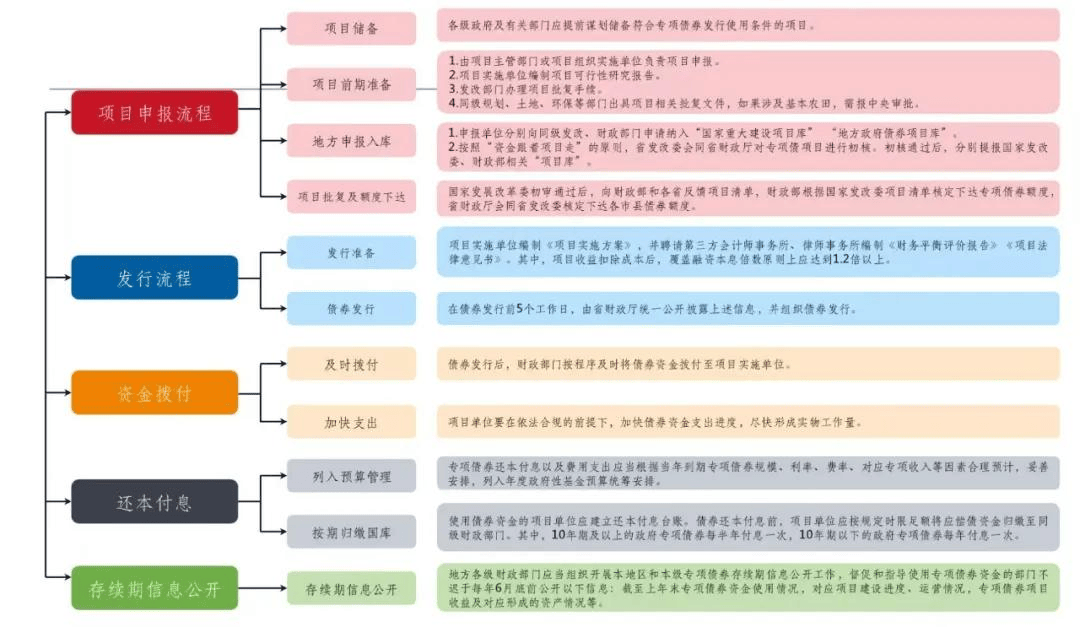
Core Viewpoint - Local government special bonds, ultra-long-term special treasury bonds, and central budgetary funds are the three core funding sources for promoting major projects, each with distinct characteristics and requirements for application and approval processes. Funding Source Comparison Ultra-Long-Term Special Treasury Bonds - Support areas include national strategic directions, regional coordinated development, food production enhancement, technological self-reliance, and ecological safety projects. Specific investment focuses on technology research, green infrastructure, and public welfare systems [1]. Local Government Special Bonds - Key support directions include traditional infrastructure, energy projects, municipal infrastructure, social services, and new infrastructure projects. The core requirement is that projects must generate stable government revenue to cover bond principal and interest, with a coverage ratio of at least 1.2 [2]. Central Budgetary Investment - Focuses on public welfare projects, rural development, major infrastructure, social services, and ecological civilization projects. The requirement is for projects to be purely public welfare with significant social benefits but not necessarily economic returns [3]. Application Requirements and Processes Special Treasury Bonds Application Process - The application process involves several steps, including notification from the state, project selection by provincial departments, preparation of application materials, and approval by national departments. A new feature for 2025 is the establishment of a separate application channel with a "report and review" mechanism [4]. Special Bonds Application Process - Applications are conducted throughout the year with three batch submissions. The process includes project planning, inclusion in national and local project databases, and joint reviews by provincial departments [6]. Central Budgetary Investment Application Process - Applications are typically submitted in two batches each year. The process includes notification from the National Development and Reform Commission, preparation of materials, initial reviews by local departments, and final approval by national authorities. In 2025, an online approval platform will be fully implemented [7]. Application Considerations - Applications for special treasury bonds must align with policy requirements, ensure sufficient preparatory work, and avoid overlap with central budgetary investments [8]. - Projects must be new or under construction, with new projects expected to start by the end of 2025, and existing projects must be nearing completion [9]. - Projects should not include prohibited content such as real estate development or performance projects [10]. - A clear funding plan must be presented to ensure complete funding closure for the project [10]. Successful Case Studies Special Treasury Bonds - A project for high-standard farmland construction received 800 million yuan in special treasury bonds, aligning with national food security strategies [78]. Special Bonds - A smart parking project with a total investment of 500 million yuan successfully issued 300 million yuan in special bonds, demonstrating a clear revenue model [78]. Central Budgetary Investment - A new compulsory education school project received 50 million yuan in central budgetary investment, addressing urgent educational needs [78]. Choosing Funding Channels - Projects with stable revenue should consider special bonds, while those with no revenue but strategic importance should look at special treasury bonds. Purely public welfare projects should apply for budgetary investments [79]. - For large projects, a combination of funding sources may be beneficial, such as using budgetary investment for public welfare components and special bonds for revenue-generating parts [79]. 2025 Application Recommendations - Stay updated on national policy trends, prepare project materials in advance, and enhance communication with supervisory departments to improve application success rates [79].

财政部:这两年安排超长期特别国债1.5万亿元推动“两重”建设
Bei Jing Shang Bao· 2025-09-12 09:18
Group 1 - The Ministry of Finance has arranged a total of 1.5 trillion yuan in special long-term bonds over the past two years to promote "dual heavy" construction [1] - In the past five years, a total of 19.4 trillion yuan in local government special bonds has been allocated to support 150,000 construction projects [1] - The central budget has invested 3.3 trillion yuan to support infrastructure construction in areas such as water conservancy and transportation, effectively leveraging government investment to stimulate social investment [1]
蓝佛安:这两年安排超长期特别国债1.5万亿元推动“两重”建设
Zheng Quan Shi Bao Wang· 2025-09-12 07:35
Group 1 - The Ministry of Finance announced the arrangement of 1.5 trillion yuan in special long-term bonds over the past two years to promote "dual heavy" construction [1] - A total of 19.4 trillion yuan in local government special bonds has been allocated over the past five years, supporting 150,000 construction projects [1] - Central budgetary investment of 3.3 trillion yuan has been arranged to support infrastructure construction in areas such as water conservancy and transportation, effectively leveraging government investment to stimulate social investment [1]
单个项目最高补助1亿!企业实训基地项目可获中央预算内投资支持
Sou Hu Cai Jing· 2025-08-12 08:57
Core Viewpoint - The National Development and Reform Commission (NDRC) has issued a management method for the central budget investment in enterprise training bases, emphasizing the need for enterprise-led construction and support for emerging fields with significant skill shortages and traditional industries with strong employment absorption capacity [1][2]. Group 1: Project Support and Scope - Enterprise training base projects should be led by enterprises, focusing on skill training for employees of the enterprise and its upstream and downstream partners, while also expanding social training functions [3][4]. - The projects will support the construction of training venues, facilities, and necessary auxiliary facilities, while not supporting general production lines, dormitories, canteens, or other unrelated facilities [3][4]. - Central budget investments will be allocated based on actual conditions, using methods such as investment subsidies (up to 20% of total project investment, with a cap of 100 million yuan per project) and interest subsidies [3][4]. Group 2: Application and Approval Process - The NDRC will work with industry authorities to refine annual support directions based on national economic needs and skill supply-demand situations, issuing application notifications accordingly [5]. - Provincial development and reform commissions will serve as project application units, guiding local enterprises to understand policy requirements and include eligible projects in a reserve pool [5][6]. - Projects must have completed necessary pre-construction procedures and secured matching funds, and cannot have received other central budget investments [6][7]. Group 3: Supervision and Management - Project units must adhere to a responsibility system, ensuring independent accounting and dedicated use of funds, while also focusing on safety production responsibilities [13][14]. - Regular monitoring and reporting on project progress, investment completion, and engineering status are required, with penalties for non-compliance [14][15]. - The NDRC will conduct various forms of supervision, including special inspections and annual assessments, to ensure project quality and fund management [14][15].
发挥政府投资带动放大效应 专项债未来3个月或集中发行
Zheng Quan Ri Bao· 2025-08-08 07:28
Group 1 - The core viewpoint is that special bonds are crucial for driving effective investment, with a cumulative issuance of 11.35 trillion yuan since the 20th National Congress, supporting around 90,000 projects in areas like infrastructure and public welfare [1] - As of August 2, 2023, local governments have issued a total of 21,710.65 billion yuan in new local bonds this year, with special bonds accounting for 17,772.69 billion yuan, representing 45.57% of the annual quota of 39,000 billion yuan [1] - Compared to the same period last year, the issuance of new local bonds has slowed down, with last year's total at 30,504.62 billion yuan, where special bonds made up 25,708.30 billion yuan, or 67.65% of the annual quota of 38,000 billion yuan [1] Group 2 - The Ministry of Finance aims to accelerate the issuance and utilization of special bonds, focusing on new infrastructure and industries, with allocations favoring regions with well-prepared projects [2] - A recent meeting of the Political Bureau of the Central Committee emphasized the need to speed up the issuance of special bonds and utilize long-term special treasury bonds to support major national strategies and enhance safety capabilities in key areas [2] - It is expected that the issuance of local government bonds will significantly accelerate in the next three months, with an estimated issuance of around 20,000 billion yuan in August and September, maintaining levels similar to the previous year [3]
最高补助1亿元!国家发改委:企业实训基地项目重点支持吸纳就业能力强的传统行业
Zhong Guo Hua Gong Bao· 2025-08-07 11:32
Core Viewpoint - The National Development and Reform Commission has issued a management approach to support the construction of enterprise training bases, focusing on skill training in emerging fields and traditional industries with high employment capacity [1] Group 1: Investment Support - The management approach specifies that central budget investment will support the construction of enterprise training bases, emphasizing projects led by enterprises [1] - Investment will be provided in the form of subsidies or interest discounts, with a support ratio of 20% of the total project investment, and a maximum support limit of 100 million yuan for individual projects [1] Group 2: Focus Areas - The training bases will primarily focus on skill training for employees of the enterprise and its upstream and downstream industry chain, while also expanding social training capabilities [1] - The approach highlights the importance of supporting training facilities, equipment, and necessary auxiliary facilities, including the renovation of existing training sites and idle land or warehouses [1]
最高补助1亿元,国家发改委:中央预算内投资支持新兴领域以及传统行业企业实训基地建设
Sou Hu Cai Jing· 2025-08-07 09:40
Core Viewpoint - The National Development and Reform Commission (NDRC) has issued a management method to support the construction of enterprise training bases through central budget investments, focusing on emerging fields with significant skill shortages and traditional industries with strong employment absorption capacity [1][5]. Group 1: Investment Scope and Standards - Enterprise training base projects should be led by enterprises, primarily targeting skill training for employees within the enterprise and its supply chain, while also expanding social training functions [6][1]. - The investment will support the construction of training venues, facilities, and necessary auxiliary facilities, while excluding general production lines, dormitories, canteens, and other unrelated facilities [6][1]. - Central budget investments must be used for new or ongoing projects that have completed preliminary procedures and are ready to start, and cannot be used for completed projects [2][6]. Group 2: Investment Support Mechanism - The central budget investment will be provided through investment subsidies or interest subsidies, with a support ratio of 20% of the total project investment, capped at 100 million yuan per project [6][1]. - Interest subsidies will be calculated based on the total loan amount that meets the subsidy conditions, the interest rate for the year, and the duration of the subsidy [6][1]. Group 3: Application and Approval Process - The NDRC will work with industry authorities to refine annual support directions based on national economic and social development needs and the supply-demand situation for skilled talent [7]. - Provincial development and reform commissions will be responsible for summarizing project applications and guiding local enterprises to understand policy requirements [8][10]. - Projects must have secured matching funds and not have received other central budget investments or central financial funds [10][9]. Group 4: Supervision and Management - Project units must adhere to project management regulations, ensuring independent accounting and dedicated use of funds, while emphasizing safety production responsibilities [18][20]. - The NDRC will conduct various forms of supervision, including special inspections and online monitoring, to ensure project progress, quality, and fund management [19][20].
今年“两重”建设项目清单8000亿元已全部下达完毕,中央预算内投资7350亿元已基本下达完毕
Zhong Guo Zheng Quan Bao· 2025-08-01 21:02
Core Viewpoint - The article highlights the significance of the Phoenix Neck Pump Station in the Yangtze River Water Diversion Project, which is part of China's major water conservation and supply initiatives [1] Group 1: Project Overview - The Yangtze River Water Diversion Project is one of China's 172 major water conservancy projects aimed at water conservation and supply [1] - The project integrates multiple functions including water supply, navigation, and ecological preservation [1] Group 2: Infrastructure Details - The Phoenix Neck Pump Station is located in Wuhu City, Anhui Province, and serves as a key hub for the West Zhaohua Line of the water diversion project [1]
南华期货焦煤焦炭周报:当头一棒-20250727
Nan Hua Qi Huo· 2025-07-27 09:44
1. Report Industry Investment Rating - No information provided in the report. 2. Core Viewpoints of the Report - This week, the spot prices of coking coal continued to rise, with the price of Mongolian 5 raw coal quoted at 1050 - 1100 yuan/ton and the price of Anze low - sulfur prime coking coal at 1400 - 1450 yuan/ton. The third round of price increases for coke spot was implemented, and the fourth round was initiated on Sunday, expected to be officially implemented on Monday. The coking coal and coke futures experienced sharp fluctuations during the week, with significant changes in price and spreads [4]. - The coking coal market: Domestically, coal mines that had reduced or suspended production due to environmental protection and inventory issues are gradually resuming production, but at a slow pace. The daily customs clearance volume of Mongolian coal at ports has returned to normal, and the import profit of overseas coal is continuously improving, which is expected to be reflected in the arrival volume in 1 - 2 months. The rebound in the futures market has driven the speculative demand for spot coking coal, leading to a rapid price increase and stimulating downstream coking plants to replenish raw material inventories. The short - term demand for coking coal has been boosted, and the inventory structure has improved significantly [4]. - The coke market: Due to the sharp increase in the price of coking coal, the losses of coking plants have widened, and their production enthusiasm is average. With the implementation of the third - round price increase and the ongoing pursuit of the fourth round, and considering the high profits of steel products, coke has a basis for further price increases. The demand for coke is strong, with high iron - making water production, rigid procurement demand from steel mills, and active participation of futures - cash traders in the market [5]. - After the Dalian Commodity Exchange restricted the daily opening volume of coking coal futures on Friday night, the coking coal futures market experienced a sharp decline, and related industrial futures also tumbled. If the speculative demand that entered the market earlier is unwound, the outflow of off - balance - sheet inventory will impact the spot market. Coking plants are currently in a wait - and - see mode, with insufficient motivation to continue replenishing inventories. Further price increases require the introduction of more than expected macro - policies. It is recommended to wait and see for unilateral trading and focus on the reverse spread of coking coal 9 - 1 for arbitrage [6]. 3. Summary by Related Catalogs 3.1 Weekly Balance Sheet - **Coking Coal**: The total supply of coking coal has shown certain fluctuations. In Week 27 (2025/7/25), the coking coal production was 977.08 million tons, and the net import was 190 million tons, with a total supply of 1167.08 million tons. The theoretical iron - making water supply and the actual iron - making water production also had differences, and the explicit inventory decreased by 69.57 million tons compared to the previous week [8]. - **Coke**: The total supply of coke also fluctuated. In Week 27 (2025/7/25), the coke production was 782.32 million tons, and the net export was 10.88 million tons, with a total domestic supply of 771.44 million tons. The theoretical iron - making water supply and the actual iron - making water production had differences, and the explicit inventory decreased by 7.42 million tons compared to the previous week [8]. 3.2 Key News This Week - **Macro News**: China's Politburo member and Vice - Premier He Lifeng will hold economic and trade talks with the US in Sweden from July 27 - 30. The National Development and Reform Commission and the State Administration for Market Regulation are soliciting opinions on the revised draft of the Price Law [11]. - **Industry News**: Shagang raised the price of scrap steel by 50 yuan/ton. The third - round price increase of coke was fully implemented. Steel enterprises at the Shaanxi - Shanxi - Sichuan - Gansu Steel Enterprises Summit Forum agreed to strengthen industry self - discipline. The Dalian Commodity Exchange restricted the daily opening volume of coking coal futures [13][14]. 3.3 Data Overview - **Coking Coal and Coke Weekly Data**: The operating rate of 523 coking coal mines increased by 0.83 percentage points to 86.9%, and the daily average raw coal production increased by 1.86 million tons to 194.74 million tons. The operating rate of 110 coal - washing plants decreased by 0.54 percentage points to 62.31%, and the daily average cleaned coal production decreased by 1.23 million tons to 52.145 million tons. The total inventory of coking coal decreased by 69.57 million tons to 2982.88 million tons. The total inventory of coke decreased by 7.42 million tons to 918.23 million tons [16]. - **Coking Coal and Coke Futures Prices**: The basis and spreads of coking coal and coke futures showed significant changes. For example, the basis of coking coal (Tangshan Mongolian 5) decreased by 203 yuan/ton compared to the previous week, and the 9 - 1 spread decreased by 10 yuan/ton [18]. - **Coking Coal and Coke Spot Prices**: The spot prices of coking coal and coke generally increased. For example, the ex - factory price of Anze low - sulfur prime coking coal increased by 150 yuan/ton to 1450 yuan/ton, and the ex - factory price of Luliang quasi - first - grade wet coke increased by 100 yuan/ton to 1130 yuan/ton [19]. - **Price, Profit, and Spread**: The coking profit was negative, and the import profit of some coking coals improved. The ratio of coking coal to thermal coal increased from 2.0732 to 2.4123 [20]. 3.4 Coking Coal Supply and Inventory - Mines: The capacity utilization rate of 523 coking coal mines was 86.9%, with an increase of 0.8 percentage points. The daily average raw coal production was 194.7 million tons, an increase of 1.9 million tons, and the raw coal inventory decreased by 79.3 million tons to 536.0 million tons. The daily average cleaned coal production was 77.7 million tons, an increase of 0.7 million tons, and the cleaned coal inventory decreased by 60.6 million tons to 278.4 million tons [63]. - Coal - washing Plants: The operating rate of 110 coal - washing plants was 62.31%, a decrease of 0.55 percentage points. The daily average production was 52.15 million tons, a decrease of 1.23 million tons. The raw coal inventory decreased by 6.16 million tons to 292.53 million tons, and the cleaned coal inventory decreased by 15.93 million tons to 175.61 million tons [65]. - Ports: The inventory of imported coking coal at 16 ports decreased by 41.46 million tons to 512.04 million tons [65]. 3.5 Coke Supply and Inventory - Independent Coking Plants: The capacity utilization rate was 73.45%, an increase of 0.44 percentage points. The daily average coke production was 64.60 million tons, an increase of 0.39 million tons, and the coke inventory decreased by 7.43 million tons to 80.12 million tons. The total coking coal inventory increased by 56.27 million tons to 985.38 million tons [96]. - Steel Mills: The daily average coke production was 47.16 million tons, an increase of 0.07 million tons. The coke inventory increased by 0.99 million tons to 639.98 million tons. The coking coal inventory increased by 8.41 million tons to 799.51 million tons [96]. - Ports: The inventory of coke at 18 ports decreased by 2.38 million tons to 250.33 million tons [96]. 3.6 Steel Production and Inventory - 247 steel mills: The blast furnace operating rate was 83.46%, remaining unchanged from the previous week, and the iron - making capacity utilization rate was 90.81%, a decrease of 0.08 percentage points. The daily average iron - making water production was 242.23 million tons, a decrease of 0.21 million tons [130]. - Steel Supply and Demand: The production of five major steel products was 866.97 million tons, a decrease of 0.1%. The total steel inventory was 1336.5 million tons, a decrease of 0.1%. The steel consumption was 868.13 million tons, with an increase of 2.7% in building material consumption and a decrease of 1.7% in plate consumption [130]. 3.7 Coal and Coke Import and Export - Coking Coal Import: The import volume of coking coal showed certain fluctuations, and the import structure also changed. The import volume from Mongolia, Russia, and other countries had different trends [169]. - Coke Export: The export volume of coke and semi - coke also showed seasonal changes, and the export profit also fluctuated [180][194].
中部六省经济半年报出炉,短期存款利率进入0字头 | 财经日日评
吴晓波频道· 2025-07-25 17:03
Group 1: Central Budget Investment - The central budget investment of 735 billion yuan has been largely allocated, focusing on modern industrial systems, infrastructure, new urbanization, rural revitalization, regional development, green development, and social welfare projects [1] - This year's investment direction has been optimized, increasing support for social welfare and reducing the financial burden on local governments [1][2] - The early allocation of central budget investment reflects a proactive fiscal policy in response to economic pressures, particularly in the real estate sector and insufficient domestic demand [1] Group 2: Economic Performance of Central Provinces - The economic performance of six central provinces shows a positive trend, with five provinces exceeding the national growth rate of 5.3% [3] - Hubei province leads with a GDP growth rate of 6.2%, while Henan follows at 5.7%, indicating strong investment, consumption, and export activities [3][4] - The economic disparity among these provinces is notable, with Shanxi facing challenges due to its reliance on coal and a less favorable business environment [4] Group 3: U.S. Manufacturing and Services Sector - The U.S. Markit manufacturing PMI fell to 49.5, indicating contraction, while the services PMI rose to 55.2, reflecting a divergence in economic performance [5][6] - The overall economic growth in the U.S. is uneven, with the services sector supporting growth despite manufacturing challenges [7] Group 4: Bank Deposit Rates - Average interest rates for short-term deposits have dropped significantly, with 3-month deposit rates entering the "0" range [8] - The decline in deposit rates is linked to a broader trend of decreasing loan rates, impacting banks' profitability [9] Group 5: Intel's Financial Performance - Intel reported a second-quarter revenue of $12.9 billion but faced a significant loss of $2.9 billion, a 81% increase in losses year-over-year [10] - The new CEO has shifted the company's strategy away from aggressive expansion, focusing on confirmed customer orders for future investments [10][11] Group 6: Country Garden's Debt Restructuring - Country Garden is expected to complete its overseas debt restructuring by the end of the year, having reached an agreement with bondholders for a $178 million compensation payment [12][13] - The restructuring plan has gained support from over 75% of bondholders, providing the company with a critical opportunity to alleviate its debt burden [13] Group 7: Chinese Companies Listing in the U.S. - There has been a significant increase in Chinese companies listing in the U.S., with 50 companies going public this year, a 78.57% increase from last year [14][15] - Despite the increase in listings, the total fundraising amount has decreased by 57.91%, indicating a shift in the fundraising landscape [14] Group 8: Stock Market Performance - The stock market experienced fluctuations, with the Shanghai Composite Index closing down 0.33% amid mixed sector performance [16][17] - The market is showing signs of increased activity, with a notable rise in trading volume and a rotation of sector performance [17]