估值扩张

Search documents
负债驱动资金之二:股债比价视角看A股行情的起点与终点
ZHONGTAI SECURITIES· 2025-08-05 05:46
Report Industry Investment Rating - The report does not explicitly mention the industry investment rating. Core Viewpoints - The extreme divergence between credit spreads and stock risk premiums led to the starting point of the current A-share valuation expansion. The current round of A-share market is driven by funds, and the logic has only reached the middle stage, with the upward trend unfinished [2]. - The fact that the risk premium has reached "mean - 1 standard deviation" does not mean the end of the market. Considering the intensity and duration of the current round of fund - driven, A - share valuations are expected to continue to expand, driving the risk premium to decline further, and the risk - compensation returns of stocks and bonds will eventually converge [2][5]. Summary by Directory 1. Historically, the stock market risk premium can stay below "mean - 1 standard deviation" for a long time - There were several historical periods when the stock market risk premium fell below "mean - 1 standard deviation", such as from December 2014 to August 2015, November 2017 to February 2018, and September 2020 to April 2021, with durations of 9 months, 2 months, and 8 months respectively. Except for the 2017 - 2018 period when the risk premium could not continue to decline due to rapid liquidity withdrawal, in other periods, it could fall to around "mean - 2 standard deviations" or even lower [3]. - These historical periods had similar macro - environments that did not support a bull market in stocks. The factors driving the significant expansion of A - share valuations were not fundamental but fund - driven, and there was no continuous expansion of corporate profits [3]. 2. In the current round of the market, the indexes have expanded to varying degrees, and there are no signs of an end - Since the beginning of the year, the stock market has priced in the decline of the risk - free rate. Different sectors have different repair progress. The repair of large - cap stocks is relatively large, with the ERP basically reaching "mean - 1 standard deviation", while the ERP of small - and medium - cap stocks is still above the historical mean [4]. - The current round of valuation expansion also starts from changes in the capital side. Since September 2024, the economic fundamentals and corporate profit growth have been weak, and the monetary policy has been relatively loose. The core factor determining the start and end of the market is the sustainability of fund - driving. The current round of fund - driven logic has only evolved to institutional - driven and allocation - driven (insurance funds taking the lead), and bank wealth management and public funds will take over in the second half of the year [4]. - With the expansion of A - share valuations, the risk premium of the Shanghai Composite Index has been below "mean - 1 standard deviation" since July 18, lasting for less than 1 month. "Mean - 1 standard deviation" cannot be a sign of the end of the market, especially since the risk premiums of some sectors are still above the mean [4]. 3. Valuation expansion space calculation under two scenario assumptions - Historically, the extreme situation of index valuation expansion is in the range of "mean - N standard deviations", where N is between 0.6 - 4.0, with a median of approximately 2.0. - Scenario 1 assumes that the stock market risk premium can fall to "mean - 2 standard deviations"; Scenario 2 assumes that it can fall to "mean - N standard deviations", where N corresponds to the lowest level previously reached by the index's ERP. - Based on these two assumptions, the ChiNext Index has the largest PE expansion space, followed by the Wind 300 (ex - banks), CSI 1000, and CSI 500. The PE expansion spaces of the SSE 50, Shanghai Composite Index, and Wind Dividend Index are relatively small, but there is still expansion space even in a conservative scenario [6][7].

宏观金融数据日报-20250804
Guo Mao Qi Huo· 2025-08-04 08:30
Report Summary 1. Report Industry Investment Rating - Not provided in the given content 2. Core Viewpoints - In the short - term, the upward speed of the stock index may slow down after the phased realization of macro - positive factors, and market fluctuations and adjustments should be watched out for. In the long run, the futures index market this year is mainly driven by valuation expansion, and the valuation factor is expected to continue to play a role. It is advisable to go long on the stock index opportunistically this week [7] 3. Summary According to Relevant Catalogs Interest Rate and Bond Market - The closing prices and changes of various interest rate varieties are as follows: DRO01 closed at 1.31, down 8.18bp; DR007 at 1.42, down 13.00bp; GC001 at 1.29, up 26.00bp; GC007 at 1.46, up 3.00bp; SHBOR 3M at 1.56, down 0.30bp; LPR 5 - year at 3.50, unchanged; 1 - year treasury bond at 1.37, down 0.73bp; 5 - year treasury bond at 1.57, down 0.23bp; 10 - year treasury bond at 1.71, up 0.60bp; 10 - year US treasury bond at 4.23, down 14.00bp [4] - Last week, the central bank conducted 1.6632 trillion yuan of reverse repurchase operations in the open market, with 1.6563 trillion yuan of reverse repurchases due, resulting in a net investment of 6.9 billion yuan. This week, 1.6632 trillion yuan of reverse repurchases will expire, with 495.8 billion, 449.2 billion, 309 billion, 283.2 billion, and 126 billion yuan expiring from Monday to Friday respectively [4][5] Stock Index Market - Stock index closing prices and changes compared to the previous day: CSI 300 closed at 4055, down 0.51%; SSE 50 at 2754, down 0.79%; CSI 500 at 6213, down 0.21%; CSI 1000 at 6670, up 0.14%. For index futures, IF当月 closed at 4043, down 0.7%; IH当月 at 2754, down 0.8%; IC当月 at 6166, down 0.4%; IM当月 at 6617, up 0.1% [6] - Last week, CSI 300 fell 1.75% to 4054.9; SSE 50 fell 1.48% to 2754.1; CSI 500 fell 1.37% to 6213.2; CSI 1000 fell 0.54% to 6670.5. In the Shenwan primary industry index, last week, the pharmaceutical and biological (2.9%), communication (2.5%), media (1.1%), electronics (0.3%), and social services (0.1%) sectors led the gains, while most sectors declined, with non - ferrous metals (-4.6%), real estate (-3.4%), transportation (-3.2%), agriculture, forestry, animal husbandry and fishery (-3%), and power equipment (-2.6%) leading the losses [6] - The IF, IH, IC, and IM index futures have different levels of premium and discount for different contracts. For example, IF's premium and discount rates for the current - month, next - month, current - quarter, and next - quarter contracts are 9.10%, 0.00%, 0.01%, and 3.41% respectively [8]
中欧半导体会议召开,国际新格局?科创50指数ETF(588870)飘红,近10日资金净流入率高达29%!关税博弈缓和,成长风格怎么看
Sou Hu Cai Jing· 2025-05-29 02:07
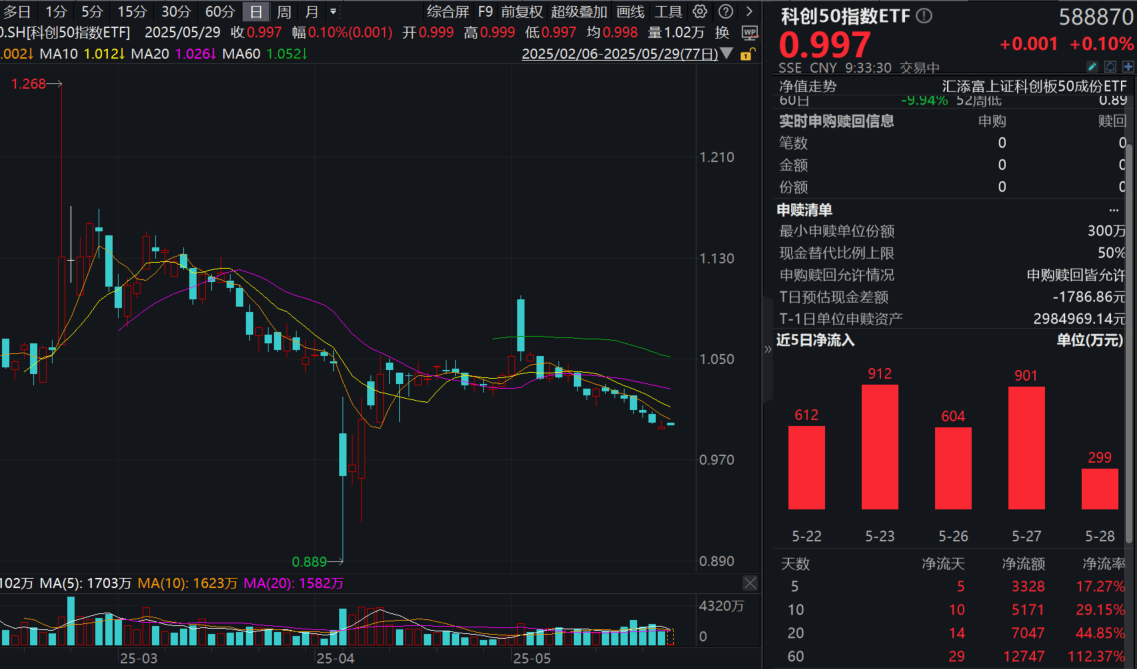
Group 1 - The A-share market showed a collective increase, with the Sci-Tech 50 Index rising by 0.14% and the corresponding ETF (588870) gaining 0.1%, indicating active trading with a turnover rate exceeding 8.5% [1] - The Sci-Tech 50 Index ETF has experienced a continuous decline for 7 days, but has seen accelerated capital inflow during this period, with a total net inflow exceeding 51 million yuan and a net inflow rate of over 29% [1] - Over the past 60 days, the ETF has received a net subscription of more than 127 million yuan, reflecting strong investor interest [1] Group 2 - A meeting on May 27 emphasized the importance of cooperation between China and Europe in the semiconductor supply chain, with representatives from over 40 companies participating [3] - The meeting highlighted China's commitment to expanding high-level openness and providing a stable policy environment for semiconductor enterprises, aiming to enhance mutual advantages and combat unilateralism [3] - The majority of the Sci-Tech 50 Index ETF's constituent stocks, including Cambricon, Chipone, and others, showed slight increases, with gains within 1% [3] Group 3 - Guosen Securities noted that the electronics industry is benefiting from the rise of DeepSeek and demand from domestic subsidies for home appliances and mobile phones, indicating a high level of prosperity in the sector [4] - The ongoing tariff disputes are expected to ease, leading to increased overseas order procurement and inventory reserves, contributing to an upward trend in the industry [4] - Guosen Securities remains optimistic about the electronics sector's valuation expansion in 2025, supported by strong fundamentals and macroeconomic policies [4] Group 4 - Huawei and Tencent Cloud have signed cooperation agreements with humanoid robot companies to accelerate the application of embodied intelligence in various scenarios [5] - The partnerships aim to enhance product technology development and promote the efficiency of humanoid robots in industrial and domestic settings [5] - The involvement of major tech companies is expected to expedite the deployment of humanoid robots across multiple applications, suggesting potential investment opportunities in related chip companies [5] Group 5 - The Sci-Tech 50 Index ETF (588870) has outperformed its benchmark index with a return of 1.32% since its launch on January 27, while the Sci-Tech 50 Index itself has seen a decline of 0.43% [6] - The ETF includes the 50 largest and most liquid stocks on the Sci-Tech board, covering sectors such as electronics, pharmaceuticals, and computer technology [6] - The ETF boasts low management and custody fees, making it an attractive option for investors [6]