借壳上市

Search documents
1919核心高管团集体“空降”怡园酒业 7人董事会大洗牌
Guo Ji Jin Rong Bao· 2026-02-05 15:58
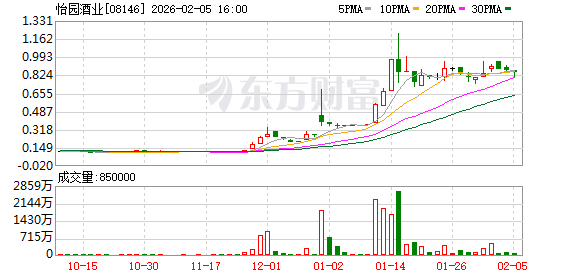
Core Viewpoint - The board of directors of Yiyuan Wine Industry has undergone a significant reshuffle, with seven new members nominated, including executives from 1919 Group, indicating a strategic move to revitalize the company [2][7]. Group 1: Board Restructuring - Seven new members have been nominated to the board of Yiyuan Wine Industry, including three executive directors: Liu Yunqiang, Xiong Xia, and Zhao Mingjun [2][3]. - Liu Yunqiang, aged 58, has over 26 years of experience in financial management and retail operations, previously serving at Suning.com and holding various positions at 1919 [3]. - Xiong Xia has over 17 years of experience in the Chinese liquor industry and has held multiple senior management roles at 1919 since joining in 2008 [3]. - Zhao Mingjun has over 16 years of experience in the liquor industry and is currently the general manager for North and Northwest China at 1919 [3]. Group 2: Non-Executive Directors - Zhao Guodong, aged 49, has over 20 years of experience in financial management and operations, having joined 1919 in 2018 and held various senior roles [4]. - Liang Mingshu, a financial expert and founder of Harmony Capital Management, has served as a non-executive director for several listed companies [5]. - Wang Renrong has over 28 years of experience in the fast-moving consumer goods sector and has held significant positions in legal and corporate affairs [6]. - Xu Yan, an expert in fermentation and beverage development, has over 23 years of experience and is currently a professor and vice president at Jiangnan University [6]. Group 3: Acquisition and Future Strategy - The restructuring follows the acquisition of Yiyuan Wine Industry by 1919 Group, with 1919's founder Yang Lingjiang becoming the largest shareholder with a 73.63% stake [7]. - The acquisition was completed for approximately 73.63 million HKD, with a share price of 0.12491 HKD [7]. - Yang Lingjiang aims to continue operating Yiyuan's existing wine business and will develop future strategies based on review results, considering diversification and long-term growth opportunities [8]. Group 4: 1919 Group's Background - 1919 Group is the largest new retail platform for alcoholic beverages in China, previously listed on the New Third Board and has attracted significant investments, including 2 billion CNY from Alibaba in 2018 [9]. - Despite its growth, 1919 has faced financial challenges, with only one profitable year from 2017 to 2022 and ongoing issues with franchisee payments [9].

邵氏46亿鲸吞正午阳光与UME:黎瑞刚的“东方好莱坞”资本棋局
Xin Lang Cai Jing· 2026-02-03 09:39
2026年1月21日, 邵氏兄弟控股公告宣布,拟向主要股东华人文化收购其核心影视资产,交易对价约 45.77亿元。这笔交易的资产规模远超邵氏自身,形成了一场罕见的"蛇吞象"式并购。 战略动机:华人文化借壳上市的资本路径 根据公告,此次交易邵氏兄弟将以配股方式支付对价,按每股0.32港元的价格向华人文化及其指定接收 方配发约159.3亿股股份,对价总额约45.765亿元人民币。 这个发行价较公告前最后一个交易日收盘价折让约15.8%。交易完成后,华人文化及其一致行动人对邵 氏兄弟的持股比例将从29.94%大幅增至59.74%,实现绝对控股。 被收购的目标业务涵盖华人文化旗下最核心的影视资产,包括剧集制作龙头正午阳光、电影投资制作公 司上海华人影业、海外发行业务CMC Pictures以及超过50家以UME品牌运营的影院网络。 正午阳光作为内地剧集制作领域的标杆企业,自2011年成立以来,制作了《琅琊榜》《大江大河》《山 海情》《知否知否应是绿肥红瘦》等一系列高口碑作品。而UME影城则是国内较早布局连锁化的影城 品牌之一,目前在全国运营63家影院,其中超过一半位于一、二线城市。 根据公告披露的数据,目标业务在20 ...
今日复牌!从暴涨400%到紧急刹车,一场由借壳猜想引发的资本狂宴,散户的狂热该醒醒了
Sou Hu Cai Jing· 2026-02-02 19:03
Core Viewpoint - The stock price of Fenglong Co., Ltd. skyrocketed, achieving a remarkable increase of 405.74% in just 17 trading days, leading to a trading suspension for regulatory review [1][4][11] Group 1: Stock Performance - Fenglong Co., Ltd. experienced a rapid increase in stock price, reaching 17 consecutive daily limits, with a price increase of over four times [1] - The stock's trading volume surged to 3.846 billion yuan on the last trading day before suspension, indicating intense speculative trading [4][8] - The static price-to-earnings ratio exceeded 4700 times, significantly higher than the industry average of approximately 45 times, indicating a substantial valuation bubble [8] Group 2: Market Dynamics - The surge in Fenglong's stock price was triggered by rumors of a potential acquisition by a prominent company, UBTECH, which fueled speculation about asset injection [3][4] - The company was characterized as a small-cap firm with traditional business operations, making it an attractive target for speculative trading [3][4] - The trading frenzy attracted both smart money and retail investors, leading to a self-reinforcing cycle of price increases [4][9] Group 3: Regulatory Response - The Shenzhen Stock Exchange intervened due to abnormal trading fluctuations, leading to a suspension for investigation [4][5] - During the suspension, the company was required to verify trading activities and media reports, which culminated in a clarifying announcement before resuming trading [5][7] - The announcement indicated that there were no plans for asset injection from UBTECH within the next 36 months, dampening speculative enthusiasm [7][9] Group 4: Future Outlook - Following the resumption of trading, the market sentiment shifted from extreme enthusiasm to a more complex and divided outlook among investors [9][11] - The potential for profit-taking by early investors could exert downward pressure on the stock price, as many had significant unrealized gains [8][9] - The company warned that any further abnormal price fluctuations could lead to another trading suspension, adding a layer of caution to future trading [11]
从《琅琊榜》到《流浪地球》,邵氏兄弟如何吞下华人文化核心资产?
Guan Cha Zhe Wang· 2026-01-26 09:46
Core Viewpoint - The acquisition of core film and television assets from CMC Moon Holdings by Shaw Brothers Holdings is a significant move, marking a "reverse merger" that aims to revitalize the company and the Chinese film industry [1][3][14]. Company Overview - Shaw Brothers Holdings plans to acquire assets valued at approximately 4.5765 billion HKD through the issuance of shares at 0.32 HKD per share, totaling 159.3 billion shares [1]. - The company, founded in 1958, was once a leader in the Chinese film industry, producing over 40 films annually during its peak [3]. - Shaw Brothers was delisted in 2009 after facing challenges due to the decline of Hong Kong cinema and the 2008 financial crisis [3]. Financial Performance - Shaw Brothers has experienced declining revenues from 2022 to 2024, with revenues of 163 million HKD, 67 million HKD, and 52 million HKD respectively, and net losses of 302,000 HKD, 2.898 million HKD, and 5.779 million HKD [4]. - In the first half of 2025, the company reported a revenue of 106 million HKD, indicating a potential turnaround with the release of new works [8]. Asset Injection Details - The assets being injected into Shaw Brothers include a comprehensive range of companies involved in content production, distribution, and exhibition, which have maintained stable revenues and profitability from 2022 to 2024, generating revenues of 2.317 billion RMB, 2.262 billion RMB, and 2.295 billion RMB, with net profits of 291 million RMB, 202 million RMB, and 280 million RMB respectively [12][13]. - This acquisition will create a full industry chain for Shaw Brothers, integrating content creation, distribution, and cinema operations [12][14]. Market Reaction and Challenges - The market has reacted cautiously to the acquisition, with Shaw Brothers' stock price dropping by 19.74% in the two trading days following the announcement, reflecting investor concerns about the feasibility of integrating significantly larger assets [15]. - The film industry is facing challenges such as slowing content demand, declining audience willingness to pay, and rising production costs, which may impact profitability [15]. - The restructured Shaw Brothers will possess a strong brand, production capabilities, and a global distribution network, which could reshape the landscape of the Chinese film industry if synergies are effectively realized [15][16].

锋龙股份17连板:日均“造富”约9亿元,公司市值近200亿元!800倍估值狂欢,谁在豪赌“机器人借壳”?
Mei Ri Jing Ji Xin Wen· 2026-01-23 06:09
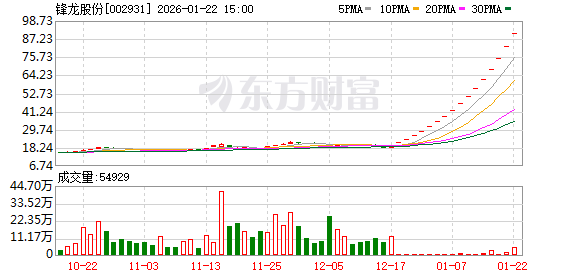
Core Viewpoint - The stock price of Fenglong Co., Ltd. has surged dramatically, reaching over 90 yuan per share, driven by the announcement of a potential acquisition by UBTECH, the first humanoid robot company listed in Hong Kong, despite warnings from the company about the stock being detached from its fundamentals [1][2][4]. Group 1: Stock Performance - As of January 22, 2026, Fenglong's stock has achieved 17 consecutive daily limit-ups, rising from around 17 yuan to over 90 yuan, representing a cumulative increase of over 400% [2][3]. - The company's market capitalization has increased from less than 4 billion yuan to approximately 20 billion yuan, with an average daily increase of over 900 million yuan during this period [2][3]. Group 2: Acquisition Announcement - The surge in stock price was triggered by UBTECH's announcement to acquire control of Fenglong for no more than 1.665 billion yuan, which will make UBTECH the controlling shareholder [3][4]. - UBTECH has committed to not transferring or reducing its stake in Fenglong for 36 months post-acquisition, indicating a focus on optimizing management and resource allocation [3][4]. Group 3: Company Fundamentals - Fenglong has repeatedly warned that its stock price is significantly detached from its fundamentals, highlighting the risks of market speculation and irrational trading behavior [5]. - The company continues to focus on its core business of developing, producing, and selling components for landscaping machinery, automotive parts, and hydraulic components, with no significant changes expected in its operations or market environment [5].

邵氏吞下正午阳光,黎瑞刚曲线上市?
Jin Rong Jie· 2026-01-23 05:50
Core Viewpoint - The film industry is witnessing a significant capital maneuver as Shaw Brothers (00953.HK) plans to acquire core film assets from its major shareholder, CMC Inc., through a share placement, despite a lukewarm market response [1][3]. Group 1: Transaction Details - Shaw Brothers announced a plan to acquire assets valued at approximately 85.58 billion yuan, while its own audited asset value is about 4.59 billion yuan as of September 2025 [1]. - The transaction price is approximately 45.77 billion yuan (around 50.98 billion HKD), with Shaw Brothers issuing about 159.30 billion shares at a price of 0.32 HKD per share, representing about 91.82% of the expanded share capital [3]. - The target business includes key assets such as the production company Noon Sunshine and the cinema network UME, which operates 63 cinemas across China [2][3]. Group 2: Financial Performance - The target business is projected to generate revenues of 2.317 billion yuan, 2.262 billion yuan, and 2.295 billion yuan from 2022 to 2024, with net profits of 291 million yuan, 202 million yuan, and 280 million yuan respectively [2]. - Shaw Brothers has faced declining revenues over the past few years, with projected revenues of 116 million yuan, 216 million yuan, 163 million yuan, 67 million yuan, and 52 million yuan from 2020 to 2024 [9]. - In the first half of 2025, Shaw Brothers reported a revenue of 106 million yuan, a 734.6% increase year-on-year, driven by the release of new productions [9]. Group 3: Industry Context - The film industry is currently experiencing a downturn, with reduced content demand and declining viewer willingness to pay, impacting profitability across the sector [7]. - CMC Inc. has been strategically acquiring assets in the Hong Kong film industry, including a stake in TVB, positioning itself as a significant player in the market [6]. - The acquisition of CMC's core assets by Shaw Brothers may represent a strategic move to revitalize the company amidst industry challenges [10].
锋龙股份17连板:逼近800倍估值狂欢 谁在豪赌“机器人借壳”?
Mei Ri Jing Ji Xin Wen· 2026-01-22 14:28
Core Viewpoint - The stock price of Fenglong Co., Ltd. (002931.SZ) has surged dramatically, reaching over 90 yuan per share from around 17 yuan, driven by the news of a potential acquisition by UBTECH Robotics (09880.HK) for no more than 1.665 billion yuan, despite warnings from the company about the stock being detached from its fundamentals [2][4][6]. Group 1: Stock Performance - As of January 22, 2026, Fenglong Co. has achieved its 17th consecutive daily limit-up, with a cumulative increase of over 400% in stock price [3][4]. - The company's market capitalization has skyrocketed from under 4 billion yuan to approximately 20 billion yuan, adding about 15.8 billion yuan in value over 17 trading days, averaging over 900 million yuan per day [3][4]. Group 2: Acquisition Details - The catalyst for this market frenzy was UBTECH's announcement regarding its intention to acquire control of Fenglong Co. through a combination of agreement transfer and tender offer [4]. - UBTECH has committed to not transferring or reducing its stake in Fenglong Co. for 36 months following the acquisition [5]. Group 3: Company Warnings - Fenglong Co. has repeatedly issued warnings about its stock price being significantly detached from its fundamentals, indicating a risk of irrational market speculation [6]. - The company maintains that its core business remains focused on the research, production, and sales of garden machinery parts, automotive parts, and hydraulic components, with no significant changes expected in the next 12 months [6].
香港借壳上市的历史流变和现状澄析(中)
Sou Hu Cai Jing· 2026-01-21 13:34
Core Insights - The article reviews the evolution of backdoor listings in Hong Kong over the past 40 years, categorizing it into three stages: early exploration, regulatory games, and comprehensive tightening. The traditional "shell acquisition - capital injection" model ended after the new regulations in 2019 [4][13] - The article provides a panoramic insight into the current market post-2019 regulations and offers practical survival guidance for mainland companies seeking backdoor listings in Hong Kong [4][35] Group 1: Current Status of Backdoor Listings - Case Study 1: The failure of WM Motor's backdoor listing through Apollo Travel highlights the challenges faced by companies with poor fundamentals, emphasizing that stringent regulations serve as a filter [5][10] - WM Motor's financial crisis included cumulative losses of 17.4 billion yuan from 2019 to 2021 and a current debt of approximately 20.4 billion yuan, leading to a situation of insolvency [6][10] - The transaction process for WM Motor's backdoor listing was abruptly terminated due to market instability and the company's application for bankruptcy restructuring in October 2023 [9][10] Group 2: Policy Implications from WM Motor's Case - The case illustrates that Hong Kong's regulatory framework prioritizes substance over form, indicating that the exchange will scrutinize the commercial essence of transactions rather than just their legal arrangements [12][14] - Successful capital operations must demonstrate that the merger creates a synergistic effect, enhancing the quality and sustainability of the listed platform [14] Group 3: Successful Case of Yiteng Pharmaceutical and Jiahe Biology - Case Study 2: The merger between Yiteng Pharmaceutical and Jiahe Biology showcases a successful path through deep industry collaboration under strict regulatory frameworks, leading to a successful backdoor listing [15][19] - The merger was structured as a share exchange, with Yiteng's shareholders retaining approximately 77.43% of the new entity, which was later renamed "Yiteng Jiahe" [18] - The success of this transaction stemmed from its solid commercial logic, creating real synergistic value and aligning with Hong Kong's regulatory goal of enhancing the quality of listed companies [19][20] Group 4: Insights from "Jiao Ge Peng You" Case - Case Study 3: The backdoor listing of "Jiao Ge Peng You" through Century Ruike represents a successful example of avoiding reverse acquisition scrutiny by employing a carefully structured transaction [23][34] - The transaction involved a gradual integration strategy, allowing the company to maintain its original business while expanding into new areas, thus avoiding triggering regulatory concerns [31] - This case demonstrates that the path for pure backdoor listings is not entirely closed, but requires meticulous planning and a strong collaborative relationship between the parties involved [33]
天普股份团队 “换血”引发监管风暴:新团队与主业“违和” 收购方高层入驻是否损害人员独立性?
Xin Lang Cai Jing· 2026-01-21 08:30
Core Viewpoint - The recent board reshuffle at Tianpu Co., Ltd. has raised concerns in the capital market due to the new management team's lack of experience in the automotive parts industry, which is critical for the company's operations, and the potential conflict with previous commitments regarding control changes [1][4]. Group 1: Management Changes - Tianpu Co., Ltd. completed its fourth board election on January 14, 2026, appointing Yang Gongyifan as chairman, Li Chenling and Kang Xiao as non-independent directors, and Chen Jiewen as vice general manager and CFO, while Fan Jianhai was appointed as general manager [1][3]. - The newly appointed management team, except for General Manager Fan Jianhai, lacks a background in the automotive parts sector, which accounts for nearly 90% of Tianpu's revenue from automotive rubber hoses and assemblies [1][3]. Group 2: Market Reactions and Regulatory Scrutiny - The rapid appointment of new executives has led to a swift inquiry from regulators, questioning the independence of the new management and their potential ties to Zhonghao Xinying, the actual controller of the company [2][5]. - Speculation regarding Zhonghao Xinying's potential reverse merger with Tianpu has contributed to a significant increase in the company's stock price, which has risen over sevenfold since the announcement of control change plans in August 2025 [2][5]. - Following the announcement of the board reshuffle, Tianpu's stock experienced a volatile trading pattern, initially dropping but then hitting the daily limit up on the same day of the announcement [2][5].

香港借壳上市的历史流变和现状澄析(上)
Sou Hu Cai Jing· 2026-01-19 11:30
Core Insights - The article reviews the evolution of backdoor listings in Hong Kong over the past 40 years, categorizing it into three phases: early exploration, regulatory games, and comprehensive tightening. The traditional "buy shell - inject capital" model ended after the new regulations in 2019 [2][3]. Group 1: Definition and Structure of Backdoor Listings - Backdoor listing is described as a capital activity where a non-listed company acquires control of a listed company (shell company) to achieve indirect public listing by injecting its business and assets [4]. - The transaction process of backdoor listings typically involves two key stages: obtaining control and asset injection and restructuring [4][6]. - The concept of "reverse takeover" (RTO) is clarified as a method where a non-listed company injects assets into a listed shell company to gain control, which is a core regulatory focus in Hong Kong [8][9]. Group 2: Historical Evolution of Backdoor Listings - The first phase (1984-2003) was characterized by strong financing demand and a lack of clear regulatory frameworks, leading to the emergence of backdoor listings as a quicker alternative for mainland companies to access international capital [13][14]. - The second phase (2004-2018) saw increased regulatory scrutiny due to frequent backdoor activities, leading to the introduction of the "bright-line test" in 2004, which established clear thresholds for transactions that would be classified as reverse takeovers [15][16]. - The third phase (2019-present) marked a significant tightening of regulations with the introduction of the "most stringent" new rules aimed at increasing costs and uncertainties associated with backdoor listings, effectively aligning them with IPO standards [17][18][19]. Group 3: Market Changes Post-New Regulations - From 2019 to 2025, the backdoor listing market has undergone structural changes due to high regulatory pressure, global liquidity tightening, and macroeconomic cycles, transforming backdoor listings into high-cost industrial acquisition methods [21]. - The number of transactions classified as reverse takeovers surged from 6 in the first nine months of 2019 to 18 in the following year, with most being terminated due to non-compliance with new regulations [22]. - The value of shell companies has drastically decreased, with prices dropping from 600-650 million HKD to 150-250 million HKD by 2025, reflecting a significant loss of their function as a shortcut to listing [23]. Group 4: New Transaction Forms and Market Dynamics - The introduction of SPACs in 2022 aimed to provide a compliant alternative for backdoor listings, but high regulatory thresholds have limited their effectiveness, resulting in only a few successful cases [24]. - A new approach called "Long-stop Asset Injection" has emerged, where buyers maintain existing businesses for 36 months before conducting substantial operations, shifting the focus from financial speculation to long-term strategic investments [25]. - The intermediary landscape has shifted, with mainland Chinese securities firms gaining prominence in the backdoor and merger advisory sectors, reflecting the changing dynamics of the market [26]. Group 5: Regulatory Enforcement and Market Cleanup - Regulatory practices have intensified, with detailed inquiries for large asset injections and a significant increase in delistings, totaling over 230 companies from 2019 to 2025, indicating a strong push to eliminate "zombie stocks" [27].