
关税政策变化

Search documents
纺织服饰行业周专题:Puma发布2025Q1季报,表现符合公司预期
GOLDEN SUN SECURITIES· 2025-05-11 10:23
Investment Rating - The industry maintains a rating of "Buy" for key companies such as Anta Sports, Tabo, and Bosideng, with a recommendation to focus on high-quality brands and companies with strong fundamentals [5][10][28]. Core Insights - Puma's Q1 2025 performance met expectations, with revenue growth of 0.1% year-on-year to €2.076 billion, while net profit saw a significant decline of 99.5% to €500,000 due to global economic fluctuations, particularly in the US and China [1][15]. - The report emphasizes the resilience of the sportswear sector, projecting a revenue growth of 4.4% and a net profit decline of only 0.6% for key apparel companies in 2024, with a stronger recovery anticipated in 2025 [4][26]. - The DTC (Direct-to-Consumer) business showed robust growth, with a 12% increase in revenue to €550 million, while wholesale revenue declined by 3.6% [3][20]. Summary by Sections Puma's Q1 2025 Performance - Revenue increased by 0.1% to €2.076 billion, with a slight decline in gross margin by 0.6 percentage points to 47% [1][15]. - Operating profit fell by 63.7% to €6 million, and net profit dropped by 99.5% to €500,000, attributed to economic volatility [1][15]. - Inventory rose by 16.3% to €2.08 billion, mainly due to increased in-transit stock [1][15]. Regional and Business Model Analysis - EMEA region revenue grew by 5.1% to €890 million, while the Americas saw a decline of 2.7% to €750 million, primarily due to a 11.1% drop in North America [2][20]. - The Asia-Pacific region experienced a 4.7% decline to €430 million, with a notable 17.7% drop in Greater China [2][20]. - The company is adapting to US tariff issues by optimizing product sourcing and reallocating production [2][20]. DTC and Wholesale Business Performance - DTC revenue increased by 12% to €550 million, with e-commerce growing by 17.3% and self-operated retail stores by 8.9% [3][20]. - Wholesale revenue decreased by 3.6% to €1.53 billion, driven by weak demand in the US and China [3][20]. Industry Outlook - The report suggests focusing on brands with solid fundamentals and anticipating a recovery in 2025, with the sportswear sector expected to benefit from government policies and increased consumer participation in sports [4][26]. - Recommendations include companies like Anta Sports, Tabo, and Bosideng, which are projected to have strong earnings growth and attractive valuations [28][29].






纺织服饰周专题:Puma发布2025Q1季报,表现符合公司预期
GOLDEN SUN SECURITIES· 2025-05-11 10:12
Investment Rating - The industry maintains a rating of "Buy" for key companies such as Anta Sports, Tabo, and others, indicating a positive outlook for investment opportunities [10][29]. Core Insights - Puma's Q1 2025 performance met expectations, with revenue growth of 0.1% year-on-year to €2.076 billion, while net profit saw a significant decline of 99.5% to €500,000 due to global economic fluctuations, particularly in the US and China [1][15]. - The report emphasizes a focus on robust fundamentals and high-quality brands in the apparel and home textiles sector, anticipating performance recovery and valuation improvement in 2025 [4][26]. - The sportswear segment is expected to benefit from national policy support and increased participation in sports, with a projected revenue growth of 8.7% for key companies in 2024 [4][26]. Summary by Sections Regional and Business Model Analysis - In Q1 2025, EMEA region revenue grew by 5.1% to €890 million, while the Americas saw a decline of 2.7% to €750 million, primarily due to an 11.1% drop in North America [2][20]. - The Asia-Pacific region experienced a 4.7% revenue decline to €430 million, largely attributed to a 17.7% drop in Greater China sales [2][20]. Business Performance - Wholesale revenue decreased by 3.6% to €1.53 billion, while Direct-to-Consumer (DTC) revenue increased by 12% to €550 million, with e-commerce growing by 17.3% [3][22]. - DTC revenue now accounts for 26.3% of total revenue, up 2.8 percentage points year-on-year [3][22]. Key Recommendations - The report recommends focusing on companies with strong fundamentals, such as Anta Sports and Tabo, which have shown significant revenue growth in Q1 2025 [28]. - Other recommended companies include Hailan Home, which is expanding its business successfully, and Bosideng, which is expected to achieve good performance in FY2025 [28][29]. - In the home textiles sector, Luolai Life is highlighted for its strong performance, with a projected net profit growth of 20% in 2025 [28][29].

机构:关税变化或将推动韩系电视品牌在美国市场份额的上升
news flash· 2025-05-08 05:06
Core Viewpoint - Changes in tariff policies and geopolitical tensions are expected to significantly alter the competitive landscape of the U.S. television market, potentially benefiting Korean brands like Samsung and LG at the expense of Chinese brands such as Hisense and TCL [1] Group 1: Market Dynamics - U.S. domestic television brands were initially projected to see strong shipment growth by 2025, but this outlook is now being challenged by external factors [1] - The competitive landscape is undergoing dramatic adjustments due to geopolitical tensions and tariff policy changes [1] Group 2: Company Performance - Samsung and LG are anticipated to gain market share in the U.S. due to their large-scale manufacturing capabilities in Mexico [1] - In contrast, Hisense and TCL may face growth challenges due to their limited production capacity in Mexico [1]


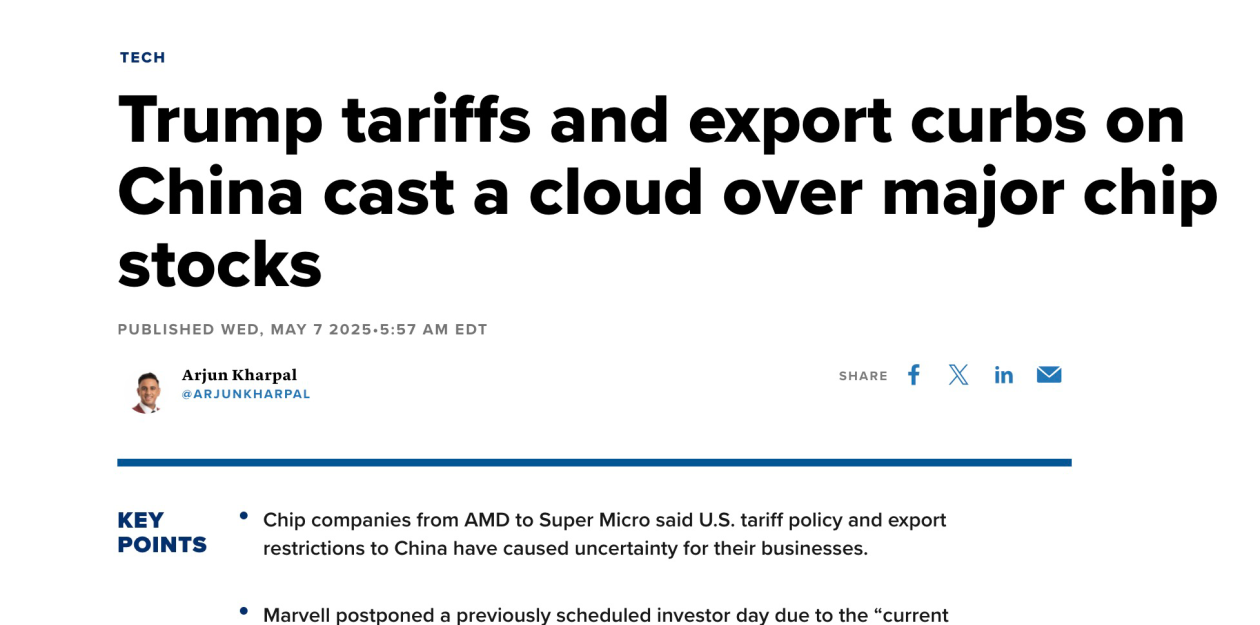
外媒:关税政策压迫 “不确定性”成半导体公司财报主题
Huan Qiu Wang· 2025-05-08 04:54
Group 1 - The core theme of the recent earnings reports from major semiconductor companies is uncertainty, primarily due to changes in U.S. tariff policies and export restrictions to China, leading to unclear product demand [1][3]. - AMD reported that despite exceeding first-quarter earnings expectations, it anticipates a loss of $1.5 billion by the end of the fiscal year due to restrictions on AI chip exports to China [3]. - Marvell postponed its investor day originally scheduled for June 10 to an unspecified date in 2026, citing the current uncertain macroeconomic environment, with its stock dropping 4.4% in pre-market trading [3][4]. Group 2 - Samsung indicated that demand fluctuations are expected to be significant due to tariff policy changes and macroeconomic uncertainty, making it difficult to predict the impact of tariffs and countermeasures on business [4]. - Analysts highlight that the semiconductor industry is facing complex demand signals and geopolitical headwinds, with Marvell's decision to delay its investor day adding to the uncertainty [4][5]. - NVIDIA's CEO stated that China could become a $50 billion AI market within two to three years, emphasizing the potential loss for U.S. companies if they cannot address the issue [5][6]. Group 3 - Chinese companies are increasing investments in self-developed technologies, with firms like Huawei and Alibaba aiming to create competitive products against companies like NVIDIA [7]. - The competitive landscape is intensifying, as U.S. companies must recognize that they are not the only players in the race for AI technology [7].


Lear(LEA) - 2025 Q1 - Earnings Call Transcript
2025-05-06 14:02
Financial Data and Key Metrics Changes - The company reported revenue of $5.6 billion for the first quarter of 2025, with core operating earnings of $270 million and operating margins improving to 4.9% [6][32] - Adjusted earnings per share were $3.12, down from $3.18 a year ago, while operating cash flow was a use of $128 million in the first quarter [6][32] Business Line Data and Key Metrics Changes - In the Seating segment, sales were $4.2 billion, a decrease of 7% year-over-year, with adjusted operating margins at 6.7% [33] - The E Systems segment reported sales of $1.4 billion, also down 7% year-over-year, with adjusted earnings of $74 million and operating margins at 5.2% [34] Market Data and Key Metrics Changes - Global vehicle production increased by 1% year-over-year, but Lear's sales-weighted production declined by 5%, with North America down 5% and Europe down 7% [28][30] - In China, production volumes increased by 12%, but Lear's business lagged industry growth estimates by 5% [30] Company Strategy and Development Direction - The company aims to extend its leadership in Seating, expand margins in E Systems, and support sustainable value creation through disciplined capital allocation [7][8] - The company is focusing on operational excellence and innovation, particularly through its ComfortFlex modules, which have received positive recognition [9][10] Management's Comments on Operating Environment and Future Outlook - Management noted that the ongoing international trade negotiations have introduced significant uncertainty, particularly regarding tariffs and production volumes [35][36] - The company remains confident in recovering the costs associated with tariffs and is adjusting its capital spending in response to the weaker industry production outlook [38][39] Other Important Information - The company has paused share repurchase activities to maintain liquidity during uncertain times, with plans to resume once visibility improves [40][41] - The company has reduced its global hourly headcount by nearly 19,000 since the end of 2023, contributing to operational efficiency [17][18] Q&A Session Summary Question: Have you seen any meaningful changes to production schedules? - Management acknowledged that changes have been announced but noted the environment remains dynamic, leading to the decision to withdraw guidance due to uncertainty [48][49] Question: Is there a way to get your customers to be the importer of record for tariff reimbursements? - Management confirmed they are discussing options with customers regarding who will be the importer of record and are considering moving production around [55][56] Question: What is the lower end of your outlook contemplating as far as LVP by region? - Management indicated that the February guidance anticipated a 1% global production decline, with significant uncertainty remaining, particularly in North America [69][70] Question: What drove the better-than-expected margin performance? - Management attributed the improved margins to better-than-expected production and a strong finish in March, along with strong operating performance across both business segments [96][97] Question: Are you pausing the buyback while figuring out the outlook for free cash flow? - Management confirmed they are pausing share repurchases temporarily until there is more visibility on production plans [91][92]

Lear(LEA) - 2025 Q1 - Earnings Call Transcript
2025-05-06 13:00
Financial Data and Key Metrics Changes - The company reported revenue of $5.6 billion for Q1 2025, with core operating earnings of $270 million and operating margins improving to 4.9% [6][12][31] - Adjusted earnings per share were $3.12, down from $3.18 a year ago, and operating cash flow was a use of $128 million in the first quarter [6][31] Business Line Data and Key Metrics Changes - In the Seating segment, sales decreased by 7% year-over-year to $4.2 billion, with adjusted operating margins at 6.7% [31][32] - The E Systems segment also saw a 7% decline in sales to $1.4 billion, with adjusted earnings of $74 million, reflecting a slight increase in operating margins to 5.2% [32][33] Market Data and Key Metrics Changes - Global vehicle production increased by 1% year-over-year, but Lear's sales-weighted production was down 5%, with North America and Europe seeing declines of 5% and 7% respectively, while China experienced a 12% increase [26][27] - Lear's sales growth in Europe outperformed industry production by 2 percentage points, while North America lagged by 2 percentage points [27][28] Company Strategy and Development Direction - The company aims to extend its leadership in Seating, expand margins in E Systems, and support sustainable value creation through disciplined capital allocation [7][12] - Recent awards in Seating and E Systems, including significant contracts with major automakers, highlight the company's focus on innovation and operational excellence [8][11][41] Management's Comments on Operating Environment and Future Outlook - Management noted ongoing uncertainty in the automotive industry due to international trade negotiations and tariff impacts, leading to a withdrawal of full-year guidance [34][35] - Despite challenges, the company remains confident in recovering tariff costs and achieving operational performance improvements [35][36] Other Important Information - The company has paused share repurchases to maintain liquidity during uncertain times, with plans to resume once visibility improves [39][86] - A strong balance sheet with no near-term debt maturities and $2.8 billion in available liquidity positions the company well for future challenges [38][39] Q&A Session Summary Question: Have you seen any meaningful changes to production schedules? - Management acknowledged some changes in production schedules but noted the environment remains dynamic, leading to the decision to withdraw guidance due to uncertainty [46][48] Question: Is there a way to get customers to be the importer of record for tariff reimbursements? - Management confirmed they are discussing options with customers regarding who will be the importer of record to maximize tariff reimbursement opportunities [52][53] Question: What is the lower end of your outlook contemplating as far as LVP by region? - Management indicated that the original guidance anticipated a 1% global production decline, with potential adjustments based on foreign exchange rates and market conditions [64][66] Question: How are you starting to see performance separate from competitors? - Management highlighted strong operational performance and innovation as key factors in gaining market share, particularly in E Systems [72][75] Question: Will you be able to offset indirect tariff impacts with accelerated restructuring benefits? - Management expressed confidence in achieving additional net performance from increased restructuring investments, despite dialing back capital spending [78][79]
Vince.(VNCE) - 2025 Q4 - Earnings Call Transcript
2025-05-02 13:32
Financial Data and Key Metrics Changes - The company reported a net sales increase of 6.2% in Q4 fiscal 2024, reaching $80 million compared to $75.3 million in Q4 fiscal 2023. Excluding the impact of an extra week in the previous year, net sales increased approximately 9% [15] - Adjusted operating margin improved by 100 basis points despite relatively flat sales performance compared to the prior year [13] - Gross profit for Q4 was $40.1 million, representing 50.1% of net sales, up from 45.4% in the same quarter last year, driven by lower promotional activity and reduced product costs [16] Business Line Data and Key Metrics Changes - The wholesale segment saw a significant increase of 26.7%, which offset an 8.1% decline in the direct-to-consumer segment [15] - The direct-to-consumer business was impacted by store closures, remodels, and relocations, leading to inconsistent store sales performance [7][16] Market Data and Key Metrics Changes - The company continues to source over 60% of its cost of goods sold from China, with plans to reduce this exposure by moving about one-third of its sourcing outside of China [8][20] - The company is actively working on mitigation strategies to address the impact of evolving tariff policies on consumer behavior [7][20] Company Strategy and Development Direction - The company is focused on navigating the current dynamic environment while enhancing operational efficiencies and product costs [4][9] - There is an emphasis on expanding the men's business and enhancing relationships with wholesale partners, which are seen as critical for growth [6][7] - The transformation plan has delivered over $10 million in savings, which will now shift to manage tariff mitigation [9] Management's Comments on Operating Environment and Future Outlook - Management expressed confidence in the company's ability to navigate current challenges due to the strong foundation built over the past year [4][9] - The company will not provide full-year guidance due to increased uncertainty regarding tariffs and consumer behavior [9][21] - For Q1 fiscal 2025, the company expects a sales decline of approximately 5% compared to the prior year, driven by planned store activities and shifts in wholesale shipments [23] Other Important Information - A non-cash goodwill impairment charge of $32 million was recorded due to a change in control of ownership [17] - The company is evaluating strategic price increases to absorb increased costs while maintaining value for consumers [9][33] Q&A Session Summary Question: What is the potential for expanding new product categories and store count? - Management is enthusiastic about expanding categories, particularly accessories, and has plans for new store openings in the U.S. and internationally [30][31] Question: How will the company market to core customers who can absorb price increases? - The focus is on full-price customers, with strategies in place to support this segment amid potential price increases [33] Question: Can the company quantify the revenue shift in wholesale? - The shift in wholesale revenue was not material for Q4, but it has significant implications for Q1 fiscal 2025 [39] Question: Will the tariff issue change product introduction plans? - There will be some SKU reduction, but the company is working to protect key items while adjusting sourcing strategies [41][42] Question: Has the strategy of shifting from airfreight to ship freight changed? - The company is currently using both methods to maintain flexibility in response to evolving tariff situations [44][45]

能源化工短纤、瓶片周度报告-20250427
Guo Tai Jun An Qi Huo· 2025-04-27 09:38
国泰君安期货·能源化工 短纤、瓶片周度报告 国泰君安期货研究所 陈鑫超 投资咨询从业资格号:Z0020238 贺晓勤 投资咨询从业资格号:Z0017709 钱嘉寅(联系人)期货从业资格号:F03124480 日期:2025年4月27日 Guotai Junan Futures all rights reserved, please do not reprint Special report on Guotai Junan Futures 观点小结 上游观点汇总 短纤:短期震荡市,中期偏弱 瓶片:震荡偏弱 供需平衡表 02 瓶片(PR) 估值与利润 基本面运行情况 短纤(PF) 估值与利润 基本面运行情况 CONTENTS 2 01 03 观点小结 01 观点总结 瓶片观点总结 短纤观点总结 瓶片:累库延续,逢高空加工费,轻仓过节 (1)高开工预计延续,总库存累库仍是确定性趋势,时间延后。市 场存在联合减产的传闻,但短期供应端开工率反而有进一步提高,本 周开工90.8%,5月初仍有三房巷75万吨装置复产。利润和库存方面, 盘面加工费仍然维持500元/吨水平,下游低价仍有补货,工厂库存压 力不大。因此一方面工厂当 ...
立讯精密20250409
2025-04-11 02:20
Summary of the Conference Call for Luxshare Precision Industry Co., Ltd. Industry Overview - The conference call primarily discusses the impact of recent changes in tariff policies between the U.S. and China on the consumer electronics manufacturing industry, particularly focusing on Luxshare Precision Industry Co., Ltd. [3][21] Key Points and Arguments 1. **Impact of Tariff Changes**: The recent tariff changes have exceeded market expectations, particularly the U.S. tariffs on products from Southeast Asian countries. Although most products from Luxshare do not export to the U.S., some finished products have been affected, leading to potential production shifts to lower-tariff regions [3][4] 2. **Production Capacity Transfer**: The likelihood of large-scale production capacity transfer from Vietnam to other countries is low unless tariffs in Vietnam exceed those in other countries by 10%. Vietnam's advantages in supply chain connectivity and logistics make it less likely for brands and manufacturers to disrupt existing value chains [4][5] 3. **Cost Sharing Mechanism**: Increased tariff costs are typically shared between supply chain customers and end consumers, rather than being fully borne by manufacturers. The specific sharing ratio depends on market negotiations and the bargaining power of each party [6] 4. **Customer Collaboration**: When facing increased tariffs, customers usually collaborate with suppliers to enhance competitiveness rather than directly passing cost pressures onto manufacturers. Historical data shows that cost pressures due to tariffs have not been directly transmitted to manufacturers [7][8] 5. **Competition Landscape**: The competitive landscape of the consumer electronics industry is not expected to change significantly due to tariff variations. Geopolitical factors and local policies have already influenced the market, and the core competitiveness of companies remains crucial [8][9] 6. **Production Timeline**: If customers require production capacity to be established in low-tariff regions, the fastest timeline for Luxshare to complete production lines is estimated to be between one to one and a half years [14] 7. **Global Tariff Policy Changes**: The current global tariff policy changes are not expected to have a large-scale impact on the consumer electronics manufacturing and automotive industries. The overall market structure remains relatively stable despite tariff fluctuations [21][22] 8. **Inventory Management**: Some companies are preparing inventory in advance to respond to fluctuations in U.S. market demand, but this practice is not widespread. Most companies are only slightly adjusting their inventory levels due to capacity constraints across the entire supply chain [23] 9. **Manufacturing Return to the U.S.**: The feasibility of manufacturing returning to the U.S. is questioned, as it requires a complete and long-term industrial chain, which is currently challenging for the consumer electronics sector. However, high-automation products may have some potential for U.S. production [12] 10. **Regional Production Strategies**: The discussion indicates that while there are considerations for production in regions like India, Mexico, or Brazil, the current conditions do not favor such moves. Vietnam remains a strong manufacturing base due to its established ecosystem [10][11] Other Important Insights - **Tariff Calculation**: Export tariffs are calculated based on the terminal export price, and there may be potential for tariff exemptions based on origin rules, although this remains uncertain [26] - **Flexibility in Global Layout**: Companies are encouraged to maintain a flexible global layout to quickly adapt to policy changes and reduce costs, as demonstrated by Luxshare's established factories in multiple countries [25] - **Market Dynamics**: The dynamics of the consumer electronics market are influenced by various factors, including tariffs, exchange rates, and overall competitiveness, which should be prioritized over panic regarding external changes [28]

深圳华强:本次关税政策变化对公司经营的直接影响有限
news flash· 2025-04-10 03:44
Core Viewpoint - The announcement of increased tariffs by the U.S. government on various countries, including China, has raised global concerns, but the direct impact on the company's operations is minimal [1] Procurement Impact - The company has a small proportion of U.S. products in its distribution, with less than 100 SKUs out of nearly 20,000 being sourced from the U.S., accounting for only about 0.2% of total procurement [1] - Most U.S. products are primarily involved in research and design, with manufacturing occurring outside the U.S. [1] Sales Impact - The company's customer base is predominantly domestic, with export business representing approximately 2% of total revenue for 2024, and there is virtually no export to the U.S. [1] - The impact of the U.S. tariffs on the company's sales operations is very limited [1]
