
大食物观

Search documents
金观平:提升农业产能和质量效益
Xin Lang Cai Jing· 2026-02-04 22:38
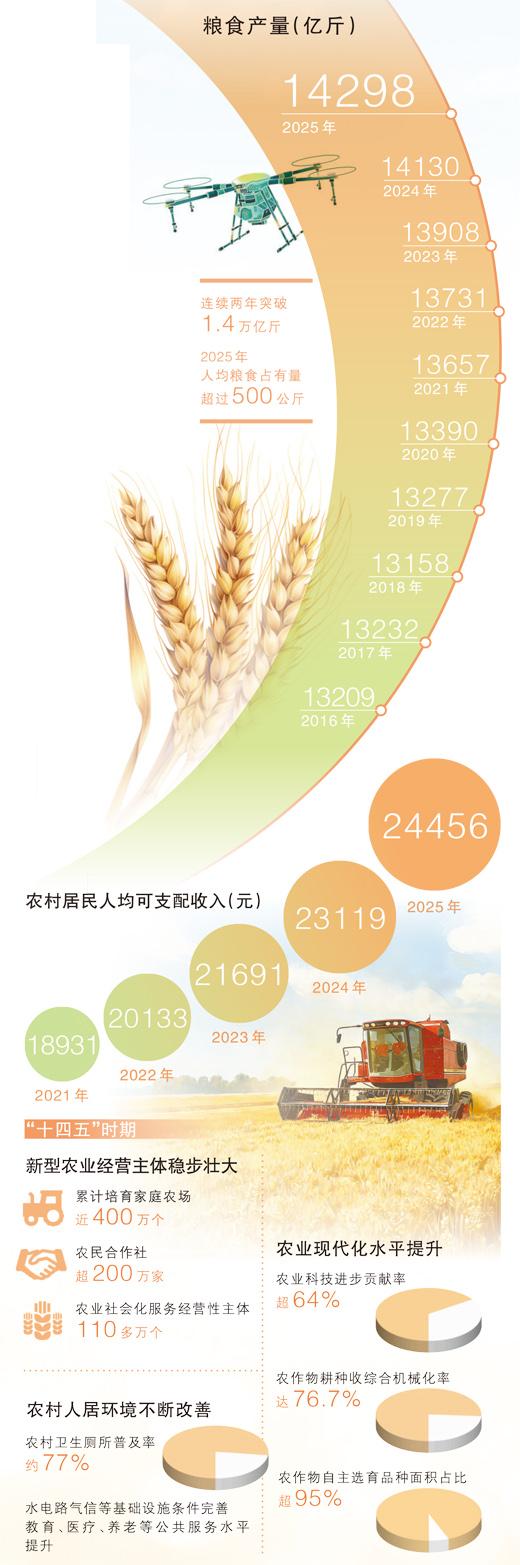
继续在提高农业综合生产能力上下功夫,全方位夯实粮食安全根基。经过多年努力,我国农业生产的基 础设施、机械装备、技术条件显著提升。今年要加力实施新一轮千亿斤粮食产能提升行动。向耕地要产 能,严守红线、严格占补平衡,严厉打击破坏耕地行为,分区分类推进高标准农田建设,确保建一块成 一块。向科技要产能,提升农业科技创新效能,加强农业关键核心技术攻关和科技成果高效转化,以人 工智能等现代科技赋能现代农业发展。同时,强化农业防灾减灾体系建设,提升应对极端天气能力,努 力将自然灾害对农业生产的影响降至最低。 粮食安全是"国之大者",确保国家粮食安全是"三农"工作的底线任务。2025年,我国粮食产量达到1.43 万亿斤,总产和单产均创历史新高,人均粮食占有量稳居1000斤水平,粮食供给丰富、储备充足、市场 平稳。但粮食产需长期紧平衡格局未变,结构性短缺矛盾依然突出。粮食安全这根弦必须始终绷紧,丝 毫松懈不得。 坚持产量产能、生产生态、增产增收一起抓,守牢国家粮食安全底线。要稳定发展粮油生产,通过稳面 积、提单产,确保粮食产量稳定在1.4万亿斤以上;因地制宜优化种植结构和区域布局,巩固提升大豆 产能,拓展油菜、花生、油茶等生产 ...
提升农业产能和质量效益
Jing Ji Ri Bao· 2026-02-04 22:17
坚持产量产能、生产生态、增产增收一起抓,守牢国家粮食安全底线。要稳定发展粮油生产,通过稳面 积、提单产,确保粮食产量稳定在1.4万亿斤以上;因地制宜优化种植结构和区域布局,巩固提升大豆 产能,拓展油菜、花生、油茶等生产空间,扩大油料多元化供给。农业不单纯是种地打粮,还要践行大 食物观,坚持农林牧渔并重,加快构建多元化食物供给体系。推动棉花、糖料、天然橡胶等产业平稳发 展。同时,减损就是增产,要耕好节粮减损"无形良田",增加粮食有效供给。 继续在提高农业综合生产能力上下功夫,全方位夯实粮食安全根基。经过多年努力,我国农业生产的基 础设施、机械装备、技术条件显著提升。今年要加力实施新一轮千亿斤粮食产能提升行动。向耕地要产 能,严守红线、严格占补平衡,严厉打击破坏耕地行为,分区分类推进高标准农田建设,确保建一块成 一块。向科技要产能,提升农业科技创新效能,加强农业关键核心技术攻关和科技成果高效转化,以人 工智能等现代科技赋能现代农业发展。同时,强化农业防灾减灾体系建设,提升应对极端天气能力,努 力将自然灾害对农业生产的影响降至最低。 今年中央一号文件把"提升农业综合生产能力和质量效益"置于首要位置,这一部署坚持稳当 ...
中央农办有关负责同志解读中央一号文件精神时表示 提升农业科技创新体系整体效能
Zhong Guo Zheng Quan Bao· 2026-02-04 21:03
Core Viewpoint - The central government emphasizes the modernization of agriculture and rural areas, focusing on four key tasks and two major support guarantees to enhance agricultural production capacity and promote rural revitalization [1][2]. Group 1: Key Tasks in Agriculture - The four key tasks outlined include improving agricultural production capacity and quality, implementing regular precise assistance, promoting stable income growth for farmers, and advancing the construction of livable and workable beautiful villages [1]. - The two major support guarantees involve strengthening institutional innovation and enhancing the Party's comprehensive leadership over agricultural work [1]. Group 2: Agricultural Technology Innovation - The focus on agricultural technology innovation includes three main aspects: strengthening integrated innovation, expanding application scenarios, and promoting the transformation of scientific achievements [2][3]. - Emphasis is placed on enhancing the overall effectiveness of the agricultural technology innovation system, fostering leading agricultural technology enterprises, and integrating research resources [2]. - The application of modern technologies such as drones and artificial intelligence is highlighted, showcasing their role in transforming agricultural practices and enhancing productivity [3]. Group 3: Modernizing Agriculture as a Major Industry - The goal of transforming agriculture into a modernized major industry reflects the evolving definition of agriculture, emphasizing diverse functions and the integration of various agricultural sectors [4]. - The approach includes promoting a diversified food supply system, enhancing post-production development, and increasing the added value of agricultural products [4][5]. Group 4: Coordination of Agricultural Trade and Production - The central government aims to promote the coordination of agricultural trade and production, recognizing the significant market potential for agricultural products in China [6]. - China is positioned as the world's second-largest agricultural product importer, with projected imports reaching $207.4 billion by 2025, addressing domestic supply gaps and enriching consumer choices [6]. - The strategy involves balancing domestic agricultural production with international trade, ensuring food security while expanding agricultural imports [7].
解读中央一号文件|三个“更” 提升农业全产业链发展
Zhong Guo Jing Ji Wang· 2026-02-04 20:58
Core Viewpoint - The central government of China has outlined key tasks in the 2026 Central No. 1 Document, focusing on agricultural modernization and rural revitalization, emphasizing the enhancement of agricultural production capacity and quality efficiency [1] Group 1: Agricultural Technology and Innovation - The new round of technological revolution presents significant opportunities for agricultural development, with a focus on modernization driven by technological progress and innovation [2] - Key tasks include strengthening integrated innovation, emphasizing the role of enterprises in innovation, and promoting the integration of production, learning, and research [2] - The document highlights the expansion of application scenarios for modern technologies, such as artificial intelligence and drones, which are becoming essential tools for farmers [2] Group 2: Agricultural Development Goals - The document aims to establish agriculture as a modernized large industry, focusing on enriching agricultural connotations, completing industrial systems, and increasing product added value [4] - It emphasizes a diversified food supply system, integrating agriculture with forestry, animal husbandry, and fishery, while also promoting post-production development to enhance the value of agricultural products [4][5] Group 3: Agricultural Trade Coordination - In 2025, China's agricultural product imports reached $207.4 billion, ranking second globally, which helps fill structural supply gaps in the domestic market [6] - The document promotes the coordination of agricultural trade and production, aiming for a sustainable development of agricultural trade while ensuring domestic supply and enhancing the competitiveness of agricultural products [7] - It emphasizes the importance of balancing agricultural imports to ensure food security and maintain a stable domestic market [7]
把农业建成现代化大产业的四大着力点丨一号文件系列评①
Nan Fang Nong Cun Bao· 2026-02-04 05:03
Core Viewpoint - The article emphasizes the need to transform agriculture into a modernized large industry in China, focusing on enhancing rural development and achieving high-quality agricultural growth [2][3][6]. Group 1: Agricultural Modernization - The central government’s 2026 document outlines strategies to anchor agricultural modernization and promote comprehensive rural revitalization [2][3]. - Guangdong, while a major agricultural province, still needs to strengthen its agricultural capabilities to align with national modernization goals [4][5][6]. Group 2: Key Focus Areas - The article identifies four critical areas for transforming agriculture into a modern industry: shifting from smallholder farming to large-scale agriculture, developing large agricultural bases, creating a comprehensive agricultural system, and establishing a multi-dimensional agricultural framework [7][23][33]. Group 3: Transitioning Perspectives - A shift from traditional smallholder views to a broader agricultural perspective is necessary, reflecting changes in consumer food preferences and increasing demand for diverse food products [9][11][14]. - The article highlights the importance of adapting to the evolving food consumption structure, where the demand for meat and vegetables is rising [11][12][13]. Group 4: Land and Resource Management - The limited arable land in Guangdong necessitates a focus on transforming small farms into larger agricultural bases to ensure food security and enhance agricultural productivity [24][26][30]. - The article stresses the need for high-standard farmland construction to support modern agricultural practices and improve land use efficiency [28][32]. Group 5: Systematic Development - The establishment of a large agricultural system involves integrating agriculture with industry and services, promoting a comprehensive approach to agricultural production, processing, and marketing [21][36][58]. - Emphasis is placed on developing a multi-functional agricultural framework that includes tourism, education, and other sectors to enhance rural value [58][60]. Group 6: Technological and Brand Development - The article advocates for the adoption of modern technologies such as big data and AI to enhance agricultural efficiency and decision-making [48][50]. - Building strong regional brands and promoting local specialties are crucial for increasing market value and consumer awareness of agricultural products [53][56].


朝着建设农业强国目标扎实迈进(政策解读·中央一号文件)
Ren Min Ri Bao· 2026-02-03 22:23
数据来源农业农村部、国家统计局等 习近平总书记强调:"各级党委和政府要坚持把解决好'三农'问题作为重中之重,坚持五级书记抓乡村 振兴,奋发进取、真抓实干,努力把农业建成现代化大产业、使农村基本具备现代生活条件、让农民生 活更加富裕美好。" 中共中央、国务院《关于锚定农业农村现代化、扎实推进乡村全面振兴的意见》公开发布。这是党的十 八大以来指导"三农"工作的第十四个中央一号文件,对2026年"三农"工作作出全面部署,充分体现了以 习近平同志为核心的党中央对"三农"工作一以贯之的高度重视。 2026年是"十五五"开局之年,做好"三农"工作至关重要。如何提升农业综合生产能力和质量效益?进入 常态化帮扶阶段第一年,如何实施精准帮扶?如何促进农民稳定增收?宜居宜业和美乡村建设如何推 进?围绕热点问题,本报记者约请中央一号文件起草组成员进行解读。 ——编者 提升农业综合生产能力和质量效益 本报记者郁静娴 习近平总书记强调,要毫不放松抓好粮食生产,促进良田良种良机良法集成增效,提升农业综合生产能 力和质量效益。 2025年,我国粮食生产克服多重不利天气影响,产量再创历史新高,连续两年稳定在1.4万亿斤以上。 面对大国竞争加 ...
从2026年中央一号文件看乡村全面振兴新机遇
Shang Hai Zheng Quan Bao· 2026-02-03 18:19
随着城乡居民收入水平提高和消费结构不断升级,民众的饮食需求已从"吃得饱"向"吃得好、吃得营养 健康"转变,这也对农业生产提出了更高要求。孔祥智认为,顺应这一消费趋势,应践行大农业观、大 食物观,向耕地草原森林海洋、向植物动物微生物要热量、要蛋白,全方位多途径开发食物资源,满足 人民群众多元化食物消费和营养健康需求。而在这一过程中,已有上市公司率先布局,资本市场仍有巨 大的发力空间和发展机遇。 张大伟 制图 ◎记者 李雁争 《中共中央 国务院关于锚定农业农村现代化 扎实推进乡村全面振兴的意见》(下称《意见》)2月3日 对外发布。这是党的十八大以来第14个指导"三农"工作的中央一号文件。 《意见》共六个部分,包括:提升农业综合生产能力和质量效益、实施常态化精准帮扶、积极促进农民 稳定增收、因地制宜推进宜居宜业和美乡村建设、强化体制机制创新、加强党对"三农"工作的全面领 导。 业内专家在接受上海证券报记者采访时表示,从《意见》来看,资本在提升农业综合生产能力、壮大县 域富民产业、完善农业社会化服务体系等方面大有可为。 提升农业综合生产能力和质量效益 《意见》明确,提升农业综合生产能力和质量效益。具体措施包括稳定发展 ...
着眼“十五五”,习近平总书记引领“三农”工作新开局
Xin Hua She· 2026-02-03 13:55
Core Insights - The 2026 Central Document, released on February 3, focuses on "agriculture, rural areas, and farmers" (referred to as "three rural issues") and marks the first document of the 14th since the new era, emphasizing the importance of these issues in the context of the 14th Five-Year Plan [1][2] Group 1: Agricultural Modernization - The document highlights the need to accelerate the construction of a strong agricultural nation, addressing the critical period of the 14th Five-Year Plan, which is essential for achieving socialist modernization [2] - It emphasizes the importance of enhancing agricultural productivity and ensuring food security, with a focus on improving comprehensive production capacity and quality efficiency [3] Group 2: Poverty Alleviation and Rural Revitalization - The document outlines systematic measures for implementing normalized and precise assistance to maintain the achievements of poverty alleviation, particularly in the transition period following the completion of poverty alleviation tasks [4] - It stresses the importance of protecting farmers' enthusiasm for farming and increasing their income through various initiatives, including supporting county-level industries and stable employment for migrant workers [4] Group 3: Rural Infrastructure and Living Conditions - The document calls for accelerating the improvement of rural living conditions and enhancing infrastructure, while also promoting the modernization of rural areas [5][6] - It emphasizes the need for a comprehensive approach to rural development, integrating agricultural and rural modernization, and ensuring that both material and spiritual living standards are improved [6] Group 4: Tailored Approaches to Rural Development - The document advocates for a "tailored" approach to rural construction, encouraging localized strategies that align with the specific needs of farmers and rural communities [5][6] - It highlights the importance of adapting rural development strategies to local conditions, ensuring that initiatives are practical and effective in meeting the demands of rural populations [6]
第一观察|着眼“十五五”,习近平总书记引领“三农”工作新开局
Xin Hua She· 2026-02-03 13:45
Core Viewpoint - The article emphasizes the importance of the "Three Rural Issues" (agriculture, rural areas, and farmers) in the context of China's 14th Central Document focusing on these issues, marking the beginning of the "15th Five-Year Plan" period. It highlights the need for modernization in agriculture and rural areas as a foundation for achieving socialist modernization in China [3][4]. Group 1: Agricultural Modernization - The "15th Five-Year Plan" period is identified as a critical time for achieving agricultural modernization and addressing existing shortcomings in the agricultural sector [3]. - The document stresses the need to enhance agricultural productivity and ensure food security, with specific measures to protect arable land and improve agricultural quality [5]. - A diversified food supply system is to be promoted, expanding beyond traditional grains to include various food sources such as meat, dairy, and vegetables [5]. Group 2: Poverty Alleviation and Rural Revitalization - The document outlines strategies for consolidating poverty alleviation achievements and ensuring that no large-scale return to poverty occurs, particularly as the transition period following the completion of poverty alleviation efforts comes to an end [6]. - Systematic deployment of regular and precise assistance measures is emphasized, focusing on improving the effectiveness of industry and employment support for underdeveloped areas [6][7]. Group 3: Rural Infrastructure and Living Conditions - The article highlights the need for improved rural infrastructure and public services, addressing the current inadequacies in these areas [8]. - It calls for a comprehensive approach to rural modernization, ensuring both material and spiritual well-being for rural residents, and emphasizes the importance of cultural enrichment alongside economic development [9]. - The principle of "adapting to local conditions" is reiterated as essential for effective rural development strategies, requiring tailored approaches based on specific local needs [9].
国产农机满足国内90%以上市场需求 机械装备让现代农业更有“劲”(向新向优的中国产业)
Ren Min Ri Bao· 2026-01-31 22:48
Core Viewpoint - The rapid advancement and integration of agricultural machinery, particularly drones and smart equipment, are significantly enhancing productivity and efficiency in China's agricultural sector, supported by government policies and technological innovations [1][2][3][5][6]. Group 1: Agricultural Drone Utilization - Agricultural drones are increasingly used for transporting crops, with one drone capable of transporting 30,000 jin (15 tons) of oranges daily, significantly reducing labor time [1]. - The total number of agricultural drones in China has surpassed 300,000, with an annual operational area exceeding 460 million acres [1]. Group 2: Domestic Agricultural Machinery Development - The domestic agricultural machinery industry is evolving, with companies like Weichai Lovol upgrading key components to enhance reliability and performance in various soil conditions [2]. - The market acceptance of domestic agricultural machinery has improved, meeting over 90% of domestic demand, with a comprehensive mechanization rate of 76.7% for crop farming [3]. Group 3: Research and Development Integration - The integration of research, production, and application is emphasized, with 500 agricultural machinery application test sites established across various regions to accelerate product development and deployment [5]. - Companies are focusing on addressing specific agricultural challenges through targeted product development, such as a new type of tractor designed for narrow plots that can increase yield [4]. Group 4: Policy Support and Emergency Response - Government policies are facilitating quick access to agricultural machinery, enabling timely harvesting and processing, especially during adverse weather conditions [6]. - A robust network of agricultural service centers and emergency response teams has been established to ensure efficient machinery deployment during critical farming periods [6]. Group 5: Future Directions and Goals - The Ministry of Agriculture aims to enhance technology innovation and shorten the agricultural machinery development cycle, focusing on equipment needed for diverse food supply [7].