开源AI

Search documents
变天了!美SPAC之王查马斯改用中国模型,不仅性能强,而且价格便宜太多!网友:中国开源大模型凭实力圈粉
Xin Lang Cai Jing· 2025-10-12 12:27
Core Insights - The competition between China and the US in AI has evolved beyond just technology to include cost-effectiveness and user preference [1][8] - Investors are increasingly considering the cost-benefit ratio of AI products, leading to a shift towards more affordable options like Kimi's K2 [8][10] AI Product Comparison - Claude, developed by Anthropic, and OpenAI's products are known for their strong technology but are expensive and closed-source, making them less accessible for small developers and businesses [7][8] - Kimi's K2 is positioned as a cost-effective alternative with open-source technology, allowing for faster iteration and lower usage costs [7][10] Market Dynamics - Chinese companies like DeepSeek, Kimi, and Qwen are leveraging open-source advantages to challenge the dominance of US closed-source models [10][14] - The open-source approach in China is attracting more participants and expanding market opportunities, while US models face challenges related to high costs and a closed ecosystem [10][14] User Perspectives - Users are recognizing the importance of cost in AI adoption, especially for small businesses, and are leaning towards open-source solutions [10][11] - There is a general consensus that effective AI, regardless of being open or closed-source, should solve real-world problems [11][14] Future Considerations - The ongoing competition between open-source and closed-source AI models is expected to intensify, benefiting the overall AI industry through technological advancements [14] - The development of Chinese large models like DeepSeek, Kimi, and Qwen is seen as a positive trend, with expectations for more growth in this sector [14]


速递|Reflection AI 融资 20 亿美元,打造美国开放前沿 AI 实验室,挑战 DeepSeek
Z Potentials· 2025-10-10 04:36
Core Insights - Reflection AI, a startup founded by former Google DeepMind researchers, achieved an impressive valuation increase from $545 million to $8 billion after raising $2 billion in funding [2][3] - The company aims to position itself as an open-source alternative to closed AI labs like OpenAI and Anthropic, focusing on developing advanced AI training systems [3][4] Company Overview - Founded in March 2024 by Misha Laskin and Ioannis Antonoglou, Reflection AI has a team of approximately 60 members specializing in AI infrastructure, data training, and algorithm development [4] - The company plans to release a cutting-edge language model trained on "trillions of tokens" next year, utilizing a large-scale LLM and reinforcement learning platform [4][8] Market Positioning - Reflection AI seeks to counter the dominance of Chinese AI models by establishing a competitive edge in the global AI landscape, emphasizing the importance of open-source solutions [5][6] - The company has garnered support from notable investors, including Nvidia and Sequoia Capital, indicating strong market confidence in its mission [2][6] Business Model - The business model is based on providing model weights for public use while keeping most datasets and training processes proprietary, allowing large enterprises and governments to develop "sovereign AI" systems [7] - Reflection AI's initial model will focus on text processing, with plans to expand into multimodal capabilities in the future [7][8] Funding Utilization - The recent funding will be allocated to acquire the computational resources necessary for training new models, with the first model expected to launch in early next year [8]

英伟达又投了,这家AI大模型公司要做美国“DeepSeek”
Hua Er Jie Jian Wen· 2025-10-10 03:06
Group 1 - Nvidia led a $2 billion funding round for Reflection AI, investing $800 million and increasing the company's valuation to $8 billion [1] - Reflection AI aims to create an open-source AI model to compete with proprietary models like those from OpenAI and Google, addressing a perceived gap in the market [1][3] - The funding round occurred just seven months after a previous $130 million Series A round, highlighting a significant increase in valuation from approximately $545 million [1] Group 2 - Nvidia's investment strategy includes both open-source and closed-source AI models, ensuring a competitive edge in a diversifying technology landscape [2] - The collaboration between Nvidia and Reflection AI involves technical support, enhancing Reflection AI's computational efficiency and model performance [2] - The AI industry is witnessing a shift towards open-source models, with Reflection AI positioning itself as a challenger to established players [3] Group 3 - Reflection AI's CEO emphasizes the need for the U.S. to establish a competitive advantage in open-source AI, likening the current situation to a space race during the Cold War [3] - The company acknowledges the increasing demand for funding to maintain competitiveness in a rapidly evolving market [3] - Reflection AI's leadership is optimistic about the company's potential to grow into a major player, potentially surpassing current large-scale cloud service providers [3]

喝点VC|a16z合伙人Chris:付费软件正在复兴,现如今对细分垂直领域初创而言是个令人激动的时刻
Z Potentials· 2025-09-19 02:43
Core Insights - The article discusses how entrepreneurs can leverage exponential forces and build network effects to create lasting value in the tech industry [3][4][5] Group 1: The Power of Networks and Network Effects - Many significant internet services are networks that become more valuable as more people use them, exemplified by email and social media platforms like Facebook and Instagram [5][6] - The tech industry benefits from powerful exponential forces, such as Moore's Law, which states that semiconductor performance doubles approximately every two years, leading to rapid advancements [6][7] - Entrepreneurs should focus on identifying these exponential forces, as they will dominate any tactical product work [6][10] Group 2: Strategies for Building Networks - Successful companies often start with a strong product that attracts users, then leverage existing networks to grow, as seen with Instagram and Substack [10][11] - The challenge lies in making networks useful from the beginning, as initial user bases can be small and unappealing [12] - The emergence of "narrow startups" that charge premium prices for specialized services indicates a shift towards more focused business models in the tech landscape [23] Group 3: The Role of Branding and Pricing - Brand power and consumer inertia are significant in the tech sector, as seen with ChatGPT's rapid rise to prominence despite lacking traditional network effects [15][21] - The increasing willingness of consumers to pay higher prices for software suggests a shift in spending priorities, with software potentially consuming a larger share of disposable income [14][21] Group 4: The Impact of AI and Open Source - The rise of AI tools has diminished the need for traditional web traffic, leading to a decline in SEO-driven traffic for many websites [20][21] - Open source software has played a crucial role in democratizing technology, allowing startups to thrive with minimal initial investment [35][36] - The future of open source AI remains uncertain, with potential for it to lag behind proprietary models, but it could provide affordable solutions for consumers [36][37]

从中国“霸榜”到全球开源,AI的新思考!GOSIM HANGZHOU 2025圆满收官
AI科技大本营· 2025-09-16 10:33
Core Insights - The GOSIM HANGZHOU 2025 conference highlighted the integration of open-source and AI technologies, showcasing their potential across various industries and emphasizing the importance of community collaboration in driving innovation [1][3][4]. Group 1: Conference Overview - The conference attracted over 200 global leaders in open-source and AI, along with more than 1500 developers, featuring keynote speeches, high-end forums, and specialized discussions on AI models and infrastructure [1][3]. - Keynote speakers included influential figures from organizations like the United Nations and major tech companies, discussing the significance of open-source in AI development and global collaboration [3][6][7]. Group 2: Community and Collaboration - The event emphasized community engagement, with forums dedicated to the Rust programming language and hands-on workshops that fostered interaction among developers [4][5][15]. - The conference featured a strong focus on practical applications, including hackathons that encouraged developers to create innovative solutions in real-time [22][24]. Group 3: AI and Open Source Integration - Discussions on the future of AI highlighted the need for high-quality training data and the challenges of integrating AI into real-world applications, stressing the role of open collaboration in overcoming these hurdles [8][12]. - The conference explored various AI themes, including embodied intelligence, intelligent agents, and the next generation of AI technologies, showcasing advancements and potential applications [10][12][14]. Group 4: Workshops and Practical Engagement - A total of 14 workshops were organized, allowing developers to engage in hands-on learning and collaboration on cutting-edge technologies [17][20]. - The workshops covered a range of topics, from AI inference to cross-platform development, providing participants with practical skills and insights [18][20]. Group 5: Future Directions and Closing Remarks - The conference concluded with a call for continued collaboration in the open-source AI community, setting the stage for future events and innovations [33][34]. - GOSIM HANGZHOU 2025 served as a platform for fostering connections between academia and industry, promoting ongoing dialogue and exploration in the tech community [29][31].

AI标识新规落地;红杉聚焦5大赛道与10万亿市场;美团、阿里加码技术护城河|混沌AI一周焦点
混沌学园· 2025-09-05 11:58
Core Insights - The article highlights the implementation of new AI content identification regulations in China, aimed at enhancing content credibility and combating misinformation [3][4][5] - Sequoia Capital's investment outlook emphasizes five key AI sectors with a projected market potential of $10 trillion, indicating significant growth opportunities in the AI industry [9][6] Regulatory Developments - The new AI identification regulations, effective from September 1, require explicit and implicit labeling of AI-generated content to mitigate the risks of misinformation [3][4] - The regulations are expected to drive compliance among AI platforms, potentially increasing operational costs for smaller companies and accelerating industry consolidation [4] Market Opportunities - Sequoia Capital identifies five focus areas for AI development over the next 12-18 months: persistent memory, seamless communication protocols, AI voice, AI security, and open-source AI [9] - The report predicts a tenfold to ten-thousandfold increase in computational power consumption by knowledge workers, creating substantial opportunities for emerging companies specializing in AI applications [9] Company Developments - OpenAI's acquisition of Statsig for $1.1 billion marks a strategic shift towards application commercialization, with a focus on enhancing ChatGPT and Codex products [9] - Meituan's launch of the Longcat-Flash-Chat model, featuring a 560 billion parameter architecture, demonstrates significant advancements in AI capabilities and cost efficiency [10][11] Performance and Challenges - Recent performance issues with GPT-5 and Claude 4.1 have raised concerns about model stability, highlighting the trade-offs between efficiency optimization and performance reliability [14] - The UItron multi-modal AI agent developed by Zhejiang University and Meituan has excelled in various evaluations, showcasing its capabilities in complex task execution [15] Financial Highlights - Alibaba's market value surged by $36.8 billion following positive Q2 earnings and rumors of a new AI chip, reflecting investor confidence in AI-driven growth [19] - Cloud-based AI company Yunzhisheng reported a 457% increase in revenue from its large model, indicating strong demand for AI solutions in various sectors [20] Industry Trends - The article discusses a shift from cost-focused strategies to building competitive advantages through compliance and ecosystem development in the AI industry [23][25] - The success of AI in healthcare, exemplified by the iAorta model, underscores the importance of integrating AI into existing market value chains rather than creating entirely new markets [26]


红杉美国:未来五大AI投资方向,与10万亿美元市场机遇
Sou Hu Cai Jing· 2025-09-01 05:52
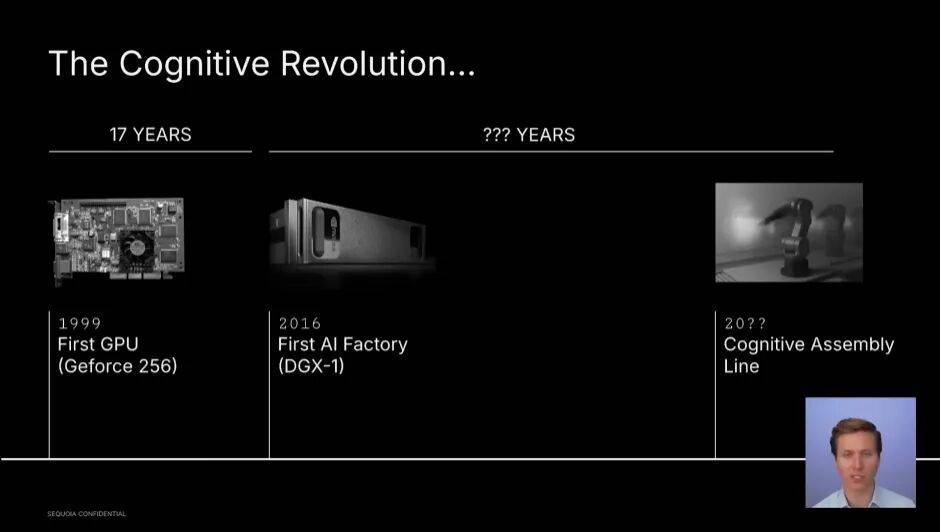
Core Insights - The AI revolution is expected to create a value of $10 trillion, with only $20 billion of the service industry currently automated by AI, indicating 99.8% of the market remains untapped [1][5][31] Group 1: Historical Context and Comparison - The development of AI is compared to the Industrial Revolution, highlighting key milestones such as the invention of the steam engine and the establishment of modern factory systems [3][4] - The first GPU by NVIDIA in 1999 is likened to the steam engine, while the first AI factory in 2016 represents the modern factory system [4] Group 2: Market Opportunities - The U.S. service industry is valued at $10 trillion, with only about $20 billion currently automated by AI, presenting a significant opportunity for growth [5][6] - The potential for AI to expand the market is compared to the early days of cloud computing, where SaaS grew from a small share to a substantial market presence [7] Group 3: Investment Focus Areas - Sequoia Capital has identified five key investment themes for the next 12-18 months, which include persistent memory, seamless communication protocols, AI voice technology, AI security, and open-source AI [21][24][25][26][29] - The need for a solution to the memory problem in AI is emphasized, as it is crucial for the large-scale application of AI agents [21][23] Group 4: Trends in AI Development - Five significant trends are identified that indicate the industrialization of AI, including the shift from certainty to leverage in work paradigms, real-world validation of AI, and the integration of AI into the physical world [9][10][11][12][16] - The prediction that computational power for knowledge workers will increase significantly, potentially by 10 to 10,000 times, is highlighted as a transformative factor [18][19][20] Group 5: Future Implications - The advancements in AI are expected to compress the timeline of industrial evolution from a century to just a few years, marking a profound cognitive revolution that will change human thinking and working methods [31][32]

红杉美国:未来一年,这五个AI赛道重点关注
Hu Xiu· 2025-08-31 03:34
Core Insights - Sequoia Capital views the AI revolution as a transformative event comparable to the Industrial Revolution, presenting a $10 trillion opportunity in the service industry, of which only $20 billion has been automated by AI so far [2][9][12]. Investment Themes - In the next 12 to 18 months, Sequoia will focus on five key investment themes: persistent memory, communication protocols, AI voice, AI security, and open-source AI [3][35]. - The company predicts that the computational power consumption of knowledge workers will increase by 10 to 10,000 times, creating significant opportunities for startups specializing in AI applications [3][32]. Historical Context - The article draws parallels between the current cognitive revolution and the Industrial Revolution, highlighting the importance of specialization in the development of complex systems [4][8]. - The first GPU in 1999 is likened to the steam engine of the current era, while the first AI factory in 2016 is seen as a pivotal development in AI production [5]. Market Potential - The U.S. service industry market is valued at $10 trillion, with only $20 billion currently automated by AI, indicating a massive growth opportunity [12][18]. - Sequoia emphasizes the importance of market size in investment decisions, as highlighted by their founder Don Valentine [15]. Investment Trends - The company identifies five investment trends in the AI cognitive revolution, including leveraging tasks over certainty, validating AI in the real world, and the integration of AI into physical processes [20][25][29]. - AI is expected to significantly enhance productivity, with knowledge workers potentially using hundreds or thousands of AI agents simultaneously [32][33]. Specific Investment Themes - Persistent memory is crucial for AI to integrate deeply into business processes, addressing both long-term memory and the identity of AI agents [36]. - Seamless communication protocols are needed for AI agents to collaborate effectively, similar to the TCP/IP protocols of the internet [39]. - AI voice technology is maturing, with applications in consumer and enterprise sectors, enhancing automation in various industries [42]. - AI security presents a vast opportunity across the development and consumer spectrum, ensuring safe technology deployment and usage [44]. - Open-source AI is at a critical juncture, with the potential to compete with proprietary models, fostering a more open and accessible AI landscape [47].
红杉美国:10万亿美元AI机遇下的五大投资主题 | Jinqiu Select
锦秋集· 2025-08-29 09:23
Core Viewpoint - Sequoia Capital describes the current AI development as a "cognitive revolution," which they believe could create transformation opportunities worth up to $10 trillion in the service industry [1][4][16]. Group 1: AI Revolution Comparison - The AI revolution is likened to the Industrial Revolution, with significant milestones occurring much faster; for instance, it took 17 years from the first GPU in 1999 to the first AI factory in 2016, compared to over two centuries for the Industrial Revolution [1][6][10]. - The concept of "specialization is imperative" is emphasized, indicating that complex systems require a combination of general and highly specialized components and labor to mature [1][7][13]. Group 2: Market Opportunities - The potential market for AI in the U.S. service sector is estimated at $10 trillion, with only about $20 billion currently automated by AI, indicating a vast opportunity for growth [1][16]. - Sequoia Capital highlights the importance of market size, referencing their founder Don Valentine’s emphasis on market significance [1][18]. Group 3: Investment Trends - Five key investment trends are identified: leveraging uncertainty, real-world validation, reinforcement learning, AI in the physical world, and computational power as a production function [1][22][30][33][37]. - The shift towards real-world validation is noted, where companies must prove their AI capabilities in practical scenarios rather than just academic benchmarks [1][25][27]. Group 4: Investment Themes - Sequoia Capital outlines five investment themes for the next 12-18 months: persistent memory, communication protocols, AI voice, AI security, and open-source AI [1][39][42][45][49][52]. - Persistent memory is crucial for AI to understand long-term context and maintain its identity over time, presenting a significant opportunity for development [1][39]. - The need for seamless communication protocols among AI systems is highlighted, which could lead to innovative applications [1][42]. - AI voice technology is seen as timely and applicable in various consumer and enterprise contexts, enhancing operational efficiency [1][45]. - AI security is identified as a critical area with vast opportunities, ensuring safe development and usage of AI technologies [1][49]. - The role of open-source AI is emphasized as essential for fostering a competitive and accessible AI landscape [1][52].

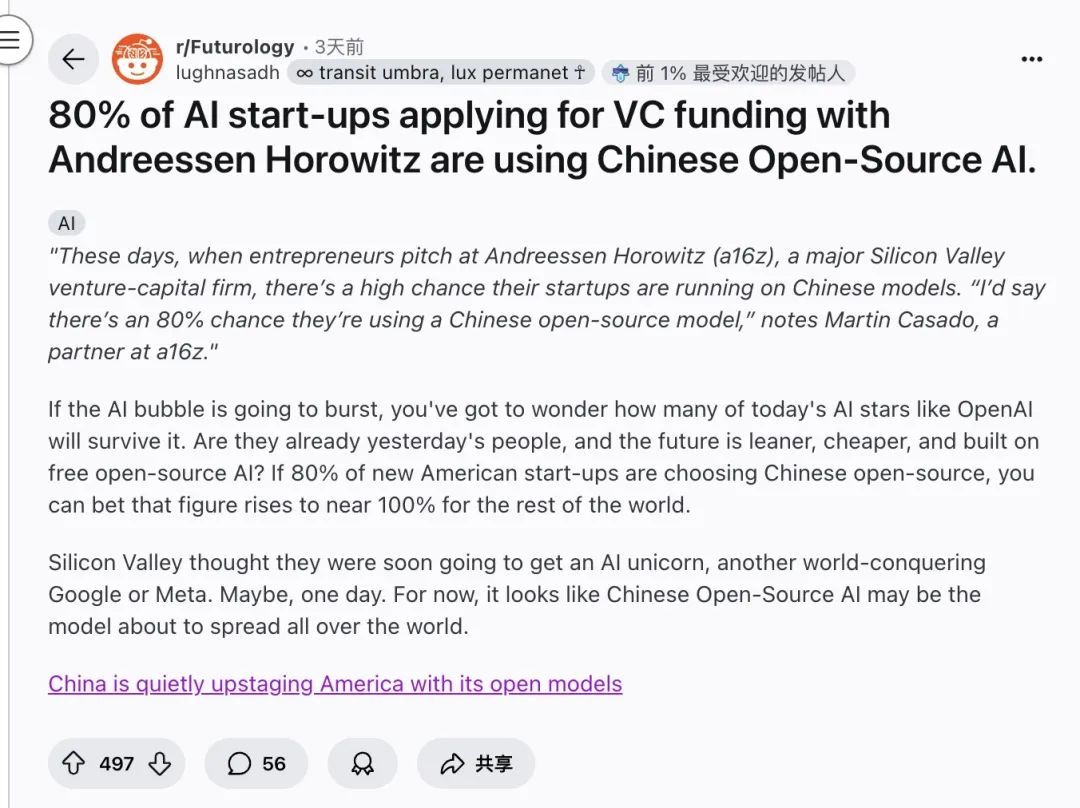
80%美国AI初创靠中国开源模型“吃饭”,a16z投资人震惊,全球开源榜前16名全被中国包揽
3 6 Ke· 2025-08-27 12:59
Core Insights - The article highlights a significant shift in the AI startup landscape in the U.S., where up to 80% of AI startups are reportedly using open-source models from China instead of those from established players like OpenAI and Anthropic [1][2][3] - This trend suggests a potential global dominance of Chinese open-source AI models, with the implication that the majority of AI startups worldwide may follow suit [1][2] - The article raises questions about the sustainability of leading AI companies and whether the future will favor more streamlined, cost-effective models based on open-source technology [2][3] Summary by Sections Shift in AI Model Usage - A report indicates that 80% of U.S. AI startups are using Chinese open-source models during funding pitches, marking a dramatic change from previous perceptions of open-source models as secondary options [1][2] - The dominance of Chinese models is further emphasized by the observation that all top 16 open-source AI models on the Design Arena platform are from China, with the highest non-Chinese model ranked 17th [7][8] Competitive Landscape - Martin Casado, a partner at Andreessen Horowitz, suggests that the trend towards Chinese open-source models may indicate a broader shift in the industry, questioning the future viability of companies like OpenAI [2][3] - The article notes that Chinese models have outperformed U.S. counterparts in various intelligence tests, indicating a growing competitive edge [2] Industry Dynamics - The article discusses a trend towards closed-source models among major players like Meta, which has shifted its strategy from open-source to a more cautious approach, potentially contradicting the open-source advocacy by figures like Casado [3][5] - Casado argues that while open-source remains crucial, the industry is witnessing a tightening of open-source initiatives, with a notable increase in the prevalence of Chinese models [5][6] User Experience and Market Perception - The Design Arena platform evaluates models based on user preferences rather than automated metrics, revealing that Chinese models excel in user experience [7][8] - Comments from users reflect a growing sentiment that Chinese models offer better value for startups, emphasizing the importance of cash flow in the entrepreneurial landscape [10]