
房地产市场复苏

Search documents
拐点已现上行持续,港资房企估值重塑
CAITONG SECURITIES· 2026-01-26 04:30
Investment Rating - The report maintains a "Positive" investment rating for the Hong Kong real estate sector [1]. Core Insights - The Hong Kong residential market is stabilizing and showing signs of recovery, with new home sales volume approaching the peak levels of 2019, and second-hand home transactions reaching a new high since 2022. The inventory de-stocking cycle has significantly reduced from 125 months to 61 months [1][8]. - The retail property market is still under pressure, but rental declines are narrowing, and vacancy rates in core areas are decreasing. Office rents and occupancy rates are under pressure, with significant regional market differentiation [1][19][25]. - The residential market is expected to continue its upward trend in 2026, driven by lower mortgage rates and an increase in rental yields. Over 80% of residential properties are projected to achieve a balance between supply and rental demand [1][34][40]. Summary by Sections 1. Hong Kong Real Estate Market Review - Residential transaction volumes are increasing, with new home sales reaching 21,000 units in 2025, a 99.1% increase from the cycle's bottom [8][12]. - The inventory pressure has eased, with the de-stocking cycle for new homes dropping significantly [16]. - Retail property rents are still adjusting, but the rate of decline is slowing, and some core areas are showing signs of recovery [19][21]. - Office rents have decreased by 21.1% since their peak in June 2019, with rising vacancy rates [25][26]. 2. Outlook for the Hong Kong Real Estate Market - The residential market is expected to continue its recovery, with structural differentiation being a key feature [34]. - The ongoing Federal Reserve rate cuts are likely to support the Hong Kong real estate market's recovery [34][37]. - The proportion of properties achieving a balance between supply and rental demand is expected to increase, enhancing home buying demand [39][40]. - Talent attraction policies are anticipated to boost potential home buying demand as more skilled individuals move to Hong Kong [44][50]. 3. Valuation Elasticity of Hong Kong Property Companies - Current valuations of major Hong Kong property companies are at historically low levels, indicating potential for recovery [1][3]. - Companies with a higher proportion of development business and land reserves are expected to exhibit greater valuation elasticity [1][3]. - The top three property companies in terms of sales in 2025 are Sun Hung Kai Properties, Henderson Land Development, and Sino Land, with significant year-on-year sales growth for Henderson and Sino [1][3].



2026年开年核心城市二手房 “量价齐升”,市场热度超预期
Xin Lang Cai Jing· 2026-01-22 06:51
Core Insights - The real estate market in core cities has shown unexpected warmth at the beginning of 2026, with a significant increase in both transaction volume and prices, marking a strong recovery trend [1][9] - The recovery is driven by a series of favorable policies that have lowered transaction costs and improved market expectations, leading to increased buyer and seller activity [3][9] Policy Impact - A combination of tax reductions and credit optimizations has been implemented, effectively lowering transaction barriers and stimulating market activity [3] - The new VAT policy, effective from January 1, reduces the tax rate from 5% to 3% for personal sales of homes held for less than two years, saving nearly 100,000 yuan in transaction costs for a property priced at 5 million yuan [3] - The central bank's interest rate cuts and the extension of tax refund policies for home purchases have further supported the market, with first-time home loan rates dropping below 3% [3][6] Market Performance - Core cities like Shanghai and Shenzhen have experienced remarkable performance, with Shanghai seeing daily transactions exceeding 1,000 units and a total of over 13,000 units sold by mid-January [4][6] - New first-tier cities such as Nanjing and Hangzhou have also reported significant increases in transactions, with Nanjing achieving a single-day high of 340 units sold [6][7] Market Dynamics - The active second-hand housing market has facilitated a "sell old to buy new" chain, linking the second-hand and new housing markets and driving demand for new homes [6][7] - The price stabilization in the second-hand market has provided a reasonable benchmark for new home pricing, preventing previous discrepancies between new and second-hand home prices [7] Future Outlook - The sustainability of the current market recovery will depend on the effectiveness of policy implementation, economic recovery pace, and demand release dynamics [8] - While core cities are experiencing a recovery, lower-tier cities continue to struggle with high inventory levels, indicating a growing disparity in market performance [8][9] - The current recovery signals a shift from a "broad increase" era to a "quality competition" era in the real estate market, emphasizing the importance of location and property quality [8][9]

惠誉:香港住宅市场有望维持温和复苏态势 商业地产或继续承压
Zhi Tong Cai Jing· 2026-01-21 08:15
Group 1: Residential Property Market - The Hong Kong residential property market is expected to maintain a moderate recovery, but the rebound will be limited [1] - Factors contributing to the rise in residential property prices and transaction volumes include a low interest rate environment, a strong stock market leading to a wealth effect, and improved rental yields [1] - New immigration policies, including talent programs, have boosted demand, with new home sales projected to reach the highest level in over a decade by 2025 [1] - Continuous promotional policies from developers and a cautious market outlook indicate that the residential market rebound is unlikely to provide significant or lasting boosts to fiscal revenue [1] Group 2: Commercial Real Estate Market - The commercial real estate sector is expected to remain under pressure, with office rental rates significantly below pre-pandemic levels [1] - Recent leasing activity in traditional core business districts has increased due to strong capital market performance, but high vacancy rates and structural headwinds will continue to limit short-term acquisition intentions for commercial land [1] - Developers may adopt a selective strategy in acquiring new residential land due to a cautious macro outlook, which could negatively impact government land sale revenue [1] Group 3: Banking Sector - The Hong Kong banking sector is expected to maintain a prudent approach, focusing on asset quality and credit standards rather than pursuing loan growth, despite a rebound in residential mortgage activity [2] - The banking sector's funding, liquidity, and capital positions remain robust, but it is not expected to provide significant support for market activity [2] - The quality of residential mortgage assets is stable, but the weak commercial real estate sector may continue to face pressure [2] Group 4: Government Revenue and Fiscal Flexibility - Hong Kong's fiscal flexibility will continue to be constrained by declining real estate-related revenues, although short-term stock trading stamp duties may offset some impacts [2] - As of the fiscal year ending March 2025, property stamp duties and land revenues accounted for approximately 5% of total government revenue, down from over 6% five years ago, and less than 1% of GDP [2] - The government has decided to suspend new commercial land auctions in response to high office vacancy rates and weak market demand, which will further limit real estate-related revenues below historical levels [2]
我省二手房交易迎“开门红”
Xin Lang Cai Jing· 2026-01-14 21:48
Core Viewpoint - The real estate market in cities like Nanjing, Suzhou, and Nantong is showing signs of recovery, with increased transaction volumes and stable prices, driven by supportive government policies and a growing sense of urgency among potential buyers [1][2][3]. Group 1: Market Trends - Nanjing's second-hand housing transactions surged, with a record of 309 units sold on January 11, the highest since January 2025, and a weekly increase of 14% in transactions [1][2]. - Suzhou and Nantong also reported significant increases in second-hand housing transactions, with Suzhou seeing a 14% rise and Nantong a 13.5% rise in weekly sales [2]. - The number of people viewing properties in Nanjing increased by approximately 13% to 14% during the same period, indicating heightened market activity [2]. Group 2: Policy Support - The central government's economic meeting in December 2025 set a tone for 2026, emphasizing the need for stable real estate policies and the implementation of more proactive macroeconomic measures [3]. - A tax policy change effective January 1, 2026, reduced the value-added tax on personal housing sales from 5.3% to 3% for properties held for less than two years, providing a strong incentive for sellers [3]. - The People's Bank of China announced reductions in policy interest rates and housing loan rates, suggesting further potential decreases in mortgage rates [3]. Group 3: Buyer Sentiment - A survey indicated that 34% of potential buyers believe 2026 is a favorable year for purchasing new or replacement homes, reflecting a growing willingness to engage in the market [4]. - The proportion of second-hand home transactions has increased from 28% in 2021 to 45% in 2026, highlighting a significant shift towards improving housing conditions [4]. Group 4: Local Initiatives - Nanjing introduced a talent policy on January 4, 2026, aimed at enhancing housing security for skilled workers, including rental and purchase subsidies [5]. - Suzhou implemented various supportive policies, including a credit repair initiative for individuals with overdue payments and expanded housing subsidies for qualified talents [6].
超七成房企销售额环比增长!最新“成绩单”出炉,它仍是行业第一
Bei Jing Shang Bao· 2026-01-13 12:13
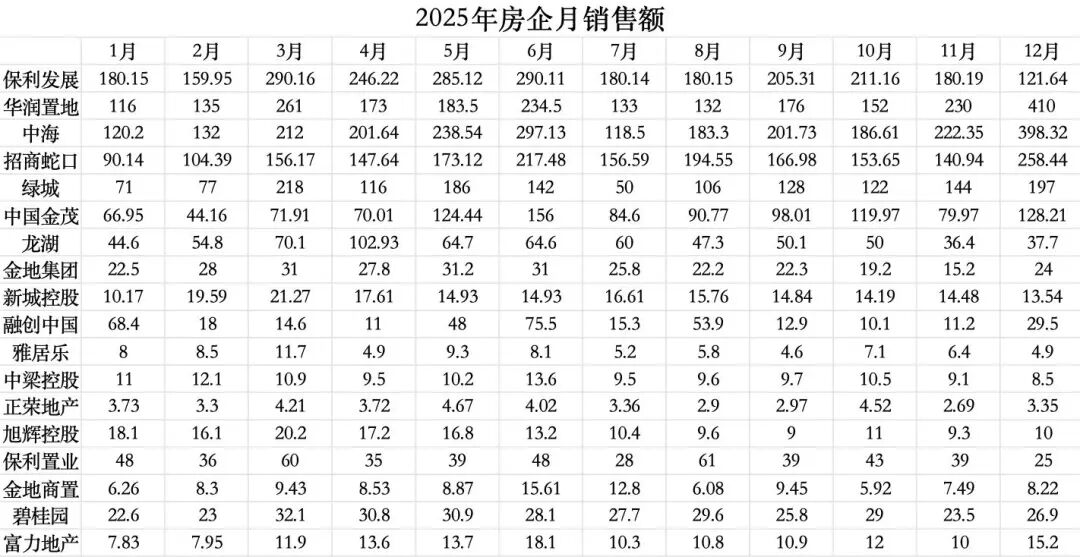
Core Viewpoint - The competitive landscape among leading real estate companies is stabilizing, with Poly Developments maintaining its position as the industry leader in sales for 2025, achieving a sales figure of 2530.3 billion yuan, despite a year-on-year decline of 21.67% from 2024 [1][6]. Sales Performance - Among the 18 real estate companies that disclosed their December 2025 sales data, 13 companies reported month-on-month growth, with China Overseas Development and China Resources Land achieving significant sales figures of 398.32 billion yuan and 410 billion yuan, respectively [4][5]. - Poly Developments led the sales with 121.64 billion yuan in December, while China Overseas and China Resources followed closely with 398.32 billion yuan and 410 billion yuan [4][6]. Market Trends - The sales growth in December 2025 indicates a positive trend for the real estate market, with companies like Sunac China and China Resources Land showing remarkable month-on-month increases of 163.39% and 78.26%, respectively [5][6]. - The overall sales performance of major companies suggests a solid foundation for the real estate market's stability and growth expectations in 2026 [5]. Land Acquisition Strategies - Poly Developments has focused heavily on the Guangzhou market, with land acquisition payments reaching 648.24 billion yuan from 2023 to 2025, significantly higher than in Beijing and Shanghai [1][10]. - China Overseas Development has also concentrated its land acquisition efforts in first-tier cities, with 60.6% of its sales coming from major cities like Hong Kong and the four first-tier cities [9]. Company Resilience - Despite facing challenges, companies with over 100 billion yuan in sales, such as Poly Developments and China Overseas, have demonstrated strong operational resilience and effective governance, allowing them to navigate market fluctuations [6][7]. - The restructuring of debts for companies like Sunac China and Country Garden has shown progress, indicating a potential for recovery and stability in the sector [8].



居者有其屋,昂贵的“美国梦”
Shenwan Hongyuan Securities· 2026-01-11 03:42
Group 1: U.S. Real Estate Market Challenges - The U.S. real estate market is currently facing a significant contradiction, primarily due to insufficient demand, with supply shortages being secondary[2] - As of January 2025, the average monthly cost of homeownership is $3,060, accounting for 43.2% of household income, significantly higher than the $2,227 monthly rental cost[2] - To bring homeownership costs down to rental levels, mortgage rates would need to decrease from the current 6.2% to 3.7%[2] Group 2: Federal Reserve's Impact on Housing Demand - The Federal Reserve is expected to lower interest rates 1-2 times in 2026, but the long-term interest rates may not decline significantly due to resilient consumer spending and other economic factors[3] - The mortgage rates are closely tied to the 10-year U.S. Treasury yield, which is projected to remain around 4.0% by the end of 2026, limiting the potential for substantial reductions in mortgage rates[3] Group 3: Trump's Real Estate Policies - Trump's administration has proposed five key policies aimed at stimulating the real estate market, including transferable mortgages and a ban on large institutional purchases of single-family homes[4] - However, the effectiveness of these policies is questionable, as only about 1% of U.S. homes are owned by large institutional investors, and the proposed measures may have limited impact on demand[4]
美银:中国2026年GDP增长4.7% 一线城市房价率先回暖
2 1 Shi Ji Jing Ji Bao Dao· 2025-12-16 12:12
Group 1 - The chief economist of Bank of America Securities for Greater China, Qiao Hong, forecasts that China's GDP growth rate will reach 4.7% for the full year of 2026 [1] - It is expected that more counter-cyclical adjustment policies will be introduced in mainland China to support economic growth close to target levels by 2026 [1] - To continuously stimulate domestic demand, monetary policy in mainland China is anticipated to be moderately accommodative, with two 10 basis point interest rate cuts expected in 2026 [1] Group 2 - The policy interest rate reductions are likely to occur in the first and second quarters of 2026 [1] - Qiao Hong indicated that the downward trend in the real estate market is expected to bottom out in 2026, with first-tier city housing prices likely to recover first [1] - Once the housing market in first-tier cities stabilizes, the recovery trend is expected to gradually transmit to the second and third-tier city markets [1]
近百轮厮杀!中海42%溢价拿下深圳超总宅地,利润腰斩仍在逆势加仓
Hua Xia Shi Bao· 2025-12-11 00:57
Core Insights - China Overseas Land & Investment (COLI) has successfully acquired the second residential land parcel in the Shenzhen Super Headquarters area, reflecting strong confidence in core assets despite high land prices [3][4][5]. Group 1: Market Dynamics - The land auction in December marked a significant competitive environment, particularly in the Guangzhou and Shenzhen markets, indicating a recovery momentum in the industry [3]. - COLI's acquisition involved a competitive bidding process with a 42.49% premium over the starting price, highlighting the intense interest in prime real estate [6][7]. Group 2: Land Acquisition Details - The T207-0068 land parcel, measuring 11,800 square meters with a building capacity of 41,100 square meters, was sold for 31.86 billion yuan, with a floor price of 77,300 yuan per square meter [6][7]. - This land was previously designated for commercial use but was converted to residential use, reflecting a strategic shift in urban planning and land value [5]. Group 3: Financial Performance - In the first three quarters of the year, COLI reported a revenue of 1,030 billion yuan, a 6% year-on-year decline, and a significant drop in operating profit by 27.7% [11]. - Despite a contraction in sales, COLI acquired 27 land parcels totaling 82.7 billion yuan, a 40.7% increase year-on-year, indicating a focus on core city investments [11][12]. Group 4: Strategic Challenges - The high land acquisition costs juxtaposed with declining sales prices have created a challenging environment for profitability, with land prices increasing significantly compared to sales prices [13][15]. - COLI's strategy of acquiring prime land in first-tier cities is seen as a long-term investment, but it raises concerns about the sustainability of profit margins amid rising costs [14][15].

拐点与复苏:新周期的曙光
BOCOM International· 2025-11-27 11:47
Investment Rating - The industry rating has been upgraded from "Neutral" to "Outperform" [1][13] Core Insights - The recovery of the Hong Kong real estate market is expected to be a gradual process, with different asset sub-sectors recovering at different rates. The residential sector is anticipated to lead the recovery, followed by quality retail assets and core office spaces [1][8] - Key catalysts for the market recovery include improvements in macroeconomic uncertainty, significant policy easing, and a return of fundamental demand drivers such as demographic trends [5][21] - The report highlights that the residential sector is poised for a rebound, with rental levels expected to rise by approximately 3-5% in 2025, and property prices projected to increase by 3-5% in 2025, 5% in 2026, and 5% in 2027 [5][12] Summary by Sections Investment Highlights - The report emphasizes the importance of selecting the right sub-sector in the Hong Kong real estate market, indicating that the recovery will not be a single event but a phased process targeting different segments [8][20] - The report identifies Sun Hung Kai Properties (16 HK) and Link REIT (823 HK) as preferred investment targets, expecting both to benefit from the sector's recovery and multiple catalysts in the next 1-2 years [1][13] Market Trends and Drivers - The report notes that the Hong Kong real estate market is experiencing a turning point, with several important catalysts indicating that the market is at or near a reversal point [5][20] - The residential sector is expected to see a significant rebound driven by sustained population inflow, which will continue to support housing demand, particularly in the rental market [5][21] - Retail properties are also on a recovery path, supported by stabilizing local consumer sentiment and an increase in inbound tourists, although the growth rate is expected to be more moderate compared to residential properties [5][12] Valuation Overview - The report discusses the potential for asset net value (NAV) expansion and valuation multiple expansion as key drivers for stock price appreciation in the real estate sector [12][11] - The anticipated recovery in rental income and asset prices will directly impact companies' NAV estimates, providing a solid foundation for stock price increases [12][11] Company-Specific Insights - Sun Hung Kai Properties (16 HK) is highlighted as a key beneficiary of the residential recovery, with expectations of improved sales performance and profit margins due to high absorption rates and rising average selling prices [14][15] - Link REIT (823 HK) is positioned as a defensive, high-yield investment choice, expected to benefit from potential interest rate cuts and inclusion in the Hong Kong Stock Connect, which could attract new capital inflows [16][17]
五年的楼市寒潮或将进入尾声
3 6 Ke· 2025-11-07 02:44
Core Insights - Since 2020, nearly 50 overseas economies have recorded nominal housing price increases averaging over 30% within five years, driven primarily by global inflation [1] - In the past year, major developed economies have seen average housing price growth exceeding 5%, with Japan experiencing a remarkable 20% increase in housing prices and over 8% in rental prices [1][2] - Tokyo's core area has new housing prices reaching 150 million yen (approximately 7 million RMB), translating to 90,000 to 100,000 RMB per square meter, with future projections indicating prices could reach 200,000 RMB per square meter [1][2] Group 1: Reasons for Price Surge - The first reason for the price surge is the severe depreciation of the yen, combined with a rental yield of around 5%, making Japanese real estate an attractive safe-haven investment for global capital [2] - The second reason is the extremely low interest rate environment, which allows wealthy individuals to leverage loans for real estate investments, effectively turning real estate into a wealth accumulation vehicle [3] - The third reason is the scarcity of land supply in Tokyo, where most areas have been developed, leading to a mismatch between housing demand and available supply, thus driving prices higher [4] Group 2: Socioeconomic Implications - Many young people in Japan are being priced out of the housing market, leading to a trend of families relocating to more affordable areas like Saitama and Chiba, resulting in long commutes for affordable housing [5] - The Tokyo real estate market is increasingly dominated by high-net-worth individuals, leading to a significant wealth gap and a shift in population demographics [6][7] - The Japanese government is hesitant to implement strict housing policies due to the need for foreign capital to support economic recovery, which complicates efforts to address the growing wealth disparity [7] Group 3: Lessons for Other Markets - The Japanese real estate boom is attributed to economic inflation, influx of foreign purchasing power, low interest rates, and land scarcity, which are critical factors for future housing price rebounds [8] - As global economic conditions shift towards inflation, similar trends may emerge in other markets, particularly in major cities where land is scarce and demand is high [11][12] - The anticipated reduction in interest rates and the influx of capital from wealthy individuals into core urban areas could lead to a significant recovery in real estate markets across various cities [10][15]