指数基金

Search documents
国泰沪深300Y份额:个人养老投资的指数化时代开启
Shenwan Hongyuan Securities· 2025-12-24 13:41
1. Report Industry Investment Rating - Not provided in the given content 2. Core Viewpoints of the Report - The "Y share" of personal pension funds is a significant initiative in the context of the national strategy for personal pension system construction, with cost advantages and tax shield effects. It can guide the transformation from "short - term funds" to "long - term funds" [3][7]. - The CSI 300 index has relatively stable dividend returns, its current valuation has a safety margin, and its future profit expectations are optimistic, making it suitable for long - term allocation [3]. - The Cathay CSI 300 Index Securities Investment Fund has outperformed the CSI 300 index in the long - term, with excellent control over tracking errors, and is a high - quality passive index fund [33]. 3. Summary by Relevant Catalogs 3.1 Personal Pension Fund "Y Share" Introduction 3.1.1 "Y Share" Policy Background: The "Cornerstone" of the Third Pillar - In the context of population aging and fiscal pressure, the construction of the personal pension system is a national strategy. The "Y share" is a standardized interface for the public fund industry to connect with the national pension strategy [7]. - It has cost advantages, with fee structures that significantly reduce long - term holding frictional costs, and tax shield effects, providing direct tax subsidies for middle - and high - income groups [7][8]. 3.1.2 "Y Share" Market Significance: Mechanism Guidance from "Short - Term Funds" to "Long - Term Funds" - For individual investors, the closed - operation mechanism of the "Y share" can lock in long - term liquidity and obtain high - equity volatility premiums. The annual contribution limit forms an annual fixed - investment rhythm, which matches the characteristics of equity - type assets [11][12]. - For the market ecosystem, personal pension account funds are long - term and stable, which can improve the A - share investor structure, reduce market volatility, and support the real economy [12]. 3.2 CSI 300 Index Introduction 3.2.1 Dividend Yield Analysis: Relatively Stable Dividend Returns - The dividend yield of the CSI 300 mostly ranges from 2.0% to 3.5%, higher than that of the CSI 500 and 1000 but lower than that of the SSE 50. It combines growth and value components, suitable for investors who prefer stable cash flows [22]. 3.2.2 Valuation Level: The Overall Valuation Level Returns to the Historical Median - Since 2021, the valuation has shown a significant downward trend. Currently, the overall valuation level of the CSI 300 is in the middle range, with a certain safety margin and medium - to long - term attractiveness [25]. 3.2.3 Profit Level: Optimistic Future Profit Expectations for the Index - The net profit has shown a steady upward trend, increasing from about 3.8 trillion in 2020 to an expected about 5.9 trillion in 2027E, with a cumulative growth of over 55%. The ROE will continue to grow in the next three years, and the index has medium - to long - term allocation value [29]. 3.3 Cathay CSI 300 Index Securities Investment Fund Analysis 3.3.1 Cathay CSI 300 Has Outperformed the CSI 300 Index in the Long - Term - Since 2020, as of December 12, 2025, the cumulative net value of Cathay CSI 300 has increased to about 1.38 times, higher than about 1.12 times of the CSI 300 index. It has achieved stable excess returns, controlled volatility and drawdowns, and has the characteristics of "high return + low volatility + strong defense" [33]. 3.3.2 Excellent Tracking Error Control of Cathay CSI 300 - The average value of the absolute value of the daily tracking deviation since 2020 is 0.05%, and the maximum value is 1.28%. The annualized tracking error has been kept within 2% since 2020 and within 1% in the past three years [40]. 3.3.3 Asset Allocation of Cathay CSI 300 - The fund has returned from active exploration to pure passive replication. The stock market value accounts for 94% - 95% of the net value, higher than the benchmark requirement. The industry weight deviation is well - controlled, making it a high - purity and tool - oriented CSI 300 index allocation vehicle [46][49]. 3.3.4 Introduction of the Current Fund Manager - Wu Zhonghao, with 3.88 years of investment experience, currently manages 18 funds with a total managed fund scale of 253.91 billion yuan as of September 30, 2025 [52].
5只中证A500指数ETF成交放量,成交额环比均增加超5亿元
Zheng Quan Shi Bao Wang· 2025-12-24 11:36
Core Viewpoint - The trading volume of the CSI A500 Index ETFs reached 67.35 billion yuan today, an increase of 4.038 billion yuan from the previous trading day, representing a growth rate of 6.38% [1] Trading Volume Summary - The trading volume of the Huaxia CSI A500 ETF (512050) was 14.054 billion yuan, up by 1.382 billion yuan, with a growth rate of 10.91% [1] - The trading volume of the GF CSI A500 ETF (563800) was 2.625 billion yuan, up by 1.066 billion yuan, with a growth rate of 68.40% [1] - The trading volume of the Southern CSI A500 ETF (159352) was 11.288 billion yuan, up by 0.890 billion yuan, with a growth rate of 8.56% [1] - The Rongtong CSI A500 ETF (159379) and Morgan CSI A500 ETF (560530) saw significant increases in trading volume, with growth rates of 639.19% and 334.80% respectively [1] Market Performance Summary - The CSI A500 Index (000510) rose by 0.54% by the end of the trading day, while the average increase for related ETFs was 0.57% [1] - The top performers included the Huaan CSI A500 Enhanced Strategy ETF (561090) and the Puyin Ansheng CSI A500 ETF (159376), which increased by 0.86% and 0.85% respectively [1]
4只中证2000指数ETF成交额环比增超50%
Zheng Quan Shi Bao Wang· 2025-12-24 11:32
Core Viewpoint - The trading volume of the CSI 2000 Index ETFs increased significantly today, indicating heightened market activity and investor interest in this segment [1]. Trading Volume Summary - The total trading volume of the CSI 2000 Index ETFs reached 510 million yuan today, an increase of 138 million yuan from the previous trading day, representing a growth rate of 37.01% [1]. - Specifically, the CSI 2000 ETF (563300) had a trading volume of 287 million yuan, up 105 million yuan from the previous day, with a growth rate of 58.04% [1]. - The Southern CSI 2000 ETF (159531) recorded a trading volume of 125 million yuan, an increase of 44.26 million yuan, with a growth rate of 54.78% [1]. - The Huatai-PB CSI 2000 ETF (159536) had a trading volume of 8.06 million yuan, up 3.57 million yuan, with a growth rate of 79.62% [1]. - The top performers in terms of trading volume increase included the Huatai-PB CSI 2000 ETF (159536) and the Fortune CSI 2000 ETF (563200), both showing increases of 79.62% and 79.58% respectively [1]. Market Performance Summary - As of market close, the CSI 2000 Index (932000) rose by 1.55%, while the average increase for related ETFs was 1.71% [1]. - The Southern CSI 2000 ETF (159531) and the Fortune CSI 2000 ETF (563200) were among the top gainers, with increases of 2.07% and 2.04% respectively [1].
今年炒股,你赚到钱了吗?
集思录· 2025-12-21 14:22
Group 1 - The overall sentiment among investors indicates mixed results for the year, with some reporting returns close to the starting value of their investments [1] - High dividend and low debt stocks are perceived as a safer investment strategy, with a reported success rate of 99% based on historical performance [2] - The current year is described as one of the best in recent years, attributed to a bull market [3] Group 2 - Some investors have experienced significant gains, with reports of a 100% increase in certain ETFs, although this was not anticipated at the beginning of the year [4] - A suggestion is made for those who have not made profits this year to consider investing in large, mid, and small-cap index ETFs after a market downturn [5] - There are reports of substantial losses for some investors, with estimates of losses ranging from 5% to 10% for the year [8] Group 3 - A notable investment strategy includes holding high-yield stocks, with one investor reporting a 7.5% profit from a 68% allocation in such stocks [13] - Some investors have faced challenges with specific stocks, such as Meituan and Baidu, leading to a reluctance to monitor their returns [12]


不破不立?!指数高点回撤近5%,宽基ETF或迎“低吸”机会
Sou Hu Cai Jing· 2025-12-17 08:38
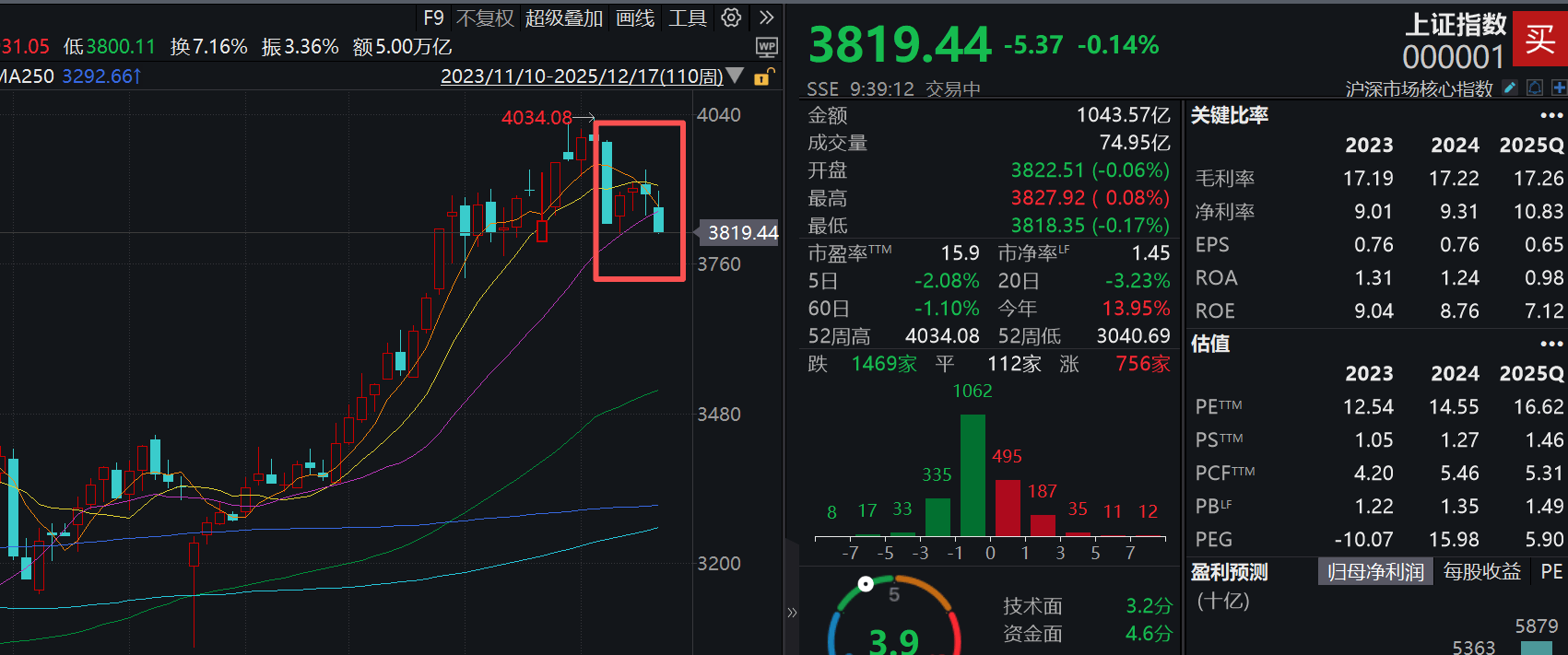
Group 1 - The market is experiencing a correction, with the Shanghai Composite Index retreating to around 3800 points, which has caused confusion among investors who were previously optimistic when the index surpassed 4000 points [1][2] - The recent market adjustment is attributed to a combination of emotional reactions rather than a fundamental collapse, triggered by external factors such as the potential interest rate hike by the Bank of Japan [4] - Small-cap stocks have seen significant declines, with the micro-cap index dropping over 6% in December, while larger indices like the Shanghai 50 and CSI 300 have only seen minor declines, indicating a divergence in market performance [5] Group 2 - Recent policy announcements aimed at expanding domestic demand have not met immediate expectations, leading to disappointment among some investors, despite positive underlying economic indicators such as GDP growth and manufacturing PMI [6] - The current market adjustment is likened to a temporary emotional outburst rather than a fundamental issue, suggesting that the long-term outlook remains positive due to supportive policies and a stable economic foundation [6] - There is a growing interest in broad-based ETFs, particularly the CSI 500 index, which has seen significant inflows, indicating a shift in investor preference towards more stable investment vehicles amid market volatility [8][9] Group 3 - The CSI 500 index has become a focal point for investors, with several ETFs linked to it experiencing substantial growth in assets under management, reflecting its increasing popularity [9][11] - The broad-based index funds are viewed as a reliable means for investors to achieve average market returns, especially in the context of China's economic transition towards high-quality growth [10][11] - The market is expected to present better allocation opportunities as it stabilizes, particularly for broad-based ETFs, which are currently perceived as undervalued compared to historical averages [7][10]
月存千元,轻松养老:螺丝钉个人养老金定投实盘|第422期直播回放
银行螺丝钉· 2025-12-16 14:03
Core Viewpoint - The article discusses the benefits and strategies of investing in personal pension accounts, emphasizing tax deductions and suitable investment options for individuals based on their income levels [3][5][7]. Group 1: Personal Pension Account Benefits - Contributions to personal pension accounts made before December 31 can enjoy tax deductions for the year 2025, with an annual contribution limit of 12,000 yuan [3]. - Individuals with higher incomes benefit more from tax deferrals associated with personal pension accounts, making it more attractive for them compared to those with lower incomes [5][8]. Group 2: Investment Options - Personal pension accounts can invest in five categories: commercial pension insurance, savings deposits, wealth management, public funds, and government bonds [10]. - As of September 30, 2025, there are 91 index funds included in the personal pension account, covering 16 mainstream stock indices [12][13]. Group 3: Index Fund Strategies - Recommended combinations for index funds include the pairing of the CSI 300 and the CSI 500, which covers large and mid-cap stocks [16][17]. - Another effective strategy is combining leading stocks (A-series indices) with dividend strategies, which is currently adopted in personal pension investment plans [19]. Group 4: Investment Style and Performance - A-shares exhibit characteristics of style rotation between growth and value, with growth styles performing better in certain years [25][28]. - Long-term performance between growth and value styles shows minimal difference, although short-term variations exist [28]. Group 5: Investment Management - Diversified allocation and rebalancing can lead to more stable excess returns, with suggested allocations between different strategies [35][36]. - The personal pension account allows flexible contributions, with options for annual, monthly, or weekly investments [38]. Group 6: Common Questions - The investment plan is suitable for individuals who can accept the volatility of index funds and ideally should be at least five years away from retirement [49][50]. - Personal pension accounts are generally closed, with funds accessible only under specific conditions, such as reaching retirement age [54].

鹏华中证全指食品交易型开放式指数证券投资基金基金份额发售公告
Shang Hai Zheng Quan Bao· 2025-12-09 19:13
Fund Overview - The fund is named Penghua CSI All Index Food Exchange-Traded Fund (ETF) with an initial share value of RMB 1.00 [12][19] - The maximum fundraising scale during the subscription period is RMB 2 billion, excluding interest and subscription fees [3][28] - The subscription period is from December 15, 2025, to December 25, 2025, with both online and offline cash subscription options available [16][39] Subscription Details - Investors must have a Shanghai Securities Account to subscribe, which can be an A-share account or a fund account [30][31] - For online cash subscriptions, each single account must subscribe for at least 1,000 shares or multiples thereof [9][13] - For offline cash subscriptions, the minimum subscription is 1,000 shares through sales agents, or at least 50,000 shares when subscribing directly through the fund manager [9][13] Fund Management and Custody - The fund is managed by Penghua Fund Management Co., Ltd., and the custodian is Suzhou Bank Co., Ltd. [1][47] - The fund's registration has been approved by the China Securities Regulatory Commission (CSRC) [1] Investor Eligibility - The fund is open to individual investors, institutional investors, qualified foreign investors, and other investors permitted by laws and regulations [2][15] Fund Operation - The fund operates as an open-ended exchange-traded fund, primarily investing in securities and futures markets [14][10] - The fund's contract will become effective if the total subscription reaches at least 200 million shares, with a minimum of 200 investors [16][43] Subscription Fees and Interest Handling - Subscription fees will be charged at the time of subscription and are not included in the fund's assets [20] - Interest generated from subscription funds during the fundraising period will be allocated to investors' shares for offline subscriptions, while for online subscriptions, it will be included in the fund's assets [21][41]

4只上证50指数ETF成交额环比增超100%
Zheng Quan Shi Bao Wang· 2025-12-05 11:21
Core Viewpoint - The trading volume of the SSE 50 Index ETFs increased significantly today, indicating heightened market activity and investor interest in these funds [1] Trading Volume Summary - The total trading volume of SSE 50 Index ETFs reached 3.029 billion yuan, an increase of 1.319 billion yuan from the previous trading day, representing a growth rate of 77.08% [1] - Specifically, the Huaxia SSE 50 ETF (510050) had a trading volume of 2.08 billion yuan, up 739 million yuan from the previous day, with a growth rate of 55.15% [1] - The E Fund SSE 50 ETF (510100) saw a trading volume of 902 million yuan, an increase of 570 million yuan, with a remarkable growth rate of 171.63% [1] - The Bosera SSE 50 ETF (510710) recorded a trading volume of 7.5746 million yuan, up 3.8391 million yuan, reflecting a growth rate of 102.78% [1] Market Performance Summary - As of market close, the SSE 50 Index (000016) rose by 0.93%, while the average increase of related ETFs tracking the SSE 50 Index was 1.09% [1] - The top performers included the Shenwan Hongyuan SSE 50 Open-Ended Index Fund (510600) and the Tianhong SSE 50 ETF (530000), which increased by 1.55% and 1.54%, respectively [1]
中证1000指数ETF今日合计成交额32.14亿元,环比增加64.49%
Zheng Quan Shi Bao Wang· 2025-12-05 11:10
Core Viewpoint - The trading volume of the CSI 1000 Index ETFs reached 3.214 billion yuan today, an increase of 1.26 billion yuan from the previous trading day, representing a growth rate of 64.49% [1] Trading Volume Summary - The Southern CSI 1000 ETF (512100) had a trading volume of 1.509 billion yuan, up 761 million yuan from the previous day, with a growth rate of 101.75% [1] - The Huaxia CSI 1000 ETF (159845) recorded a trading volume of 1.369 billion yuan, an increase of 391 million yuan, with a growth rate of 40.01% [1] - The Fortune CSI 1000 ETF (159629) saw a trading volume of 128 million yuan, up 65.7 million yuan, with a growth rate of 104.91% [1] - The Guotai CSI 1000 Enhanced Strategy ETF (159679) and the 1000 ETF Enhanced (560590) had the highest increases in trading volume, with growth rates of 316.70% and 223.58% respectively [1] Market Performance Summary - As of market close, the CSI 1000 Index (000852) rose by 1.29%, while the average increase for related ETFs tracking the CSI 1000 Index was 1.24% [1] - The top performers included the Guotai CSI 1000 Enhanced Strategy ETF (159679) and the Tianhong CSI 1000 Enhanced Strategy ETF (159685), which increased by 1.57% and 1.45% respectively [1]
最高52%!养老基金今年真的很赚钱
华尔街见闻· 2025-12-04 09:30
Core Viewpoint - The article emphasizes the significance of evaluating the performance of various pension funds (Y shares) as the investment deadline for personal pension tax incentives approaches in 2025, highlighting the potential for capital gains and dividend income alongside tax benefits [2][3]. Group 1: Performance of Pension Funds - The inclusion of equity index funds in personal pension accounts starting December 2024 has provided investors with more options for pension investments, with a focus on the performance of these funds in 2025 [3]. - The best-performing Y shares in 2025 are primarily concentrated in index funds such as the CSI Technology Innovation 50 and the ChiNext 50, with several funds showing annual gains exceeding 50% as of November 28, 2025 [3][4]. - Specific funds like Tianhong CSI Technology Innovation 50 ETF Link Y and E Fund CSI Technology Innovation 50 ETF Link Y have reported growth rates of 52.25% and 51.78%, respectively [4]. Group 2: Active Fund of Funds (FOF) Performance - Active FOFs have also shown impressive performance, with funds like Guotai Min'an Pension 2040 Three-Year Y and ICBC Pension 2050 Five-Year Hold Y achieving growth rates over 30% [5][6]. - Other notable active FOFs, such as E Fund Pension Target Date 2050 and E Fund Huayu Active Pension, have growth rates ranging from 23.6% to 28.2%, aligning closely with the average performance of active equity funds [5]. Group 3: Investment Strategies and Asset Allocation - The Guotai Min'an Pension 2040 Three-Year Y fund has maintained a relatively low drawdown over the past two years, with a significant recovery post-September 2024, leading to new net value highs [7][9]. - This fund has a central equity asset allocation of 52%, with a range of 37%-60%, indicating a balanced approach to equity investments, primarily focusing on sectors like gold and non-ferrous metals [9][11]. - The ICBC Pension 2050 Five-Year Hold Y fund has adopted a technology-focused investment strategy, adjusting its holdings to include sectors such as gaming, cloud computing, and robotics, reflecting a dynamic asset allocation approach [13][14]. Group 4: Market Trends and Future Outlook - The article notes that the performance of pension funds in 2025 has been commendable, with various strategies, including technology-focused and dividend-oriented approaches, yielding positive results [15]. - The overall market environment has allowed for significant growth in pension fund values, although investors are reminded to consider their risk tolerance given the volatility of certain funds [17].