中证A500指数ETF

Search documents
资金加仓恒生科技等赛道 宽基核心资产受关注
Zhong Guo Zheng Quan Bao· 2026-02-08 21:55
Group 1 - The consumer and photovoltaic sectors saw significant gains last week, with several related ETFs rising over 3% [1][2] - The A-share market's broad-based products experienced active trading, with ETFs tracking the CSI A500 index exceeding a total transaction volume of 250 billion yuan [1][2] - The market outlook for February suggests a continuation of the upward trend, driven by concentrated earnings forecasts and the recovery of leading companies' performance [1][4] Group 2 - The Hong Kong consumer sector performed strongly, with ETFs such as the Hang Seng Consumer ETF leading the gains [2] - Gold-related ETFs faced a downturn, with an average decline of over 5% across 14 commodity gold ETFs, and some gold stock ETFs dropping more than 13% [2] - The technology sector attracted significant capital inflow, with the Huatai-PineBridge Hang Seng Technology ETF seeing a net inflow of over 3.8 billion yuan last week [3] Group 3 - Several asset management institutions have released macro outlooks for China's equity market in 2026, highlighting diverse growth paths driven by the 14th Five-Year Plan [4][5] - Key investment areas identified include technology, manufacturing, renewable energy, healthcare, and emerging consumer sectors [4][5] - The market is expected to maintain a structural trend in February, with a focus on core growth assets that are currently at historical median valuation levels [5]
多家中企赴新加坡上市
第一财经· 2026-01-25 12:07
Core Viewpoint - The current trend of Chinese companies listing in Singapore is experiencing a structural warming, driven by policy support, market adaptation, and strategic needs, reversing a decade-long stagnation where only 8 Chinese firms listed on the Singapore Exchange [3][6][9]. Group 1: Recent Developments - Since the second half of 2025, companies like Kangzheng Pharmaceutical and Xiehe New Energy have successfully completed their listings in Singapore, indicating a shift in the previous trend [3][6]. - The number of inquiries from companies regarding listings in Singapore has significantly increased, particularly from those with urgent financing needs and a focus on Southeast Asia [6][10]. - The launch of the Southern Eastern A500 Index ETF in Singapore marks the first time A-share core assets have entered the Singapore market through financial products [6][7]. Group 2: Factors Driving the Trend - Policy initiatives from the Singapore Monetary Authority and the China Securities Regulatory Commission have facilitated the dual listing of Chinese companies in Singapore, including incentives such as listing grants and support from sovereign wealth funds [10][11]. - The Singapore Exchange has optimized its listing framework, reducing the approval cycle to approximately six to eight weeks, making it more attractive for companies [10][11]. - The unique market structure of the Singapore Exchange, where many types of Chinese companies are considered rare assets, provides a unique opportunity to attract Southeast Asian institutional investors [10][11]. Group 3: Strategic Implications - The shift in focus for Chinese companies is moving from mature markets in Europe and the U.S. to emerging markets like Southeast Asia, which presents new opportunities for growth [11][12]. - Companies can leverage secondary listings to enhance their visibility in international markets and integrate overseas resources, thereby increasing their brand influence in Southeast Asia [12][14]. - The recent increase in liquidity in the Singapore secondary market has positively influenced market expectations, with the Straits Times Index showing a 28.8% increase over the past year [14][15]. Group 4: Challenges Ahead - Despite the positive outlook, challenges such as limited liquidity and a concentrated investor structure in the Singapore market remain significant concerns for companies considering listings [4][15]. - The relatively small scale of the local market may restrict the financing capabilities and affect the pricing and liquidity of large IPOs [15]. - Companies are advised to maintain realistic expectations during the decision-making process and adopt proactive management strategies post-listing to ensure market confidence [15].


资金流向大揭秘:跟着“聪明钱”选ETF,“地产老登”迎来春季行情?
Sou Hu Cai Jing· 2026-01-25 09:47
Core Viewpoint - The A-share market in 2026 has shown mixed performance, with some investors profiting significantly from AI ETFs while others face challenges in sectors like real estate. The article emphasizes the importance of understanding liquidity changes to navigate the market effectively [1][3]. Group 1: Market Dynamics - The recent spring market rally has been driven by three waves of capital inflow: first, broad-based ETFs, second, flexible foreign capital, and third, leveraged funds, each contributing to the market's upward momentum [4]. - The first wave involved broad-based ETFs, particularly the CSI A500 Index ETF, which saw significant inflows as institutional investors positioned themselves early [4]. - The second wave was characterized by flexible foreign capital entering the market due to a strengthening RMB, boosting market sentiment [4]. - The third wave saw leveraged funds becoming a major force as investors increased their positions, pushing indices to new highs [4]. Group 2: Recent Changes in Liquidity - Recent weeks have shown signs of liquidity pressure, with net redemptions in ETFs, particularly in the CSI 300 and STAR 50 Index ETFs, indicating a shift in investor behavior [5][6]. - The inflow of flexible foreign capital has slowed, with expectations of continued outflows as these investors tend to be short-term players [6]. - Regulatory measures have been introduced to cool down the rapid inflow of leveraged funds, which may lead to increased market volatility but is intended to promote rational investment [7]. Group 3: Investment Opportunities - Despite short-term liquidity pressures, the spring market rally is expected to continue, presenting potential buying opportunities during market fluctuations [8][9]. - Investors are advised to focus on sectors with strong fundamentals and potential for growth, such as technology and undervalued traditional assets like real estate [10][12]. - The article suggests avoiding ETFs with high redemption pressures and instead focusing on those with strong institutional backing, such as the CSI A500 Index ETF [11]. - Real estate and other traditional sectors like non-bank financials and liquor are highlighted as having potential for investment due to their stable cash flows and improving fundamentals [12][14].

中企“出海”持续,赴新交所二次上市会是新方向吗
Di Yi Cai Jing· 2026-01-25 09:08
Core Insights - The trend of Chinese companies listing in Singapore is experiencing a structural increase, breaking a decade-long stagnation where only 8 Chinese firms were listed on the Singapore Exchange [1][2] - Factors driving this trend include policy support, market adaptation, and strategic needs, with local Southeast Asian investors becoming increasingly important for A-share companies seeking secondary listings [4][6] Group 1: Recent Developments - Since the second half of 2025, companies like Kangji Pharmaceutical and Xiehe New Energy have successfully completed their listings in Singapore, with several others expressing intentions to follow suit [1][2] - The Southbound A500 Index ETF has also made its debut in Singapore, marking the first time A-share core assets have accessed the Singapore market through financial products [2][3] Group 2: Market Dynamics - The Singapore Exchange has optimized its secondary listing framework, reducing the approval cycle to approximately six to eight weeks, and offers various incentives for companies, including listing grants of up to 2 million SGD (approximately 11 million RMB) [5][6] - The market structure in Singapore is seen as advantageous for certain types of Chinese companies, providing unique opportunities to attract Southeast Asian institutional investors [5][6] Group 3: Future Outlook - Industry experts express a generally positive outlook for the continued rise of A-share companies listing in Singapore, aligning with Singapore's financial market development plans [8] - The recent increase in liquidity in Singapore's secondary market has shifted market expectations positively, with the Straits Times Index showing a 28.8% increase over the past year [8]
超140亿元!加仓
Zhong Guo Ji Jin Bao· 2026-01-14 06:29
Core Insights - On January 13, the A-share market experienced adjustments, but stock ETFs saw a significant net inflow of 146.46 billion yuan, indicating a reverse trend in funding during market fluctuations [1] Group 1: ETF Performance - The total scale of 1,301 stock ETFs in the market reached 5.06 trillion yuan, with a net inflow of 146.46 billion yuan on January 13 [2] - Industry-themed ETFs and Hong Kong market ETFs attracted the most funds, with net inflows of 175.86 billion yuan and 33.68 billion yuan, respectively [2] - The media sector saw the most significant net inflow, with 45.35 billion yuan on January 13, and over 79 billion yuan in the past five days [2] - The satellite industry also experienced notable inflows of 37.8 billion yuan, with a single product, the Yongying Fund's satellite ETF, seeing a net inflow of 18.86 billion yuan [2] - Other sectors like artificial intelligence, computing, and non-ferrous metals also had substantial inflows, with net inflows of 37.6 billion yuan, 32.6 billion yuan, and 22.4 billion yuan, respectively [2] Group 2: Institutional Insights - The manager of the Rongtong Internet Media Fund anticipates that by 2026, the AI narrative will shift towards commercialization, with the AI application market expected to grow from hundreds of billions to trillions of yuan [3] - EasyOne Fund's AI ETF saw a net inflow of over 7 billion yuan, while other ETFs like software and cloud computing also experienced significant inflows [3] - Huaxia Fund's ETFs, including the electric grid equipment ETF and the Sci-Tech 50 ETF, had notable net inflows of 7.95 billion yuan and 6.26 billion yuan, respectively [3] Group 3: Market Trends - The broad-based ETFs faced significant outflows, totaling 57.65 billion yuan, with the CSI 300 index leading the outflows at 24.7 billion yuan [4] - The market is expected to maintain a stable upward trend in 2026, supported by policy and industrial drivers, with a favorable macro environment anticipated in the first quarter [4] - EasyOne Fund's index investment department believes that the market's rhythm is likely to remain stable and positive in January, with a focus on core growth assets [5]
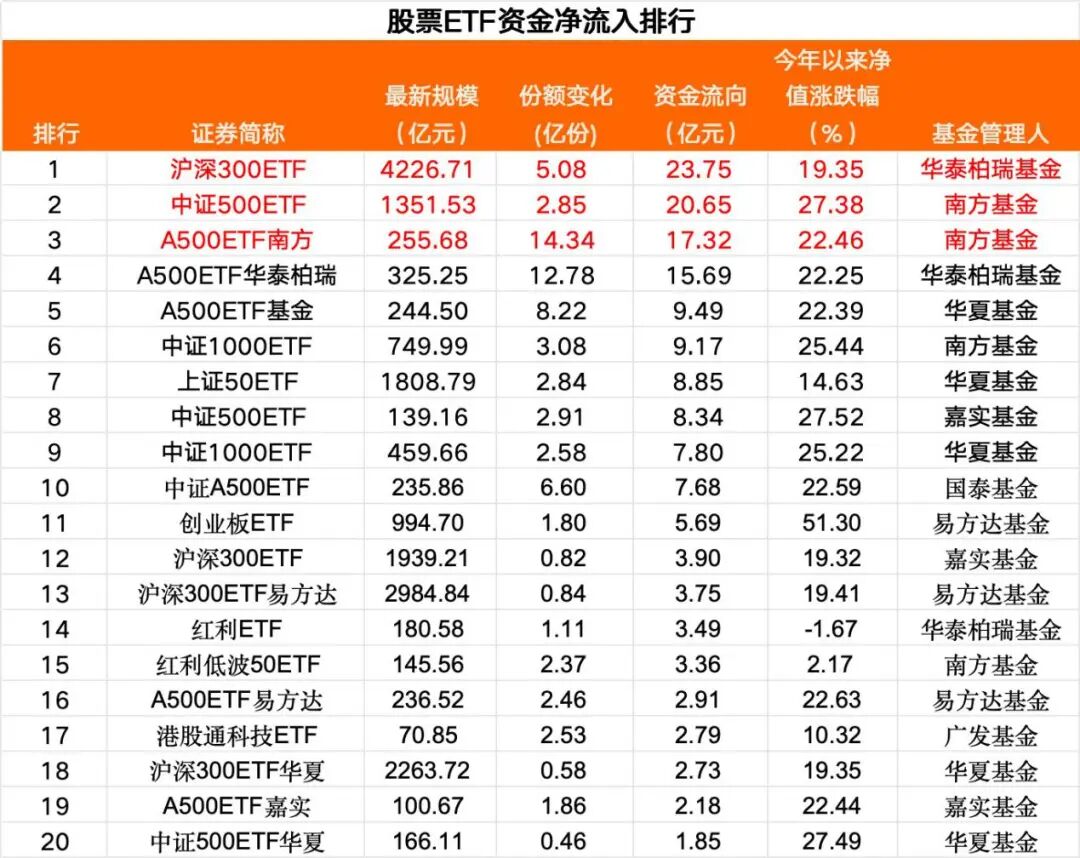
规模近4400亿元!国内最大ETF官宣更名,行业规范化进程加速
Sou Hu Cai Jing· 2026-01-10 11:40
Core Viewpoint - The Chinese ETF market is undergoing a significant transformation with the renaming of Huatai-PB's CSI 300 ETF, marking the first name change in over 13 years and responding to regulatory requirements for standardized naming [1][3]. Group 1: ETF Market Changes - Huatai-PB's CSI 300 ETF will officially change its name to "CSI 300 ETF Huatai-PB" starting January 9, 2024, in compliance with new regulatory guidelines [1][2]. - The fund's size has reached nearly 440 billion yuan, making it the largest ETF in China, with a growth of over 87 billion yuan in the past year [3]. - The renaming aligns with the Shanghai Stock Exchange's revised fund business guidelines, which require standardized naming formats for ETFs by March 31, 2026 [3]. Group 2: Industry Standardization - Other fund managers, including E Fund, GF Fund, and others, are also modifying their ETF names, accelerating the industry-wide standardization process [4]. - Prior to standardization, ETF names followed a "first-come, first-served" principle, leading to confusion among investors due to the variety of names for similar index-tracking products [4]. - The standardization aims to enhance brand recognition and accountability among fund managers, shifting the competitive focus from random name selection to the overall reputation and strength of the fund companies [5]. Group 3: Market Outlook - The total size of China's ETF market has surpassed 6 trillion yuan, with over 1,400 products available, indicating a growing and evolving market [5]. - The ongoing improvements in foundational regulations are expected to create a more transparent, standardized, and healthy ETF market ecosystem [5]. - Future competition in the ETF market will likely emphasize long-term expertise and service quality, benefiting investors with clearer market choices [5].
5只中证A500指数ETF成交放量,成交额环比均增加超5亿元
Zheng Quan Shi Bao Wang· 2025-12-24 11:36
Core Viewpoint - The trading volume of the CSI A500 Index ETFs reached 67.35 billion yuan today, an increase of 4.038 billion yuan from the previous trading day, representing a growth rate of 6.38% [1] Trading Volume Summary - The trading volume of the Huaxia CSI A500 ETF (512050) was 14.054 billion yuan, up by 1.382 billion yuan, with a growth rate of 10.91% [1] - The trading volume of the GF CSI A500 ETF (563800) was 2.625 billion yuan, up by 1.066 billion yuan, with a growth rate of 68.40% [1] - The trading volume of the Southern CSI A500 ETF (159352) was 11.288 billion yuan, up by 0.890 billion yuan, with a growth rate of 8.56% [1] - The Rongtong CSI A500 ETF (159379) and Morgan CSI A500 ETF (560530) saw significant increases in trading volume, with growth rates of 639.19% and 334.80% respectively [1] Market Performance Summary - The CSI A500 Index (000510) rose by 0.54% by the end of the trading day, while the average increase for related ETFs was 0.57% [1] - The top performers included the Huaan CSI A500 Enhanced Strategy ETF (561090) and the Puyin Ansheng CSI A500 ETF (159376), which increased by 0.86% and 0.85% respectively [1]
数据看盘银行ETF近三周份额大减超过50亿份 多家机构与实力游资激烈博弈商业航天概念股
Sou Hu Cai Jing· 2025-12-22 09:48
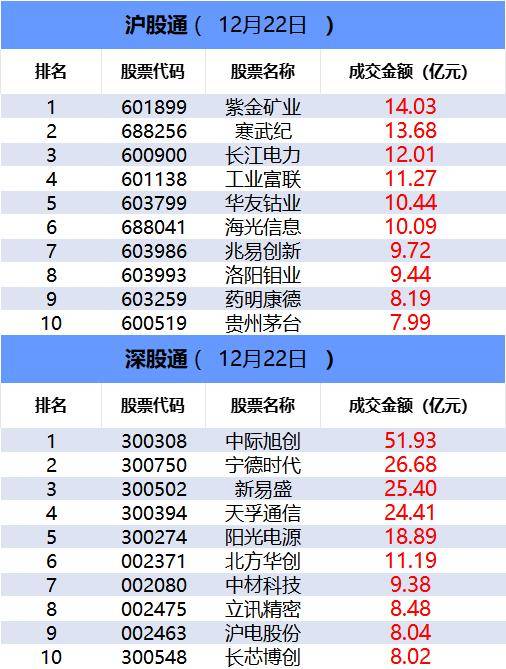
Summary of Key Points Core Viewpoint - The trading volume of the Shanghai and Shenzhen Stock Connect reached a total of 182.16 billion yuan, with Zijin Mining and Zhongji Xuchuang leading in individual stock trading volume. The communication sector saw the highest net inflow of funds, while the banking ETF experienced a significant reduction in shares over the past three weeks [1][2][12]. Trading Volume - The total trading amount for the Shanghai Stock Connect was 81.04 billion yuan, while the Shenzhen Stock Connect totaled 101.12 billion yuan [2]. Top Trading Stocks - In the Shanghai Stock Connect, Zijin Mining topped the list with a trading volume of 14.03 billion yuan, followed by Cambricon Technologies at 13.68 billion yuan and Yangtze Power at 12.01 billion yuan [3]. - In the Shenzhen Stock Connect, Zhongji Xuchuang led with a trading volume of 5.193 billion yuan, followed by CATL at 2.668 billion yuan and Newray at 2.540 billion yuan [3]. Sector Performance - The communication sector had the highest net inflow of funds at 7.098 billion yuan, followed by the electronics sector with 5.699 billion yuan. In contrast, the computer sector saw the largest net outflow at -2.295 billion yuan [6][7]. ETF Trading - The top ETF by trading volume was the A500 ETF from Huatai-PB, with a trading amount of 13.747 billion yuan, showing a 2.86% increase from the previous trading day [8]. - The China Securities A500 Index ETF (563880) experienced a remarkable 309% increase in trading volume compared to the previous trading day, reaching 5.1981 billion yuan [9]. Share Changes in ETFs - The A500 ETF from Southern saw the largest increase in shares last week, with an increase of 8.373 billion shares, followed by the Huatai-PB A500 ETF with an increase of 7.08 billion shares [10]. - The banking ETF (512800) has seen a total reduction of 5.154 billion shares last week, amounting to a total decrease of 5.1 billion shares over the past three weeks [12]. Institutional Activity - The commercial aerospace concept stocks remained active, with Tianyin Electromechanical receiving 65.44 million yuan from two institutions, while it faced a sell-off of 64.87 million yuan from three institutions [14][15]. - The stock Shenong Agriculture saw a significant buy from four institutions amounting to 224 million yuan, indicating strong institutional interest in the Hainan Free Trade Zone concept [15].





中证A500指数ETF今日合计成交额613.77亿元,环比增加23.72%
Zheng Quan Shi Bao Wang· 2025-12-22 08:38
Summary of Key Points Core Viewpoint - The trading volume of the CSI A500 Index ETFs increased significantly today, indicating heightened market activity and investor interest in this segment [1]. Trading Volume and Changes - The total trading volume of the CSI A500 Index ETFs reached 61.377 billion yuan, an increase of 11.769 billion yuan from the previous trading day, representing a growth rate of 23.72% [1]. - Specific ETFs such as Guotai CSI A500 ETF (159338) saw a trading volume of 10.832 billion yuan, up by 4.407 billion yuan, with a growth rate of 68.58% [1]. - Southern CSI A500 ETF (159352) had a trading volume of 10.453 billion yuan, increasing by 2.523 billion yuan, reflecting a growth rate of 31.81% [1]. - Huaxia CSI A500 ETF (512050) recorded a trading volume of 12.269 billion yuan, up by 2.265 billion yuan, with a growth rate of 22.64% [1]. Market Performance - The CSI A500 Index (000510) rose by 1.16% by the end of trading, while the average increase for related ETFs was 1.12% [1]. - Notable performers included Morgan CSI A500 ETF (560530) and Tianhong CSI A500 Enhanced Strategy ETF (159240), which increased by 1.44% and 1.39%, respectively [1]. Noteworthy Increases in Trading Volume - ETFs such as Huatai-PineBridge CSI A500 ETF (563880) and Ping An CSI A500 ETF (159215) experienced remarkable increases in trading volume, with growth rates of 309.35% and 234.39%, respectively [1]. - Other ETFs also showed significant increases, including E Fund CSI A500 ETF (159361) with a growth rate of 17.92% and GF CSI A500 ETF (159215) with a growth rate of 14.42% [1]. Additional ETF Performance - The trading volume changes for various ETFs were detailed, showing both increases and decreases in trading volumes across different funds, with some funds like the Morgan CSI A500 Enhanced Strategy ETF (560530) experiencing a decrease of 26.34% [2].
越跌越买!超165亿抄底
Zhong Guo Ji Jin Bao· 2025-12-15 06:42
Core Viewpoint - The stock ETF market experienced significant net inflows, exceeding 16.5 billion yuan on December 12, with notable contributions from various indices, indicating strong investor interest and potential market momentum [1][3]. Group 1: Market Overview - As of December 12, the total scale of the stock ETF market reached 4.62 trillion yuan, with a total of 1,273 stock ETFs [3]. - On December 12, the market saw an increase of 796.4 million shares, with a net inflow of 16.573 billion yuan, where 41 stock ETFs had net inflows exceeding 100 million yuan [3]. - The top five sectors for fund inflows included the CSI A500 index (5.91 billion yuan), CSI 300 index (3.55 billion yuan), CSI 500 index (3.25 billion yuan), CSI 1000 index (1.81 billion yuan), and the Dividend index (1.49 billion yuan) [3]. Group 2: Fund Inflows and Outflows - The CSI A500 index ETF led the inflows with 5.9 billion yuan, while the STAR 50 index ETF saw the largest outflow of 770 million yuan [3]. - Over the past five days, the CSI A500 index ETF attracted over 9.6 billion yuan, and the Hang Seng Technology index ETF saw inflows exceeding 3 billion yuan [2][3]. - On the outflow side, seven stock ETFs experienced net outflows exceeding 1 billion yuan, particularly in sectors like technology and banking [5]. Group 3: Fund Management Insights - Leading fund companies, such as E Fund and Huaxia Fund, reported substantial net inflows in their ETF products, with E Fund's ETFs increasing by 223.5 billion yuan since 2025, including a net inflow of 60.33 billion yuan [6]. - E Fund's notable inflows on the previous trading day included 570 million yuan for the ChiNext ETF and 380 million yuan for the CSI 300 ETF [6]. - Market analysts suggest that the index may enter a "cross-year market" phase, driven by policy catalysts, with a shift from defensive to aggressive investment strategies recommended [7].