
立德树人

Search documents
把握好五对关系提升辅导员素养
Xin Lang Cai Jing· 2025-12-22 22:24
Core Viewpoint - The article emphasizes the importance of counselors in higher education institutions as key figures in ideological and political education for students, highlighting their growing numbers and the need for professional development in this role [1]. Group 1: Responsibilities and Roles - Counselors have nine main responsibilities, including ideological education, student management, psychological counseling, and career guidance, which are considered their "primary duties" [2]. - Counselors often take on additional administrative roles, which can detract from their primary responsibilities if not managed properly [2]. Group 2: Integration and Simplification - The fundamental task of schools is to cultivate virtue, requiring collaboration across various elements and forces [3]. - Counselors should integrate resources from different stakeholders to enhance student development while also simplifying complex tasks to make them more manageable [3]. Group 3: Proximity and Engagement - Counselors need to build close relationships with students by actively engaging in their environments, such as dormitories and classrooms, to foster trust and open communication [4]. Group 4: Balancing Emotion and Regulation - Counselors face the challenge of balancing emotional engagement with regulatory frameworks, ensuring fairness while fostering a supportive environment [5][6]. Group 5: Short-term vs Long-term Development - Counselors must navigate the balance between immediate responsibilities and long-term professional growth, recognizing that their development is a continuous process [7]. Group 6: Mission and Vision - Counselors are seen as essential to the mission of building a first-class university and achieving educational strength, tasked with guiding students towards self-awareness and independence [8].
【光明论坛】因地制宜创新形式,劳动教育才有魅力
Xin Lang Cai Jing· 2025-12-21 19:39
Core Viewpoint - Recent labor education activities in universities, such as fishing events at Yangzhou University and Wuhan University of Science and Technology, highlight the importance of integrating practical labor experiences with student-teacher interactions to enhance educational outcomes and foster closer relationships between students and faculty [1][2]. Group 1: Labor Education and Student Development - Labor education is crucial for the growth and development of university students, serving as a pathway to shape well-rounded personalities and promote mental health [3]. - The implementation of labor education can counteract feelings of emptiness and anxiety among students, providing tangible feedback through practical tasks and fostering collaboration [3]. Group 2: Cultural Integration and Labor Practices - The integration of traditional cultural symbols, such as the significance of fish in Chinese culture, into labor education activities allows students to experience the beauty of culture while engaging in labor [2]. - Activities like fish farming and collective cooking not only teach students about hard work but also instill a respect for labor and the value of teamwork [2]. Group 3: Innovative Approaches to Labor Education - Many universities still rely on simplistic forms of labor education, such as tree planting and cleaning, which may not yield ideal educational outcomes [4]. - Innovative practices, such as engaging students in agricultural work in rural areas or specialized workshops, can enhance the effectiveness of labor education and strengthen the bond between students and faculty [4]. Group 4: The Essence of Labor Education - Labor education embodies a holistic approach to student growth, emphasizing the importance of integrating labor into daily life and fostering a culture of respect for work [4]. - By promoting a love for labor and a spirit of hard work, labor education can become a foundational element in cultivating well-rounded individuals who contribute to society [4].
把握“守界”与“跨界” 推动思政教育高质量发展
Xin Hua Ri Bao· 2025-12-18 21:34
Group 1 - The core issue is how the discipline of ideological and political education can expand its boundaries while maintaining its essence, emphasizing the need for a dialectical unity between "guarding boundaries" and "cross-disciplinary integration" for high-quality development [1] Group 2 - "Guarding boundaries" is essential for establishing the discipline's foundation, focusing on the strategic choice of ideological, political, and practical aspects, and creating a recognizable knowledge framework centered on the formation and development of ideological concepts, political views, and moral norms [2] - The core value of the discipline is to cultivate virtue, which should guide all academic activities and practical teaching, ensuring alignment with the fundamental question of "what kind of person to cultivate, how to cultivate, and for whom to cultivate" [2] - A self-aware method selection mechanism should be established to protect the discipline's characteristics, avoiding the simple transplantation of methods from other disciplines and fostering a unique methodological system [2] Group 3 - "Cross-disciplinary integration" serves as a driving force for the discipline's development, requiring a proactive fusion based on established boundaries, with a clear understanding of the subjectivity and purpose of the integration [3] - A value-based screening mechanism should be established to evaluate and filter interdisciplinary knowledge, ensuring that the integration remains aligned with the core mission of cultivating virtue and ideological attributes [3] - The integration process should rely on a solid disciplinary core and mature theoretical framework to decode, digest, and reconstruct external knowledge, ultimately forming new knowledge and paradigms that enhance the discipline's explanatory power and practical effectiveness [3] Group 4 - Achieving a dialectical unity between guarding boundaries and cross-disciplinary integration requires adherence to the guiding position of Marxism and the fundamental task of cultivating virtue, while also responding to contemporary challenges with an open attitude [4] - The discipline should engage in cross-disciplinary research, such as "political education + psychology" and "political education + sociology," while ensuring that explorations do not deviate from the essence of the discipline [4] - A cross-disciplinary evaluation system should be constructed to assess both the maintenance of disciplinary boundaries and the effectiveness of cross-disciplinary innovations, ensuring that the discipline does not lose its fundamental characteristics in the process of open integration [4]
武汉理工大学“卓越之光”第四届理工故事展演会举行
Zhong Guo Qing Nian Bao· 2025-12-18 08:38
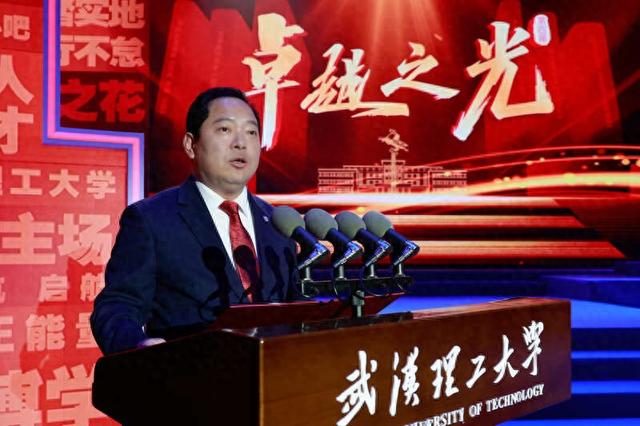
中国青年报客户端讯(丁仕琼 潘薇 中青报·中青网记者 雷宇)12月17日晚,武汉理工大学"卓越之光"第 四届理工故事展演会在西院大礼堂精彩上演。校友代表、师生代表汇聚一堂,共同欣赏属于武汉理工人 的"最美"故事。 在原创歌曲《最美》的唯美旋律中,全国"最美教师"姜德生院士、"最美辅导员"靳敏、"最美大学生"黄 莺以及师生代表分享了他们对"最美"的感悟,是五十年来在科研与讲台间从未停歇的行走;是在宿舍走 廊轻叩房门的侧影;是"除了看不见,什么都能做"的坚韧。 国门引航,三代人一个梦。学校首届引航班学子、被誉为"水上国门形象第一人"的姚泽炎深情回忆自己 从"想开船"到成为"船长的船长"的成长历程,四十年坚守国门的职业生涯见证了中国航运事业的崛起, 更深刻理解引航权背后沉甸甸的国家主权与民族尊严。 青春主场,赛场国旗高扬。"不仅要参赛,更要通过自主创新,在国际舞台上展现中国青年的智慧和力 量。"WUT混动方程式赛车队的师生站上舞台,讲述赛车第一次征战海外,把遥远的异国赛场变成武汉 理工大学学子"青春主场"的故事。 "卓越之光"第四届理工故事展演会于今年9月份启动,在广泛征集、部门推荐和深入挖掘的基础上,结 合立德树 ...

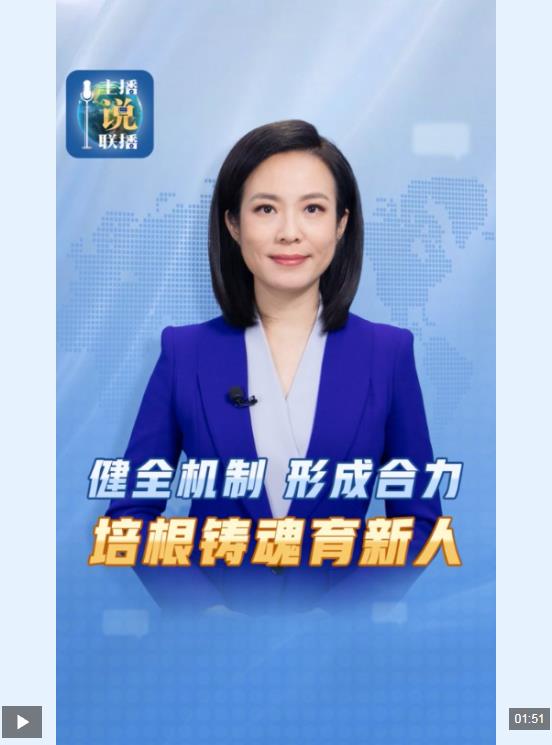
主播说联播丨抓好这项战略性、基础性工作,总书记强调各方形成合力
Yang Shi Xin Wen Ke Hu Duan· 2025-12-16 00:30
Group 1 - The core viewpoint emphasizes the importance of moral education for minors as a strategic and foundational task, highlighting the high priority given by the General Secretary [1][3] - The need for a collaborative effort among schools, families, and society to enhance moral education is stressed, with schools taking the lead in moral education, families providing foundational support, and society creating a positive cultural environment [3] - The article outlines the responsibilities of various levels of government and organizations in strengthening leadership and fulfilling duties related to the moral education of minors, including improving online education capabilities and establishing a psychological health service system for minors [3][4] Group 2 - The General Secretary's ongoing concern for the healthy growth of children is noted, emphasizing the importance of instilling ideals, patriotism, moral character, knowledge, and a spirit of hard work in minors [4] - The article suggests that proper moral education not only guides minors in their personal development but also contributes to the future of China by nurturing new talent [4]
“三向”发力推动思政课建设与党的创新理论武装同步推进
Si Chuan Ri Bao· 2025-12-14 21:58
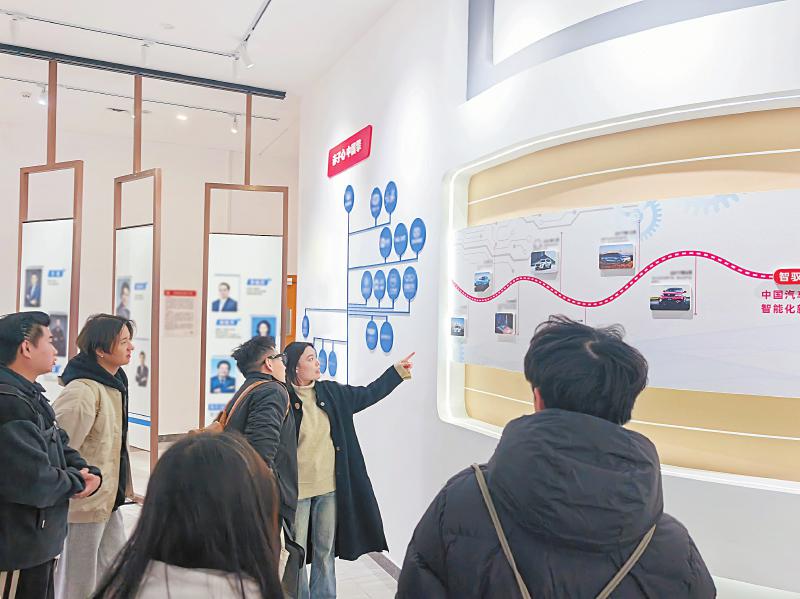
Core Viewpoint - The core topic of the construction and development of ideological and political courses at Geely College is the simultaneous advancement of ideological education and the Party's innovative theories, emphasizing a deep collaborative logic and practical requirements [1]. Group 1: Importance of Synchronization - The necessity of synchronizing ideological education with the Party's innovative theories stems from the fundamental attributes of ideological courses, which are essential for cultivating moral integrity and guiding students with correct thoughts [1]. - This synchronization is a response to the evolving global landscape and the active thoughts of young students, providing authoritative guidance on significant issues related to the development of socialism with Chinese characteristics [2]. - High-quality ideological courses are characterized not only by improved teaching methods and rich resources but also by the timeliness, thoughtfulness, and leadership of the content, which is enhanced by the integration of the Party's innovative theories [2]. Group 2: Clarity in Educational Goals - The educational goals of ideological courses in the new era form an organic whole, encompassing three dimensions: moral integrity as the fundamental task, the Party's innovative theories as core content, and practical education as a vital pathway [4]. - These three dimensions are interrelated and collectively constitute a "three-dimensional" educational goal system, where moral integrity leads, theoretical education is the soul, and practical education serves as the bridge [4]. Group 3: Course Structure and Function - The ideological course system is structured as "6 + N," where "6" refers to six mandatory courses and "N" includes elective and specialized courses, focusing on the systematic integration of the Party's innovative theories [5]. - The teaching design of mandatory courses aims to cover the core essence and practical requirements of the Party's innovative theories, while elective courses emphasize theoretical extension and relevance [5]. Group 4: Practical Implementation - The college emphasizes the integration of the Party's innovative theories into practical teaching, guiding students to apply these theories in social observation and problem analysis [6]. - A "three-dimensional" educational goal framework is established, incorporating the mastery and application of the Party's innovative theories as a core indicator for evaluating the effectiveness of ideological courses [6]. Group 5: Enhancing Practical Education - Initiatives such as the "University Students Speak Well of Ideological Courses" program encourage students to prepare and deliver micro-ideological lessons, enhancing their understanding and recognition of the Party's innovative theories [7]. - The establishment of an "Entrepreneurial Spirit in the Automotive Industry" educational base integrates the history and achievements of China's automotive industry with the Party's innovative theories, creating a rich context for practical education [7].
大国五年丨立德树人,夯实民族复兴之基
Xin Hua She· 2025-12-01 08:25
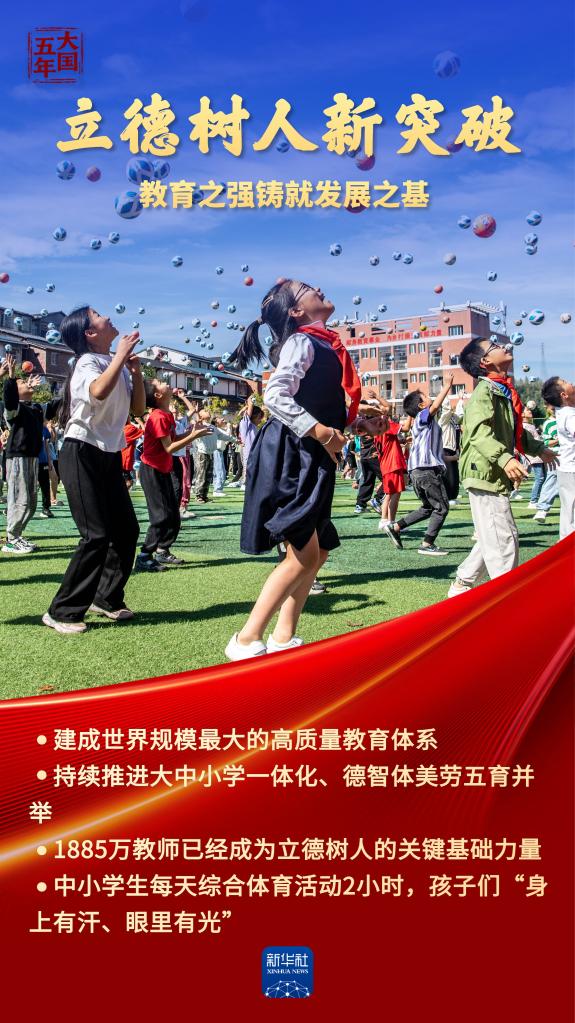
Group 1 - The article emphasizes the establishment of the world's largest and high-quality education system in China, highlighting the importance of education for national development and the future of the nation [1][2] - It mentions that 18.85 million teachers have become a key foundational force in moral education [2] - The integration of physical education into daily routines is noted, with students engaging in two hours of comprehensive physical activity each day [2] Group 2 - Basic education has achieved balanced development across 2,895 counties, with a gross enrollment rate in preschool education reaching 92%, benefiting over 12 million children [4] - By the end of 2024, the enrollment rate for disabled children in compulsory education is expected to reach 97% [4] Group 3 - The gross enrollment rate in higher education has increased from 30% in 2012 to 60.8% currently, indicating a significant rise in accessibility [6] - Higher education institutions have produced 55 million graduates, contributing to over 75% of national natural science awards and technology invention awards [6] Group 4 - China has built the world's largest vocational education system, supplying over 70% of new high-quality skilled talent for modern industries [8] - More than 44 million individuals have obtained vocational skill certificates, with over 6,000 recognized as top-level technicians [8] Group 5 - The "Double First-Class" initiative has led to universities producing over 50% of the nation's master's degrees and 80% of doctoral degrees, fulfilling over 90% of national high-level talent training tasks [11] - The focus on cultivating innovative talent aligns with national strategic development goals [11] Group 6 - Teacher salaries in compulsory education are maintained at or above the average salary of local civil servants, with rural teachers in central and western regions receiving additional living subsidies [13] - Policies have been implemented to enhance teachers' social status and benefits, including digital empowerment initiatives [13] Group 7 - A comprehensive digital education platform has been established, covering over 200 countries and regions, with more than 170 million learners [15] - The platform includes a lifelong learning center offering 1,000 micro-majors and 1,000 vocational training courses, along with over 5,000 high-quality courses [15] Group 8 - China has expanded its educational influence globally, collaborating with 183 countries and regions, and establishing educational cooperation mechanisms with ASEAN and Central Asian countries [17] - The establishment of the Global Teacher Development Academy aims to share Chinese educational philosophies and practices internationally [17]
加快建设教育强国 办好人民满意的教育——访教育部党组书记、部长怀进鹏
Xin Hua She· 2025-11-18 09:52
Core Viewpoint - The article emphasizes the importance of education in building a strong nation and highlights the achievements and future plans for educational reform in China, as outlined in the recent national policy documents [1][4]. Achievements in Education - During the "14th Five-Year Plan" period, China's education system has made historic achievements and undergone significant changes, establishing the largest and high-quality education system [2]. - The fundamental task of moral education has been effectively implemented, integrating ideological and political education across various educational levels and practices [2]. - The public's sense of educational gain has improved, with 2,895 counties achieving basic balance in compulsory education and over 12 million children benefiting from free preschool education [2][3]. - Higher education has supplied 55 million talents to society, with vocational education contributing over 70% of new high-quality skilled talents in modern industries [3]. Future Educational Development Plans - The "15th Five-Year Plan" outlines a strategic framework for educational reform, emphasizing the integration of education with national modernization efforts [4][5]. - The focus will be on cultivating talents loyal to the Party and the nation, addressing the changing demographics and societal needs for education [5]. - Key initiatives include implementing a comprehensive moral education program, enhancing innovative talent cultivation, and promoting the integration of technology and industry [6][7][8]. Key Strategic Tasks - The education sector will prioritize the implementation of moral education as a primary initiative, ensuring that ideological education is integrated across all levels [6]. - There will be a push for innovative talent cultivation, particularly in strategic fields like artificial intelligence and integrated circuits, with a focus on aligning educational outcomes with national needs [7]. - Enhancements in public education services will be made, including optimizing resource allocation and expanding quality education access, especially in rural areas [8]. - Continuous reforms will be pursued to improve educational evaluation systems and promote international cooperation in education [8].
培根铸魂,立德树人——希望教育集团举办第三届党组织书记讲立德树人活动
Huan Qiu Wang· 2025-11-04 04:42
Core Points - The "Cultivating Virtue and Educating People" event organized by Hope Education Group aims to enhance the understanding and implementation of the "立德树人" (Lide Shuren) principle among educational institutions [1][2][4] - The event includes lectures, discussions, and showcases of best practices in promoting moral education and cultural values within the educational framework [1][3][4] - The initiative reflects the group's commitment to fostering a strong educational foundation aligned with national goals and enhancing the political capabilities of grassroots party organization leaders [4][5] Group 1 - The event is part of a three-day program that includes lectures, discussions, and exchanges among party organization leaders from various educational institutions [1][2] - Notable figures, including Guo Wenbin, delivered keynote speeches emphasizing the importance of traditional culture in nurturing students' moral values [1][3] - The event has been held for three consecutive years, demonstrating the group's ongoing commitment to the "立德树人" mission and the cultivation of educational leaders [4] Group 2 - Hope Education Group has implemented various measures to support ideological and political work across its institutions, including document issuance, guidance, and activity organization [3] - The event culminated in the selection of award winners based on presentations and papers submitted by participants, highlighting effective experiences in moral education [5] - The group aims to enhance the quality of grassroots party building and ensure the comprehensive implementation of educational policies across its institutions [4]
双融双促”,打造高校高质量发展“红色引擎
Xin Hua Ri Bao· 2025-10-27 20:23
Core Viewpoint - The integration of party building and discipline construction in higher education is essential for achieving high-quality development and aligning with national strategic needs [4][9]. Group 1: Political Leadership and Discipline Development - Political leadership is crucial for guiding discipline development, ensuring alignment with national strategies and regional needs [2][4]. - The role of party committees in universities is emphasized, focusing on decision-making and implementation responsibilities [2][5]. - Strengthening the role of party organizations in major research projects and interdisciplinary platforms is necessary for effective governance [2][4]. Group 2: Talent Development and Educational Integration - The cultivation of talent is the fundamental goal of discipline construction, integrating ideological education into various courses [3][5]. - The establishment of a "big ideological and political education" framework is essential for aligning professional education with ideological education [3][5]. - The dual mentorship system for graduate and undergraduate students is proposed to enhance academic guidance and ideological leadership [3][8]. Group 3: Mechanisms for Integration - A systematic approach is needed to ensure the integration of party building and discipline construction, moving beyond mere ideological advocacy [6][7]. - The establishment of a collaborative mechanism involving multiple departments and party organizations is crucial for effective implementation [6][7]. - Evaluation systems should incorporate contributions to party work and national strategy service as key indicators [8]. Group 4: Innovation and Cultural Development - Creating platforms for collaboration between party building and discipline development is vital for fostering innovation [7][8]. - Regular events led by party members in key disciplines can enhance engagement and promote a culture of collaboration [7][8]. - A strong cultural environment that integrates party activities, academic exchanges, and achievement displays is necessary for effective integration [7][8]. Group 5: Talent Recruitment and Political Guidance - The principle of party management of talent should be upheld, ensuring political integrity in the recruitment of high-level talents [8][9]. - A long-term mechanism for developing party members among high-level talents and young teachers is essential [8]. - Political guidance and integration for returning overseas scholars and high-level talents should be strengthened to align personal aspirations with national development [8].