美国财政政策

Search documents
特朗普万亿减税法案通过众议院,但“金主们”不太高兴
Jin Shi Shu Ju· 2025-05-23 00:49
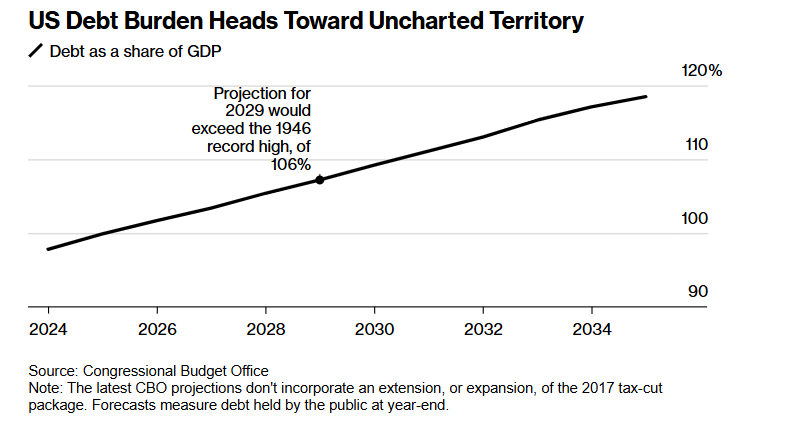
Group 1 - The core issue revolves around President Trump's tax proposal, which has passed the House but faces challenges in the Senate due to rising U.S. debt and bond market concerns [1][9][10] - The 30-year U.S. Treasury yield has surpassed 5%, indicating investor anxiety about the fiscal situation, which could lead to higher borrowing costs and economic slowdown [1][2][8] - Moody's has downgraded the U.S. credit rating, highlighting that the country's economic strength is no longer sufficient to offset declining fiscal indicators, with debt projected to rise to 134% of GDP in the next decade [1][4][7] Group 2 - The tax bill includes new tax benefits for key political groups, but Republican senators are signaling a need for spending cuts to mitigate fiscal pain [1][10] - The demand for 20-year bonds was weak during a recent auction, reflecting growing investor concerns about U.S. fiscal health [2][3] - The Congressional Budget Office predicts that by 2029, U.S. debt will exceed 106% of GDP, marking a historical high [4][7] Group 3 - Republican leaders are under pressure to achieve a legislative victory before the midterm elections, with the tax bill seen as crucial for maintaining support [9][10] - The potential for increased interest payments due to rising yields could exacerbate the government's fiscal challenges [2][3] - The proposed increase in state and local tax deduction limits from $10,000 to $40,000 is a key negotiation point among Republicans [7]

鲍威尔七年苦劝无人听 穆迪降级可能只是“小菜”!
Jin Shi Shu Ju· 2025-05-20 09:55
Group 1 - Federal Reserve Chairman Powell has consistently emphasized that the U.S. fiscal path is "unsustainable," particularly regarding the federal deficit issue [1][3] - Powell stated that while the Federal Reserve does not have the authority to set fiscal policy, long-term fiscal policy will significantly impact the economy [1] - Moody's downgrade of the U.S. AAA rating has heightened the urgency of the fiscal crisis, predicting a $4 trillion increase in deficits over the next decade if Congress extends the 2017 tax cuts [1] Group 2 - The White House and Congress remain calm in response to Moody's downgrade, with officials asserting that the debt issue is not a recent development [2] - The White House Economic Council Chair highlighted the importance of reducing the deficit, predicting that new tax legislation could lead to economic growth of 4.2%-5.2% annually over the next four years [2] - Powell did not comment on the downgrade but acknowledged that the rating's future impact on prices should not be overlooked [2] Group 3 - Powell suggested that policymakers should focus on mandatory spending areas like Medicare and Social Security rather than discretionary spending to address the fiscal issues [3] - He warned that an aging population will exacerbate the shrinking tax base and increasing welfare spending, making it crucial to address the long-term unsustainable budget deficit [3] - Powell's previous warnings about the expensive healthcare system and aging population are now manifesting in the form of credit rating downgrades [3]
大摩预判:5月开始美国通胀走高、美联储今年降不了息、美国财政没有大刺激
Hua Er Jie Jian Wen· 2025-05-18 04:02
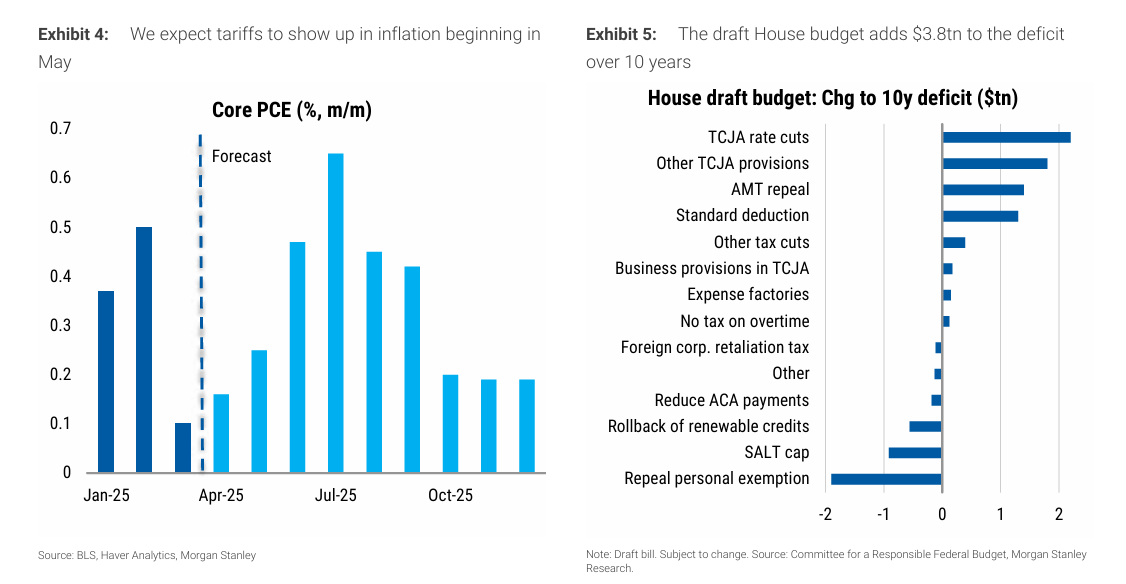
Core Insights - The U.S. economy is expected to experience a combination of rising inflation and slowing economic activity, leading the Federal Reserve to maintain interest rates in 2025 [1][5]. Group 1: Economic Outlook - Morgan Stanley predicts that inflation in the U.S. will rise significantly starting in May, with an annual inflation rate potentially reaching 3.0-3.5% by year-end [1][2]. - The recent easing of U.S.-China trade tensions has reduced the risk of a hard stop in trade flows, but the effective tariff rate remains high at 13%, compared to about 2% at the beginning of the year [2][5]. - The forecast indicates that inflation will precede a slowdown in economic activity, with core PCE inflation expected to rise month-over-month by 0.3% in May and 0.5% in June, July, and August [2][5]. Group 2: Federal Reserve Policy - Morgan Stanley maintains its outlook that the Federal Reserve will not lower interest rates in 2025, as inflation is expected to deviate more from the Fed's 2.0% target than employment levels will from maximum employment [5]. - The Fed may begin to cut rates in March 2026, driven by a slowdown in economic activity and reduced labor demand, which could increase the unemployment rate [5]. Group 3: Fiscal Policy - The recent budget proposal passed by the House of Representatives is projected to increase the deficit by $3.8 trillion over the next decade, with significant contributions from the extension of the Tax Cuts and Jobs Act (TCJA) [6]. - The analysis suggests that the fiscal stance will remain largely unchanged, with potential for higher deficits if certain tax cuts are not allowed to expire as scheduled [6].
巴菲特对美元发出“罕见警告”:我们不会投资即将“大幅贬值”的货币
Hu Xiu· 2025-05-04 05:43
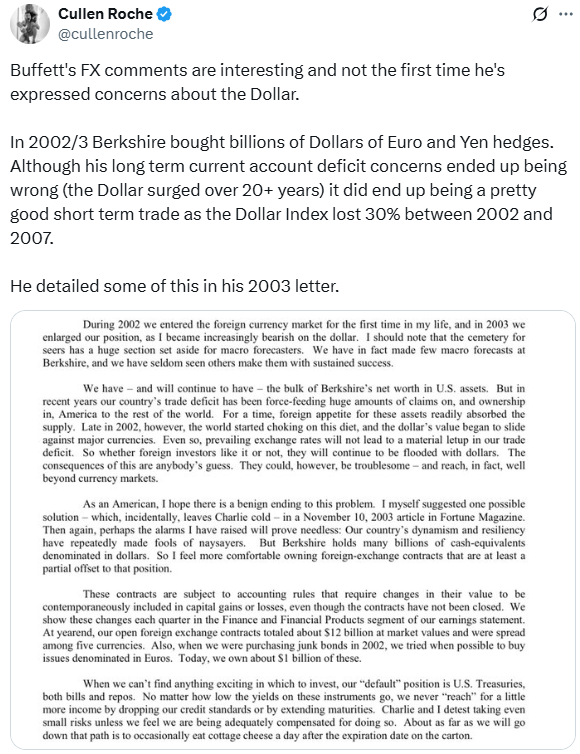
Core Viewpoint - Warren Buffett issued a severe warning regarding the future of the US dollar, attributing potential devaluation to irresponsible fiscal policies by the US government [1][2]. Group 1: Concerns about the US Dollar - Buffett expressed that the current fiscal deficit model in the US is unsustainable and could erode the value of the dollar [2][11]. - He stated, "We would not want to hold any currency that we believe will significantly depreciate," indicating a shift in investment focus towards other currencies, particularly the Japanese yen [3][4]. - Buffett's comments reflect a broader concern about the potential for currency devaluation due to government actions, which he believes could lead to severe consequences [7][10]. Group 2: Investment Strategy Adjustments - Berkshire Hathaway has been adopting a more conservative investment strategy, having sold $134 billion worth of stocks in 2024 alone, including significant reductions in holdings of Apple and Bank of America [4]. - The company's cash reserves have reached a historic high of $347 billion, indicating a cautious approach in light of economic uncertainties [4]. - Buffett noted that managing currency risk is challenging and that the company would not take actions based solely on quarterly or annual earnings [6]. Group 3: Broader Economic Implications - Buffett criticized the current fiscal policies, suggesting they could lead to a loss of confidence in the dollar, similar to historical precedents in other countries [7][10]. - He emphasized that the issues surrounding fiscal irresponsibility are not unique to the US but are a global concern, with many governments making decisions that could lead to currency devaluation [7][10]. - The lack of effective oversight and accountability in government fiscal management raises concerns about future governance and financial stability [9][14].
5月3日电,巴菲特在伯克希尔・哈撒韦股东大会上表示,伯克希尔从不关注美元收益的短期影响。美国的财政政策是他感到害怕的东西。
news flash· 2025-05-03 14:42
Core Viewpoint - Berkshire Hathaway does not focus on the short-term impact of dollar earnings, indicating a long-term investment strategy [1] - The company's chairman, Warren Buffett, expressed concern about U.S. fiscal policy, highlighting it as a source of fear [1] Summary by Relevant Categories Company Strategy - Berkshire Hathaway prioritizes long-term investment over short-term dollar earnings [1] Economic Concerns - Warren Buffett identifies U.S. fiscal policy as a significant concern, suggesting potential implications for the broader economic environment [1]
美国财长贝森特:可能会宣布一些关于印度的消息。
news flash· 2025-04-29 12:57
Group 1 - The U.S. Treasury Secretary, Janet Yellen, indicated that there may be announcements regarding India in the near future [1]
揭秘美元强势背后的经济密码与全球影响力
Sou Hu Cai Jing· 2025-04-21 01:15
Group 1: Economic Factors Supporting Dollar Strength - The scale and diversity of the US economy provide a solid foundation for the strength of the dollar, as the US is the largest economy globally with a GDP that has long been at the top [1] - The resilience of the US economy, characterized by its diverse industrial structure, enhances the stability of the dollar in the face of external shocks [1] Group 2: Financial Market Dynamics - The depth and liquidity of the US financial markets, including stock, bond, and foreign exchange markets, are crucial for the dollar's strength, making it the preferred currency for global investors, especially during market turbulence [3] - The transparency and regulatory framework of the US financial markets increase investor confidence in the dollar [3] Group 3: Monetary and Fiscal Policies - The monetary policy of the Federal Reserve significantly influences the dollar's trajectory, with interest rate adjustments impacting capital flows and dollar demand [3][4] - US fiscal policy, including spending and tax policies, directly affects economic growth and the fiscal situation, which in turn influences the dollar's value [4] Group 4: Innovation and Competitiveness - The US's leadership in technological innovation, supported by top-tier tech companies and research institutions, bolsters the dollar's strength by enhancing economic growth and global competitiveness [4] Group 5: Geopolitical and Military Influence - The military strength and geopolitical influence of the US contribute to the dollar's dominance, as military presence supports strategic interests and enhances the dollar's role in global trade [5] Group 6: Legal and Institutional Framework - The robust legal and institutional environment in the US, including intellectual property protection and market regulation, fosters economic stability and investor trust in the dollar [5] Group 7: Consumer Market Impact - The US consumer market, being the largest globally, plays a vital role in driving global economic growth and influencing the dollar's value through trade dynamics [6] Group 8: Energy Production and Export - The US's position as a leading energy producer and exporter significantly impacts global energy markets and, consequently, the dollar's strength through trade growth [7] Group 9: International Financial Center Status - The US's status as a key international financial center, with major hubs like New York and Chicago, enhances the dollar's credibility and influences global capital flows [8]