
财政悬崖

Search documents
美联储,降息新信号!
Sou Hu Cai Jing· 2025-05-23 04:46
当地时间周四,美国三大股指收盘涨跌不一,标普500指数录得三连跌。美国长期国债抛售潮再度扩大,30年期国债收 益率盘中一度升至5.15%,续刷2023年10月以来的最高水平。市场投资者对美国财政赤字不断膨胀感到忧虑。 当日,美联储理事克里斯托弗·沃勒在接受福克斯商业频道采访时明确表示,如果美国政府对贸易伙伴征收的关税维持 在约10%的水平,美联储可能从2025年下半年开始降息。 美联储或在下半年降息 "如果我们能将关税维持在约10%的水平,并且在7月前尘埃落定、彻底落实,那么下半年我们就会处于一个不错的位 置上。"沃勒称, "那美联储就有良好条件,在下半年推出一系列降息行动。" 沃勒表示,硬数据表明当前经济表现良好,尚未明显受到关税的影响。他认为,与关税相关的任何通货膨胀上升都将 是暂时的。然而,如果政府恢复到更高的关税水平,这将"对通货膨胀产生更大的影响,并将限制我们对短期利率采取 任何行动的能力。" 他还强调,美联储不会在初级拍卖中购买债券。就最近美国国债市场的抛售,沃勒作出了评论。他表示,从金融市场 参与者那里听到了关于共和党税改法案的担忧:"他们本以为会看到更多的财政克制,但现在并未看到。" 由于整体 ...


减税法案获众议院通过继续推高美债收益率 美联储官员给出下半年降息路径
Xin Hua Cai Jing· 2025-05-23 02:10
新华财经北京5月23日电美国国会众议院周四(5月22日)通过大规模减税法案,对美国联邦债务规模将 大幅提高的担忧情绪令投资者继续抛售美债,10年期美债收益率盘中升至4.62%,续创2月以来新高。 近几日飙升的20年期和30年期美债收益率盘中也分别触及5.16%的2023年10月以来新高,和5.15%的 2007年6月以来新高。 美国国会众议院22日以微弱优势通过一项大规模税收与支出法案。美国联邦预算问责委员会对这项法案 深表担忧,警告说,众议院的预算框架是"对财政责任的公然蔑视",该法案不仅将令国债激增3万亿美 元以上,还埋下大规模减税与支出政策到期形成的"财政悬崖"隐患,即如果延续这些政策,可能将再度 耗费数万亿美元。最新数据显示,美国国债规模已攀升至36.2万亿美元。 自穆迪上周末下调美国主权信用评级以来,对美国预算赤字的担忧持续加重,债券投资者认为在关税将 加剧通胀的背景下,减税法案会给已经下跌的债券带来额外压力。周三的20年期长债发行结果惨淡,则 令本就脆弱的美债投资者信心再遭重创。 Argent资本管理公司投资组合经理 Jed Ellerbroek在接受采访时表示,"从短期来看,这项税收法案对经 济 ...
债务危机加信用下降 美国迫近“财政悬崖” 专家分析→
Yang Shi Xin Wen· 2025-05-23 02:03
Core Viewpoint - Moody's has downgraded the U.S. sovereign credit rating from Aaa to Aa1 due to deteriorating fiscal conditions, while the White House continues to push for a large tax cut that may increase federal debt by trillions of dollars [1] Group 1: U.S. Debt Situation - The total U.S. federal debt has surpassed $36 trillion, with approximately one-quarter of this debt maturing within the current year, heightening the risk of federal debt [1] - Analysts indicate that the U.S. is trapped in a structural dilemma of dollar credit and debt crisis, with long-term fiscal deficits leading to an imbalance in the supply and demand of government bonds [1] - The crisis is characterized by a persistent state where the supply of U.S. Treasury bonds exceeds demand, which is likely to result in rising bond yields [1] Group 2: Economic Implications - The U.S. government and financial sector have been depleting dollar credit over the years, with the extent of damage to the dollar being difficult to quantify [2] - The issuance of government bonds and quantitative easing aimed to rescue the economy from crises, leading to a phase where the economy is in a state of stagnation [2] - There is a growing concern that a loss of confidence in U.S. national credit may trigger active selling of U.S. Treasury bonds, which has already begun to manifest [2] Group 3: Future Risks - If the debt ceiling is not raised, the U.S. could face economic recession and a "debt cliff" scenario; conversely, raising the ceiling would lead to an accumulation of debt that may require solutions like direct money printing, potentially causing hyperinflation [2] - The U.S. is caught between the threats of economic recession and inflation, which will further exacerbate the risks associated with U.S. Treasury bonds [2]
一票之差!特朗普减税案在众院涉险过关,参院还有难关得过
Hua Er Jie Jian Wen· 2025-05-22 21:13
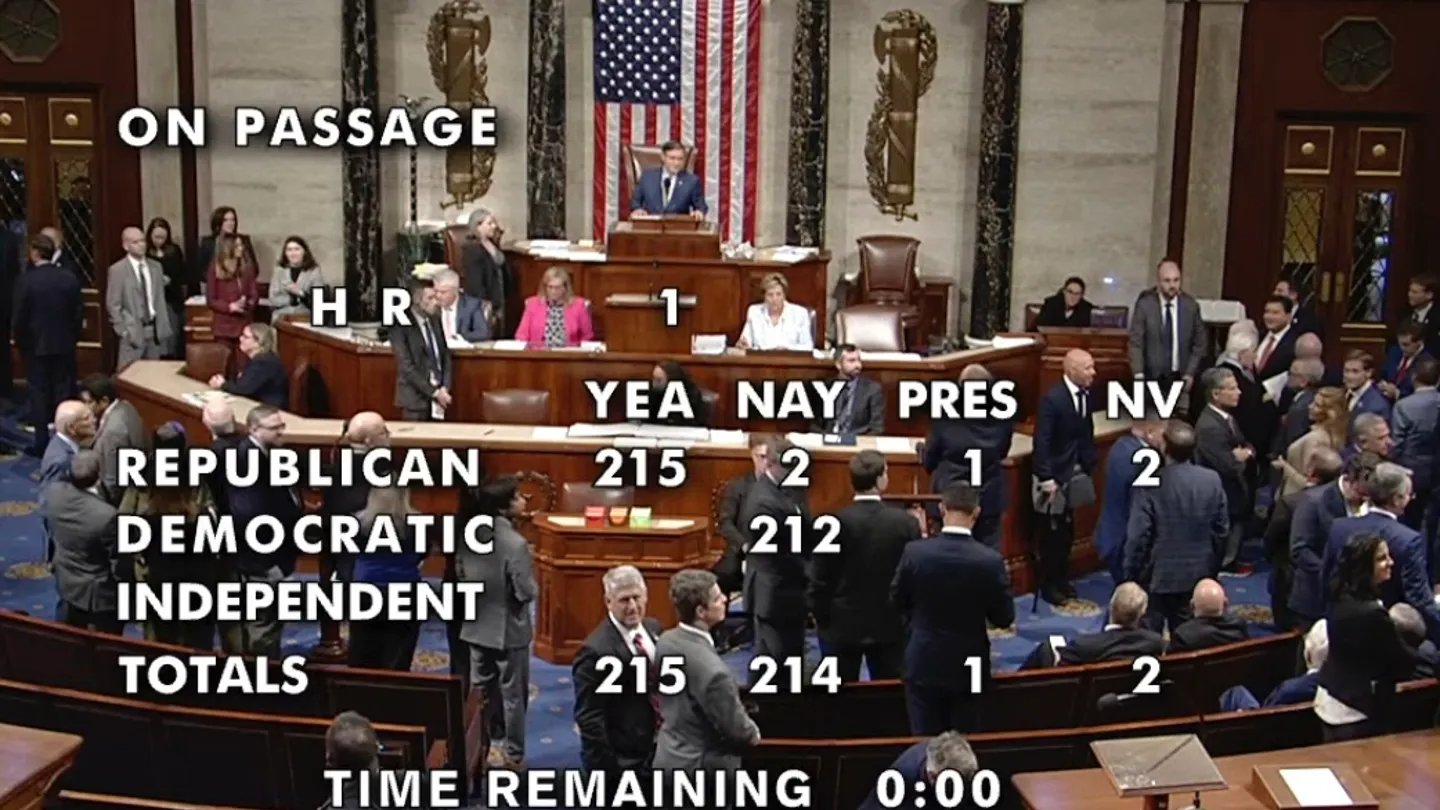
Core Points - The Trump 2.0 tax reform plan has passed the House of Representatives with a narrow margin of 215 votes in favor and 214 against, but faces significant challenges in the Senate [1][2] - The bill includes major tax cuts, an increase in the debt ceiling, and the repeal of Biden's clean energy tax credits, indicating a shift in fiscal policy [4][5] - The legislation is expected to increase the national debt by $2.3 trillion and could lead to a significant budget deficit, raising concerns among market observers [15][16] Group 1: Legislative Process - The bill was passed in the House after numerous last-minute modifications aimed at uniting different factions within the Republican Party [2][6] - Senate Republicans have committed to making substantial changes to the bill before it can be voted on, indicating potential internal conflicts [7][8] - The bill's passage in the Senate may utilize the "budget reconciliation" process, allowing it to bypass the usual 60-vote requirement [7] Group 2: Key Provisions - The bill extends the corporate and individual tax cuts from Trump's first term, which were set to expire at the end of the year [5] - It raises the SALT deduction cap from $10,000 to $40,000, benefiting taxpayers in high-tax states [5][10] - The legislation includes provisions for increased military spending and immigration enforcement, alongside cuts to safety net programs [5] Group 3: Political Implications - The bill is seen as a significant victory for Trump, reinforcing his influence over the Republican Party and fulfilling key campaign promises [9][10] - Democratic leaders have criticized the bill as detrimental to working families, framing it as a "robbery from the poor to give to the rich" [14][15] - The political fallout from the bill could impact the upcoming midterm elections, with Democrats vowing to hold Republicans accountable [14][15] Group 4: Economic Impact - The Congressional Budget Office predicts that the bill will reduce resources for low-income families by 4% while increasing resources for high-income families by 2% [15] - Concerns about the bill's impact on the national debt have already influenced market sentiment, leading to declines in major stock indices prior to the vote [17] - The Federal Budget Accountability Committee has expressed alarm over the potential for the bill to exacerbate the national debt by over $3 trillion [16]
深夜,美股、美债又崩了!
21世纪经济报道· 2025-05-22 00:04
作 者丨吴斌 余纪昕 编 辑丨包芳鸣 周炎炎 刘雪莹 美国资产再出现"股汇债三杀"! 北 京 时 间 5 月 2 2 日 , 美 股 三 大 指 数 均 创 一 个 月 来 最 大 跌 幅 , 标 普 5 0 0 指 数 跌 1 . 6 1% , 纳 指 1 . 4 1%,道指跌1 . 9 1%,VIX恐慌指数狂飙1 5 . 4 2%。 长期国债成为抛售的重灾区。 美国2 0年期国债收益率日内冲高1 3个基点至5 . 1 2%,3 0年期国 债收益率升至5 . 0 9%;十年期国债收益率也升至近3个月的新高4 . 6 0%。 据财联社报道,今日(5月2 2日 )凌晨美国财政部2 0年期国债标售数据出炉,本次发行的最 高中标利率达到5 . 0 4 7%,较预发行利率5 . 0 3 5%高出约1 . 2个基点,也是近6个月来最大尾部利 差,投标倍数也从近六个月平均水平2 . 5 7下降至2 . 4 6。 市场普遍评价称,结果相当糟糕。 | 名称▼ | 买入 | 卖品 | | --- | --- | --- | | 30Y 美国国 | 5.0987 | 5.0965 | | 30YRBOND.GB | | | | ...

财政悬崖逼近 “抛售美国”要卷土重来了?
Jin Shi Shu Ju· 2025-05-20 07:19
Core Viewpoint - The deteriorating fiscal situation in the U.S. is threatening the positive atmosphere on Wall Street, with significant budget deficits and rising interest costs leading to a downgrade of the U.S. credit rating by Moody's [1][2] Group 1: Fiscal Situation and Market Reactions - Investors sold U.S. government bonds and dollars following the downgrade of the U.S. credit rating, which was attributed to large budget deficits and increasing interest costs [1] - The 30-year U.S. Treasury yield briefly surpassed 5%, reflecting a continued upward trend in yields due to concerns over recession, inflation, and increased bond issuance from larger deficits [1][2] - The recent budget deficits are particularly alarming as they occur during a period of economic strength rather than during a recession, which typically sees a drop in tax revenues [1][3] Group 2: Legislative Developments and Economic Implications - The House Budget Committee passed a tax and spending bill expected to increase the deficit by trillions of dollars, with a proposal to extend expiring tax cuts and introduce new ones [1][3] - The projected increase in the budget deficit is approximately $3 trillion over the next decade, raising concerns about the long-term imbalance between U.S. spending and tax revenues [3] - The total publicly held federal debt is around $29 trillion, nearly double the amount when the initial tax cuts were signed into law in 2017 [3] Group 3: Investor Sentiment and Market Dynamics - Despite rising Treasury yields, the stock market has shown resilience, with the S&P 500 and Dow Jones Industrial Average posting gains [2] - Investors are closely monitoring changes in policies and interest rates, indicating a level of uncertainty that is reflected in market behavior [4] - Factors such as trade policy changes are seen as more likely to impact the market in the short term compared to long-standing concerns about U.S. fiscal health [4][5]
美股低开,科技股普跌!黄金一度突破3230美元,美国“财政悬崖”迫近
21世纪经济报道· 2025-05-19 14:04
Core Viewpoint - The article discusses the recent downgrade of the U.S. sovereign credit rating by major credit rating agencies, highlighting the implications of rising fiscal deficits and the potential for a "fiscal cliff" scenario in the U.S. economy [7][17][22]. Market Reaction - On May 19, U.S. stock indices opened lower, with the Nasdaq dropping over 1.2%, the S&P 500 down nearly 1%, and the Dow Jones falling over 0.5% [1][3]. - Major tech stocks experienced declines, with Tesla down over 4% and Nvidia and TSMC down approximately 2% [3][4]. U.S. Treasury Yield Trends - Following the downgrade, U.S. Treasury yields rose significantly, with the 10-year yield surpassing 4.5% and the 30-year yield exceeding 5% [11][12]. - The increase in yields is attributed to concerns over inflation and fiscal sustainability, with the long-end yields driven by fiscal factors post-downgrade [12][18]. Fiscal Deficit Concerns - The U.S. budget deficit has consistently exceeded 6% of GDP over the past two years, with projections for FY2024 at 6.4% and FY2023 at 6.2% [15]. - The U.S. Treasury reported a deficit of over $1.3 trillion in the first half of FY2025, marking the second-highest historical figure for that period [15]. Credit Rating Downgrade Implications - The downgrade from AAA to AA1 by Moody's reflects structural issues related to long-term fiscal pressures, with all three major credit agencies having downgraded the U.S. rating [7][9][17]. - The downgrade is expected to increase borrowing costs for the U.S. government, impacting overall interest rate structures and potentially leading to higher rates for corporate and personal loans [21]. Future Outlook - Analysts warn of rising supply pressures in U.S. debt issuance, with net issuance expected to increase in FY2025 due to ongoing fiscal deficits [18]. - The potential for a "fiscal cliff" looms as negotiations over the debt ceiling and tax reforms continue, with significant uncertainty surrounding the outcomes [19][22].

21深度|美国“AAA时代”落幕:“财政悬崖”迫近 美债旧伤未愈再添新愁
2 1 Shi Ji Jing Ji Bao Dao· 2025-05-19 14:03
Core Viewpoint - The recent downgrades of the U.S. sovereign credit rating by major rating agencies highlight the growing concerns over the sustainability of U.S. fiscal policy and the looming "fiscal cliff" that could have severe implications for the economy and global financial markets [1][2][10]. Group 1: Credit Rating Downgrades - In May 2025, Moody's downgraded the U.S. sovereign credit rating from AAA to AA1, citing increased government debt and rising interest payment ratios [1]. - Fitch downgraded the U.S. long-term foreign currency issuer default rating from AAA to AA+ in August 2023, attributing it to the frequent deadlock in debt ceiling negotiations [2]. - The cumulative downgrades by S&P, Fitch, and Moody's signify the end of the "AAA era" for the U.S. [2]. Group 2: Fiscal Challenges - The U.S. public debt-to-GDP ratio is projected to approach 130% in 2024, raising concerns about fiscal sustainability [2]. - The U.S. budget deficit has consistently exceeded 6% of GDP over the past two years, with projections of 6.4% for the 2024 fiscal year [5]. - The U.S. Treasury reported a fiscal deficit exceeding $1.3 trillion in the first half of the 2025 fiscal year, marking the second-highest half-year deficit in history [5]. Group 3: Market Reactions - Following the downgrade by Moody's, U.S. Treasury yields rose significantly, with the 10-year yield surpassing 4.5% and the 30-year yield exceeding 5% [3]. - The market's response to the downgrades has evolved; unlike in 2011, when a downgrade led to a flight to safety in U.S. Treasuries, the recent downgrades have resulted in increased yields, indicating a loss of confidence in the "safe haven" status of U.S. debt [4][10]. Group 4: Legislative Developments - The "One Big Beautiful Tax Cut" bill, which aimed to reduce taxes and adjust healthcare spending, faced significant political hurdles, reflecting ongoing partisan divisions over fiscal policy [6][7]. - The bill's passage through the House Budget Committee was contentious, highlighting the challenges in reaching a consensus on fiscal reforms [6][7]. Group 5: Long-term Implications - Analysts warn that the U.S. government's debt burden could escalate dramatically, with projections indicating that the debt-to-GDP ratio could reach 200% by 2055 if current trends continue [9]. - The potential for a "fiscal cliff" looms as political polarization hampers effective governance, raising fears of an unsustainable fiscal trajectory [11].