
美国政府债券

Search documents
丹麦养老基金宣布抛售美债,美财长:是报复
Sou Hu Cai Jing· 2026-01-21 09:47
Group 1 - The Danish "Academic Pension Fund" announced plans to sell $100 million worth of U.S. government bonds by the end of the month due to concerns over the poor fiscal condition of the U.S. government [1] - The fund manages total assets of approximately $25.7 billion, with its U.S. bond holdings amounting to about $100 million [1] - The Chief Investment Officer, Anders Schelde, stated that the decision to sell was driven by the need to seek alternatives for liquidity and risk management, and emphasized that the decision is not directly related to the ongoing dispute between the U.S. and Europe over Greenland [1] Group 2 - U.S. Treasury Secretary Janet Yellen, attending the World Economic Forum in Davos, commented on the potential market disruption caused by European plans to sell U.S. bonds as a form of "retaliation" against the U.S. [1] - The "Academic Pension Fund" covers nearly 175,000 individuals, and the bond sale is attributed to the rising scale of U.S. government debt [1]


丹麦养老基金宣布抛售美债 美财长:是报复
Sou Hu Cai Jing· 2026-01-21 09:01
Core Viewpoint - The Danish "Academic Pension Fund" announced plans to sell $100 million worth of U.S. government bonds by the end of the month due to concerns over the poor fiscal condition of the U.S. government, emphasizing that this decision is not directly related to the ongoing dispute between the U.S. and Europe regarding Greenland [1] Group 1: Fund's Actions and Rationale - The "Academic Pension Fund" manages total assets of approximately $25.7 billion, with a bond holding of about $100 million in U.S. debt [1] - The Chief Investment Officer, Anders Schelde, stated that the decision to sell is driven by the need to seek alternatives for liquidity and risk management due to the U.S. government's poor fiscal situation [1] - The fund's decision to divest is also influenced by the rising scale of U.S. national debt [1] Group 2: Market Reactions and Political Context - U.S. Treasury Secretary Janet Yellen, attending the World Economic Forum in Davos, commented on the potential market disruption caused by European intentions to sell U.S. bonds as a form of "retaliation," urging calm and caution against media exaggeration [1] - The "Academic Pension Fund" covers nearly 175,000 individuals, indicating a significant impact on its stakeholders due to the decision to sell U.S. bonds [1] - The geopolitical context includes U.S. President Trump's repeated claims regarding Greenland, which have faced strong opposition from Denmark and other European nations [1]
【环球财经】丹麦养老基金抛售美国国债 称与格陵兰岛无关
Xin Hua She· 2026-01-21 08:45
Group 1 - The Danish "Academic Pension Fund" announced plans to sell $100 million worth of U.S. government bonds by the end of the month, citing poor fiscal conditions of the U.S. government as the reason for the decision [1] - The fund manages total assets of approximately $25.7 billion, with its U.S. bond holdings amounting to about $100 million [1] - The Chief Investment Officer of the fund stated that the decision to sell is driven by the need to seek alternatives for liquidity and risk management due to the deteriorating fiscal situation in the U.S. [1] Group 2 - The U.S. Treasury Secretary, attending the World Economic Forum in Davos, warned that Europe's intention to sell U.S. bonds as a form of "retaliation" could disrupt markets and urged calm [1] - The "Academic Pension Fund" covers nearly 175,000 individuals, and the bond sale is attributed to the rising scale of U.S. national debt [1]

丹麦养老基金抛售美国国债 称与格陵兰岛无关
Xin Hua She· 2026-01-21 06:45
Core Viewpoint - The Danish "Academic Pension Fund" announced plans to sell $100 million worth of U.S. government bonds by the end of the month due to concerns over the poor fiscal condition of the U.S. government, emphasizing that this decision is not directly related to the ongoing dispute between the U.S. and Europe regarding Greenland [1]. Group 1: Fund's Decision - The "Academic Pension Fund" manages approximately $25.7 billion in assets, with about $100 million held in U.S. government bonds [1]. - The Chief Investment Officer, Anders Schelde, stated that the decision to sell is driven by the need to seek alternatives for liquidity and risk management due to the U.S. government's poor fiscal situation [1]. - The fund's decision is not linked to the geopolitical tensions surrounding Greenland, as clarified by Schelde [1]. Group 2: Market Reactions - U.S. Treasury Secretary Janet Yellen, attending the World Economic Forum in Davos, commented on the potential market disruption caused by European intentions to sell U.S. bonds as a form of "retaliation" [1]. - Yellen urged all parties to remain calm and not to believe media exaggerations regarding the situation [1]. Group 3: Context of the Dispute - The pension fund covers nearly 175,000 individuals, and the bond sale is attributed to the rising scale of U.S. national debt [1]. - The geopolitical context includes former President Trump's repeated claims about acquiring Greenland and threats of tariffs against European countries opposing this acquisition [1].
摩根大通「逃离」美联储 3500 亿美元猛攻美债
Jin Shi Shu Ju· 2025-12-17 13:41
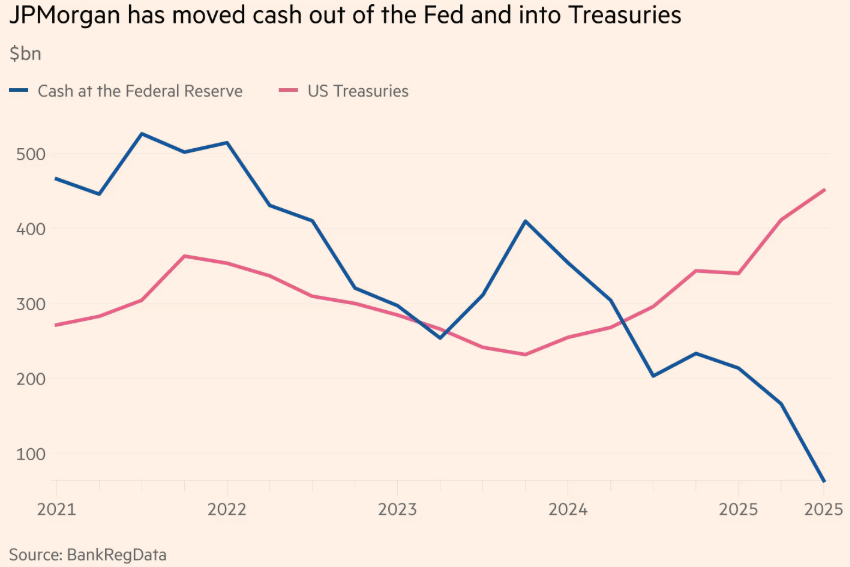
Core Insights - JPMorgan Chase has withdrawn nearly $350 billion from its Federal Reserve account since the beginning of 2023, reallocating most of these funds into U.S. government bonds as a defensive strategy against potential profit erosion from interest rate cuts [1][5] - The bank's balance at the Federal Reserve has plummeted from $409 billion at the end of 2022 to just $63 billion by the third quarter of 2023, while its holdings of U.S. Treasury securities have surged from $231 billion to $450 billion [1][5] - This strategic shift reflects how the largest U.S. bank is preparing for the end of a period of easy profitability, where it previously earned returns on cash held at the Federal Reserve while paying low interest to most depositors [1] Group 1 - JPMorgan Chase is proactively moving funds from the Federal Reserve to U.S. Treasuries to lock in higher yields in anticipation of declining interest rates [5][9] - The bank's actions have been significant enough to offset the total changes in deposits at the Federal Reserve for over 4,000 other banks, which saw total deposits drop from $1.9 trillion to approximately $1.6 trillion since the end of 2023 [9] - The Federal Reserve's interest payments on reserves have surged, with projected payments reaching $186.5 billion in 2024, raising questions about the effectiveness of this policy [9][12] Group 2 - JPMorgan Chase has not disclosed the duration of its U.S. Treasury investments or the extent to which it uses interest rate swap contracts to manage risk [5] - The bank's stable deposit base allowed it to benefit from returns on cash held at the Federal Reserve during high interest periods, contrasting with competitors like U.S. Bank, which faced significant losses [5] - In 2024, JPMorgan Chase is expected to receive $15 billion in interest payments from the Federal Reserve, contributing to its total projected profit of $58.5 billion for the year [12]

贸易争端中,加拿大投资者买入美国债券数量创2023年以来新高
news flash· 2025-06-17 17:10
Core Viewpoint - The ongoing trade tensions have not diminished Canadian investors' interest in U.S. assets, as they continue to significantly purchase U.S. government bonds [1] Group 1: Investment Trends - In April, Canadian investors net bought 9.2 billion CAD (approximately 6.8 billion USD) in U.S. government bonds, marking the largest single investment since November 2023 [1] - During the same month, amidst escalating tariff tensions, investors also purchased 1.1 billion CAD in U.S. Treasury bonds while reducing their holdings in U.S. stocks [1] - Prior to this, in February, Canadian investors had reached a record high investment in U.S. stocks amounting to 29.8 billion CAD [1]
瑞典央行金融稳定报告:对美元和美国政府债券信心的迅速恶化可能对金融稳定产生重大影响。
news flash· 2025-05-28 07:36
Core Insights - The rapid deterioration of confidence in the US dollar and US government bonds may significantly impact financial stability [1] Group 1 - The Swedish central bank's financial stability report highlights concerns regarding the US dollar and US government bonds [1] - A decline in confidence could lead to broader implications for global financial markets [1] - The report emphasizes the interconnectedness of financial systems and the potential ripple effects of such confidence issues [1]
单周下跌2%,美元创4月“对等关税”以来最大跌幅
Hua Er Jie Jian Wen· 2025-05-24 02:08
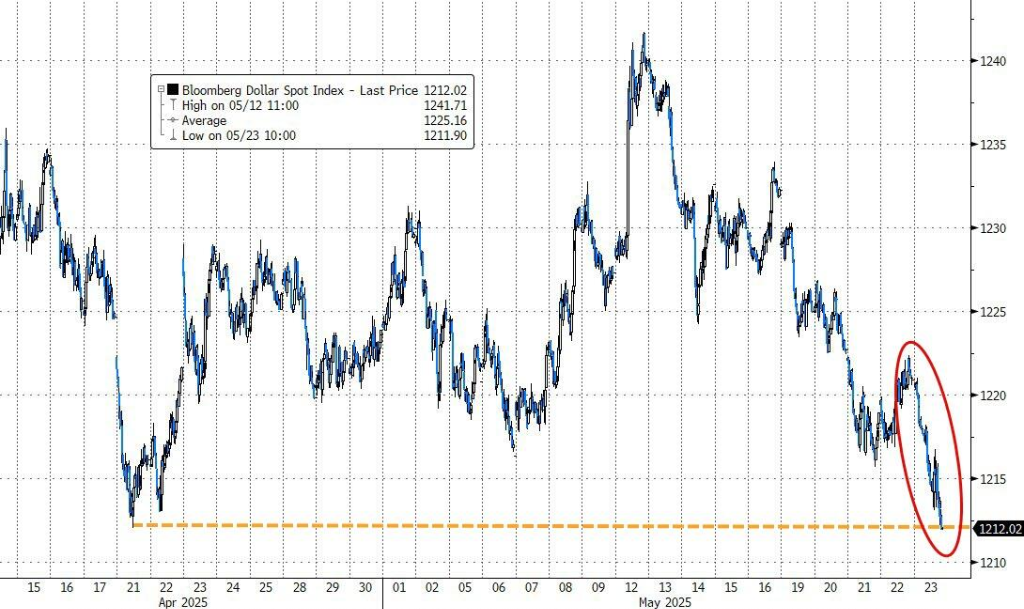
Core Points - The US dollar has dropped 2% this week, marking the largest weekly decline since April, amid rising concerns over the US fiscal situation [1] - The dollar's decline is unusual given the high interest rate environment, as typically higher yields would attract investment in dollar assets [1] - The Bloomberg Dollar Index fell significantly, breaking below April lows and reaching a new yearly low [1][4] Group 1: Market Reactions - Investors are exhibiting panic selling of dollar assets, indicated by simultaneous declines in the dollar, US government bonds, and stocks [1] - Chris Turner from ING highlights ongoing concerns about the quality of US asset markets and threats of de-dollarization putting pressure on the dollar [1] - US Treasury Secretary Mnuchin attempted to downplay the dollar's weakness, attributing it to strength in other currencies rather than a decline in the dollar itself [1] Group 2: Fiscal Concerns - The fiscal deficit concerns stemming from Trump's tax cuts have led to a sell-off in long-term US bonds, with the 30-year bond yield rising 0.13 percentage points to surpass 5% [5] - Analysts warn that worries about the increasing fiscal burden on the US are gradually intensifying [5] - MUFG's Lee Hardman states that renewed concerns about the US fiscal outlook and speculation about weakening the dollar in international discussions are exacerbating the sell-off [7] Group 3: Long-term Outlook - The ongoing decline of the dollar is linked to growing investor concerns about the impact of comprehensive tariffs on the US economy [7] - RBC Asset Management analysts predict that the dollar's weakness will persist as investors seek to hedge dollar exposure in the short term and reconsider structural overexposure to the US in the long term [7]
财政悬崖逼近 “抛售美国”要卷土重来了?
Jin Shi Shu Ju· 2025-05-20 07:19
Core Viewpoint - The deteriorating fiscal situation in the U.S. is threatening the positive atmosphere on Wall Street, with significant budget deficits and rising interest costs leading to a downgrade of the U.S. credit rating by Moody's [1][2] Group 1: Fiscal Situation and Market Reactions - Investors sold U.S. government bonds and dollars following the downgrade of the U.S. credit rating, which was attributed to large budget deficits and increasing interest costs [1] - The 30-year U.S. Treasury yield briefly surpassed 5%, reflecting a continued upward trend in yields due to concerns over recession, inflation, and increased bond issuance from larger deficits [1][2] - The recent budget deficits are particularly alarming as they occur during a period of economic strength rather than during a recession, which typically sees a drop in tax revenues [1][3] Group 2: Legislative Developments and Economic Implications - The House Budget Committee passed a tax and spending bill expected to increase the deficit by trillions of dollars, with a proposal to extend expiring tax cuts and introduce new ones [1][3] - The projected increase in the budget deficit is approximately $3 trillion over the next decade, raising concerns about the long-term imbalance between U.S. spending and tax revenues [3] - The total publicly held federal debt is around $29 trillion, nearly double the amount when the initial tax cuts were signed into law in 2017 [3] Group 3: Investor Sentiment and Market Dynamics - Despite rising Treasury yields, the stock market has shown resilience, with the S&P 500 and Dow Jones Industrial Average posting gains [2] - Investors are closely monitoring changes in policies and interest rates, indicating a level of uncertainty that is reflected in market behavior [4] - Factors such as trade policy changes are seen as more likely to impact the market in the short term compared to long-standing concerns about U.S. fiscal health [4][5]
回不到“解放日”前了?债基巨头警告:特朗普的关税信仰被低估
Jin Shi Shu Ju· 2025-05-08 06:36
Group 1 - Pimco warns that investors are underestimating Trump's commitment to high tariffs, with the risk of economic recession at its highest level in years [1][3] - Trump's recent tariff implementation on major trading partners led to significant market turmoil, but a temporary suspension of tariffs helped stabilize the market [1] - Ivascyn emphasizes that the belief in a complete rollback of tariffs is misguided, indicating uncertainty about returning to pre-tariff conditions [1] Group 2 - Ivascyn suggests that tariffs could lead to a "stagflationary" environment, where economic slowdown coincides with rising price levels [2] - The likelihood of an economic recession is at its highest in years, as noted by Ivascyn, coinciding with warnings from the Federal Reserve about increased uncertainty and potential inflation [3] - Pimco maintains a cautious approach in sectors sensitive to economic fluctuations, citing "bubble or complacency" in corporate bonds [3] Group 3 - Despite the cautious stance, Pimco favors high-quality sectors like mortgages due to strong household balance sheets, while slightly increasing holdings in short-term U.S. government bonds [3] - The volatility and uncertainty in the U.S. market, along with deteriorating fiscal conditions, enhance the appeal of diversifying investments into other sovereign debt markets [3] - Ivascyn states that the U.S. will not lose its reserve currency status in the short term, but meaningful progress on deficit issues is unlikely, which may lead to rising price levels [3]