
资产负债表扩张

Search documents
贵金属日报2025-10-31:贵金属-20251031
Wu Kuang Qi Huo· 2025-10-31 01:23
1. Report Industry Investment Rating There is no information provided regarding the report industry investment rating. 2. Core View of the Report - The precious metals market has returned to being influenced by the Fed's monetary policy expectations. Powell's statement on the expansion of the balance sheet is a significant positive factor for gold and silver prices [1]. - The discussion on the balance sheet in the recent interest - rate meeting exceeded market expectations in the medium term. Although the balance - sheet reduction will end on December 1st, later than expected, Powell clearly stated that the Fed will expand the balance sheet again [2]. - After Powell's hawkish statement, the prices of gold and silver declined in the short term. The release of the Fed's loose monetary policy expectations still requires a certain period. The interest - rate meeting sent a signal that the December interest rate cut is still uncertain while strengthening the subsequent "interest rate cut + balance - sheet expansion" monetary policy idea. In the loose monetary policy cycle, it is recommended to buy silver on dips. The reference operating range for the main contract of Shanghai gold is 880 - 966 yuan/gram, and for the main contract of Shanghai silver is 11001 - 12366 yuan/kilogram [3]. 3. Summary According to Related Catalogs 3.1 Market Quotes - Shanghai gold rose 1.11% to 920.40 yuan/gram, and Shanghai silver rose 1.47% to 11448.00 yuan/kilogram. COMEX gold was reported at 4031.70 US dollars/ounce, and COMEX silver was reported at 48.70 US dollars/ounce. The US 10 - year Treasury yield was reported at 4.11%, and the US dollar index was reported at 99.53 [1]. - The key data of gold and silver on October 30, 2025, showed that the closing price of COMEX gold's active contract was 4038.30 US dollars/ounce, up 2.45% from the previous day; the trading volume was 24.25 million lots, down 13.72%; the position was 52.88 million lots, up 2.43%. The closing price of COMEX silver's active contract was 48.73 US dollars/ounce, up 3.08%; the position was 16.58 million lots, up 1.75% [6]. 3.2 Policy Information - The US Treasury Secretary responsible for the selection of the new Fed Chairman said that the final list will be submitted to Trump around Thanksgiving (late November) for selection, and the selection of the Fed Chairman will be completed before Christmas (late December) [1]. - The interest - rate meeting decided that the balance - sheet reduction will end on December 1st, later than market expectations. Powell clearly stated that the Fed will expand the balance sheet again, which is his first key statement on balance - sheet expansion in this interest - rate cut cycle [2]. 3.3 Strategy Suggestions - In the loose monetary policy cycle, it is recommended to buy silver on dips. The reference operating range for the main contract of Shanghai gold is 880 - 966 yuan/gram, and for the main contract of Shanghai silver is 11001 - 12366 yuan/kilogram [3].
金价亚盘短期承压下跌,关注下方支撑位多单布局
Sou Hu Cai Jing· 2025-10-30 05:55
Group 1 - The core focus of the news is the cautious trading in the gold market, influenced by the upcoming US-China summit in Seoul and the potential impact on gold prices depending on the outcomes of trade negotiations [1] - If the trade talks do not yield significant progress, gold prices may find short-term support due to safe-haven demand; conversely, optimistic developments could lead to downward pressure on gold prices [1] - The market is currently at a crossroads, with factors such as a hawkish shift from Powell, strengthening of the dollar and US Treasury yields, and the end of quantitative tightening overshadowing any potential benefits for gold [1] Group 2 - Gold experienced significant volatility, initially rising nearly 2% to surpass the $4000 mark, reaching a high of $4029.90 per ounce, before reversing course following a hawkish statement from Fed Chair Powell [3] - The Fed's decision to lower rates by 25 basis points did not prevent gold from declining, as Powell's comments led to a drop to a low of $3916.56 per ounce, closing around $3930, reflecting a daily decline of approximately 0.57% [3] - The Fed's stabilization of bond holdings and potential resumption of balance sheet expansion in 2026 may support bond prices and lower yields, but the immediate impact of Powell's hawkish remarks has overshadowed these factors [3]


国际银寻找低点上涨 美联储量化紧缩将画句号
Jin Tou Wang· 2025-10-30 03:28
Group 1 - The Federal Reserve announced the resumption of limited Treasury bond purchases, officially ending years of quantitative tightening (QT) policy, which is expected to stabilize bond holdings and slow monetary market tightening [2] - The plan includes maintaining a maximum of $35 billion in mortgage-backed securities (MBS) per month without reinvestment, with all MBS maturity funds reinvested into Treasury bonds starting December 1 [2] - Market expectations for a rate cut in December have significantly cooled due to the Fed's hawkish stance, as indicated by comments from Fed Chair Powell [2] Group 2 - International silver is currently trading below $47.52, with a slight decline of 0.33% to $47.36 per ounce, indicating a short-term bearish trend [1] - Despite the current bearish sentiment, the silver market shows strong fundamentals and potential for future price increases, with a target of $49.5 expected this week [2] - The previous strategy of buying silver around $46 remains unchanged, with expectations for continued bullish momentum [2]
美联储QT终局将至,接下来是临时干预和提前扩表?
Jin Shi Shu Ju· 2025-10-29 06:29
Core Viewpoint - There is a growing expectation on Wall Street that the Federal Reserve will soon end its balance sheet reduction process, with some analysts predicting a potential restart of balance sheet expansion in the near term [1][4]. Group 1: Federal Reserve's Policy Meeting Expectations - Economists are calling for the Federal Reserve to announce the termination of quantitative tightening (QT) at the upcoming two-day policy meeting, with a general market expectation for a 25 basis point cut in the benchmark interest rate to a range of 3.75%-4.00% [1][4]. - The unexpected and sometimes severe rise in money market rates is a core reason for analysts urging the central bank to end the balance sheet reduction [1][4]. - The use of the Standing Repo Facility indicates that previously ample liquidity in the money market is tightening, further shifting expectations [1]. Group 2: Market Pressure and QT Implications - During the QT period, indicators show that the funds withdrawn from the financial system have reached a critical point, leading many economists to believe that the QT window is officially closed if policymakers wish to maintain control over the federal funds rate [4]. - Deutsche Bank strategists expect the FOMC to announce the end of QT at the upcoming meeting, while some analysts express uncertainty about whether this will happen [4]. - Federal Reserve officials have provided vague guidance on the future of QT, with Chairman Powell mentioning that QT may end in the coming months while emphasizing the need for flexibility in balance sheet management [4]. Group 3: Potential for Market Interventions - The Federal Reserve's balance sheet expanded significantly during the COVID-19 pandemic, and the current QT process has reduced its holdings from approximately $9 trillion to $6.6 trillion [5]. - The Fed's previous aim to withdraw excess liquidity was to ensure sufficient cash in the financial system and maintain the federal funds rate at desired levels, but there are no clear indicators for when these goals will be achieved [5]. - Some analysts suggest that the current pace of QT is nearly stagnant, and even if an announcement to terminate QT is made soon, it may not stabilize the money market as needed [5]. Group 4: Future Actions and Predictions - Analysts from JPMorgan suggest that after terminating QT, the Federal Reserve should "immediately" implement temporary market interventions and lower the borrowing rate of the Standing Repo Facility to enhance its attractiveness [6]. - Evercore ISI predicts that the Fed will need to turn to net purchases of bonds earlier than planned, estimating monthly net purchases of about $35 billion in Treasury bonds starting in the first quarter of next year [7]. - There is a consensus that the Fed's future bond purchases will primarily focus on short-term Treasury bills, while the reduction of MBS holdings may continue due to challenges [7].
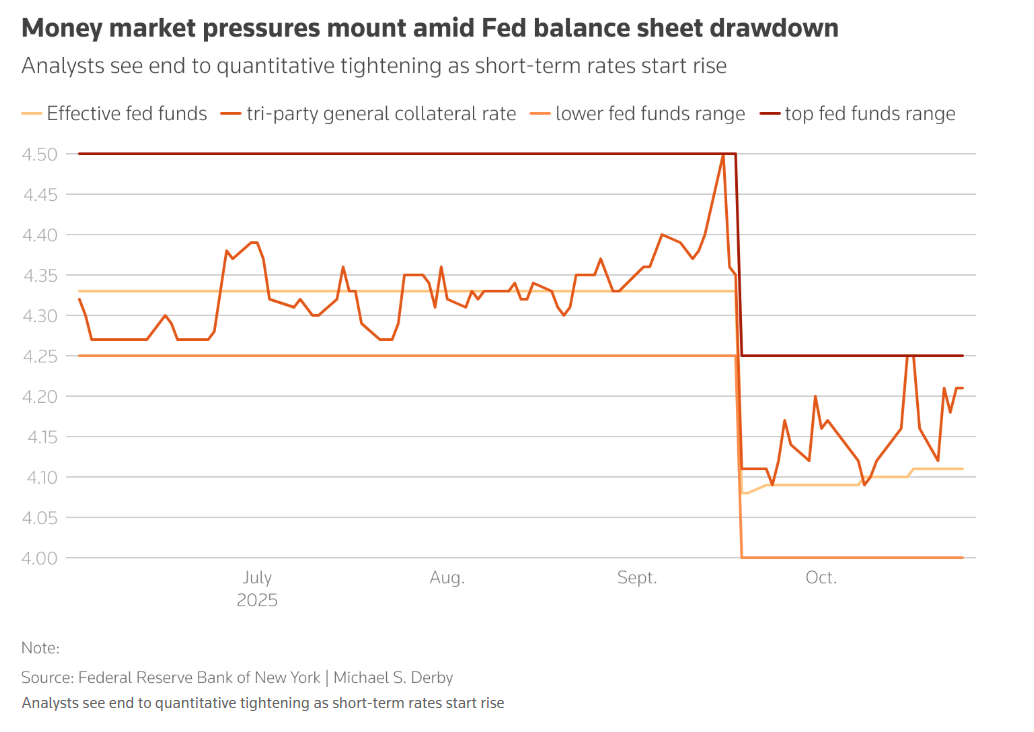
财政部发债“倒逼”美联储,扩表放水终将到来?
Jin Shi Shu Ju· 2025-10-16 02:06
Group 1 - Federal Reserve Chairman Jerome Powell hinted at a potential halt in the reduction of U.S. Treasury securities from the balance sheet in the coming months, without mentioning the Treasury's role in this process [1] - The Treasury has been increasing the supply of short-term Treasury bills (maturing in one year or less), indicating a need for the federal government to maintain higher Treasury General Account (TGA) balances, which have been targeted at $850 billion for most of the past year [1] - Analysts suggest that the TGA balance could reach at least $900 billion in the upcoming quarterly update on November 3 [1] Group 2 - Bank of America data indicates that the increase in the weekly auction size of short-term Treasury bills suggests a net supply of approximately $146 billion this month, exceeding expectations by $80 billion [2] - The increase in short-term Treasury bill supply necessitates a higher TGA balance to match cash flow, with the Treasury aiming to maintain the TGA balance at a level sufficient to cover one week of expenditures and maturing tradable debt [2] - Wrightson ICAP's senior economist Lou Crandall noted that the official quarterly target balance for the TGA has remained stable at $850 billion for most of the past year, with expectations for an increase to $900 billion in the new borrowing forecast to be released on November 3 [2]