金融博弈

Search documents
中国就是不松口!特朗普走投无路了,想来北京一趟,中方反手抛189亿美债
Sou Hu Cai Jing· 2025-05-21 11:00
Group 1 - The U.S. Treasury Secretary has warned that the federal government's cash reserves and measures to keep debt within the legal limit may be exhausted by August, urging Congress to act before mid-July to raise or suspend the debt ceiling [1][3] - The current legal debt ceiling is set at $36.1 trillion, which was reached in early January, and the Treasury has been employing "extraordinary measures" to avoid a potential default [1][3] - Analysts predict that the remaining capacity of these extraordinary measures will only last until June or July, leading to a situation where the government may run out of funds if Congress does not act [3] Group 2 - The ongoing trade tensions and tariff policies under the Trump administration have raised concerns about the risk of a debt default crisis, as countries affected by U.S. tariffs may retaliate by selling U.S. debt [6] - Recent data shows that as of March 2025, Japan and the UK increased their holdings of U.S. Treasury bonds, while China reduced its holdings, indicating a shift in the dynamics of foreign investment in U.S. debt [6] - The Federal Reserve has indicated that inflation risks are linked to tariff policies, complicating the economic landscape and affecting market confidence [7]

中方大举抛售美债,特朗普付出代价,美国走向破产,日本被逼接盘
Sou Hu Cai Jing· 2025-05-19 23:11
Core Viewpoint - The article discusses the declining confidence in U.S. Treasury bonds, highlighting China's recent sale of $18.9 billion in U.S. debt, reducing its holdings to $765.4 billion, and the implications of this financial maneuvering in the context of global economic stability [1][3][18]. Group 1: U.S. Economic Challenges - The U.S. economy has not fully recovered since the 2008 financial crisis, with GDP growth remaining weak and manufacturing shrinking [5][7]. - The U.S. government faces escalating fiscal deficits, with national debt approaching astronomical figures, raising concerns about potential bankruptcy [7][9]. - U.S. policies, including sanctions and the weaponization of the dollar, have led to a loss of trust in the stability of the U.S. financial system, causing global investors to reconsider the value of U.S. Treasury bonds [9][10]. Group 2: China's Strategic Moves - China has been gradually reducing its holdings of U.S. Treasury bonds, with a recent sale of $18.9 billion reflecting a strategic shift to mitigate risk [18][20]. - The reduction in U.S. debt holdings is part of a broader strategy to diversify investments and avoid over-reliance on U.S. assets, as the global financial landscape evolves [22][24]. - China's approach indicates a keen awareness of global market trends, focusing on investments in emerging sectors rather than solely on U.S. debt [22][24]. Group 3: Japan's Dilemma - Japan holds a significant amount of U.S. Treasury bonds, but its economic position limits its ability to reduce these holdings without facing repercussions from the U.S. [16][26]. - Despite recognizing the risks associated with U.S. debt, Japan's dependence on the U.S. for military and economic support complicates its financial decisions [16][26]. - Japan's situation illustrates the challenges faced by countries caught between the need for economic security and the risks of holding U.S. debt [26][28].
美国糊弄人,日本拆台:对汽车征税,不可接受
Guan Cha Zhe Wang· 2025-05-03 10:47
Core Viewpoint - The trade negotiations between Japan and the United States have shown little progress, with the U.S. expressing optimism while Japan remains cautious about the outcomes of the discussions [1][2]. Group 1: Negotiation Dynamics - The U.S. Treasury Secretary and other officials described the discussions as "frank and constructive," emphasizing the importance of tariffs and economic security [1]. - Japan's representatives indicated measures to reduce trade surplus, such as reviewing non-tariff barriers on auto imports and increasing purchases of U.S. agricultural products [2]. - Japanese Prime Minister Shigeru Ishiba stated that tariffs on automobiles are "absolutely unacceptable" and emphasized that reducing the U.S. trade deficit should not come at the expense of Japanese jobs [2]. Group 2: Future Negotiation Prospects - The U.S. has taken a hard stance, refusing to discuss tariffs on automobiles, steel, and aluminum, which complicates cooperation [4]. - Japan's Economic Revitalization Minister indicated plans for another meeting in mid-May, focusing on expanding trade and reducing non-tariff barriers [4]. - Japan's Finance Minister acknowledged the need to consider its own economic security when responding to U.S. demands, particularly regarding economic ties with China [4]. Group 3: Financial Implications - Japan holds approximately $1.08 trillion in U.S. Treasury bonds, which could be used as leverage in trade negotiations, although this approach has been previously denied by Japanese officials [5]. - Analysts suggest that Japan's mention of U.S. debt as a negotiation tool marks a new phase in trade tensions, despite concerns about the potential negative impact of selling U.S. bonds [5][6]. - The strategy of using U.S. debt as a bargaining chip could position Japan favorably in negotiations without immediate action [6].
暴跌4540元/吨!贸易战重压,铜价高台跳水
Hua Xia Shi Bao· 2025-04-07 23:12
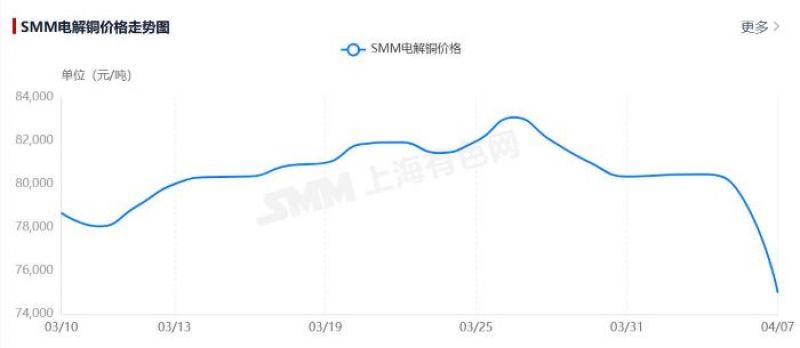
Core Viewpoint - The recent escalation of the trade war between the U.S. and China has significantly impacted copper prices, leading to a sharp decline in both spot and futures markets due to heightened concerns over global supply chain disruptions and reduced industrial demand [3][6][8]. Price Movements - On April 7, SMM 1 electrolytic copper spot prices fell sharply to a range of 73,820 to 75,400 yuan/ton, with an average price of 74,610 yuan/ton, down 4,540 yuan/ton from the previous trading day [3]. - The futures market also saw a significant drop, with the Shanghai copper futures closing at 73,640 yuan/ton, down 5,550 yuan, marking a decline of 7.01% [3]. Trade War Impact - The U.S. announced a 34% tariff on imports from China, prompting retaliatory measures from China, which has led to increased fears of a global economic slowdown and reduced demand for industrial metals, particularly copper [3][4][6]. - Despite copper not being included in the initial tariff list, the market reacted negatively, with COMEX copper futures dropping over 14% in the week following the announcement [5][6]. Market Sentiment - Analysts indicate that the trade tensions have escalated market volatility, with copper prices reflecting a pessimistic outlook on industrial demand due to the uncertainty surrounding global economic stability [6][8]. - The LME copper price fell by 8.95% and COMEX copper by 10.21% since the announcement of the tariffs, indicating a significant market reaction to the trade war [6]. Future Outlook - Short-term projections suggest that copper prices may continue to experience high volatility, with potential fluctuations between 70,000 and 80,000 yuan/ton, depending on the developments in the trade war [12]. - Long-term expectations indicate that copper prices may stabilize in a range of 65,000 to 90,000 yuan/ton, driven by structural changes in demand, particularly in the renewable energy and data center sectors [12][13].