集成化

Search documents
富临精工20250828
2025-08-28 15:15
Summary of Fulin Precision Engineering Conference Call Company Overview - **Company**: Fulin Precision Engineering - **Industry**: Automotive Parts and Lithium Battery Materials Key Points and Arguments Business Performance - In the first half of 2025, Fulin Precision achieved revenue of 5.81 billion yuan, a year-on-year increase of 61.7% [3] - Net profit attributable to shareholders was 170 million yuan, up 32% year-on-year [3] - Growth driven by automotive parts and lithium battery materials, with lithium battery materials revenue reaching 3.7 billion yuan, a 96% increase [3] Lithium Battery Materials - The company’s lithium iron phosphate (LiFePO4) business shipped 105,000 tons in the first half of 2025, with a full-year target of 260,000 to 270,000 tons [11] - The introduction of fifth-generation products is expected to enhance profitability, with a price premium of approximately 1,000 yuan per unit [14][19] - Supply chain upgrades are anticipated to reduce costs by about 2,000 yuan per unit, with significant effects expected by 2026 [15] Automotive Parts Business - The automotive parts segment is expected to enter a prosperous period in Q3 2025, with increased deliveries of electronic water pumps and electronic oil pumps [7] - The company is focusing on integrated and platform-based development, moving towards potential body manufacturing [6][20] Robotics Sector - Fulin has begun mass production of robotic joint assemblies and modules, supplying mainstream customers [6] - The company is collaborating with Zhiyuan and other startups to enhance its position in the robotics industry [10] - Revenue from robotic components is projected to reach tens of millions to 100 million yuan this year [27] Strategic Partnerships - Fulin's partnership with Zhiyuan has deepened, with expectations of generating 100 million yuan in revenue from parts sales and OEM business [9] - The company is also involved in projects for military applications, enhancing its market presence [12] Market Trends and Industry Dynamics - The industry is moving away from low-cost, low-quality strategies, leading to improved market prices and a more favorable competitive landscape [12][13] - Fulin is positioned as a technology leader, which may further enhance its profitability [5] Future Outlook - The company plans to increase the proportion of fifth-generation products to over 70% by 2026 [16] - Expansion of production capacity is underway, with a new project expected to produce 200,000 tons of lithium phosphate [17] Cost Management and Competitive Advantage - Fulin aims to maintain a competitive edge through technological breakthroughs and large-scale manufacturing capabilities [25] - The company is focused on reducing costs associated with robotic components to enhance overall market competitiveness [25] Product Development - The company is actively developing applications for robotic components and plans to expand into body manufacturing [20] - Current market share in the electronic water pump sector is approximately 30%, with annual sales exceeding 3 million units [23] Conclusion - Fulin Precision Engineering is strategically positioned for growth in the automotive parts and lithium battery materials sectors, with a strong focus on technology, partnerships, and market trends that favor quality over cost. The company is set to enhance its profitability and market share through innovative product development and strategic collaborations.

帅丰电器: 浙江帅丰电器股份有限公司2025年半年度报告全文
Zheng Quan Zhi Xing· 2025-08-27 16:31
Core Viewpoint - The report highlights a significant decline in the financial performance of Zhejiang Sanfer Electric Co., Ltd. for the first half of 2025, with a notable drop in revenue and net profit compared to the same period last year, attributed to reduced sales volume and fewer new orders [2][4][10]. Company Overview and Financial Indicators - Company Name: Zhejiang Sanfer Electric Co., Ltd. [2] - Stock Code: 605336 [2] - Total Revenue for H1 2025: 130.36 million RMB, a decrease of 44.15% year-on-year [4] - Total Profit: 5.54 million RMB, down 88.17% year-on-year [4] - Net Profit Attributable to Shareholders: 3.30 million RMB, a decline of 91.80% year-on-year [4] - Total Assets: 2.02 billion RMB, down 4.67% from the previous year [4] Industry and Business Situation - The integrated stove industry is experiencing a downturn, with a 27.6% decline in retail sales and a 24.1% drop in retail volume in the first half of 2025 [5][10]. - The market for new housing is shrinking, impacting the kitchen appliance sector, although government policies promoting appliance upgrades may improve demand in the future [5][10]. - The company focuses on integrated kitchen appliances, emphasizing innovation and user needs to enhance product offerings [6][10]. Product Development and Innovation - The company has been continuously upgrading its integrated stove products since 2005, expanding its product line to include various kitchen appliances [17][25]. - Recent product launches include the Time-Space S5 series and Ideal L3 series, designed to meet diverse consumer needs [17][25]. - The company collaborates with Zhejiang University to enhance product design and functionality, integrating advanced technology into its offerings [18][20]. Marketing and Sales Strategy - The company employs a flat and efficient dealer model, maintaining nearly 1,000 dealers and approximately 1,900 sales terminals [9][12]. - It actively develops online and offline sales channels, leveraging e-commerce platforms like Tmall and JD.com to reach a broader audience [12][14]. - The company emphasizes brand positioning as a high-end kitchen appliance provider, targeting middle to high-income consumers [10][11]. Customer Engagement and Service - The company has implemented the "Sanfer Smile Service 3.0" initiative to enhance customer service and satisfaction [22][23]. - It focuses on building long-term relationships with customers through various engagement strategies, including loyalty programs and after-sales support [16][24]. - The company aims to improve customer experience by offering comprehensive service solutions and maintaining high service standards [22][24].

趋势研判!2025年中国配电柜行业整体发展形势分析:市场正迎来前所未有的增长机遇,市场规模将达662.7亿元[图]
Chan Ye Xin Xi Wang· 2025-08-22 01:35
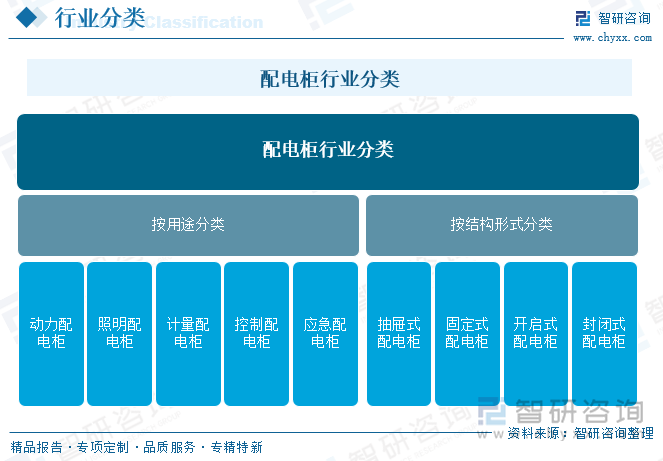
Core Viewpoint - The distribution cabinet industry is experiencing unprecedented growth opportunities due to rapid urbanization and the development of the renewable energy sector, with China being a major consumer market for distribution cabinets [1][4][6]. Industry Definition and Classification - Distribution cabinets are electrical equipment assemblies used for centralized control, distribution of electrical energy, and protection, monitoring, and control of circuits and electrical devices. They can be classified by purpose (e.g., power distribution, lighting, control) and structure (e.g., drawer-type, fixed-type) [2][6]. Current Industry Development Status - The global distribution cabinet market is projected to grow from $30.91 billion in 2018 to $35.57 billion by 2024, with the Asia-Pacific region accounting for 49.29% of the market share [4][6]. In China, the demand for distribution cabinets is expected to reach 1,563,183 units in 2024, with a market size of 62.42 billion yuan [7][9]. Industry Demand and Market Size - In 2024, the demand for distribution cabinets in China is expected to be 1,563,183 units, with a market size of 62.42 billion yuan. By 2025, demand is projected to increase to approximately 1,665,364 units, with a market size of about 66.27 billion yuan [7][9]. Industry Production and Output - The production value of China's distribution cabinet industry is expected to reach 64.48 billion yuan in 2024, with an output of 1,588,089 units. By 2025, the production value is projected to be 68.4 billion yuan, with an output of 1,690,422 units [9][19]. Industry Supply Chain - The upstream of the distribution cabinet industry includes raw materials such as metals (copper, aluminum, steel), insulation materials, and electrical components. The midstream involves research, design, production, and sales, while the downstream applications span various sectors including power, construction, and transportation [11][16]. Industry Development Environment - Related Policies - Various policies have been issued to promote the high-quality development of the distribution network, including standards for energy efficiency and the integration of renewable energy [13][15]. Industry Competitive Landscape - The distribution cabinet market has many regional small and medium-sized enterprises in the low-end segment, leading to intense price competition. In the high-end market, leading international companies dominate due to their technological advantages [16][19]. Industry Development Trends - The industry is moving towards increased intelligence, with future distribution cabinets expected to feature real-time monitoring, fault diagnosis, and remote control capabilities [23]. Additionally, there is a trend towards green and environmentally friendly designs, focusing on energy efficiency and the use of recyclable materials [24]. The demand for smaller and more integrated distribution cabinets is also rising, driven by space efficiency requirements [25].


上海汽配拟开展车载冰箱业务 预估2033年全球市场规模将达1400亿元
Zheng Quan Shi Bao Wang· 2025-08-05 13:46
Group 1 - Company plans to establish a joint venture focusing on car refrigerator business with Wuhan Reyi, with a registered capital of 20 million yuan, where Shanghai Auto Parts will contribute 12 million yuan (60%) and Wuhan Reyi will contribute 8 million yuan (40%) [1] - The establishment of the joint venture is part of the company's strategy to enhance product structure and diversify its product offerings, which is expected to significantly increase production scale and improve risk resistance and competitiveness [2] - The car refrigerator market is anticipated to experience substantial growth, with the global market size projected to reach 50 billion yuan in 2024 and expand to 140 billion yuan by 2033, reflecting a compound annual growth rate of 11.5% during the forecast period [2] Group 2 - Shanghai Auto Parts' main business includes the research, development, production, and sales of automotive thermal management system components and engine system components, with direct sales accounting for 93% of its main business revenue in 2024 [3] - In 2024, the company achieved a sales revenue of 2.101 billion yuan, a year-on-year increase of 13.72%, and a net profit of 188 million yuan, up 16.75% year-on-year [3] - The automotive thermal management system products generated sales revenue of 1.714 billion yuan, reflecting a year-on-year increase of 15.34%, while engine system products achieved sales revenue of 387 million yuan, up 7.08% year-on-year [3]

研判2025!中国码垛机器人行业发展背景、市场规模、竞争格局及发展趋势:制造业转型升级,推动行业规模上涨16.78%[图]
Chan Ye Xin Xi Wang· 2025-07-17 01:18
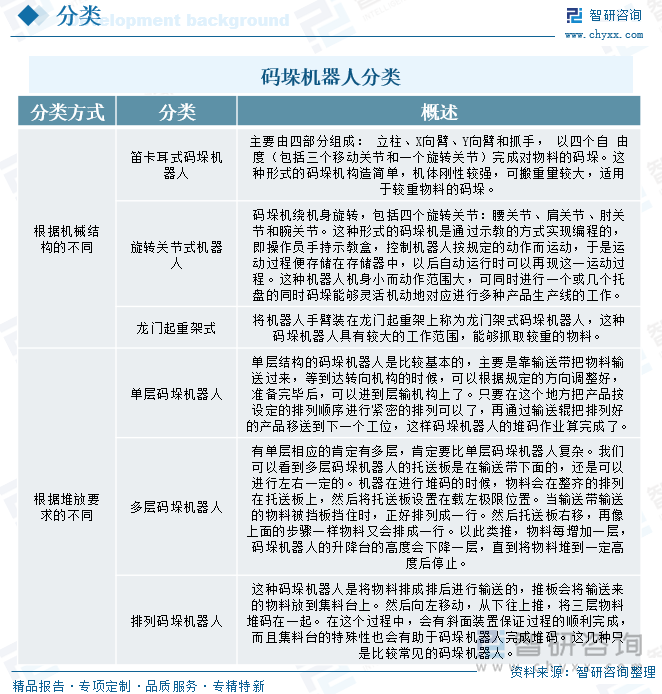
Core Viewpoint - The traditional manual stacking methods in industrial manufacturing are increasingly inadequate, leading to a shift towards automation in the stacking process, with palletizing robots becoming essential for enhancing production efficiency and safety [1][13]. Industry Overview - The palletizing robot is an automated device that mimics human arm movements for grabbing, transporting, and stacking items, integrating multiple technologies such as mechanics, electronics, and artificial intelligence [3]. - The working principle of palletizing robots involves three stages: perception, decision-making, and execution, utilizing various sensors to gather environmental data, process it to formulate optimal strategies, and execute tasks through mechanical arms [3]. Market Size and Growth - The market size of China's palletizing robot industry is projected to reach 31.52 billion yuan in 2024, representing a year-on-year increase of 16.78% [1][13]. - The rapid growth of the palletizing robot market is expected to continue as its applications expand across various sectors [1]. Industry Chain - The upstream of the palletizing robot industry includes the development and production of key components such as precision reducers, servo motors, and sensors, which are crucial for the robots' performance [9]. - The midstream consists of manufacturers that integrate these components into complete palletizing systems tailored to customer needs [9]. - The downstream encompasses various application fields, including food and beverage, chemicals, construction materials, and logistics, where palletizing robots play a vital role in material handling and storage [9]. Competitive Landscape - The palletizing robot market is experiencing a new wave of technological iteration and restructuring, with leading companies consolidating resources while emerging firms exploit market gaps through differentiated strategies [15]. - High-precision 3D vision systems and flexible gripping algorithms are becoming critical competitive differentiators [15]. Industry Trends 1. **Intelligent Development**: The industry is moving towards greater intelligence, enhancing human-machine interaction capabilities [20]. 2. **Integration**: There is a growing demand for multifunctional and versatile palletizing robots, necessitating a shift towards modular and integrated designs [21]. 3. **Environmental Responsibility**: The industry is increasingly focusing on environmental issues, with a trend towards eco-friendly technologies in palletizing robots [23].


研判2025!中国电池托盘行业市场规模、主要参与者及重点企业经营情况分析:新能源汽车市场需求占主导地位,行业趋向轻量化、集成化、模块化[图]
Chan Ye Xin Xi Wang· 2025-07-08 01:29
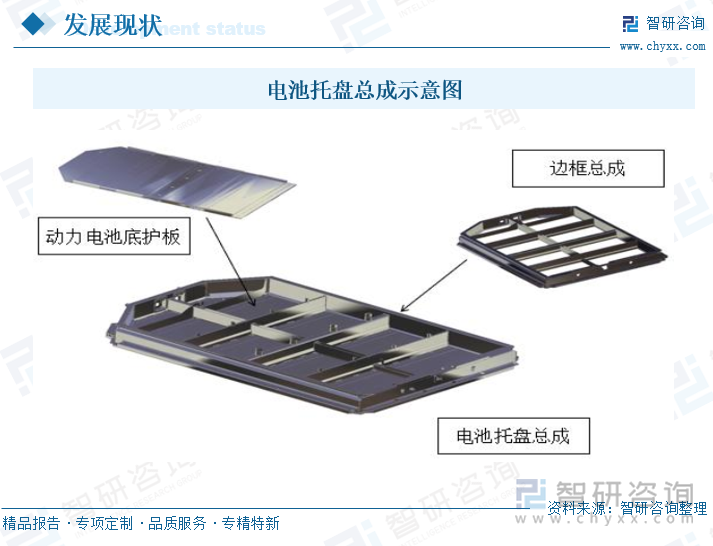
Industry Overview - Battery trays are crucial components of the power system in electric vehicles, accounting for 20%-30% of the battery system's weight and requiring high precision, corrosion resistance, high-temperature resistance, and impact resistance [1][4] - The battery tray industry in China is experiencing significant growth, with market size projected to increase from 2.63 billion yuan in 2020 to 33.93 billion yuan by 2024, maintaining a double-digit growth rate [7][8] Market Demand - The demand for battery trays is primarily driven by the electric vehicle market, with the market size for electric vehicle battery trays expected to reach 28.5 billion yuan in 2024, representing 84% of the total market [8] - The energy storage system market is also growing rapidly, with a projected market size of 5.429 billion yuan in 2024, accounting for 16% of the total market [8] Competitive Landscape - The battery tray industry features a concentrated market share among key players, including traditional component manufacturers, battery manufacturers, and material extension companies [12] - Major participants include Huayu Automotive, Huada Technology, Lingyun Industrial, and Ningde Times, among others, with a focus on aluminum alloy and high-strength steel products [14][15] Production Capacity Dynamics - Leading companies are accelerating production capacity to capture market share, with Jiangsu Tianjun Precision Technology Co., Ltd. planning to invest in 14 high-standard production lines for battery trays, aiming for an annual output of approximately 400,000 units [15] - YouSheng Aluminum's battery tray series is experiencing significant revenue growth, with a 59.85% increase in 2024, contributing to 29.77% of the company's total revenue [23][25] Trends in the Battery Tray Industry - The industry is witnessing a shift towards lightweight, integrated, and modular products, with aluminum alloys remaining the dominant material due to their excellent strength-to-weight ratio and processability [29][30] - Innovations in battery pack structure technologies (CTP/CTC/CTB) are driving the need for battery trays to integrate more functions, requiring higher rigidity, strength, and thermal management compatibility [30]




中国一体化电驱动总成市场现状研究分析与发展前景预测报告
QYResearch· 2025-07-01 08:48
Core Viewpoint - The integrated electric drive system is a compact and efficient power output unit that combines key components such as motors, gearboxes, and controllers, leading to enhanced vehicle performance and reduced costs [1][2]. Market Overview - The sales revenue of China's integrated electric drive system market is projected to reach 67.232 billion in 2024 and is expected to grow to 163.074 billion by 2031, with a compound annual growth rate (CAGR) of 12.39% from 2025 to 2031 [2]. - The market is primarily driven by the rapid increase in the penetration rate of new energy vehicles and the urgent demand from automakers for integrated and lightweight electric drive systems [2]. Product Types and Market Share - The integrated electric drive system mainly consists of three-in-one and multi-in-one systems, with the three-in-one system (motor + controller + gearbox) currently dominating the market, holding over 72% market share [3]. - Multi-in-one systems, which include integrated thermal management and power modules, are becoming the main direction for technological upgrades, with an expected CAGR of over 19% from 2025 to 2031 [3]. Application Areas - The primary application area for integrated electric drive systems is pure electric vehicles (BEVs), which are expected to account for 72.99% of revenue share in 2024 [4]. - The plug-in hybrid electric vehicle (PHEV) market is also experiencing significant growth, with a 45% year-on-year increase in vehicle sales in 2024, driving demand for compact and highly compatible electric drive systems [4]. Competitive Landscape - The market is characterized by a concentration of leading players, with BYD, Tesla, Huawei, United Automotive Electronics, and NIO Drive Technology collectively holding over 67% of the market share in 2024 [4]. - Huawei is rapidly gaining market share through its HI model in collaboration with automakers like Changan and Seres, while second-tier manufacturers face challenges in technology and capacity [4][6]. Industry Drivers - The growth of the electric and hybrid vehicle market is a significant driver for integrated electric drive systems, providing more efficient driving solutions and extending battery range [8]. - Government policies supporting the new energy vehicle industry, including strategic planning, financial subsidies, and tax reductions, have also played a crucial role in the industry's development [8]. Technological Advancements - Breakthroughs in technology, such as the 800V high-voltage platform, SiC control modules, and non-rare earth motors, have significantly improved drive efficiency (over 90%) and reduced costs (material costs down by 30%) [9]. - Multi-in-one integrated designs are further enhancing the competitiveness of vehicles in terms of range and cost-effectiveness [9]. Challenges - The integration of multiple components in the electric drive system presents technical challenges, including the need for coordination and stability among different parts [11]. - Supply chain risks, such as dependency on multiple suppliers, can complicate management and lead to production disruptions if issues arise [12]. - Fluctuations in downstream demand can impact the electric drive system's market, requiring suppliers to maintain flexibility and rapid response capabilities [13].

新能源材料:绝缘耐温云母行业深度报告
材料汇· 2025-06-26 15:26
Core Viewpoint - The article discusses the growth potential and market dynamics of the mica industry, particularly focusing on the insulation and high-temperature applications of mica materials, with significant growth expected in the new energy sector and home appliances. Group 1: Market Overview - Mica is a major rock-forming mineral widely used in insulation, high-temperature, and pearlescent materials, with 80.8% of its application in the refractory insulation sector in 2022 [2] - The global market for new energy mica is projected to exceed 10 billion by 2027, with a CAGR of 40.5% from 2023 to 2027, driven by the increasing demand for safety in new energy vehicle batteries [4] - The home appliance mica market is expected to grow at a CAGR of 20.2% from 2020 to 2025, with the market size reaching 1.341 billion by 2025 [6] - The global high-temperature refractory mica market is expected to reach 5.73 billion by 2025 [8] Group 2: Competitive Landscape - The industry has high barriers to entry due to customer, technical, financial, and product certification barriers, creating a strong moat for existing players [12][17] - Leading companies like Zhejiang Rongtai and Ping An Electric have revenues approaching those of international leaders, while most domestic firms remain small and varied in technical capabilities [18] - The market is characterized by a fragmented structure with leading firms holding significant market shares, particularly in the new energy sector where Zhejiang Rongtai had a market share of 27.14% in 2022 [20] Group 3: Industry Trends - The domestic mica market is expanding, driven by increasing demand from the new energy vehicle sector and energy storage applications, with a market size of 5.6 billion in 2022 [26] - The trend towards integrated solutions in new energy vehicles is expected to enhance the value proposition of mica manufacturers, as they shift from providing single products to comprehensive thermal runaway protection solutions [31][32] - The performance of mica products is moving towards high-end applications, with synthetic mica showing significant potential due to its superior properties compared to natural mica [35]

2025-2030年中国汽车线束行业市场需求与投资战略咨询报告
Sou Hu Cai Jing· 2025-06-04 06:29
Group 1 - The automotive wiring harness industry is defined and categorized, including its components and manufacturing processes [2][3] - The industry supply chain structure is analyzed, covering upstream supply markets such as copper, connectors, and wire and cable markets [2][3] - The market structure of the automotive wiring harness industry is examined, including product structure by location and voltage, as well as regional and application structures [2][3] Group 2 - The competitive landscape of the automotive wiring harness industry is assessed using Porter's Five Forces analysis, focusing on bargaining power of suppliers and buyers, threat of new entrants, threat of substitutes, and internal competition [3] - The competition methods in the market are analyzed, highlighting technological and cost competition [3] Group 3 - Global automotive wiring harness market demand and supply conditions are evaluated, including market size and regional structure [3][4] - The analysis of developed countries' automotive wiring harness markets, specifically in the US, Japan, and Germany, includes supply and demand conditions [3][4] Group 4 - The upstream supply market analysis includes detailed assessments of copper, PVC, engineering plastics, and rubber markets, focusing on production scales, consumption, and price trends [4][5][6] - The automotive wiring harness industry is segmented into various product analyses, including powertrain, front compartment, instrument panel, interior, and door harnesses [5][6] Group 5 - Future development predictions for the automotive manufacturing market and automotive electronics market are provided, including global and Chinese market analyses [6][7] - The automotive repair and used car markets are also analyzed, covering market conditions, operational models, and future trends [6][7] Group 6 - The technological development status of domestic and international wiring harness enterprises is reviewed, along with trends in automotive wiring harness products, such as lightweight, modular, and integrated designs [7][8] - Key automotive wiring harness enterprises are analyzed, both domestically and internationally, highlighting major players in the industry [7][8] Group 7 - Factors influencing the development of the automotive wiring harness industry are discussed, including supportive policies, stable automotive industry growth, and challenges such as a closed supplier system [8][11] - Investment analysis in the automotive wiring harness industry includes investment trends, directions, and recommendations for strategic focus based on customer needs [11]
大咖分享(四) | 黄家奇博士:新能源汽车产业发展及尼龙用材趋势
DT新材料· 2025-05-29 15:39
Core Viewpoint - The report presented by Dr. Huang Jiaqi at the "2025 Advanced Nylon Industry Innovation and Application Development Conference" emphasizes the evolution of nylon materials in the context of the global automotive industry's transition towards electrification, lightweighting, and intelligence, providing a theoretical framework and practical guidance for collaborative innovation in the industry [2]. Group 1: Traditional Fuel Vehicle System Analysis - Nylon materials have significantly contributed to the lightweighting and cost optimization of internal combustion engine vehicles, with a 47% increase in penetration in engine subsystems from 2000 to 2020 [4]. - Specific applications include: - Intake Manifold: Glass fiber reinforced nylon 6/66 replaces aluminum alloy, achieving a lightweight rate of 60%-65% and reducing manufacturing costs by 30% through integrated injection molding [4]. - Fuel Lines: Multi-layer barrier nylon materials (PA12/PA6) exhibit a pressure resistance of 8MPa and outperform traditional rubber materials in fuel permeability by three orders of magnitude [4]. - Thermal Management Systems: High-temperature nylon (e.g., PA46) maintains over 85% creep strength retention under 120℃ cycling conditions [4]. Group 2: New Energy Vehicle Technology Requirements - A three-dimensional analysis model of "demand-performance-application" is constructed to address the technical characteristics of new energy vehicles [5]. - Key requirements include: - Lightweight Rigid Demand: Long glass fiber reinforced nylon for battery pack structural components must have a tensile strength of ≥150MPa and a density 40% lower than aluminum alloys [5]. - High-Pressure Electrical System Compatibility: Materials for 800V high-pressure platform connectors must withstand temperatures up to 180℃, with semi-aromatic nylon (PA9T/PA10T) maintaining volume resistivity >10^15 Ω·cm after 1000 hours of aging at 180℃ [7]. - Thermal Management Complexity: Thermal conductive nylon for battery liquid cooling plates improves heat exchange efficiency by 120% compared to traditional PP materials [8]. Group 3: Strategic Directions for Nylon Material Innovation - The strategic directions for nylon material innovation include: - High Performance: New technologies such as semi-solid batteries and 800V high-pressure platforms require nylon to possess higher heat resistance (over 150℃ for long-term use) and electrical breakdown resistance [9]. - Low Carbon: Bio-based nylon (e.g., PA56) and recycled nylon are becoming essential choices for manufacturers to reduce carbon footprints, aligning with EU "carbon tariff" policies [9]. - Customization: New energy vehicle companies are pursuing differentiation, driving the application of specialty materials like spray-free nylon and metallic-feel nylon in interior and exterior components [9]. Group 4: Conclusion - The technological revolution in new energy vehicles fundamentally represents a systematic reconstruction of material systems, with nylon materials evolving from "functional substitutes" to "technology definers," deeply integrating into vehicle engineering design logic [10]. - Industry participants must grasp the trends of high performance, low carbon, and integration to build a technology ecosystem based on scenario innovation, which will be crucial for seizing the high ground in next-generation automotive materials [10].