QDII基金

Search documents
基金市场周报:国防军工板块表现较优QDII基金平均收益相对领先-20250811
Shanghai Securities· 2025-08-11 14:30
Group 1 - The core viewpoint of the report indicates that the defense and military industry sector performed well during the period, with QDII funds showing relatively leading average returns [1][6] - The Shanghai Composite Index rose by 2.11% and the Shenzhen Component Index increased by 1.25% during the reporting period [1] - Various types of funds experienced gains, with actively managed stock funds increasing by 1.31%, mixed funds by 1.47%, and bond funds by 0.14% [1] Group 2 - The defense and military sector, along with non-ferrous metals, showed strong performance among the Shenwan first-level industry indices [6] - Over the last 12 periods, the comprehensive and defense military indices have demonstrated favorable performance [6] Group 3 - In the bond market, the convertible bond index rose by 2.31%, leading to an average return of 2.59% for convertible bond funds during the reporting period [12] - The average return for convertible bond funds this year stands at 13.96%, indicating strong performance compared to other bond categories [12] Group 4 - Among QDII funds, the Greater China equity funds led with a return of 2.43% during the reporting period, while the year-to-date return is 34.21% [14][16] - The report highlights that various QDII fund categories experienced different levels of performance, with global equity funds returning 2.33% and emerging market equity funds returning 2.21% [14][16]
新批QDII额度难解“渴”:8月多只基金暂停申购或下调申购额度
Huan Qiu Wang· 2025-08-07 05:03
Group 1 - QDII funds have frequently adjusted subscription limits since August, with six funds announcing suspension or reduction of subscription limits [3][4] - Bosera Fund announced the suspension of subscriptions for its Nasdaq 100 ETF (QDII) starting August 4, citing the need to protect the interests of fund shareholders [3] - Wanji Fund also limited large subscriptions for its two QDII products, reducing the maximum subscription amount from 500,000 yuan to 100,000 yuan for one product, and suspending large subscriptions for another [4] Group 2 - As of August 6, over 60% of the 673 QDII funds were under subscription limits, with 30 funds suspended from subscriptions and 374 funds limiting large subscriptions [4] - A new batch of QDII investment quotas was approved in June, with 60 fund managers and securities firms receiving a total of 2.12 billion USD in new quotas [5] - Despite the new quotas, some fund companies still face tight quota issues, leading to subscription limits to protect existing shareholders amid market volatility [5]


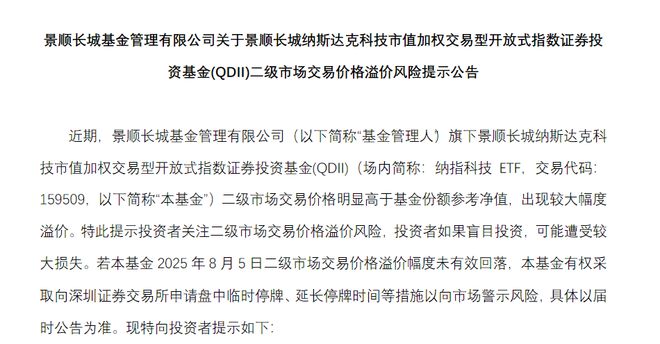
溢价高企,QDII基金频发风险提示,有基金月发20余次警示
2 1 Shi Ji Jing Ji Bao Dao· 2025-08-06 05:37
Group 1 - The Invesco Great Wall Nasdaq Technology ETF (QDII) has issued a premium risk warning for the 14th time since July, indicating that its secondary market trading price is significantly higher than its reference net asset value [1][3] - As of August 5, the closing price of the fund was 1.81 yuan, with a premium of 6.82% [3] - Similar premium issues have been observed across other QDII funds, with multiple funds issuing premium warnings almost daily since July [3][4] Group 2 - QDII funds are primarily investing in Hong Kong and US stocks, with the US market reaching historical highs and the Hong Kong market showing bullish trends, leading to increased investor enthusiasm for overseas investments [4] - The number of QDII funds in China reached 319 with a total scale of 683.77 billion yuan, marking an 11.85% increase from the previous year [4] - Due to overheated trading, several QDII funds have suspended subscriptions, and the exchanges are closely monitoring abnormal trading behaviors [4]
7月份87%QDII正收益 易方达全球医药行业混合涨28%
Zhong Guo Jing Ji Wang· 2025-08-04 23:09
Group 1 - In July 2023, 670 comparable QDII funds were analyzed, with 586 funds (87.46%) showing an increase in net value, while 80 funds experienced a decline, and 4 funds remained flat [1] - 15 QDII funds had a monthly increase exceeding 24%, with the top performers being E Fund Global Healthcare Mixed Fund (QDII) C (USD) at 28.94%, followed closely by other E Fund variants [1] - The E Fund Global Healthcare Mixed Fund (QDII) C (USD) was established on November 15, 2023, while its A share (USD) was launched on January 20, 2020 [1] Group 2 - As of July 31, 2025, the year-to-date returns for the top E Fund variants were 97.18%, 96.71%, 96.05%, and 95.63%, with cumulative net values ranging from 0.1956 to 1.4089 [2] - The fund maintained a positive outlook on the Chinese pharmaceutical industry, particularly focusing on innovative drug companies, and optimized stock selection as of the second quarter [2] - The largest fund by size among the top performers was the GF CSI Hong Kong Innovative Drug ETF, with a scale of 15.9 billion yuan and a July increase of 27.04% [2] Group 3 - The Manulife India Equity Fund (QDII), established on January 30, 2019, reported a year-to-date return of -2.38% and a cumulative net value of 1.5203 yuan as of July 31, 2025 [3] - The fund's investment strategy shifted from strong defensive positions to include more mid-cap companies and sectors like public utilities and new consumption [3] - The top ten holdings of the Manulife India Equity Fund included major companies such as Reliance Industries and HDFC Bank as of the second quarter [3]
鹏华QDII债基近1年业绩同类领先,专业团队护航投资者海外布局
Cai Fu Zai Xian· 2025-07-31 03:54
Group 1 - The core viewpoint is that QDII bond funds are becoming essential tools for investors to diversify risks and capture overseas returns in the context of global asset allocation [1][2][3] - Penghua Global High Yield Bond (QDII) has achieved a net value growth rate of 6.79% over the past year, ranking 1st out of 55 peers, showcasing its strong performance [2] - Penghua Global Short and Medium-Term Bond, managed by the same team, has a net value growth rate of 6.61% over the past year and 17.18% over three years, ranking 3rd out of 55 and 9th out of 51 respectively [2] Group 2 - The management team, led by Hao Lili, has significant overseas investment experience, contributing to the strong performance of the funds [2][3] - QDII bond funds offer lower entry thresholds and allow domestic investors to invest in overseas bonds without occupying cross-border quotas, making them a convenient investment tool [3] - Penghua Fund's international business department has a robust research and investment capability, being one of the earliest teams to invest in overseas bond markets, which supports the performance of its QDII products [3]
年内最强基金“闭门谢客”
Guo Ji Jin Rong Bao· 2025-07-30 15:52
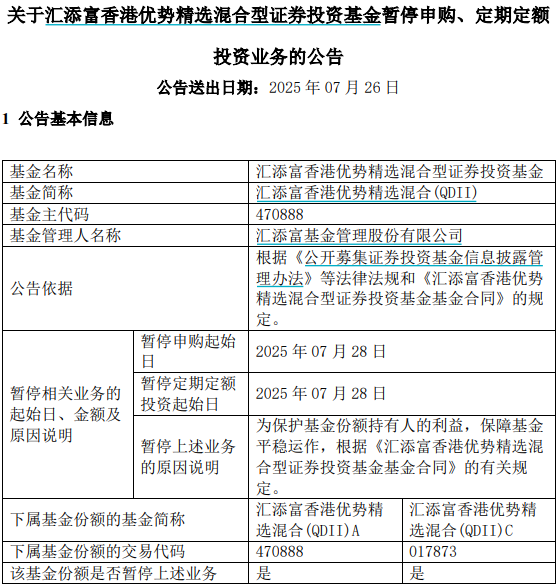
Core Viewpoint - The recent surge in the Hong Kong stock market has led several QDII funds, including the top-performing Huatai-PineBridge Hong Kong Advantage Select, to suspend subscriptions to protect the interests of existing investors [1][4][11]. Group 1: Fund Performance and Actions - Huatai-PineBridge Hong Kong Advantage Select (QDII) reported a year-to-date net value increase of 139.12% as of July 28, making it the top fund in the market [1][6]. - Multiple QDII funds have announced restrictions or suspensions on subscriptions and regular investments, including those tracking European and Japanese markets, to ensure stable operations and protect investor interests [3][4]. - The suspension of subscriptions is attributed to excessive investor enthusiasm, leading to tight foreign exchange quotas [1][6][11]. Group 2: Market Trends and Investor Behavior - The QDII fund sector has seen a significant increase in total scale, reaching 683.77 billion yuan by the end of June, up from 611.32 billion yuan at the end of last year, despite a slight decrease in the number of funds [9]. - The inflow of funds into cross-border ETFs, particularly those related to Hong Kong stocks, has been notable, with significant net inflows recorded for various ETFs [10]. - The current market environment is characterized by a "barbell strategy," where investors are allocating funds to both dividend stocks and growth stocks, influenced by liquidity conditions and risk preferences [10].
月内超70次溢价提示,这类ETF是否能套利?聪明钱早已调转枪头
Sou Hu Cai Jing· 2025-07-30 07:51
Core Insights - The article discusses the phenomenon of premium pricing in QDII funds, particularly in the context of limited supply and high demand for overseas assets [1][2] - It highlights the structural issues leading to premium pricing, such as delayed net asset value (NAV) calculations and lack of transparency in secondary market pricing [3] Group 1: Premium Pricing in QDII Funds - QDII funds are experiencing significant premium pricing, with over 70 announcements of premium risk since July, predominantly in QDII funds [1] - The S&P 500 ETF and S&P Consumer ETF have issued 21 premium risk alerts since July [1][2] - The premium pricing is driven by strong demand for overseas asset allocation, compounded by restrictions on foreign exchange quotas and redemption thresholds [2] Group 2: Market Performance and Trends - The U.S. stock market has shown robust performance, particularly during the second quarter earnings season, with the Nasdaq achieving four consecutive days of gains [2] - Over the past three years, both the S&P 500 and Nasdaq indices have significantly outperformed domestic indices, leading to increased premium purchases by investors [2][3] Group 3: Structural Issues in Pricing - The premium pricing reflects structural issues such as the lag in overseas asset NAV calculations and the opacity of secondary market pricing mechanisms [3] - Smaller, T+0 funds are currently the main contributors to premium pricing [3] Group 4: Fund Flow and Investment Shifts - Institutional investors are shifting focus from the S&P 500 to Hong Kong tech stocks, with significant inflows into QDII funds targeting this sector [6] - As of the end of Q2, the Huaxia Hang Seng Technology ETF (QDII) saw a substantial increase in fund shares, indicating a shift in investment strategy [6] - Recent data shows a record net inflow into Hong Kong stocks, surpassing previous annual totals, indicating strong investor interest [6][7]

海外股市又在新高,这些权益类QDII基金赢麻了!上半年20强均跑赢全球主要股指!
私募排排网· 2025-07-19 03:35
Core Viewpoint - The article discusses the strong performance of overseas stock indices and the corresponding success of QDII funds, particularly those investing in the Hong Kong and US markets, highlighting the significant returns achieved in the first half of 2025 [3][4][8]. Group 1: Overseas Stock Market Performance - Multiple overseas stock indices, including NASDAQ, S&P 500, and Germany's DAX, reached historical highs in July 2025, with several indices showing over 20% gains in the first half of the year [3][4]. - The DAX index recorded a 31.12% increase over the past year and an 87.03% increase over three years, while the NASDAQ and S&P 500 also showed substantial growth [5][6]. Group 2: QDII Fund Overview - QDII funds, which allow domestic investors to invest in overseas markets, have shown impressive performance, with 525 equity QDII funds accounting for 77.43% of the total QDII funds and a total scale of approximately 682.8 billion yuan [8][9]. - The average return for equity QDII funds in the first half of 2025 was approximately 13.46%, with a median return of 9.72%, indicating a positive trend in cumulative returns over three years [9][10]. Group 3: Top Performing QDII Funds - The top 20 equity QDII funds in the first half of 2025 had a performance threshold of nearly 32%, outperforming major global stock indices, with a significant portion focused on Hong Kong's innovative pharmaceutical sector [10][11]. - The leading fund, Huatai Fuhong Hong Kong Advantage Selection Mixed Fund (QDII) A, achieved a return of approximately 86.48% in the first half of 2025, with a one-year return of 92.59% [11][14]. Group 4: Investment Focus and Manager Profiles - The top-performing funds primarily invested in innovative pharmaceutical companies listed in Hong Kong, with the top three funds heavily weighted in this sector [15][18]. - Fund managers of the leading QDII funds have strong backgrounds in finance and investment, contributing to their successful management strategies [16][23].
海外股市又在新高,这些权益类QDII基金赢麻了!上半年20强均跑赢全球主要股指!
私募排排网· 2025-07-17 03:10
Core Viewpoint - The article highlights the strong performance of overseas stock indices and the corresponding success of QDII funds, particularly those investing in the Hong Kong and US markets, with a focus on healthcare and technology sectors [3][4][8]. Group 1: Overseas Stock Market Performance - Multiple overseas stock indices, including NASDAQ, S&P 500, and DAX, reached historical highs in July 2025, with many indices showing over 20% gains in the first half of the year [3][4]. - The DAX index recorded a 31.12% increase over the past year and an 87.03% increase over three years, while the NASDAQ and S&P 500 also showed significant gains [5][6]. Group 2: QDII Fund Overview - QDII funds, which allow domestic investors to invest in overseas markets, primarily target Hong Kong and the US, with some exposure to emerging markets like Vietnam and India [7][8]. - As of June 30, 2025, there were 525 equity QDII funds, accounting for 77.43% of total QDII funds, with a total scale of approximately 682.8 billion yuan [8]. Group 3: QDII Fund Performance - The average return for equity QDII funds in the first half of 2025 was approximately 13.46%, with a median return of 9.72%. Over three years, the average return was about 36.21% [9][10]. - The top 20 equity QDII funds in the first half of 2025 had a return threshold close to 32%, outperforming major global indices, with a significant portion invested in Hong Kong's innovative pharmaceutical sector [10][11]. Group 4: Top Performing QDII Funds - The top three performing QDII funds for the first half of 2025 were: 1. Huatai-PineBridge Hong Kong Advantage Selection Mixed (QDII) A 2. E Fund Global Pharmaceutical Industry Mixed (QDII) A 3. ICBC New Economy Mixed (QDII) RMB [11][18]. - The Huatai-PineBridge fund achieved a return of approximately 86.48% in the first half of 2025, with a one-year return of 92.59% [14][19]. Group 5: Sector Focus - The article emphasizes that a significant number of top-performing QDII funds are heavily invested in the healthcare sector, particularly in innovative pharmaceutical companies listed in Hong Kong [15][22]. - The top-performing funds over the past year also included those with substantial holdings in technology giants and new consumer companies [22][28].
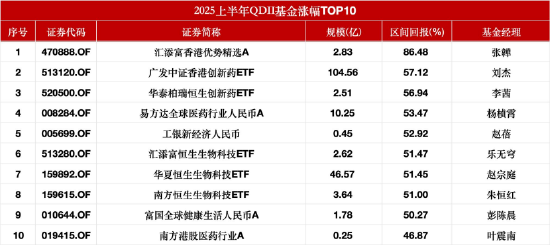
QDII基金上半年首尾差98%!汇添富香港优势精选涨86%夺冠,华泰柏瑞东南亚科技ETF跌11%垫底
Xin Lang Ji Jin· 2025-07-02 09:38
Core Insights - The QDII fund market has seen significant growth, with a total scale of 582.37 billion and 312 products as of June 30, 2025, driven by domestic investors' increasing demand for overseas asset allocation [1] - There is a notable performance divergence among QDII funds in the first half of 2025, with Hong Kong and global pharmaceutical theme funds leading the performance rankings, while Southeast Asian technology, oil, and related regional theme products faced adjustment pressures [1][5] Performance Summary Top Performing QDII Funds - The top ten QDII funds in terms of returns are all focused on the pharmaceutical and biotechnology sectors, with the leading fund, 汇资高香港优势精选A, achieving a return of 86.48% [2][3] - Other notable performers include 广发中证香港创新药ETF with a 57.12% return and 华泰柏瑞恒生创新药ETF with a 56.94% return [2][3] - Smaller funds also showed strong performance, such as 工银新经济人民币 with a return of 52.92% despite a small scale of 0.45 billion [3] Underperforming QDII Funds - The bottom ten QDII funds primarily consist of Southeast Asian technology ETFs, with 华泰相瑞商力乐央新交所之东南亚科技ETF experiencing a decline of 11.66% [4][5] - Oil-themed funds also faced pressure, with 易方达原油A人民币 and 南方原油A both showing declines exceeding 5% [5] - Regional theme funds showed significant divergence, with two Saudi Arabian ETFs declining over 7%, indicating pressure from sovereign fund reductions [6] Market Outlook - Analysts believe that the Hong Kong market still offers investment value, with a focus on high-quality companies that can withstand economic cycles and dividend assets in a low-interest-rate environment [6] - There is an expectation of continued foreign capital inflow into Chinese assets as corporate earnings recover, supported by improved fundamentals and market share gains [6]