
零碳园区

Search documents
新城市:拟使用1.57亿元募集资金投资“建筑绿能及零碳园区规划建设项目”
Xin Lang Cai Jing· 2025-10-19 08:25
Core Viewpoint - The company plans to invest part of its raised funds into a new project focused on green energy and zero-carbon park development, pending shareholder approval [1] Group 1: Company Meetings - The company will hold its 14th meeting of the third board of directors and the 13th meeting of the third supervisory board on October 17, 2025 [1] - The meetings will review the proposal for using part of the raised funds for new project investments [1] Group 2: Fund Allocation - The company intends to allocate 157 million yuan of the remaining funds from the "Smart City Perception System Design Center Project" to the "Green Energy and Zero-Carbon Park Planning and Construction Project" [1] - This allocation is part of the company's strategy to enhance its investment in sustainable development initiatives [1]
2025中国·澄迈国际经济贸易洽谈会开幕
Hai Nan Ri Bao· 2025-10-19 02:03
Core Points - The 2025 China Chengtai International Economic and Trade Fair opened on October 18, featuring over 1,000 participating companies and signing 173 projects with an intended contract value of approximately 67.36 billion yuan, significantly surpassing last year's figures [1][2] - The event aims to create a high-level, wide-ranging, and international economic cooperation platform, focusing on cutting-edge fields and facilitating global collaboration [1] - Key signed projects include areas such as energy trade, oil service support, new energy vehicle exports, cross-border e-commerce, and digital trade cooperation, highlighting their alignment with Chengtai's industrial development plans [1] Event Highlights - The conference features a "1+9+N" activity series, including an opening ceremony, nine thematic activities, and multiple closed-door meetings and salons, designed to showcase Chengtai's investment potential and business environment [1] - A central dialogue titled "Closing the Gap: Opportunities and Going Global" brought together experts from government, enterprises, and academia to analyze industry trends and policy benefits, promoting precise connections within the industrial chain [2] - The county aims to extend trade connections to over 120 countries by 2024 and further establish Chengtai as a bridge for Chinese enterprises to go global and foreign enterprises to enter China [2]
浙琼合作产业园零碳园区揭牌
Hai Nan Ri Bao· 2025-10-19 01:37
Core Insights - The Zhejiang-Hainan Cooperation Industrial Park Zero Carbon Park was officially inaugurated on October 18, 2023, during the 2025 China·Chengmai International Economic and Trade Fair [3] - The park is located in Hainan's Old Town Science and Technology New City, covering an area of approximately 2,613 acres, and aims to establish a green energy system integrating various clean energy sources [3][4] - The park is expected to produce 640 million kilowatt-hours of green electricity annually, with a clean energy consumption ratio of 96.2%, significantly exceeding national standards for zero carbon parks [3][4] Project Overview - The park has planned to introduce 20 key projects with a total investment of approximately 15.113 billion yuan, of which 6 projects have already signed agreements [4] - The core energy project, biomass cogeneration, is expected to commence construction by the end of 2025 and be operational by 2027 [4] - The park has reserved 500 acres for future industries, including energy storage devices, carbon management platforms, and marine renewable energy equipment [4] Industry Focus - The park will focus on three major green industry sectors: new energy, new materials, and high-end equipment manufacturing [4] - The new energy sector will concentrate on biomass power generation, green batteries, and distributed photovoltaics, aiming to create a complete green energy supply chain [4] - The new materials sector will develop low-carbon materials such as basalt fiber and green building materials, while the high-end equipment manufacturing sector will focus on electric vehicles and precision manufacturing [4][5] Technological Development - The park will increase investment in green low-carbon technology research and application, accelerating key technology breakthroughs and results transformation [5] - Digital empowerment through big data, IoT, and AI will enhance energy scheduling and efficiency within the park [5] - The goal is to establish Chengmai as a leading area for new productivity cultivation in Hainan, creating a zero-carbon "Hainan model" [5]

与会嘉宾建言浙琼合作产业园零碳园区建设
Hai Nan Ri Bao· 2025-10-19 01:30
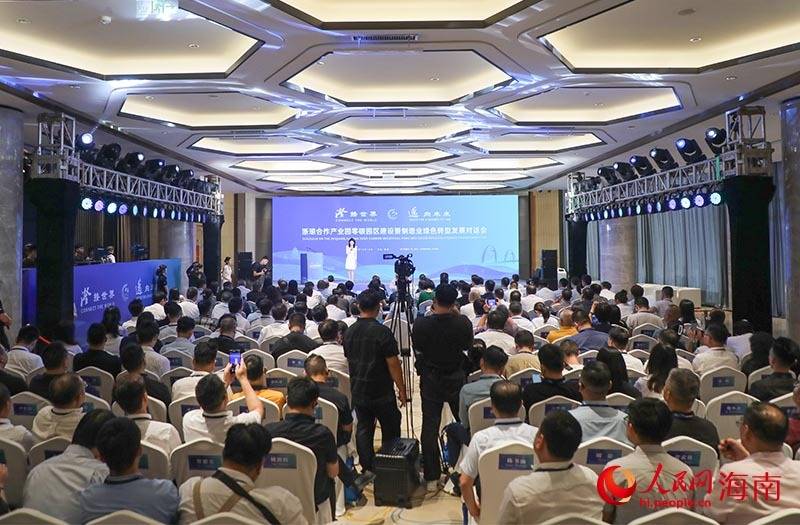
Core Viewpoint - The conference on the construction of a zero-carbon park in the Zhejiang-Qiong cooperation industrial park aims to create a replicable "Chengmai Zero-Carbon Model" to enhance green development in the Hainan Free Trade Port [2][3]. Group 1: Zero-Carbon Park Development - The Chengmai zero-carbon park will focus on three main sectors: new energy, new materials, and high-end manufacturing, utilizing a smart energy carbon platform and direct green electricity supply [2][3]. - The park aims to establish a complete value network linking local agricultural and forestry resources, clean energy supply, high-end green manufacturing, and international market output [2][3]. Group 2: International Collaboration and Standards - Experts from various international institutions discussed technical pathways, international standards, green finance, and carbon management platforms to provide practical references for the park's construction [3]. - The park is seen as a significant practice in China's commitment to achieving dual carbon goals, with suggestions for establishing an innovation laboratory to foster collaboration among enterprises, universities, and research institutions [2][3]. Group 3: Strategic Advantages and Innovations - Chengmai's geographical advantages and policy space position it as a key node in Hainan's green energy layout, with potential for integrating AI and clean energy technologies [3]. - The park is expected to leverage its proximity to the Ma Village deep-water port to create a closed-loop system for zero-carbon production, logistics, and international market access, facilitating a "green export golden channel" [3].
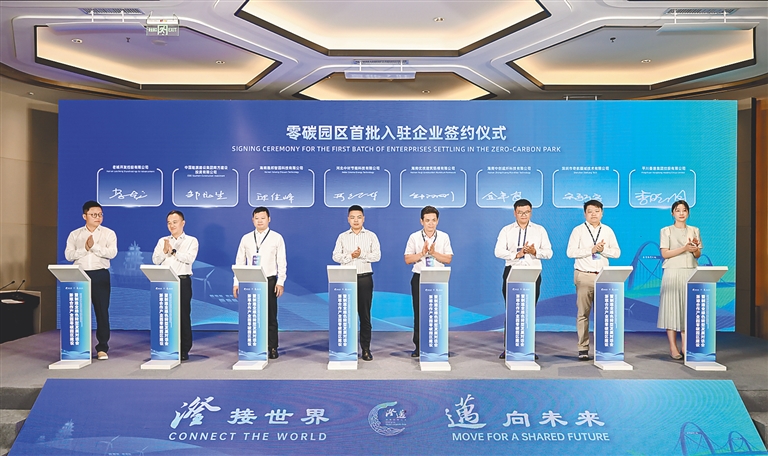
浙琼合作产业园零碳园区正式揭牌 多家企业现场签约入驻
Sou Hu Cai Jing· 2025-10-18 13:46
Core Viewpoint - The 2025 China Chao Mai International Economic and Trade Fair emphasizes the construction of zero-carbon parks and the green transformation of the manufacturing industry, highlighting the importance of sustainable development in the context of the free trade port [1][3]. Group 1: Zero-Carbon Park Development - The dialogue focused on "Zero-Carbon Park Construction and Green Low-Carbon Transformation of Manufacturing," gathering government representatives, industry experts, and entrepreneurs to explore sustainable development paths for manufacturing under the free trade port framework [3]. - The Zhejiang-Qiong Cooperation Industrial Park Zero-Carbon Park was officially inaugurated, with a total land area of approximately 2,613 acres, integrating various clean energy forms such as biomass, solar, and wind energy [7][9]. - The park aims to achieve a green energy system characterized by "multi-energy complementarity and intelligent collaboration," with an expected annual production of 640 million kilowatt-hours of green electricity and a clean energy consumption ratio of 96.2% [9]. Group 2: Investment and Project Development - The park has planned to attract 20 key projects with a total investment scale of approximately 15.113 billion, of which six projects have already been signed [9]. - The biomass cogeneration project, as the energy core of the park, is expected to commence construction by the end of 2025 and be completed by 2027 [9]. - The park's establishment is in substantial progress, with application materials having passed provincial review and being recommended to national ministries for pilot qualification as a national zero-carbon park [9]. Group 3: International Competitiveness and Market Access - Experts noted that with the introduction of international carbon border adjustment mechanisms, green low-carbon products have become essential for manufacturing exports [12]. - The zero-carbon park will provide traceable green electricity, heat, and carbon management services, effectively reducing product carbon footprints and enhancing international competitiveness [12]. - The future production of low-carbon products in the park is expected to carry stronger "green labels," facilitating access to global markets [12].
对话英利集团董事长苗青:虚拟电厂是实现零碳园区的路径 | 财之道
Xin Lang Cai Jing· 2025-10-18 03:08
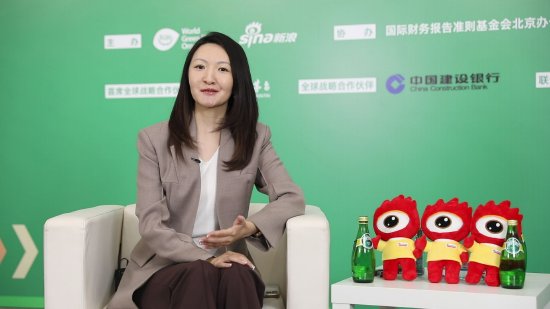
Core Insights - The 2025 Sustainable Global Leaders Conference is being held in Shanghai from October 16-18, focusing on the transformation in the photovoltaic (PV) industry and the challenges of integrating renewable energy into the grid [1] Group 1: Industry Trends - The photovoltaic industry has reached a new milestone with a total installed capacity of 1700 GW, highlighting the need for better integration of renewable energy into the grid for stability and safety [1] - The industry has experienced several cycles of overcapacity since 2005, with each technology application having a shorter-than-expected benefit period of 3-4 years [6] Group 2: Company Strategy - The company aims to provide affordable green electricity through technological innovation, product iteration, and cost reduction, focusing on vertical integration to lower costs across the supply chain [3][4] - The company has launched a new brand, Jiasheng Photovoltaics, targeting Building-Integrated Photovoltaics (BIPV) as a new application area, which combines energy generation with building materials [3][4] Group 3: Product Development - BIPV products must meet both energy generation and building functionality requirements, with a lifespan that matches or exceeds traditional building materials [4] - The company has developed over 200 applications of its BIPV products globally, aiming to replace traditional building materials with sustainable options [4] Group 4: International Expansion - The company is expanding its overseas presence, particularly in Southeast Asia, the Middle East, and Latin America, by forming a "Light Storage Charge Alliance" to combine domestic supply chain resources for international markets [4][5] - The company’s UniGo brand is positioned to offer comprehensive energy solutions, significantly reducing costs from over $20 to around $6 for diesel replacement in Southeast Asia [5] Group 5: Future Outlook - The company emphasizes the importance of finding new application scenarios and integrating traditional energy sources with renewable energy to optimize electricity usage [6][7] - The concept of virtual power plants and zero-carbon parks is seen as a pathway to achieving sustainable energy goals, leveraging digital and intelligent solutions for better resource management [7]
一座工业园区,如何协同减碳?(美丽中国·关注零碳园区)
Ren Min Ri Bao· 2025-10-16 22:20
Core Insights - Shanghai Minhang Economic and Technological Development Zone is transitioning from a traditional manufacturing park to a green intelligent manufacturing and R&D innovation park, focusing on carbon emission reduction and energy efficiency improvement since the launch of its zero-carbon park initiative [2][3] Group 1: Carbon Emission Accounting System - The Minhang Development Zone has established a carbon emission accounting system to guide enterprises in reducing carbon emissions, leveraging an existing energy consumption statistics platform [3] - A comprehensive action plan for creating a zero-carbon demonstration park was released in June 2022, outlining a three-step strategy and specific action tasks [3] Group 2: Energy Efficiency and Carbon Reduction - The park promotes centralized heating solutions to replace individual boilers, enhancing energy efficiency and pollution control, with a centralized heating project spanning approximately 5.8 kilometers completed in October 2022 [3] - Distributed photovoltaic power generation is being implemented as a key "zero-carbon power source," with several enterprises installing solar panels on their rooftops [4] Group 3: Corporate Initiatives - Siemens Switches has implemented various green low-carbon transformations, achieving over 30% energy self-sufficiency and reducing carbon emissions by approximately 1,200 tons annually [4][5] - The number of enterprises in the Minhang Development Zone recognized as national green factories and zero-carbon benchmark factories has increased to nine by 2024 [5] Group 4: Community Engagement - Shanghai Mitsubishi Elevator has introduced energy-efficient upgrades to old elevators, utilizing regenerative energy feedback systems to reduce overall energy consumption [6][7] - The company collaborates with local communities to gather feedback for continuous improvement of their green elevator systems, emphasizing the importance of community involvement in energy-saving initiatives [7] Group 5: Future Plans - The Minhang Development Zone aims to continue enhancing its green initiatives by actively engaging in renewable energy, green certificate trading, carbon finance, and carbon inclusivity [7]
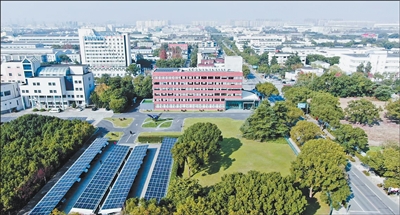
上海闵行经济技术开发区探索能源高效利用、提升产业含绿量 一座工业园区 如何协同减碳?(美丽中国·关注零碳园区)
Ren Min Ri Bao· 2025-10-16 22:08
核心阅读 自启动零碳园区创建以来,上海闵行经济技术开发区探索碳排放核算体系,引导企业不断提升能效和碳 效,逐步实现从传统制造园区向绿色智能制造和研发创新园区的转型。 走进上海闵行经济技术开发区(以下简称"闵行开发区")园区服务中心一楼大堂,智慧能源平台显示屏 上,各家并网企业的发电量等主要指标实时、清晰可见。 "得益于产业结构不断优化、节能降耗持续推进、能源结构日趋清洁化,2009年以来,园区在实现工业 产值持续上升的前提下,碳排放总量稳步下降。"闵行开发区园区服务部副主任余仲华说。 园区—— 探索碳排放核算体系 "闵行开发区是全国首批14个国家级经济技术开发区之一,3.5平方公里的园区面积不大,含金量却 高。"余仲华介绍,经过几十年发展,闵行开发区逐步实现从传统制造园区向绿色智能制造和研发创新 园区的转型,形成了以装备制造、新材料等为主导的产业格局。 以高端制造为主的工业园区,如何走出更高效率、更低成本的零碳园区创建之路?2021年,闵行开发区 启动零碳园区创建研究。 "创建零碳园区首先要摸清碳排放的家底,当时的碳排放统计核算标准以针对企业为主,缺乏园区这一 层面的核算指导。"上海市环境科学研究院环境政策与 ...
西子洁能(002534) - 002534西子洁能投资者关系管理信息20251016
2025-10-16 13:18
Group 1: Company Overview and Business Segments - The company was established in 2002 and became part of the Xizi Elevator Group, listed on the Shenzhen Stock Exchange in 2011, and renamed Xizi Clean Energy Equipment Manufacturing Co., Ltd. in 2022 [3][4]. - The main business includes waste heat boilers, clean energy power generation equipment, solutions, and spare parts and services [3][4]. - Key products in waste heat boilers include gas turbine waste heat boilers, dry quenching waste heat boilers, and cement kiln waste heat boilers, serving high-energy-consuming industries such as power, steel, and cement [4][5]. Group 2: Industry Development and Company Plans - The company aims to leverage the advantages of "low-carbon power generation + flexible adjustment + grid-friendly" in the solar thermal power sector, with a focus on large-scale, low-cost independent installations [5]. - The "Qinghai Model" features three 350 MW independent solar thermal power plants, marking a significant advancement in the industry [5]. - The company plans to secure orders for three 350 MW projects, capitalizing on its market and technological advantages [5]. Group 3: Policy and Market Opportunities - Recent policies encourage the development of green electricity direct connection projects and zero-carbon parks, providing opportunities for the company to explore market potential [6][7]. - The company has established China's first zero-carbon factory and the largest user-side molten salt energy storage project in Zhejiang Province [7]. Group 4: Nuclear Power Sector - The company has over 20 years of experience in the nuclear power sector, providing pressure vessels and heat exchangers for multiple nuclear power plants [8]. - In 2025, the company will enhance its nuclear power industry layout and has established a joint venture to expand its nuclear business opportunities [8]. Group 5: Future Market Directions - The company targets the renewable energy and storage market, focusing on molten salt storage technology for various applications [9][10]. - It aims to enhance its nuclear product manufacturing capabilities and expand into international markets, particularly in Southeast Asia and South America [10][11]. Group 6: Competitive Advantages in Solar Thermal - The company can participate in key stages of solar thermal power plant construction, including heat absorption, heat exchange, and heat storage [12]. - It has a strong market and technological advantage, having participated in 17 solar thermal demonstration projects since 2010 [12][13].

西子洁能(002534) - 002534西子洁能投资者关系管理信息20251015
2025-10-15 13:30
Company Overview - Founded in 1955, joined Xizi Elevator Group in 2002, and listed on the Shenzhen Stock Exchange in 2011, renamed Xizi Clean Energy Equipment Manufacturing Co., Ltd. [3][4] - Main business includes waste heat boilers, clean energy equipment, solutions, and spare parts & services [4]. Business Segments - **Waste Heat Boilers**: Includes gas turbine waste heat boilers, dry quenching waste heat boilers, sintering machine waste heat boilers, cement kiln waste heat boilers, and power station boilers [4]. - **Clean Energy Equipment**: Comprises waste incineration boilers, biomass boilers, wastewater and gas treatment boilers, molten salt heat exchangers, and nuclear power equipment [4]. - **Solutions**: Focuses on molten salt energy storage, heat exchangers, seawater desalination devices, and gasification furnaces [4]. - **Spare Parts & Services**: Offers technical services, project renovation, and maintenance [4]. Market Opportunities - **New Energy and Storage Market**: Expanding applications in solar thermal power, user-side storage, and zero-carbon parks leveraging molten salt storage technology [5]. - **Nuclear Power Market**: Upgrading manufacturing capabilities for nuclear products and establishing a joint venture for nuclear business opportunities [11]. - **Overseas Market**: Targeting international markets with core products like gas turbine waste heat boilers [5]. Order Status - In the first three quarters of 2025, the company secured new orders totaling CNY 4.054 billion, with waste heat boilers at CNY 1.196 billion, clean energy equipment at CNY 0.426 billion, solutions at CNY 1.94 billion, and spare parts & services at CNY 0.492 billion [6][7]. - As of September 30, 2025, total orders on hand reached CNY 5.884 billion [6]. Industry Development - The solar thermal power sector is evolving towards large-scale, low-cost independent installations, exemplified by Qinghai's 350 MW solar thermal power stations [8]. - The company aims to secure orders for three 350 MW projects in the solar thermal field [8]. Policy and Market Trends - Recent policies encourage green electricity projects and zero-carbon park developments, creating market opportunities for the company [9][10]. - The company has established China's first zero-carbon factory and a significant user-side molten salt storage project [10]. Profitability - As of mid-2025, profit margins for various products are as follows: waste heat boilers at 29.68%, clean energy equipment at 14.35%, solutions at 15.97%, and spare parts & services at 31.61% [12]. - Compared to the previous year, profit margins for waste heat boilers increased by 8.08% [12]. Shareholder Actions - Chairman Wang Kefe plans to increase his stake in the company by investing between CNY 30 million and CNY 50 million, having already acquired 2.9 million shares [13]. International Expansion - The company exports through general contractors and direct contracts, with products reaching over 100 countries [14]. - Focus on enhancing overseas sales teams and partnerships, particularly in Belt and Road regions [14]. Strategic Partnerships - Collaboration with Kexin Technology in solar thermal power and energy storage, holding a 3.25% stake in the company [15]. - Investment in Hangzhou Zhongneng Photovoltaic Technology Co., Ltd., with a 6.2281% stake, focusing on perovskite solar cell production [16].