
个人信息保护

Search documents
中国联通,你把用户信息给别人得到授权了吗?
Xin Lang Cai Jing· 2025-05-31 10:47
Group 1 - The core viewpoint of the article highlights the issue of data misuse and the need for stronger regulations to protect personal information, as emphasized by the recent implementation plan from the National Development and Reform Commission and other departments [1][11]. - The article discusses a specific incident involving a customer, L, who experienced unauthorized access to her personal information by a third party posing as a China Unicom employee, raising concerns about data privacy and security [9][10]. - The article mentions the response from China Unicom's customer service, which failed to address L's concerns adequately, indicating potential gaps in the company's handling of customer data and complaints [10][11]. Group 2 - The article provides details about the timeline of events related to L's experience with China Unicom, including her application for a new phone number and subsequent interactions with customer service and on-site personnel [5][6][7]. - It emphasizes the importance of regulatory measures to prevent data misuse, as outlined in the implementation plan, which aims to combat illegal data acquisition and enhance the protection of sensitive personal information [1][11]. - The article concludes with a mention of stock price trends for China Unicom, although it refrains from providing commentary on the stock performance [13][14].



监管要求机构切实提升对个人信息保护工作的重视
news flash· 2025-05-30 07:13
Core Viewpoint - The China Securities Regulatory Commission (CSRC) has communicated concerns regarding personal information protection issues within the industry, highlighting compliance failures among certain institutions' mobile applications, mini-programs, and software development kits (SDKs) [1] Group 1: Regulatory Concerns - The CSRC reported that some institutions have not strictly implemented the Personal Information Protection Law during the collection, storage, transmission, and utilization of personal information, leading to compliance issues and potential risks [1] - Institutions are required to enhance their focus on personal information protection, conduct timely inspections of their apps, mini-programs, and SDKs, and rectify identified issues [1] Group 2: Recommendations for Improvement - Institutions can improve their professional capabilities in personal information protection through app detection certification and external evaluations [1] - There is an emphasis on the need for institutions to strengthen problem analysis and risk assessment to proactively prevent and mitigate potential risks [1]
误导下载、违规收集个人信息,49款App及SDK被通报
Nan Fang Du Shi Bao· 2025-05-30 02:46
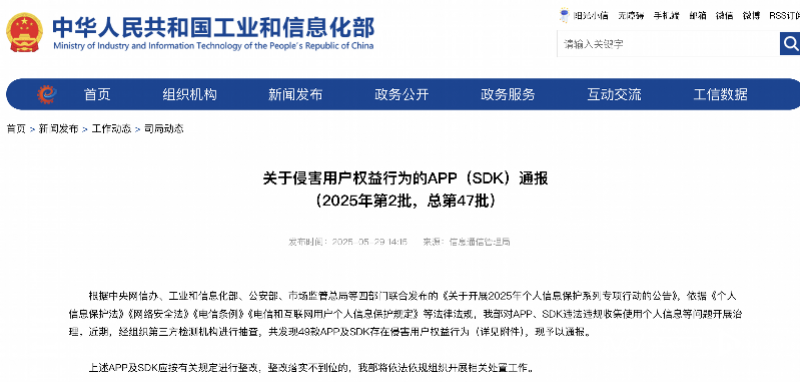
南都讯记者李玲有鱼记账、美人相机等49款App及SDK,存在侵害用户权益行为。 5月29日,工信部通报了今年第二批侵权App及SDK名单,要求其按有关规定整改,若整改落实不到位的,工信部 将开展相关处置工作。 南都·隐私护卫队查阅发现,被指侵权的App共有38款,来自苹果App Store、应用宝、OPPO软件商店、小米应用 商店、360手机助手、豌豆荚、百度手机助手等多个应用来源。 梳理这些App所涉问题,多集中在违规或超范围收集和使用个人信息、信息窗口乱跳转。另有美人相机、造梦次 元、弱视增视助手、智慧安保云、无线手机打印机、技能家低压电工题库、消防员新题库、PK Cam、妙音每日经 典等9款App涉及强制、频繁、过度索取权限问题。 还有个别应用,如游戏App"我的超级汽车工厂"被通报存在"点击误导下载"问题,另有一款主打智慧物业、社区生 活服务的App"左邻右家",不仅违规收集个人信息问题,还强制用户使用定向推送功能。 南都·隐私护卫队注意到,此次有多款教育学习类App被点名,涉及中大英才(北京)网络教育科技有限公司开发 的"会计职称"、北京千牛网络技术公司推出的"考研政治"、苏州律盾信息技术有限公司的 ...
紧急提醒!这些App违法违规→
新华网财经· 2025-05-29 14:17
据国家网络与信息安全信息通报中心通报,依据《中华人民共和国网络安全法》《中华人民共和国个人 信息保护法》等法律法规,按照《中央网信办、工业和信息化部、公安部、市场监管总局关于开展2025 年个人信息保护系列专项行动的公告》要求,经国家计算机病毒应急处理中心检测, 63款移动应用存 在违法违规收集使用个人信息情况 ,现通报如下。 1、 在App首次运行时未通过弹窗等明显方式提示用户阅读隐私政策等收集使用规则 ;个人信息处理者 在处理个人信息前,未以显著方式、清晰易懂的语言真实、准确、完整地向个人告知个人信息处理者的 名称或者姓名、联系方式、个人信息的保存期限等。 涉及6款移动应用如下:《一键登录SDK》(版本2.0.6,官网)、《厦门银行企业银行》(版本8.0.0, vivo应用商店)、《云挂卡》(版本1.1.6,华为应用市场)、《极验身份验-一键登录号码认证SDK》 (版本2.9.6,官网)、《推手管家》(版本5.4.4,苹果应用商店)、《神蓍广告安卓SDK》(版本 6.5.1.8,官网)。 2、 隐私政策未逐一列出App(包括委托的第三方或嵌入的第三方代码、插件)收集使用个人信息的目 的、方式、范围等。 涉 ...

工信部通报49款APP及SDK存在侵害用户权益行为
news flash· 2025-05-29 10:34
Core Viewpoint - The announcement by four government departments highlights the initiation of a series of special actions for personal information protection by 2025, focusing on the governance of APPs and SDKs that illegally collect and use personal information [1] Group 1: Government Actions - The Ministry of Industry and Information Technology is leading efforts to address issues related to illegal collection and use of personal information by APPs and SDKs [1] - A third-party testing organization conducted random checks, revealing that 49 APPs and SDKs were found to infringe on user rights, which are now being publicly reported [1]
中国国家互联网信息办公室副主任王京涛应约会见韩国个人信息保护委员会副委员长崔壮赫
news flash· 2025-05-28 13:27
据"网信中国"微信公众号,2025年5月28日,中国国家互联网信息办公室副主任王京涛在京应约会见韩 国个人信息保护委员会副委员长崔壮赫一行,双方围绕个人信息保护、数据跨境流动、人工智能治理等 议题进行深入交流。 ...
唤醒平台治理责任,斩断网络“开盒”黑手
2 1 Shi Ji Jing Ji Bao Dao· 2025-05-28 04:07
Core Viewpoint - The Chinese internet is facing significant challenges from the "open box" black and gray industry, which has evolved from "human flesh search" in the era of big data, prompting the Central Cyberspace Administration to implement a comprehensive strategy to combat this issue. Group 1: Regulatory Measures - The Central Cyberspace Administration has issued a notice to block the spread of "open box" information, improve early warning mechanisms, increase punitive measures, optimize protective measures, and enhance public awareness [1] - Platforms are urged to abandon the "traffic is king" mentality and eliminate toxic traffic, as their ambiguous positioning has contributed to the problem [2] Group 2: Platform Responsibilities - Platforms must take responsibility for regulating the dissemination of personal information, as many incidents of "open box" occur on foreign social media platforms, highlighting the need for domestic platforms to close loopholes [3] - Transparency in personal information protection practices among platform companies needs to be improved, as many leading apps have not published dedicated reports on personal information protection [3] Group 3: Enforcement and Accountability - The current approach of platforms, which focuses on limiting traffic and banning IDs rather than holding actual users accountable, is insufficient [4] - Regulatory bodies are committed to enhancing the enforcement of laws against the leakage, theft, and sale of personal information, utilizing technology to ensure that such activities are effectively addressed [4]
个人信息保护如何跳出“猫鼠游戏”(人民时评)
Ren Min Ri Bao· 2025-05-27 22:40
Core Viewpoint - The article highlights the increasing risks of personal information leakage in the digital age, emphasizing the need for proactive measures and regulatory improvements to protect consumer data [1][2][3]. Group 1: Current Situation of Personal Information Protection - Personal information leakage has become a pressing issue, with cases like the recent Shanghai incident revealing how easily sensitive data can be sold and misused [1]. - The challenges in personal information protection have shifted from overt rights violations to more covert technological abuses, often linked to new business models [2]. Group 2: Regulatory and Technological Responses - New regulations, such as the "Facial Recognition Technology Application Safety Management Measures," have been introduced to prevent the misuse of technology and protect personal information rights [3]. - Companies are encouraged to adopt proactive measures, such as allowing users to revoke historical data authorizations and employing privacy-preserving technologies to enhance data security [3]. Group 3: Future Directions - There is a call for a more refined governance approach that balances development and security, aiming to create a comprehensive governance system that integrates rules, technology, and social collaboration [3].
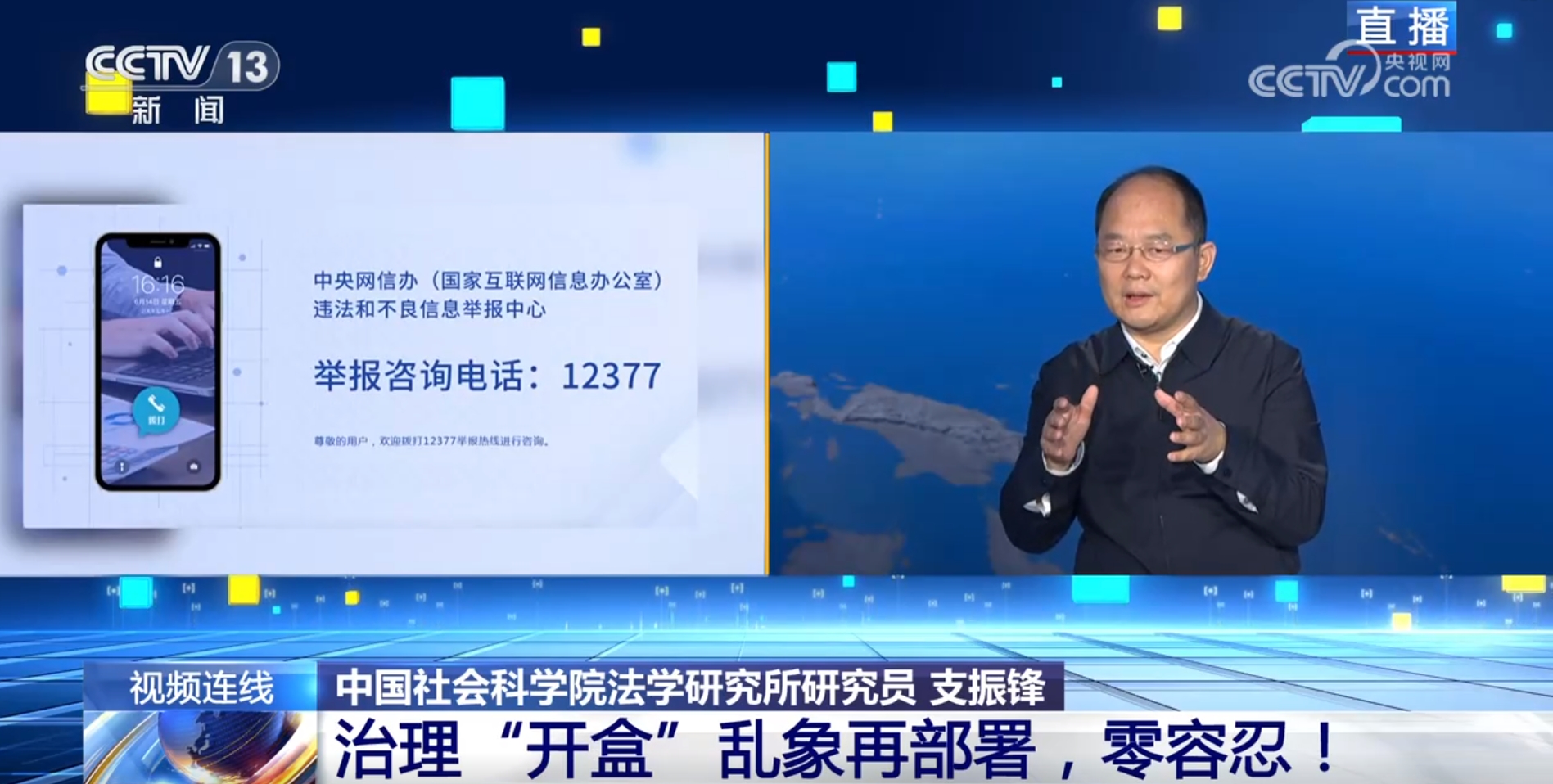
新闻1+1丨以“零容忍”态度坚决打击“开盒”乱象 具体怎么做?
Yang Shi Wang· 2025-05-27 22:33
Core Viewpoint - The central government is taking a "zero tolerance" approach to combat the "open box" phenomenon, which involves the illegal collection and dissemination of personal information online, emphasizing the need for stricter regulations and platform accountability [1][4]. Group 1: Definition and Impact of "Open Box" - "Open box" refers to a new form of online violence where individuals illegally gather and publish personal information such as names, photos, ID numbers, and contact details [2]. - Victims of "open box" often face online harassment, including insults, defamation, and real-life disturbances like incessant calls and messages from strangers [3]. Group 2: Regulatory Measures and Responsibilities - The Central Cyberspace Administration of China has already penalized three major online platforms, signaling that all platforms, regardless of size, must comply with laws protecting personal information [4]. - The emphasis on punishing large platforms is due to their greater technical capabilities and user bases, which impose a higher legal and social responsibility to monitor and prevent personal information leaks [4]. Group 3: Future Actions and Expected Outcomes - The next steps include blocking dissemination channels, enhancing protective measures, and increasing punitive actions against violators [7]. - If these measures are effectively implemented, they could significantly reduce the illegal collection and misuse of personal information, thereby enhancing the protection of individual rights [7]. Group 4: Systematic Approach and Collaboration - Addressing the "open box" issue requires a coordinated effort among various government departments, including the Ministry of Industry and Information Technology, the State Administration for Market Regulation, and the Ministry of Public Security [8]. - The irreversible nature of personal information leaks necessitates a focus on preventing new incidents from occurring at the source [8]. Group 5: Vulnerabilities in Personal Information Security - The primary vulnerability in personal information security is the ease and prevalence of obtaining personal data, often required for various online services [9]. - The frequent sharing of personal information increases the likelihood of it being illegally accessed [9]. Group 6: Legal Framework and Enforcement - China has a comprehensive legal framework for protecting personal information, including laws like the Cybersecurity Law, Data Security Law, and Personal Information Protection Law, along with relevant provisions in the Civil Code and Criminal Law [11]. - In 2024, law enforcement agencies have already cracked over 7,000 cases related to the infringement of personal information rights, indicating active measures are being taken to address these issues [11].
【西街观察】莫让“开盒”继续狂欢
Bei Jing Shang Bao· 2025-05-27 15:24
Core Viewpoint - The article emphasizes the urgent need for enhanced regulation and legal frameworks to address the growing issue of personal information leakage and the phenomenon known as "opening boxes" which exposes individuals' private information online [1][2][3]. Group 1: Regulatory Response - The Central Cyberspace Administration has issued a notice to strengthen the management of "opening boxes" by blocking information dissemination, improving early warning mechanisms, increasing punitive measures, and optimizing protective measures [1]. - There is a societal expectation for stronger regulations to combat the rampant issue of personal information leakage and the associated risks of online violence [1][2]. Group 2: Nature of the Problem - "Opening boxes" refers to the online exposure of personal privacy, which has escalated fears regarding information leakage, with the severity of such leaks surpassing public awareness [2]. - The prevalence of app-based over-collection of personal data, harassment calls, and targeted telecom fraud highlights the pervasive nature of personal information collection [2][3]. Group 3: Legal Framework and Challenges - Current laws protecting personal biometric information are fragmented across various legal texts, making enforcement challenging [4]. - Despite the introduction of guidelines to punish online violence, many cases remain unresolved due to insufficient evidence and difficulties in cross-platform evidence collection [4]. - There is a pressing need for clearer legal standards regarding the punishment of information misuse and for establishing a cross-platform defense mechanism to enhance personal information protection [4].