扩大内需

Search documents
陈茂波:香港三大增长引擎发展潜力巨大
Xin Hua Wang· 2026-01-22 08:33
Core Viewpoint - The Hong Kong government emphasizes the significant growth potential of finance, trade, and innovation as the three main engines for economic development, highlighting the need to embrace technological advancements like AI and blockchain to drive economic transformation [1]. Group 1: Economic Growth Engines - Finance, trade, and innovation are identified as the three primary growth engines for Hong Kong, with substantial development potential [1]. - The government is actively exploring and experimenting in financial and technological innovation under the "One Country, Two Systems" framework, indicating a strong collaborative potential with cities in the Guangdong-Hong Kong-Macao Greater Bay Area [1]. Group 2: Technological Advancements - Breakthroughs in technologies such as artificial intelligence and blockchain are driving profound industrial changes, necessitating that all economies adapt to these developments [1]. - The emphasis on technological innovation aligns with the broader economic transformation goals, positioning Hong Kong as a favorable investment destination [1]. Group 3: International Trade Dynamics - International trade is undergoing a paradigm shift, with developed countries needing to recognize the changing development models of some developing countries, which are moving beyond merely manufacturing and exporting low-cost products [1]. - China's strategy of promoting high-level two-way opening and expanding domestic demand is expected to inject momentum into its high-quality economic development, creating significant market opportunities for quality products and services from various economies [1]. Group 4: Economic Resilience and Growth Strategies - The Finance Secretary participated in discussions with global leaders on enhancing economic resilience and strategies for promoting growth, indicating a proactive approach to global economic challenges [2].
火速翻红再创近三年新高!化工ETF(516020)赚钱效应火热,资金加仓大提速
Mei Ri Jing Ji Xin Wen· 2026-01-22 06:09
Group 1 - The chemical sector continues to show strong performance, with the Chemical ETF (516020) experiencing a price increase of over 1.5%, reaching a nearly three-year high [1] - As of January 21, the Chemical ETF (516020) has seen a net subscription of over 870 million yuan in the past five days and nearly 1.2 billion yuan in the last ten days [1] - Analysts suggest that the "14th Five-Year Plan" emphasizes expanding domestic demand, which will drive growth in chemical product demand, especially with the onset of a U.S. interest rate cut cycle [1] Group 2 - The Chemical ETF (516020) and its linked fund (012537) track the CSI segmented chemical industry theme index, with nearly 50% of its holdings concentrated in large-cap leading stocks such as Wanhua Chemical and Salt Lake Industry [2] - The remaining 50% of the portfolio includes leading stocks in sub-sectors like phosphate fertilizers, fluorine chemicals, and nitrogen fertilizers, allowing for comprehensive investment opportunities in the chemical sector [2]
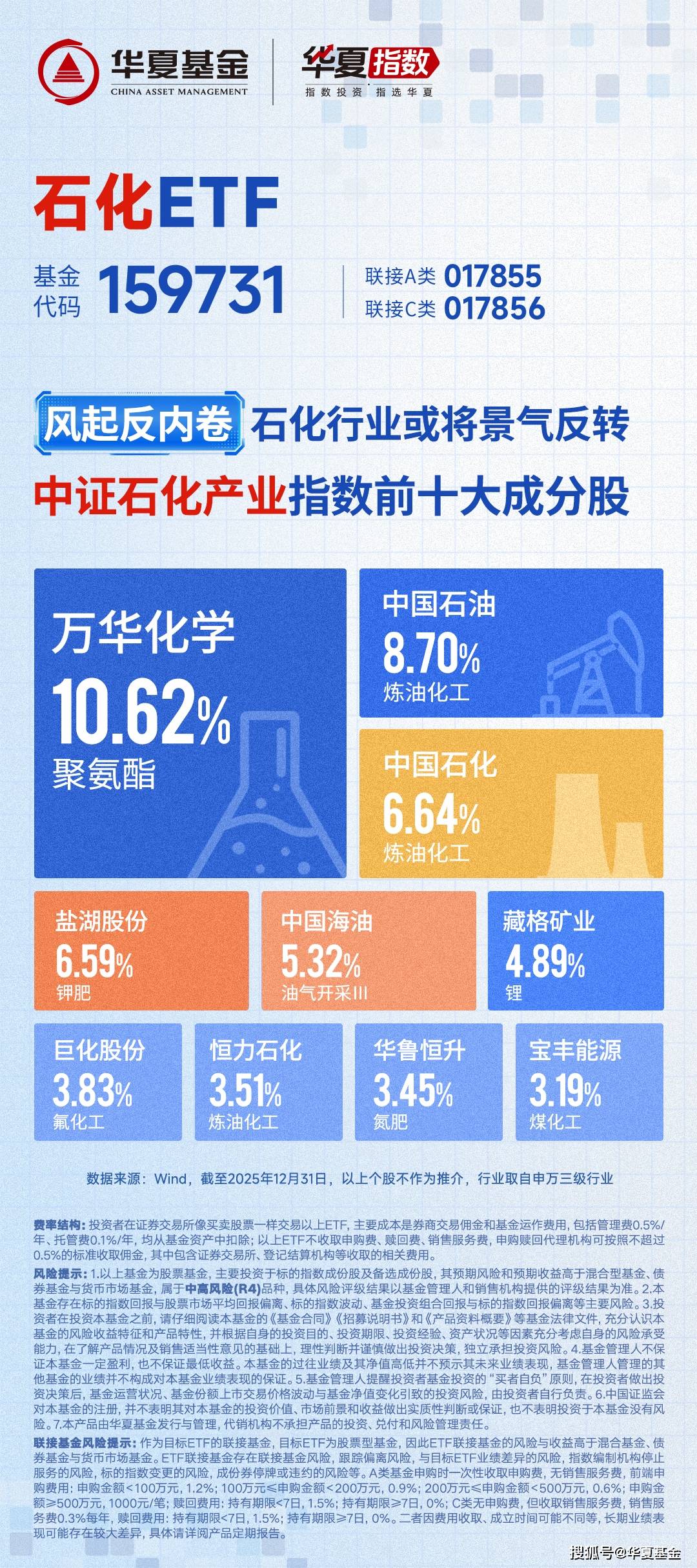
反内卷效果显现,关注石化板块投资机会
Sou Hu Cai Jing· 2026-01-22 03:11
Group 1 - The anti-involution movement has been ongoing for over a year, with varying results across different sectors, showing significant improvement in the petrochemical sector compared to others like large commodities and new energy [1] - The industry has seen effective production cuts that have boosted corporate profitability, with major products like PTA and polyester expected to stabilize in price as new capacity is set to be completed by the end of 2026 [1] - Strong downstream demand is facilitating price recovery, with leading chemical companies recently disclosing positive earnings forecasts for 2025, indicating a rebound in multiple sub-sectors [1] Group 2 - The petrochemical industry is currently at the bottom of a four-year downturn, but the ongoing anti-involution and expansion of domestic demand are expected to accelerate the industry's cyclical recovery [6] - As a crucial industrial raw material, the rise in chemical prices suggests that the industry is gradually moving out of a phase of demand stagnation and inventory adjustment, entering a period of upward momentum, making it an area of significant investment interest [6]

中泰国际每日晨讯-20260122
ZHONGTAI INTERNATIONAL SECURITIES· 2026-01-22 02:33
Market Overview - On January 21, Hong Kong stocks experienced a slight adjustment in the morning but rebounded in the afternoon, with the Hang Seng Index rising by 97 points (0.4%) to close at 26,857 points[1] - The Hang Seng Tech Index increased by 62 points (1.1%), closing at 5,746 points, with total market turnover reaching HKD 250.5 billion[1] - Southbound capital inflow expanded to HKD 13.89 billion[1] Sector Performance - The semiconductor sector remained strong, driven by Micron's announcement of a potential memory shortage lasting until 2028, with Hua Hong Semiconductor and SMIC rising by 4%-6%[1] - TCL Electronics surged by 14.8% after announcing a joint venture with Sony, holding a 51% stake[1] - Skyworth Group's stock jumped by 37.5% following its announcement of a spin-off and share buyback[1] Geopolitical Impact - Gold stocks generally rose due to heightened geopolitical tensions, with Lingbao Gold and Zhaojin Mining increasing by 5%-8%[1] - The report suggests a short-term focus on strong sectors such as semiconductors and gold[1] U.S. Market Reaction - In the U.S., the Dow Jones Index rebounded by 588 points (1.5%) to 49,077 points, while the Nasdaq and S&P 500 indices rose by 270 points (1.2%) and 78 points respectively[2] - Gold prices remained strong, peaking at USD 4,888.4 per ounce[2] Macroeconomic Policy - The National Development and Reform Commission outlined policy directions for 2026, focusing on strengthening domestic circulation and expanding domestic demand strategies[3] Automotive Sector - China National Heavy Duty Truck Group saw a 7.5% increase in stock price after a major shareholder reduced their stake by 2%[4] - The company is expected to maintain strong export growth and a high dividend yield of approximately 7%[4] Energy and Utilities - Defensive sectors like environmental protection and gas utilities received support amid rising geopolitical risks, with stocks like Hong Kong and China Gas and CLP Holdings rising by 1.1%-3.2%[4] - Alibaba and China National Nuclear Corporation formed a joint venture for nuclear energy, potentially benefiting related companies[4] Healthcare Sector - The Hang Seng Healthcare Index rose by 0.7%, with WuXi Biologics increasing by 3.5%[5] - The CXO sector is expected to see a rebound in demand, with a projected 20.6% increase in clinical trial projects per company by 2025[5]
新华视点|解读2025经济数据:稳中向好 向新向优
Xin Hua She· 2026-01-22 02:28
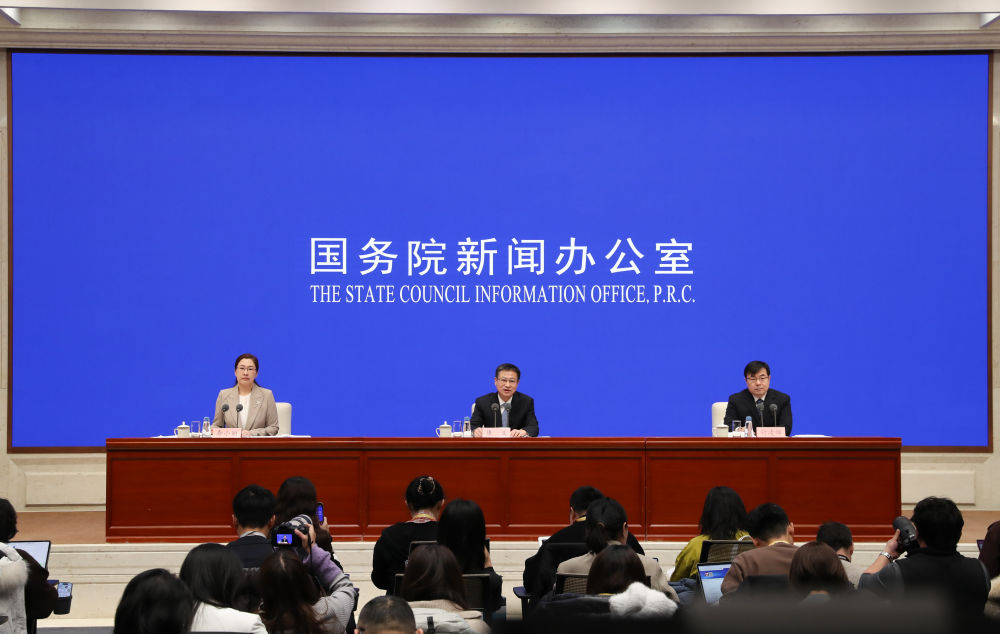
经济体量稳居世界第二、增速位居世界主要经济体前列、"十四五"年均增速远超世界平均水平……一系列指标清晰勾勒出中国作为超大规模经 济体稳健前行的坚实轨迹。 0:00 1月19日,2025年中国经济成绩单发布——国内生产总值(GDP)首次跨越140万亿元大关,比上年增长5.0%。 经济实力跃上新台阶 细看2025年成绩单,中国经济从"量"的累积加速迈向"质"的提升,高质量发展底气更足、韧性更强。这一年,面对外部环境变化影响加深,我 国创新驱动发展步履铿锵,新动能积厚成势,新优势不断塑造。 新华社照片,北京,2026年1月19日 1月19日,国务院新闻办公室在北京举行新闻发布会,国家统计局局长康义,国家统计局新闻发言人、总经济师、国民经济综合统计司司长付 凌晖介绍2025年国民经济运行情况,并答记者问。 新华社记者 单宇琦 摄 以"数"观势,这一年中国经济成长壮大的足迹愈发清晰—— "稳"的格局巩固:规模以上工业增加值比上年增长5.9%,城镇调查失业率平均值为5.2%,货物贸易规模再创新高,外汇储备余额超3.3万亿美 元; "进"的步伐有力:规模以上高技术制造业增加值占规模以上工业增加值比重升至17.1%,最终消费 ...
去年3000亿元以旧换新撬动2.6万亿元消费
Xin Lang Cai Jing· 2026-01-22 01:23
Core Viewpoint - In 2025, China will implement a more proactive macro policy to support economic growth and social development, balancing immediate needs with long-term structural transformation [2][11]. Group 1: Fiscal Policy and Debt Management - The fiscal deficit is set at around 4%, marking a historical high for China [3][12]. - New government debt will reach 11.86 trillion yuan, an increase of 2.9 trillion yuan from the previous year, significantly exceeding average levels from prior years [3][12]. - Special bonds issued in 2025 will total 4.59 trillion yuan, the highest in five years, with a focus on infrastructure and social projects [3][12]. Group 2: Support for Key Sectors - Key areas such as social security, employment, technology, education, and health will receive substantial funding, with over 10 trillion yuan allocated in the first 11 months, accounting for over 40% of general public budget expenditures [4][13]. - A total of 2 trillion yuan will be allocated to replace existing hidden debts, and 800 billion yuan in new special bonds will be issued to support local government finances [4][13]. Group 3: Consumer Support Initiatives - In 2025, 300 billion yuan will be allocated for consumer subsidies, aimed at boosting sales by over 2.6 trillion yuan [4][12]. - The issuance of long-term special bonds will support consumption and economic transformation [4][12]. Group 4: Future Fiscal Strategies - In 2026, the fiscal deficit and total debt will be maintained at necessary levels, ensuring that spending in key areas continues to grow [5][14]. - The government will adopt a zero-based budgeting approach to reduce ineffective spending and increase investment in consumer support and social welfare [5][14]. Group 5: Financial Sector Reforms - Policies will be optimized to enhance support for technology innovation and manufacturing, with a focus on long-term investments in hard technology [7][15]. - The central bank will lower interest rates on various structural monetary policy tools by 0.25 percentage points to reduce financing costs [6][15].
市场全天冲高回落
Dongguan Securities· 2026-01-22 01:01
Market Overview - The A-share market experienced a day of fluctuations, with the Shanghai Composite Index closing at 4116.94, up 0.08% [2] - The Shenzhen Component Index rose by 0.70% to close at 14255.13, while the ChiNext Index increased by 0.54% to 3295.52 [2] - The STAR 50 Index saw a significant rise of 3.53%, closing at 1535.39 [2] Sector Performance - The top-performing sectors included non-ferrous metals, electronics, machinery, steel, and building materials, with non-ferrous metals leading at a gain of 2.79% [3] - Conversely, the banking sector saw a decline of 1.58%, along with coal and food & beverage sectors, which fell by 1.57% and 1.53% respectively [3] - Notable concept indices included lead and zinc metals, which rose by 5.01% and 4.83%, while the duty-free shop sector declined by 1.16% [3] Future Outlook - The market is currently consolidating after reaching a new high, with a trading volume of 2.6 trillion yuan, down 177.1 billion from the previous trading day [6] - The report suggests that the market's upward trend may continue, supported by regulatory guidance and macroeconomic factors [6] - As the earnings forecast season approaches, investor sentiment is expected to increase, shifting focus from macro liquidity to micro performance verification [6] - Key sectors to watch include dividends, TMT (Technology, Media, and Telecommunications), and power equipment [6] Policy Insights - The National Development and Reform Commission emphasizes the importance of expanding domestic demand and enhancing consumer capacity through strategic plans for 2026-2030 [5] - The focus is on creating an economic model driven by domestic demand and consumption, which is expected to support overall market stability [5]
热点思考 | 财政金融协同,助力“开门红”(申万宏观·赵伟团队)
赵伟宏观探索· 2026-01-21 19:18
Core Viewpoint - The article discusses the coordinated policy signals from various ministries, particularly focusing on stimulating domestic demand, enhancing support for technological innovation, and invigorating private investment as key areas for future policy efforts [1][2]. Group 1: Policy Signals from Ministries - The recent press conferences from the central bank and the Ministry of Finance emphasize the need to tap into domestic demand potential, increase support for technological innovation, and activate private investment [2][8]. - Fiscal policies are being directed to consumer endpoints, with personal consumption loan interest subsidies increasing from 500 yuan to 3000 yuan, and the inclusion of credit card installment payments [2][46]. - The central bank has lowered the interest rates on various structural monetary policy tools by 0.25 percentage points to guide down financing costs [2][46]. Group 2: Addressing Key Issues - The significant decline in new household loans in 2025, with only 360 billion yuan added compared to a decrease of 22,910 billion yuan in 2024, is a primary concern driving the expansion of personal consumption loan interest subsidies [3][48]. - Fixed asset investment fell by 3.8% in 2025, with equipment purchases being a major driver, showing an 11.8% increase, indicating the need for additional policy support to stabilize investment [4][48]. Group 3: Potential Effects of Current Policies - The fiscal interest subsidies are expected to stabilize financial data and stimulate domestic demand, despite commercial banks facing challenges in loan growth and high loan write-offs averaging 122.6 billion yuan per month in 2025 [4][26]. - The expansion of the personal consumption loan interest subsidy range is anticipated to support stable consumer spending, particularly in service consumption, as the demand shifts towards services [6][50]. - The dual benefits of equipment updates and new policy financial tools are likely to strengthen the support for new infrastructure investments, with significant increases in investment proportions in core areas like electricity, internet software, and logistics [6][36].

问道2026
Sou Hu Cai Jing· 2026-01-21 16:49
国家统计局1月19日发布的数据显示,经初步核算,2025年GDP为1401879亿元,按不变价格计算,比上 年增长5.0%,完成了年初设定的预期目标。 2025年经济运行成绩单刚刚公布,在这一年中,面对外部环境的急剧变化,我国经济以强大的韧性稳中 前行,2025年GDP首次跃上140万亿元新台阶,经济社会发展主要目标任务圆满实现,"十四五"胜利收 官。过去一年中我国经济发展有哪些亮点?2026年全球经贸环境依然恶劣,我国经济将如何保持韧性? 未来在推动内需方面,我国有望出台哪些增量措施?在新一年的起点,我们邀请15位首席经济学家一起 展望全年经济形势,给出这些问题的预判。 一、经济数据预测 1 全年GDP同比预测中位数为4.80% 指标 平均值 中位数 最大值 最小值 GDP同比(2026年,%) 4.79 4.80 5.00 4.30 经济学家们认为,2026年我国经济增长动能将持续转换,经济增长质量将进一步提升,他们对2026年 GDP同比的预测均值为4.79%,中位数为4.80%。 民生银行温彬表示,展望2026年,政策将遵循"稳中有进、提质增效"取向,加大逆周期和跨周期调节力 度,提升宏观经济治理效能 ...
去年3000亿元以旧换新撬动2.6万亿元消费,2026年财政总体支出力度“只增不减”
Hua Xia Shi Bao· 2026-01-21 14:18
Group 1 - The core viewpoint of the article emphasizes the implementation of a more proactive macroeconomic policy in China for 2025, aimed at supporting economic growth and structural transformation while ensuring long-term sustainable development [2][3] - The fiscal policy for 2025 includes a deficit rate set at around 4%, marking a historical high, and a new government debt scale of 11.86 trillion yuan, which is an increase of 2.9 trillion yuan compared to the previous year [4] - The issuance of special bonds in 2025 is projected to reach 4.59 trillion yuan, the highest in five years, with a focus on infrastructure and social projects [4] Group 2 - In 2025, significant funding is allocated to key areas such as social security, employment, technology, education, and health, with expenditures exceeding 10 trillion yuan in the first eleven months, accounting for over 40% of the general public budget [5] - The government plans to replace 2 trillion yuan of existing hidden debt and allocate 800 billion yuan in new special bonds to support local government financial capacity [5] - A notable initiative includes a 300 billion yuan fund for consumer subsidies, aimed at boosting consumption and driving sales of related goods by approximately 2.6 trillion yuan [5] Group 3 - For 2026, the fiscal policy will continue to maintain necessary levels of deficit, debt, and expenditure, ensuring that spending in key areas remains robust [6] - The government will adopt a zero-based budgeting approach to reduce ineffective spending and redirect funds towards consumption, investment in people, and social welfare [6] - The issuance of long-term special bonds will continue to support key construction and new initiatives, with an increase in personal consumption loan interest subsidies [7] Group 4 - The Ministry of Finance aims to enhance the role of government investment funds to support early-stage investments in hard technology and innovative sectors [8] - New policies will include interest subsidies for technology innovation loans, with a focus on supporting small and medium-sized enterprises in high R&D sectors [8] - Measures to stimulate private investment include loan interest subsidies and risk-sharing mechanisms for private enterprises, alongside a 1 trillion yuan re-loan for private enterprises [8]