
绿色消费

Search documents
九部门20条举措推进绿色消费 涵盖农产品、家电家装、餐饮住宿等多领域
Yang Shi Wang· 2026-01-05 09:10
Core Viewpoint - The Ministry of Commerce and nine other departments have jointly issued a notice to promote green consumption, outlining 20 specific measures across various sectors including agriculture, home appliances, and hospitality [1][3]. Group 1: Focus on Quality Supply in Livelihood Security - The notice emphasizes enhancing the supply of green agricultural products, promoting green home appliances and home decoration, and encouraging green consumption in the automotive sector [3]. - It aims to elevate green service consumption by developing green dining, accommodation, and housekeeping services to meet the public's aspirations for a better life [3]. Group 2: Cultivating New Growth Points for Green Consumption - The notice proposes the creation of green supply chains, conducting carbon footprint assessments, and promoting green procurement, products, and packaging [5]. - It encourages the implementation of green consumption points and the innovation of green sharing services, including shared transportation, space, and goods [5]. - Additionally, it emphasizes the importance of promoting green recycling, reducing single-use plastic products, and facilitating the reuse of waste items and the circulation of second-hand goods [5]. Group 3: Optimizing the Green Consumption Environment - The notice calls for the promotion of energy-saving facilities and equipment, prioritizing the use of green electricity [7]. - It advocates for the widespread adoption of green consumption concepts and encourages consumers to engage in green travel [7]. Group 4: Next Steps for Implementation - The Ministry of Commerce will guide local authorities in implementing the green consumption promotion actions and will summarize effective experiences and practices to further expand green consumption [9].


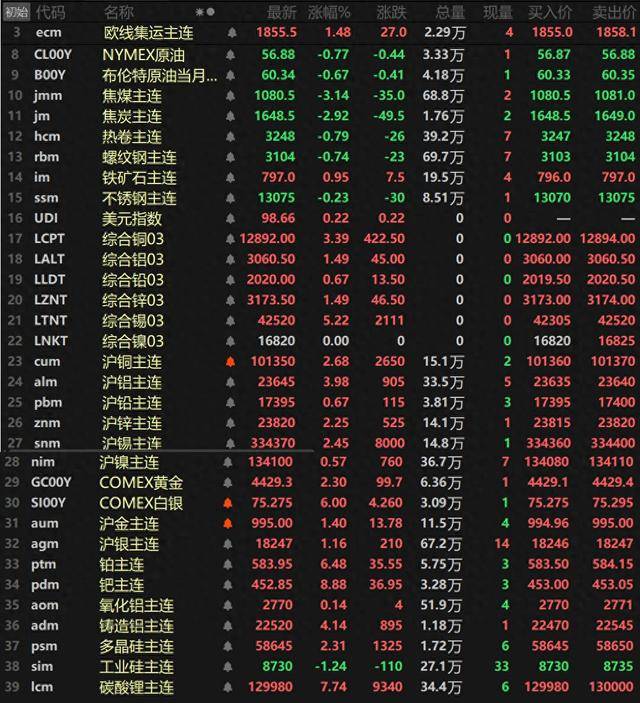
金属近全线上涨 伦铜、沪铝涨逾3% 铂主连涨超8% 碳酸锂涨逾7%
Sou Hu Cai Jing· 2026-01-05 09:07
Metal Market - Domestic base metals experienced a general increase, with Shanghai aluminum leading at a rise of 3.98%, reaching a peak of 23,780 yuan/ton, a new high since March 2022 [1] - Shanghai copper, zinc, and tin also saw gains exceeding 2%, with copper up 2.68%, zinc up 2.25%, and tin up 2.45% [1] - Other metals had increases of less than 1%, while alumina rose by 0.14% and casting aluminum surged by 4.14%, hitting a historical high of 22,695 yuan/ton since its listing [1] - Lithium carbonate increased by 7.74%, and polysilicon rose by 2.31%, while industrial silicon fell by 1.24% [1] - In the black metal sector, iron ore was the only metal to rise, up 0.95%, while hot-rolled and rebar both fell over 0.7% [1] - As of 15:04, foreign base metals were generally up, with London nickel stable at $16,820/ton, and tin rising by 5.22% and copper by 3.39% [1] - Precious metals also saw gains, with COMEX gold up 2.3% and silver up 6%, while domestic gold and silver rose by 1.4% and 1.16% respectively [1][2] Macro Environment - The Chinese Commodity Price Index rose for the eighth consecutive month, reaching 117.9 points in December 2025, a 3.2% increase from the previous month, indicating improved market conditions [6] - The People's Bank of China conducted a net withdrawal of 468.8 billion yuan through reverse repos, maintaining a stable monetary policy [7] - The US dollar index increased by 0.22% to 98.66, with expectations of potential interest rate cuts by the Federal Reserve later this year [8]
商务部、国家发改委等九部门发布重要行动通知
中国能源报· 2026-01-05 09:05
Core Viewpoint - The article emphasizes the implementation of green consumption initiatives to promote sustainable development and reduce carbon emissions across various sectors in China [1][2]. Group 1: Richening Green Product Supply - Encouragement for enterprises to expand the supply of green agricultural products, including organic and geographical indication products, and to establish dedicated sales areas for these products [2]. - Promotion of green home appliances and home decoration, urging the purchase of certified green products and the use of eco-friendly materials [3]. - Support for the consumption of new energy vehicles and the development of related markets, including second-hand cars and car-sharing services [3]. Group 2: Enhancing Green Service Consumption - Development of green dining services, urging restaurants to adopt standards that reduce waste and promote the use of biodegradable packaging [4]. - Promotion of green accommodation, encouraging hotels to use non-toxic and biodegradable cleaning products and to provide refillable toiletries [4]. - Encouragement of green housekeeping services that utilize eco-friendly cleaning products and innovative service models [4]. Group 3: Innovating Green Consumption Models - Promotion of green supply chains that prioritize eco-friendly products and practices throughout the supply chain [5]. - Establishment of a green consumption points system to incentivize consumers for purchasing green products and using low-carbon services [6]. - Encouragement of innovative sharing models, including shared transportation and resource-sharing platforms [6]. Group 4: Promoting Green Circular Recycling - Reduction of single-use plastic products through various initiatives, including the promotion of reusable shopping bags [7]. - Development of a comprehensive recycling system for waste products, including furniture and electronics, to enhance recycling efficiency [7]. - Support for the circulation of second-hand goods and the establishment of platforms for second-hand transactions [8]. Group 5: Optimizing Green Consumption Environment - Promotion of energy-efficient facilities and smart energy management systems to reduce energy consumption [9]. - Advocacy for green consumption awareness, encouraging consumers to adopt low-carbon lifestyles and make environmentally friendly choices [9]. - Strengthening public awareness campaigns to promote green consumption as part of national ecological and energy-saving initiatives [9]. Group 6: Strengthening Green Consumption Foundation - Encouragement for businesses to adopt green standards and certifications to foster a culture of sustainability [10]. - Participation in the formulation of international standards for green consumption to align with global practices [10]. Group 7: Increasing Policy Support - Strengthening policy integration and coordination among various departments to support green consumption initiatives [11]. - Encouragement for financial institutions to increase support for green consumption loans and innovative financial products [11].

商务部等9部门关于实施绿色消费推进行动的通知
中汽协会数据· 2026-01-05 09:04
Core Viewpoint - The article emphasizes the importance of promoting green consumption as a means to accelerate economic and social development while achieving a comprehensive green transformation during the "14th Five-Year Plan" period [1]. Group 1: Enriching Green Product Supply - Encourage the supply of green agricultural products, including organic and high-quality goods, and support the establishment of dedicated sales areas for these products [1]. - Promote the purchase of green home appliances and building materials, focusing on energy efficiency and sustainability [2]. - Support the consumption of new energy vehicles and explore the potential of the automotive aftermarket [2]. Group 2: Enhancing Green Service Consumption - Develop green dining practices by encouraging restaurants to adopt standards that reduce waste and promote the use of biodegradable materials [3]. - Foster green accommodation by promoting eco-friendly practices in hotels and encouraging the use of sustainable products [4]. - Innovate in green housekeeping services by promoting the use of non-toxic cleaning products and smart home technologies [4]. Group 3: Innovating Green Consumption Models - Promote the development of green supply chains and encourage the use of environmentally friendly products and packaging [5]. - Establish a green consumption points system to incentivize consumers for purchasing green products and services [5]. - Encourage innovative sharing models in green consumption, leveraging technology for efficient resource use [6]. Group 4: Promoting Green Circular Recycling - Reduce the use of single-use plastic products and promote the use of reusable alternatives [7]. - Establish a comprehensive recycling system for waste materials, focusing on furniture, electronics, and textiles [8]. - Support the development of second-hand goods markets and encourage community initiatives for recycling and reuse [8]. Group 5: Optimizing the Green Consumption Environment - Promote energy-efficient facilities and encourage the use of green electricity in businesses [9]. - Raise awareness of green consumption and advocate for low-carbon lifestyles among consumers [9]. - Strengthen public awareness campaigns to promote green consumption as part of national environmental initiatives [9]. Group 6: Strengthening Policy Support - Enhance policy integration and coordination among various departments to support green consumption initiatives [12]. - Increase credit support for green consumption loans and encourage financial institutions to collaborate with businesses [12]. - Innovate financial products to provide insurance and investment opportunities for green consumption projects [12].

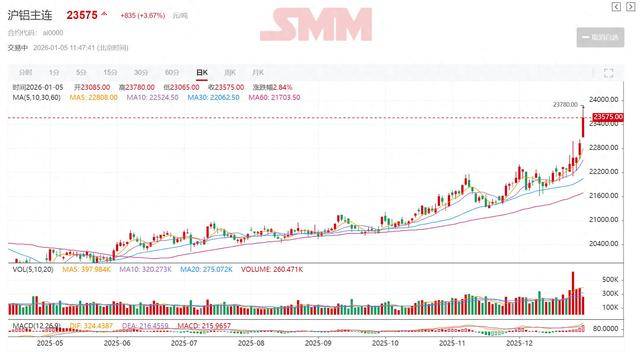
涨逾4%!政策利好刺激沪铝节后首日刷逾3年新高 但基本面不容忽视
Sou Hu Cai Jing· 2026-01-05 08:50
来源:上海有色网 元旦假期归来首个交易日,沪铝主连在经历前6个交易日的接连上涨之后继续跳空高开,盘中一度涨逾 4%,最高上探至23780元/吨,刷新2022年3月以来的新高。截至午间收盘,沪铝主连以3.67%的涨幅报 23575元/吨。 消息面上,委内瑞拉方面的政治冲突也一度引发市场热议,公开资料显示,委内瑞拉铝土矿资源量约 34.8亿吨,已探明储量13.3亿吨,占全球第三。但需要注意的是,委内瑞拉铝土矿资源开发勘探程度较 低,且其并不是主要的铝市场产出国和消费地,因此,该地的相关冲突并不会对整体产业链产生直接影 响。整体而言,该事件虽然会对市场产生一定程度上的情绪面影响,但对实际的铝市场供需影响较小。 至于当前实际的铝市场,据SMM了解,近期铝价维持高位,下游需求端受铝价高位抑制以及环保限产 的共同制约,铝水比例显著下滑,下游型材等多个板块开工率延续弱势,现货消费表现疲软。 伦铝方面也在元旦假期期间继续上扬并成功突破3000美元/吨的整数关口,今日开盘之后也继续上涨, 盘中最高一度上探至3069美元/吨,刷新2022年5月以来的新高。 且库存近期也呈现累库态势,据SMM数据显示,2025年年底,随着前期沸沸 ...
九部门:鼓励金融机构加大对符合标准的绿色消费贷款支持力度
Xin Lang Cai Jing· 2026-01-05 08:40
Core Viewpoint - The Ministry of Commerce and nine other departments have issued a notice to implement actions promoting green consumption, emphasizing increased credit support for green consumption loans [1][2] Group 1: Credit Support - Financial institutions are encouraged to enhance support for green consumption loans that meet specific standards [1][2] - Banks are urged to provide convenient services for users with good records in green consumption [1][2] Group 2: Collaboration and Innovation - Financial institutions are encouraged to collaborate with trade and circulation enterprises to expand the application scenarios for green consumption loans [1][2] - There is a push for innovation in financial products, including insurance guarantees for green consumption [1][2] Group 3: Infrastructure and Investment - The establishment of a project library for green consumption infrastructure is being explored, with regular recommendations of quality projects to financial institutions [1][2] - Support is provided for eligible projects to issue Real Estate Investment Trusts (REITs) in the infrastructure sector [1][2]
中国九部门发文实施绿色消费推进行动
Zhong Guo Xin Wen Wang· 2026-01-05 08:35
Core Viewpoint - The Chinese Ministry of Commerce and nine other departments have jointly issued a notice to implement green consumption initiatives during the "14th Five-Year Plan" period, outlining 20 specific measures across various sectors to promote a green and low-carbon lifestyle [1][2]. Group 1: Green Consumption Incentives - The notice emphasizes the establishment of a green consumption incentive mechanism, proposing seven areas of focus and 20 specific measures [1]. - It highlights the need to enrich the supply of green products, increase the supply of green agricultural products, promote green home appliances and home decoration, and encourage green consumption in the automotive sector [1]. Group 2: New Growth Points in Green Consumption - The notice aims to cultivate new growth points in green consumption by creating green supply chains and encouraging companies to conduct carbon footprint evaluations of their supply chains [1]. - It promotes green procurement, green products, and green packaging, and encourages the establishment of a universal green consumption points system that can be used both online and offline [1]. Group 3: Resource Recycling and Environmental Optimization - The notice stresses the importance of promoting green circular recycling, reducing the use of single-use plastic products, and developing a resource recycling system based on "reduction—recycling—reuse" [2]. - It calls for optimizing the green consumption environment by promoting energy-saving facilities, prioritizing the use of green electricity, and advocating for green travel and the use of low-carbon products [2].
加大信贷投放,创新金融产品——九部门联合部署绿色消费推进行动!
Xin Lang Cai Jing· 2026-01-05 08:35
Core Viewpoint - The Ministry of Commerce and nine other departments jointly issued the "Notice on Implementing Green Consumption Promotion Actions," outlining arrangements for green consumption during the 14th Five-Year Plan period, aiming to enhance the incentive mechanism for green consumption and promote a green, low-carbon lifestyle for high-quality development [1][5]. Group 1: Enhancing Green Product Supply - The notice emphasizes increasing the supply of green agricultural products, encouraging enterprises to expand procurement of high-quality items such as organic and geographical indication products, and supporting the establishment of dedicated sales areas for green products [2][6]. - It advocates for the promotion of green home appliances and home decoration, encouraging the purchase of certified green products and improving energy and water efficiency standards [2][6]. - The notice also supports the promotion of green automotive consumption, including the purchase of electric vehicles and the exploration of potential in the used car and car-sharing markets [2][6]. Group 2: Improving Green Service Consumption - The notice calls for the development of green dining services, urging restaurants to implement standards that reduce waste and promote the use of biodegradable packaging [3][7]. - It highlights the need for green accommodation, encouraging hotels to adopt eco-friendly practices and provide sustainable amenities [3][7]. - The notice promotes green housekeeping services, advocating for the use of non-toxic cleaning products and innovative service models [3][7]. Group 3: Financial Support for Green Consumption - The notice proposes increasing credit support for green consumption loans, encouraging financial institutions to offer favorable services to consumers with good green consumption records [4][8]. - It calls for the innovation of financial products to provide insurance for green consumption and the establishment of a project library for green consumption infrastructure [4][8].
新华鲜报丨9部门发文!中国实施绿色消费推进行动
Xin Hua Wang· 2026-01-05 08:30
Core Viewpoint - The Chinese government, through nine departments including the Ministry of Commerce, has launched a green consumption promotion initiative aimed at fostering a green, low-carbon lifestyle and production methods across various sectors [1]. Group 1: Food Sector - The initiative emphasizes increasing the supply of green agricultural products and promoting green dining practices [3][4]. - It encourages businesses to procure high-quality products such as organic and geographical indication agricultural products, while also advocating for reduced cooking oil emissions and the use of biodegradable packaging [4]. Group 2: Housing Sector - The initiative promotes the purchase of green-certified smart home appliances and eco-friendly building materials [5][6]. - It encourages the development of green hotels that utilize non-toxic, water-saving cleaning agents and provide refillable toiletries, while also innovating in health-oriented guest services [6]. Group 3: Transportation Sector - The initiative aims to strengthen the automotive industry by exploring the potential of the second-hand car market and promoting new consumption models such as RV camping and car-sharing [8]. - It highlights the importance of technology in supporting green consumption through smart products and resource optimization [8]. Group 4: Recycling and Second-hand Market - The initiative promotes green recycling practices and encourages retailers to offer reusable shopping options [9]. - It outlines the establishment of a three-tier recycling system and supports the development of second-hand shops to enhance the value of idle goods [9]. Group 5: Challenges and Future Outlook - The initiative acknowledges existing shortcomings in the green consumption market, such as the lack of unified standards and regulations in the second-hand market [10]. - It aims to align domestic green consumption standards with international ones, fostering deeper integration and cooperation in standardization [10].
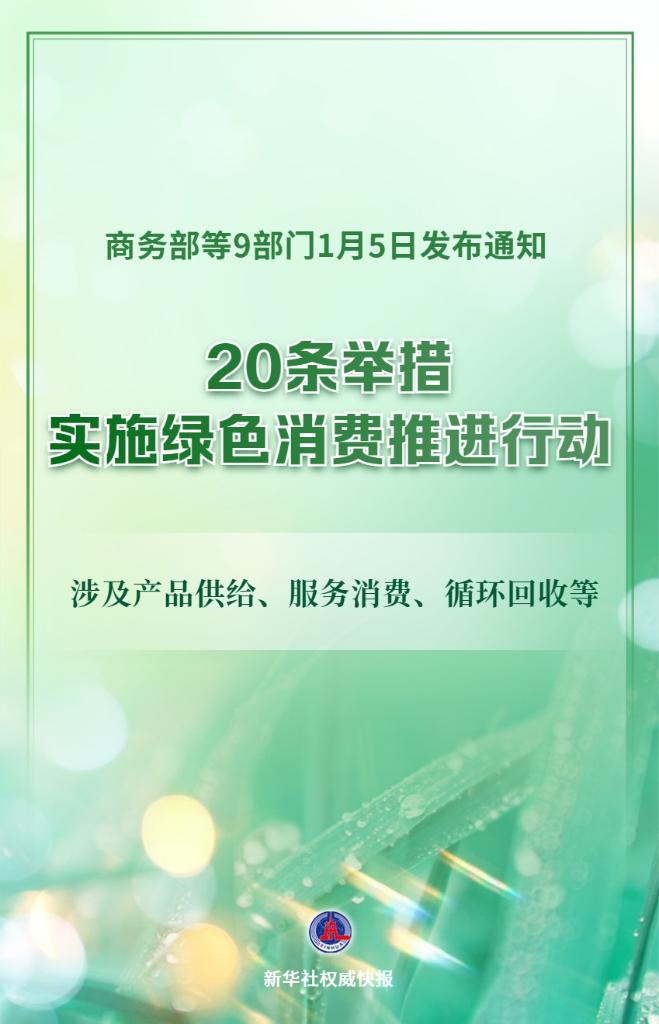
实施绿色消费推进行动!9部门发文,20条举措
Xin Hua She· 2026-01-05 07:07
推进行动从丰富绿色产品供给、提升绿色服务消费、创新绿色消费模式、推动绿色循环回收、优化 绿色消费环境、夯实绿色消费基础、加大政策支持力度7方面发力,提出加大绿色农产品供应、发展绿色 餐饮、推广绿色消费积分、减少一次性塑料制品使用、推动废旧物品回收再利用、发展二手商品流通、 加大信贷投放等20条具体举措。 记者:谢希瑶、向定杰 海报制作:谢希瑶 商务部等9部门1月5日发布通知 20 - Fran 实施绿色消费推进行动 涉及产品供给、服务消费、循环回收等 新华社权威快报 商务部等9部门关于实施绿色消费推进行动的通知1月5日对外发布。 [责任编辑:杨晓] 新华社国内部出品 ...