多模态大模型

Search documents
上海首个交通领域多模态大模型问世 有望让路口通行效率提升15%
news flash· 2025-05-27 03:07
Core Insights - The establishment of Zhongchengjiao (Shanghai) Technology Co., Ltd. marks the first state-owned enterprise in Shanghai focused on vertical field large models, specifically in the transportation sector [1] - The launch of the "Tongda" multimodal large model represents Shanghai's first dedicated traffic model, signifying an upgrade in the city's traffic intelligence [1] Company Overview - Zhongchengjiao (Shanghai) Technology Co., Ltd. is positioned as a key player in the development of intelligent transportation solutions [1] - The company aims to enhance traffic management through advanced data processing and algorithmic support [1] Model Capabilities - The "Tongda" model serves two primary functions: acting as an "expert consultant" providing professional knowledge services and assisting in traffic organization management [1] - The model utilizes video monitoring and IoT devices to capture real-time traffic flow and surrounding road conditions, enabling rapid data analysis [1] Performance Impact - In pilot cities, the implementation of the "Tongda" model has resulted in approximately a 15% improvement in intersection traffic efficiency [1]
从马拉松到格斗大赛,人形机器人在教育行业的奇点时刻还有多远?
3 6 Ke· 2025-05-26 23:48
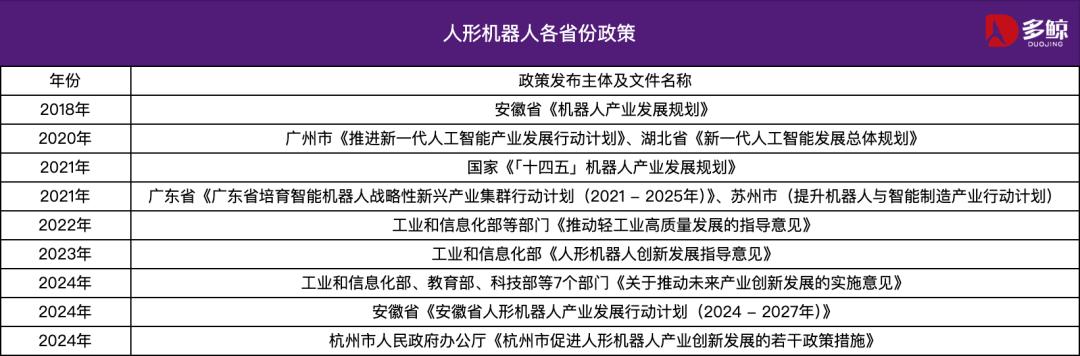
Core Insights - The humanoid robot and embodied AI industry is transitioning from laboratory experiments to large-scale applications, becoming a focal point for global technology and capital competition [1][2] - The humanoid robot market is currently valued at $3.28 billion globally, with projections indicating that the domestic market will exceed 20 billion yuan within three years [2] - Humanoid robots are recognized as a revolutionary product, akin to computers, smartphones, and electric vehicles, and are increasingly integrated with advanced technologies such as AI, high-end manufacturing, and new materials [1][2] Policy Landscape - Various policies have been established across provinces in China to support the development of humanoid robots, including the "14th Five-Year Plan for Robot Industry Development" and the "Guidance on the Innovation and Development of Humanoid Robots" [3] - The policy framework aims to foster innovation and collaboration in the humanoid robot sector, facilitating the establishment of innovation centers and strategic industry clusters [3] Development History - The evolution of humanoid robots can be categorized into several phases: early exploration (1969-2000), integrated development (2000-2015), dynamic and intelligent progress (2015-2022), and the current explosive growth phase (2022-present) [4][5][6][7] - Recent advancements in large-scale AI models and high-performance computing have significantly enhanced the capabilities of humanoid robots, enabling them to perform complex tasks and interact with their environment [7][8] Industry Chain Structure - The humanoid robot industry chain is structured into three levels: upstream core technologies, midstream manufacturing, and downstream application scenarios [12] - The core technologies include the "brain" (embodied intelligence), "cerebellum" (motion coordination), and "body" (biomimetic systems), which collectively enable humanoid robots to perceive, decide, and act [11][13][19] Current Market Trends - The market for humanoid robots is expanding from industrial applications to household services, with robots increasingly capable of performing complex tasks in domestic environments [23] - The rental market for humanoid robots is gaining traction, allowing companies to validate market demand and reduce user entry barriers by offering flexible usage options [23][24] Future Business Models - The future of humanoid robots is expected to evolve from pure hardware sales to a hybrid model combining hardware and services, including subscription-based services for businesses and consumers [24] - The competition in the humanoid robot industry is anticipated to shift towards an "ecosystem war," with companies like Tesla and NVIDIA developing comprehensive solutions that integrate hardware, AI, and manufacturing capabilities [24] Educational Applications - Humanoid robots are poised to play a significant role in education, particularly in specialized fields, with potential applications in rehabilitation and training [25][26] - The integration of humanoid robots in educational settings is currently in the validation stage, with a gradual transition towards deeper integration as technology matures and costs decrease [26][27] Future Trends - The deep integration of embodied intelligence with multimodal large models is expected to enhance the personalization and generalization of educational applications [34] - The development of simulation training platforms will accelerate the intelligent iteration of educational scenarios, allowing for low-cost testing and rapid deployment of humanoid robots in classrooms [35] - The emergence of new roles and industry reshuffling will create opportunities for algorithm developers focused on educational applications of humanoid robots [39][40]


上海网达软件股份有限公司关于2024年度暨2025年第一季度业绩暨现金分红说明会召开情况的公告
Shang Hai Zheng Quan Bao· 2025-05-26 19:35
Summary of Key Points Core Viewpoint - The company held a performance briefing for the fiscal year 2024 and the first quarter of 2025, highlighting significant growth in revenue and net profit, driven by advancements in artificial intelligence and innovative solutions in various sectors [1][2]. Financial Performance - For the fiscal year 2024, the company reported a revenue of 334,431,235.63 yuan, an increase of 13.18% year-on-year - The net profit attributable to shareholders was 10,476,947.66 yuan, up 112.57% from the previous year - The net profit after deducting non-recurring gains and losses was 2,206,158.43 yuan, reflecting a growth of 102.34% [2]. Future Growth Drivers - Future profitability is expected to be driven by self-developed industry models targeting smart security, smart communities, and smart healthcare, providing specialized and lightweight solutions - The company aims to standardize its technology modules to reduce customization costs and enhance operational efficiency [3]. Industry Solutions Development - The company plans to integrate AI large models with ultra-high-definition video and XR technology to offer high-value solutions in niche markets [5]. Dividend Distribution - The company proposed a cash dividend of 1.50 yuan per 10 shares, totaling approximately 40,051,312.35 yuan (including tax), reflecting a significant increase in profit distribution compared to previous years [5]. Collaboration with Huawei - The company is a service provider for Huawei's HarmonyOS and has over 100 certified engineers, actively participating in the development of applications for the HarmonyOS ecosystem [6]. Product Applications in AI Models - The company is developing AI models for various sectors, including safety management in ports and comprehensive media content production systems, enhancing operational efficiency and media capabilities [7][8]. First Quarter Performance - In the first quarter of 2025, the company achieved a revenue of 74,470,050.49 yuan, an increase of 11.11% year-on-year, with a net profit of 1,210,720.75 yuan, up 35.34% [11]. 2025 Development Plans - The company plans to strengthen its video technology capabilities, activate AI model potential, and expand XR technology applications, focusing on digital transformation in various industries [12].

第九届世界无人机大会暨国际低空经济与无人系统博览会在深圳举行
Nan Fang Ri Bao Wang Luo Ban· 2025-05-26 07:57
Group 1: Event Overview - The 9th World Drone Conference and International Low-altitude Economy and Unmanned Systems Expo opened in Shenzhen on May 23, showcasing advancements in drone technology and applications [1] - This year's focus is on the integration of drones with embodied intelligence technology, expanding product lines into more niche markets [1] Group 2: Innovations in Drone Technology - Over 5,000 unmanned aerial vehicles (UAVs) including helicopters, fixed-wing aircraft, multi-rotor drones, airships, and underwater drones were displayed at the expo [2] - Daotong Intelligent showcased its industrial-grade drones and highlighted the application of multi-modal large models, aiming to transform drones into intelligent robots capable of autonomous operation and path optimization [2] Group 3: Emergency Rescue Applications - The conference featured a variety of emergency rescue applications, including drone firefighting units, smart remote-controlled rescue stretchers, and flying life-saving devices [3] - A notable innovation is a flying life-saving ring developed by Zhejiang Juxing Power Technology, which can be remotely controlled to drop near drowning victims, enhancing rescue efficiency [3] - Longyi Aviation presented a drone firefighting unit capable of rapid deployment, with the ability to cover an area of 500 square meters in three minutes, significantly improving firefighting efficiency [3]
重磅!2025年中国及部分省市多模态大模型行业政策汇总及解读(全)政策鼓励多模态大模型应用场景创新
Qian Zhan Wang· 2025-05-26 03:25
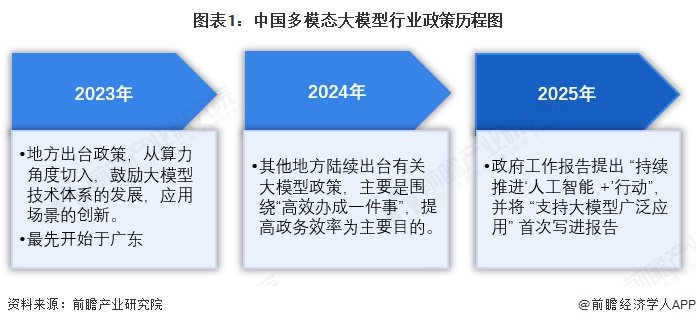
Core Insights - The article discusses the development and support of the multimodal large model industry in China, highlighting various policies and initiatives at both national and local levels aimed at enhancing AI capabilities and applications [1][4][11]. Policy Development Timeline - In 2023, local policies began to emerge, focusing on computational power to encourage the development of large model technology and innovative application scenarios, starting with Guangdong, Beijing, and Shanghai. By 2024, more regions are expected to introduce relevant policies aimed at improving administrative efficiency [1]. - By 2025, government work reports will emphasize the ongoing promotion of the "Artificial Intelligence +" initiative, with a focus on supporting the widespread application of large models [1]. National Policy Summary - The Chinese government has implemented several measures to support the AI industry, particularly multimodal large models, which are seen as crucial products within the AI sector. The State Council has identified embodied intelligence as a future industry, promoting the integration of digital technology with manufacturing and market advantages [4][5]. - Key national policies include the "Guidelines for the Development of Artificial Intelligence Industry" and the "Three-Year Action Plan for Data Elements," which aim to enhance data utilization and promote high-quality economic development through data-driven initiatives [11][13]. Local Policy Highlights - Various provinces have introduced specific policies to support the development of AI large models. For instance, Guangdong aims to develop a comprehensive technology system for large models with trillion-parameter capabilities, while Beijing targets the creation of 3-5 advanced, controllable foundational model products by the end of 2025 [13][15]. - Local initiatives also include the establishment of intelligent computing centers and the promotion of AI applications in various sectors, such as manufacturing, healthcare, and urban governance [13][14]. Key Development Directions - The article outlines that provinces like Guangdong, Beijing, and Shanghai have set ambitious goals for the development of large models, focusing on creating a robust ecosystem for AI innovation and application [15]. - The emphasis is on fostering collaboration between government, industry, and academia to drive advancements in AI technologies and their practical applications across different sectors [15].



2025年中国多模态大模型行业主要模型 主要多模态大模型处理能力表现出色【组图】
Qian Zhan Wang· 2025-05-22 08:58
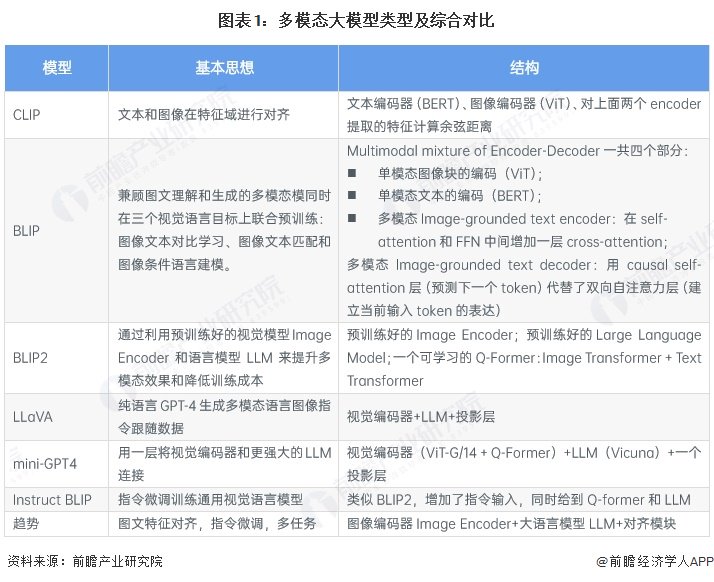
Core Insights - The article discusses the development and comparison of multimodal large models, emphasizing the integration of visual and language components to enhance understanding and generation capabilities in AI systems [1][7]. Multimodal Model Types - The mainstream approach for visual and language multimodal models involves using pre-trained large language models and image encoders, connected through a feature alignment module to enable deeper question-answer reasoning [1]. - CLIP, developed by OpenAI, utilizes a contrastive learning method to connect image and text feature representations, allowing for zero-shot classification by calculating cosine similarity between text and image embeddings [2]. - Flamingo, introduced in 2022, combines visual and language components, enabling text generation based on visual and textual inputs, and includes various datasets for training [5]. - BLIP, proposed by Salesforce in 2022, aims to unify understanding and generation capabilities for visual language tasks, enhancing model performance through self-supervised learning and addressing complex tasks like image generation and visual question answering [7]. - LLaMA integrates a visual encoder (CLIP ViT-L/14) with a language decoder, utilizing generated data for instruction fine-tuning, ensuring that visual and language tokens exist in the same feature space [8].
第二批展商抢先看|2025张江具身智能开发者大会:聚势启新,共赴产业新程
机器人大讲堂· 2025-05-21 12:13
Core Viewpoint - The 2025 Zhangjiang Embodied Intelligence Developer Conference and International Humanoid Robot Skills Competition will take place on May 29 in Shanghai, focusing on "open source, openness, and innovation" with over 200 leading companies and 1,000 experts and developers participating [1]. Group 1: Event Overview - The conference will feature a summit, competitions, and exhibitions, aiming to build an ecosystem for humanoid and embodied robot industries [1]. - The exhibition will cover four main areas: embodied intelligence, developer ecosystem, humanoid robot industry chain, and humanoid robot bodies, showcasing the application results of humanoid robot technology [1]. Group 2: Participating Companies and Innovations - Major companies like Kepler Robotics, Zhuoyide Robotics, and Magic Atom have confirmed participation, showcasing advancements in humanoid robots [2]. - Kepler's K2 "Bumblebee" features 52 degrees of freedom, high load capacity, and long endurance, capable of lifting 30kg and operating for 8 hours on a single charge [5][6]. - Zhuoyide's "Walker II" is the world's first modular humanoid robot based on bionic tendon drive technology, with a weight of 30kg and energy consumption reduced by 25% compared to competitors [7]. Group 3: Technological Advancements - The conference highlights the role of embodied intelligence in achieving autonomous decision-making and efficient interaction with environments, with significant investments from Chinese tech companies [14]. - Innovations in core components, such as sensors and actuators, are crucial for the development of humanoid robots, with domestic companies showing competitive capabilities [18]. Group 4: Future Directions - The event aims to present a complete innovation chain and ecosystem for China's humanoid robot industry, marking a shift from being a follower to a rule-maker in the global market [27].

2025年中国多模态大模型行业文娱媒体应用场景 多模态大模型提升文娱媒体创作效率【组图】
Qian Zhan Wang· 2025-05-20 07:27
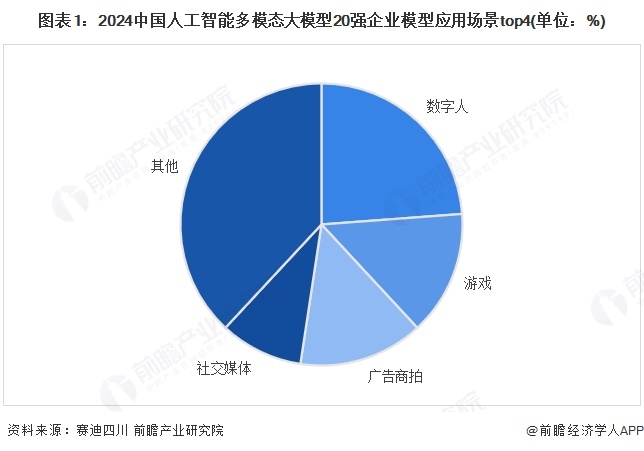
Core Insights - The article emphasizes the growing importance and application of multimodal large models in various industries, highlighting their clearer commercial monetization paths compared to language-only models [1] Multimodal Large Models Applications - Multimodal large models are categorized into 11 application scenarios, with the top five being digital humans, gaming, advertising, social media, and intelligent marketing, indicating a high maturity level and significant attention in these areas [1] - Digital humans leverage multimodal technology to enhance human-computer interaction through natural language processing, voice synthesis, and realistic visual presentation, improving user experience [2][5] - In gaming, multimodal large models enhance interaction by allowing characters to understand player commands and respond contextually, creating a more immersive experience [5] - The advertising industry benefits from multimodal technology by automating content creation, personalizing ad delivery, and enhancing user engagement, leading to a more efficient and intelligent advertising ecosystem [8][10] - Social media platforms are being transformed by multimodal large models, improving content creation, user recommendations, interaction experiences, community governance, and commercialization [11][12]

全球科技行业周报:国内多模态大模型相继迭代,算力仍为计算机长期主题
Huaan Securities· 2025-05-18 07:50
Investment Rating - Industry investment rating: Overweight [2] Core Views - The report highlights the rapid iteration of multimodal large models in the domestic market, indicating that computing power remains a long-term theme for the computer industry [1][4] - The supply and demand sides of computing power are both favorable, with TSMC planning to open or upgrade nine advanced manufacturing plants in 2025, with an annual budget set between $38 billion and $42 billion [4][5] - The report emphasizes the strong momentum in AI development both domestically and internationally, suggesting potential investment opportunities in related companies [6][8] Weekly Market Review - From May 12 to May 16, 2025, the Shanghai Composite Index rose by 0.76%, the ChiNext Index increased by 1.38%, and the CSI 300 Index gained 1.12%. The Hang Seng Technology Index rose by 1.95%, while the Nasdaq Index surged by 7.15% [3][26] - Sector performance showed the Media Index decreased by 0.67%, while the Hang Seng Internet Technology Index increased by 2.1%. The AI Index fell by 0.95%, and the Computer Index dropped by 1.26% [3][26] AI Developments - Tencent released the Hunyuan Image 2.0 model on May 16, 2025, achieving real-time image generation capabilities, which enhances the creative process for professional designers [4][42] - Alibaba open-sourced the Wan2.1-VACE model on May 14, 2025, which supports video generation and editing, with versions that can run on consumer-grade graphics cards [4][43] Semiconductor Sector - TSMC is accelerating the production of 2nm technology in Taiwan and has completed the second phase of its Arizona plant, with plans for further expansion [5] - AMD achieved a 39.4% revenue share in the global server CPU market in Q1 2025, marking a significant increase from previous quarters [10][43] Investment Recommendations - Focus on overseas AI companies such as Meta, Adobe, Microsoft, Apple, Nvidia, AMD, and Amazon due to their advancements in model iterations [6][8] - In the domestic AI sector, companies like Baidu, Alibaba, Tencent, and Kuaishou are highlighted for their innovative developments [9][10]



【前瞻分析】2025-2030年中国多模态大模型生成生活相关场景分析
Sou Hu Cai Jing· 2025-05-14 12:57
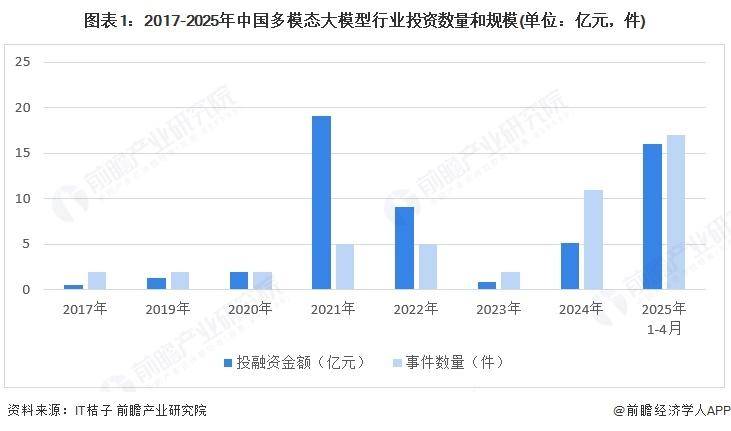
行业主要公司:阿里巴巴(09988.HK,BABA.US);百度(09888.HK,BIDU.US);腾讯(00700.HK, TCEHY);科大讯飞(002230.SZ);三六零(601360.SH);云从科技(688327.SH)等 2025年开始投融资呈爆发式增长 截至2025年4月,多模态大模型投融事件数量接近50件,其中国2021年投融资金额出现了高峰,达19.1 亿元,尽管当年投资事件数量为5件。2024年开始新一轮的投资周期,共有11件投资事件,金额达5.16 亿元。2025年前4个月,共有17件投资事件,金额为16亿元,后续多模态大模型题材的投资将呈现爆发 式增长。 投资目的地为北京 根据企业投融资目的地来看,目前行业内资金主要流向北京,占全部项目的一半。其次是深圳,占比 10%,上海占比8%。北京具有良好的互联网科技、人工智能产业发展基础,企业对于多模态大模型需求 较高,投资吸引力强。此外还有宁波、三亚、苏州三市的项目,这些地方具有较好的营商环境。 多模态大模型生成生活相关场景 智能营销、教学辅助、3D建模以及智能驾驶等应用场景是生产生活中的重要领域,也是目前多模态大 模型可以切入并且精准赋 ...