
企业文化

Search documents
“进入厂区请放弃一切自由”,龙头企业现雷人标语
Xin Hua Ri Bao· 2025-12-04 10:20
Core Viewpoint - A company in Qinzhou, Guangxi, displayed a controversial slogan "Please voluntarily give up all freedom upon entering the factory" which sparked widespread public concern regarding its implications on personal freedom and corporate culture [1][2]. Group 1: Company Response and Actions - On December 2, the company staff suggested that inquiries about the matter should be directed to local police, indicating a dismissive attitude towards public concern [2]. - Following intervention from the Qinzhou Port police, the company voluntarily removed the controversial slogan, which was initially a requirement for them to amend [2]. - The company is identified as Guangxi Hengyi New Materials Co., Ltd., a wholly-owned subsidiary of Hengyi Petrochemical [2][5]. Group 2: Company Background and Financials - Guangxi Hengyi New Materials Co., Ltd. has a registered capital of 3.955 billion yuan and is primarily engaged in the chemical fiber business [5]. - Hengyi Petrochemical reported a revenue of approximately 83.885 billion yuan for the first three quarters of 2025, a year-on-year decrease of 11.53%, while the net profit attributable to shareholders was about 231 million yuan, a slight increase of 0.08% [6]. - The company is currently advancing a project for an integrated production line with an annual capacity of 1.2 million tons of caprolactam and polyamide, which has recently entered trial production [6][8]. Group 3: Market Performance - On December 3, Hengyi Petrochemical's stock closed at 8.45 yuan per share, reflecting a 2.92% increase, with a market capitalization of approximately 30.44 billion yuan [10].


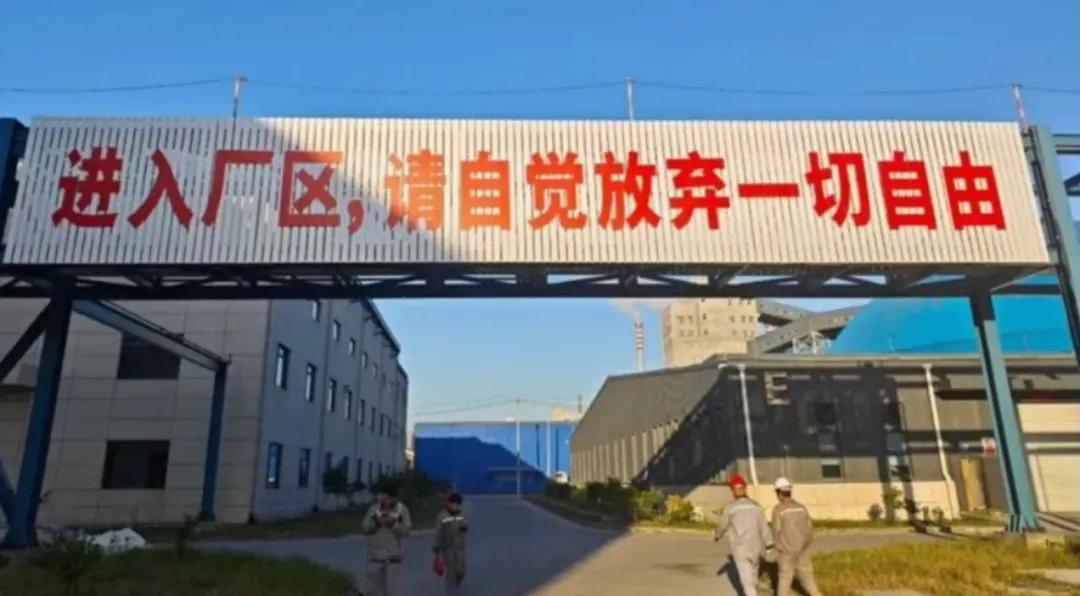
“进入厂区请放弃一切自由”,一公司现雷人标语,记者采访被怼:什么事找公安,吃饱了撑!警方介入后,标语已撤换
新浪财经· 2025-12-04 10:18
Core Viewpoint - The incident involving a controversial sign at a company in Qinzhou, Guangxi, has raised concerns about corporate culture and personal freedom, leading to public backlash and subsequent removal of the sign by the company [2][3][5]. Company Overview - The company involved is Guangxi Hengyi New Materials Co., Ltd., a wholly-owned subsidiary of Hengyi Petrochemical (000703.SZ) [7]. - As of mid-2025, Guangxi Hengyi New Materials has a registered capital of 3.955 billion yuan and is primarily engaged in the manufacturing of chemical fiber products [7]. Incident Details - The sign that sparked controversy read "Please consciously give up all freedom upon entering the factory," which was perceived as a restriction on personal freedom [2][5]. - Following public outcry, the sign was removed after intervention from local authorities, with the company stating that any inquiries should be directed to the police [3][8]. Corporate Response - In response to the incident, Hengyi Group replaced the controversial sign with a new message emphasizing safety and collective participation [8][10]. - The company has highlighted its technical and integrated advantages in its ongoing projects, including a significant production facility for caprolactam and polyamide, which is expected to enhance collaboration with its Brunei refining project [11]. Financial Performance - Hengyi Petrochemical reported a revenue of approximately 83.885 billion yuan for the first three quarters of 2025, reflecting a year-on-year decrease of 11.53%, while net profit attributable to shareholders was about 231 million yuan, showing a slight increase of 0.08% [9].
海信贾少谦:中国企业已具备以文化软实力走向全球的硬实力
Zhong Guo Xin Wen Wang· 2025-12-04 10:03
12月2日,,由中国企业联合会、中国企业家协会主办的第十六届全国企业文化年会在青岛举行。"伟大 公司的成功,往往源于背后强大的文化。"海信集团董事长贾少谦表示,中国企业已经具备以文化软实 力走向全球的硬实力,坚信对质量的敬畏和坚守,在喧嚣背后守住良心的企业,才是中国高质量发展的 底气和未来。 贾少谦表示,文化是一个企业最底层的经营逻辑和发展动力,只有文化无法复制,只有文化能创造出永 恒的差异性。海信在不断跨越周期的实践中一再笃定,企业文化是海信拥有稳健驾驭能力的核心,是一 代代海信人砥砺前行的动力,更是海信面对困难和混沌时的终极解答,是不确定性中的最大确定性。 当天,备受瞩目的"第十六届全国企业文化成果"揭晓,海信集团《以东方管理文化驱动企业全球化发 展》案例荣获特等奖最高荣誉。该奖项是在企业自愿申报及各地方企联、行业协会、有关企业集团推荐 的基础上,经过了初审、复审和终审等严格程序评定出来的。以特等成果为代表的13项企业文化成果, 充分彰显了各自的企业文化建设特色及内涵。 (文章来源:中国新闻网) 结合海信56年的发展历史,贾少谦介绍了推动海信从优秀走向卓越的四个关键文化:视质量为生命的质 量文化、敢为天下 ...

“进入厂区请放弃一切自由”,一公司现雷人标语,记者采访被怼:什么事找公安,吃饱了撑!警方介入后,标语已撤换
中国基金报· 2025-12-04 06:04
Core Viewpoint - The incident involving a company in Guangxi Qinzhou displaying a controversial sign has sparked widespread public concern regarding corporate culture and personal freedom [2][5]. Company Overview - The company involved is Guangxi Hengyi New Materials Co., Ltd., a wholly-owned subsidiary of Hengyi Petrochemical (000703.SZ) [5][6]. - As of mid-2025, Guangxi Hengyi New Materials Co., Ltd. has a registered capital of 3.955 billion yuan, primarily engaged in chemical fiber product manufacturing [6]. Incident Details - The sign stating "Please voluntarily give up all freedom upon entering the factory" was removed after intervention from local authorities [3][5]. - The company initially responded dismissively to inquiries about the sign, suggesting that concerns should be directed to the police [3]. Corporate Response - Following the incident, the company replaced the controversial sign with a new one emphasizing safety and prevention [7][9]. - Hengyi Petrochemical's recent performance report indicated a revenue of approximately 83.885 billion yuan for the first three quarters of 2025, a year-on-year decrease of 11.53%, while net profit slightly increased by 0.08% to about 231 million yuan [8]. Project Development - Guangxi Hengyi New Materials Co., Ltd. is currently advancing a project for an integrated production line with an annual capacity of 120,000 tons of caprolactam and polyamide, which has recently entered trial production [8][10]. - The project is expected to leverage technical and structural advantages, enhancing collaboration between China's and ASEAN's petrochemical industries [10]. Market Performance - On December 3, Hengyi Petrochemical's stock closed at 8.45 yuan per share, reflecting a 2.92% increase, with a market capitalization of approximately 30.44 billion yuan [13].
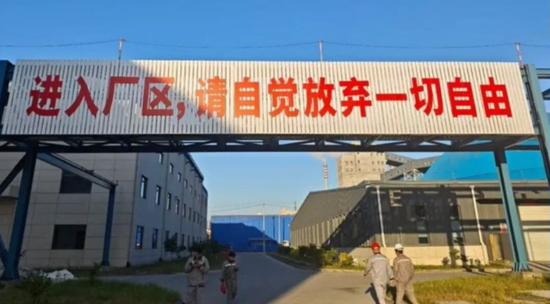
“进入厂区请放弃一切自由”,恒逸石化全资子公司现雷人标语
Xin Lang Cai Jing· 2025-12-04 01:43
Core Viewpoint - A controversial slogan displayed at a factory in Guangxi, China, stating "Please consciously give up all freedom upon entering the factory," has drawn significant public attention and criticism for its implications on personal freedom and corporate culture [1][2][3] Company Overview - The factory in question is operated by Guangxi Hengyi New Materials Co., Ltd., a wholly-owned subsidiary of Hengyi Petrochemical Co., Ltd. (stock code: 000703.SZ) [6][17] - Guangxi Hengyi New Materials Co., Ltd. has a registered capital of 3.955 billion yuan and is primarily engaged in the manufacturing of chemical fiber products [18][19] Recent Developments - Following public outcry, the controversial slogan was removed after intervention from local authorities, with the company replacing it with a more positive message emphasizing safety and participation [2][8][19] - Hengyi Petrochemical reported a revenue of approximately 83.885 billion yuan for the first three quarters of 2025, reflecting a year-on-year decrease of 11.53%, while net profit attributable to shareholders was about 231 million yuan, a slight increase of 0.08% [22][24] Project Updates - The company has successfully initiated trial production for its "120,000 tons/year caprolactam-polyamide integrated project," which is expected to leverage technical and structural advantages, enhancing collaboration with its Brunei refining project [12][24] Market Performance - On December 3, Hengyi Petrochemical's stock closed at 8.45 yuan per share, marking a 2.92% increase, with a market capitalization of approximately 30.44 billion yuan [26]
花名文化引热议,三只松鼠称”鼠”字前缀为增强团队亲切感
Xi Niu Cai Jing· 2025-12-02 00:27
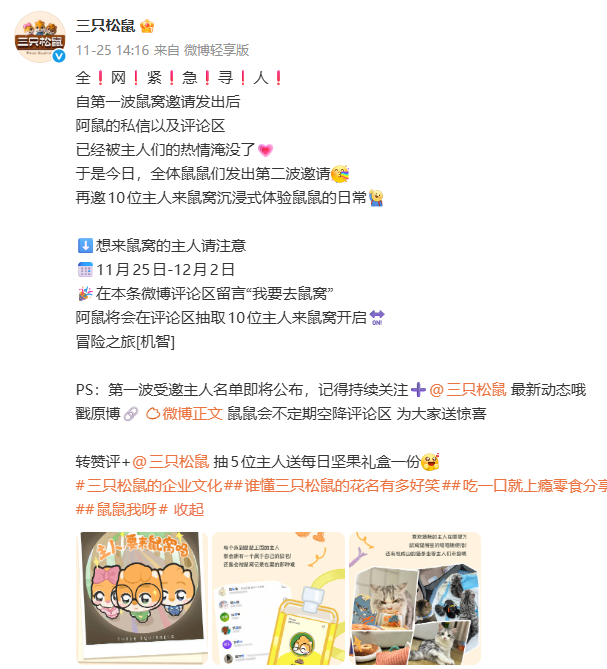
Core Viewpoint - The recent controversy surrounding the nickname system at Three Squirrels has sparked discussions about corporate culture and employee identity, with the company clarifying that the practice is voluntary and aimed at enhancing brand identity and team cohesion [2][3] Group 1: Company Culture - Three Squirrels has implemented a nickname system where employees adopt names starting with "Squirrel," such as "Squirrel Daddy" and "Mouse Love Talent," to foster a sense of community and brand identity [2] - The company stated that these nicknames are primarily for internal communication, with real names still used on business cards and in official contexts [2] - Employees reportedly choose their own nicknames, which can be creative, and the company retains these names for future employees if there are duplicates [2] Group 2: Financial Performance - Three Squirrels is currently facing financial pressure, with a reported revenue of 7.759 billion yuan for the first three quarters of 2025, reflecting a year-on-year growth of 8.22% [3] - However, the company's net profit has significantly declined by 52.91%, amounting to 161 million yuan [3] - Increased sales expenses exceeding 300 million yuan, along with rising management and R&D costs, have contributed to the financial strain [3] Group 3: Public Perception and Legal Considerations - The nickname controversy has led to public scrutiny regarding the balance between corporate management focus and brand image [3] - Legal experts have noted that as long as the nickname system is not mandatory and does not infringe on name rights, it is not illegal, but companies should be cautious of any implicit pressure it may create [2]
段永平的大道至简,怎么落实到我们的实际投资中?
雪球· 2025-11-29 13:01
Group 1 - The article discusses the difficulty of understanding the investment strategies of successful investors like Duan Yongping, emphasizing that simply mimicking their actions is not effective [4][5][6] - It highlights the distinction between copying "techniques" and "philosophies" in investing, noting that Duan's unique experiences shape his investment philosophy [8][9] - Duan Yongping's success is attributed to his deep understanding of business, gained from his entrepreneurial background, which allows him to analyze companies more effectively than others [12][14] Group 2 - The article explains that true understanding in investing varies among individuals, with Duan Yongping having a limited number of successful investments compared to others like Peter Lynch [24][26] - It emphasizes that understanding does not equate to precise market timing but involves recognizing opportunity costs and making informed decisions based on personal comfort with investments [31][32] - The importance of maintaining rationality during market fluctuations is highlighted, with Duan's approach focusing on investing in companies he understands [36][38] Group 3 - The article suggests that not understanding certain investment strategies does not preclude profitability, as ordinary investors can still find success through simpler methods like investing in the S&P 500 [47][48] - It warns against short-term trading, describing it as a zero-sum game and advocating for long-term investment strategies that are easier to replicate [49][50] - The article concludes that asset allocation can be a more suitable approach for most investors, allowing for diversification and risk management [58][59]



三只松鼠花名引争议,坦诚也是企业“加分项”
2 1 Shi Ji Jing Ji Bao Dao· 2025-11-28 00:14
Core Viewpoint - The article discusses the recent controversy surrounding the internal naming culture at Three Squirrels, highlighting the importance of consumer trust and brand management in response to public opinion events [2][5]. Group 1: Incident Overview - A recent post by a netizen claimed that employees at Three Squirrels are required to adopt a "mouse" themed nickname upon joining, which sparked widespread attention [2]. - Three Squirrels clarified that the "mouse name" is a non-mandatory aspect of their corporate culture, allowing employees to choose their nicknames freely without any negative consequences for opting out [2][6]. Group 2: Company Response - The founder and CEO of Three Squirrels, Zhang Liaoyuan, emphasized that any employee culture that aligns with the company's values and is accepted by employees is beneficial [2][6]. - The company addressed consumer concerns regarding a return process where the return recipient was labeled "Return Mouse," explaining that this is part of their internal culture and not intended to offend [2][5]. Group 3: Public Perception and Management - The incident illustrates how internal corporate culture can attract public scrutiny, leading to questions about employee respect and management style [5]. - Three Squirrels adopted a transparent approach in handling the situation, clarifying the voluntary nature of the nickname system and showcasing that even executives use similar nicknames, which helps mitigate public skepticism [6][7]. Group 4: Consumer Engagement - The company utilized social media to invite consumers to engage with and understand their corporate culture, transforming public criticism into an opportunity for brand explanation [7]. - The humorous and light-hearted nature of the corporate culture resonates well with the target consumer demographic, enhancing brand perception through effective public relations strategies [7].

三只松鼠花名引争议,坦诚也是企业“加分项”|消费舆警指数
2 1 Shi Ji Jing Ji Bao Dao· 2025-11-28 00:05
Core Viewpoint - The article discusses the recent controversy surrounding the employee nickname culture at Three Squirrels, highlighting the importance of consumer trust and brand management in response to public sentiment [1] Group 1: Incident Overview - A recent post by a netizen claimed that employees at Three Squirrels are required to adopt a nickname starting with "Squirrel" upon joining, which sparked widespread attention [1] - Three Squirrels clarified that the use of "Squirrel" nicknames is voluntary and not mandatory, emphasizing that employees can choose whether to adopt such names without facing negative consequences [2] Group 2: Company Response - The company adopted a candid approach in addressing the public's concerns, stating that the nickname culture is not enforced and that it reflects a fun and engaging corporate culture [3] - Three Squirrels' founder and CEO, Zhang Liaoyuan, expressed that any culture that employees enjoy and aligns with the company's values is beneficial [2][3] Group 3: Consumer Interaction - The company faced criticism when a consumer noted that the return label for a product was "Return Squirrel," which was perceived as having a negative connotation [2] - In response, Three Squirrels explained that the nickname is part of their internal culture and is not intended to offend consumers [2] Group 4: Public Relations Strategy - The company effectively communicated its internal culture by showcasing that even executives use similar nicknames, which helped alleviate public skepticism regarding employee consent [3] - By inviting consumers to engage with the brand and understand its culture, Three Squirrels transformed public scrutiny into an opportunity to explain and promote its brand values [4]
从段永平的万字访谈中,帮你梳理好了他的股票投资体系
雪球· 2025-11-27 08:06
Group 1 - The core idea of the article revolves around investment strategies and methodologies shared by prominent investors like Duan Yongping, emphasizing the importance of understanding company culture, business models, and differentiation in stock selection [5][7][39]. - The article highlights the significance of company culture, stating that a strong culture can guide a company back on track, and changes in culture should prompt investors to reassess their investments [10][18][20][24]. - It discusses the importance of a solid business model, using examples like Buffett's investment in Coca-Cola and Duan's success with NetEase, showcasing the need for deep understanding of the business [25][28][29][31]. Group 2 - Differentiation is emphasized as a critical factor in avoiding price wars and maintaining customer loyalty, with Duan mentioning that products lacking differentiation face significant challenges [32][34][37]. - The article advises investors to limit the number of stocks they invest in, suggesting that understanding a few companies deeply is more beneficial than spreading investments too thin [39][41][44]. - It introduces the concept of "full position" investing, where investors should fully commit to stocks they understand, rather than holding cash that may lose value over time due to inflation [46][48][51]. Group 3 - The article warns against short-term trading, explaining that quantitative trading strategies can make it increasingly difficult for retail investors to profit from market fluctuations [54][56][62]. - It contrasts long-term investing with quantitative trading, suggesting that successful investing is akin to nurturing a growing tree, while quantitative strategies focus on short-term price discrepancies [66][70]. - The article clarifies a common misconception about value investing, stating that while long-term holding is essential, investors should also be prepared to sell if better opportunities arise [72][76].

