
农产品出口

Search documents
出口覆盖224个国家和地区 中国农产品“圈粉”世界
Ren Min Ri Bao· 2025-12-30 02:46
Core Insights - China's agricultural product exports are experiencing significant growth, with an increase from 544.34 billion yuan in 2021 to 732.75 billion yuan in 2024, representing a 34.6% growth rate [1] - The export of agricultural products has expanded to cover 224 countries and regions, showcasing the resilience and vitality of Chinese agriculture in a complex international environment [1] Group 1: Export Growth and Market Expansion - The export of lychee has reached over 4,000 tons this year, marking an approximate 18% year-on-year increase, highlighting the international recognition of Chinese lychee varieties [2] - The implementation of the "5+2" appointment inspection by the General Administration of Customs has reduced the customs clearance time for fresh agricultural products by 50%, facilitating faster access to international markets [3] - In the first ten months of this year, emerging markets have shown remarkable growth in agricultural product exports, with garlic being a standout product that has successfully entered the Middle Eastern market [4] Group 2: Competitive Advantages and Industry Development - The establishment of strict production standards in regions like Anxi County has enabled local tea companies to obtain organic certifications, allowing them to sell at prices 30% to 50% higher than ordinary tea [6] - A diverse market structure has effectively mitigated demand fluctuations in certain regions, injecting new momentum into export growth [6] - The total export value of fruits, vegetables, aquatic products, livestock products, and beverages accounts for 57.3% of the total agricultural product exports, indicating the leading role of these advantageous products [3] Group 3: Challenges and Strategic Initiatives - The global demand for tilapia has decreased, leading to a significant reduction in orders and production halts for processing lines, indicating the challenges faced by the industry [7] - To address these challenges, companies are innovating by developing deep-processed products and expanding into new international markets, including RCEP member countries and regions in the Middle East and Africa [7] - The Ministry of Agriculture and Rural Affairs aims to cultivate high-quality entities in agricultural international trade, targeting the establishment of over 50 entities with annual export values exceeding 100 million USD by 2030 [8]


出口覆盖224个国家和地区,中国农产品“圈粉”世界
Guo Ji Jin Rong Bao· 2025-12-30 00:03
Core Insights - China's agricultural product exports are experiencing significant growth, with a projected increase from 544.34 billion yuan in 2021 to 732.75 billion yuan in 2024, representing a 34.6% growth rate [3] - The export of high-quality specialty agricultural products, such as oranges and lychees, is gaining traction in international markets, showcasing China's agricultural resilience and vitality [3][4] Group 1: Export Growth and Market Reach - The total value of a recent order for 108 tons of oranges from Hubei to Dubai was $150,000, highlighting the effectiveness of cross-border logistics in enhancing competitiveness in the Middle Eastern market [2] - In the first 11 months of this year, China's agricultural exports reached 224 countries and regions, demonstrating the extensive reach of Chinese agricultural products [3] - The export of fruits, vegetables, seafood, livestock products, and beverages accounted for 57.3% of total agricultural exports, indicating the leading role of these products in driving export growth [5] Group 2: Product-Specific Success - Lychee exports have reached over 4,000 tons this year, marking an 18% increase, with various lychee varieties catering to different taste preferences [4] - Garlic has emerged as a star product in vegetable exports, with successful entry into the Middle Eastern market and long-term agreements with South African clients [6] - The establishment of a garlic processing plant in Vietnam has enabled direct supply to local wholesale markets, enhancing the efficiency of the supply chain [6] Group 3: Industry Innovations and Standards - The implementation of a "5+2" appointment inspection system by customs has reduced the clearance time for fresh agricultural products by 50%, facilitating faster access to international markets [5] - The introduction of specialized insurance policies for agricultural exports has covered over 150 countries, further supporting the export process [5] - The establishment of strict production standards and certification systems in regions like Fujian has significantly increased the export prices of tea products by 30% to 50% compared to ordinary tea [7] Group 4: Strategic Market Expansion - The rise of emerging markets has been notable, with companies like Jinhaiyuan successfully entering new markets and establishing long-term partnerships [6] - The agricultural sector is encouraged to deepen engagement with countries along the Belt and Road Initiative, reducing reliance on single markets and enhancing global trade influence [9] - The Ministry of Agriculture aims to cultivate high-quality export entities, targeting over 50 companies with annual exports exceeding $10 million by 2030 [9]

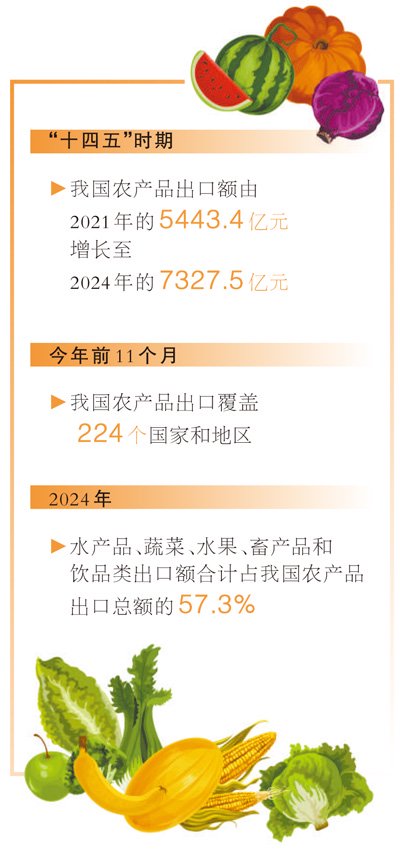
出口额逐年增长,覆盖224个国家和地区 中国农产品“圈粉”世界(大数据观察)
Ren Min Ri Bao· 2025-12-29 22:05
Core Viewpoint - The export of Chinese agricultural products is experiencing significant growth, driven by efficient logistics, diverse market expansion, and the establishment of high-quality production standards, enhancing competitiveness in international markets [1][3][6]. Group 1: Export Growth and Market Expansion - China's agricultural product export value is projected to increase from 544.34 billion yuan in 2021 to 732.75 billion yuan in 2024, marking a growth of 34.6% [1]. - In the first ten months of this year, new emerging markets have shown remarkable growth in agricultural exports, with garlic being a standout product that has successfully entered the Middle Eastern market [4]. - The export of fruits has become a new engine for agricultural export growth, with a year-on-year increase of over 20% last year [3]. Group 2: Product Quality and Branding - The "Lychee Huadan" brand has been developed to promote local agricultural products to a global level, with over 4,000 tons of lychee exported this year, reflecting an 18% increase [2]. - Strict production standards in regions like Anxi County have led to higher export prices for tea, with organic certifications allowing for a price increase of 30% to 50% compared to regular tea [5]. Group 3: Logistics and Support Measures - The implementation of the "5+2" appointment inspection system by the General Administration of Customs has reduced the customs clearance time for fresh agricultural products by 50% [3]. - The China Export & Credit Insurance Corporation has introduced a special insurance policy for agricultural exports, covering over 150 countries, facilitating smoother international trade [3]. Group 4: Industry Challenges and Innovations - The global demand for tilapia has decreased, leading to a significant reduction in orders, prompting companies to innovate by introducing new processed products to adapt to changing consumer preferences [7]. - The agricultural sector is encouraged to deepen engagement with emerging markets along the "Belt and Road" initiative and to participate in international standard-setting to enhance global trade influence [8]. Group 5: Future Development Goals - By 2030, the goal is to cultivate over 50 national quality entities with annual export values exceeding 100 million USD, aiming for these entities to account for over 50% of the national export value in their respective product categories [8].
辩证看农产品出口成绩单(人民时评)
Ren Min Ri Bao· 2025-12-25 22:19
Core Insights - China, as the world's largest agricultural product importer, has reported impressive export figures, with nearly 600 billion yuan in agricultural exports over the first ten months of the year, covering 838 product categories and reaching 223 countries and regions [1] Group 1: Export Growth and Quality Improvement - The increase in export categories and the enhancement of product quality indicate that China's agricultural exports are moving beyond the "large quantity, low price" phase, demonstrating strong market competitiveness [1] - By aligning with international high standards and integrating into the global market, China's agricultural products are gaining higher recognition and added value [1] Group 2: Efficiency in Logistics and Customs - The introduction of innovative customs and logistics mechanisms, such as the "batch inspection" model in Huzhou and the "green channel time+" rapid release mode in Yunnan, has significantly improved efficiency in the export process [2] - Infrastructure connectivity and regulatory improvements have collectively enhanced the competitiveness of Chinese agricultural products [2] Group 3: Balancing Export and Food Security - High-quality agricultural exports do not conflict with food security; instead, they can support it by optimizing the use of domestic and international markets [2] - The export of specialty products like fruits and vegetables, which often utilize non-arable resources, contributes to a balanced agricultural structure [2] Group 4: Economic Benefits for Farmers - Agricultural exports can lead to higher premiums, incentivizing farmers and creating a positive cycle of industry development and rural revitalization [3] - Examples include the high prices of Nanfeng honey oranges in South Africa and the value-added processing of Yantai apples, which significantly increase farmers' incomes [3] Group 5: China's Role in Global Agricultural Trade - China has become the world's second-largest agricultural trading nation, with a balanced approach to imports and exports that supports food security [3] - The future of Chinese agriculture lies not only in domestic production but also in its ability to compete in global markets [3]
油脂油料早报-20251223
Yong An Qi Huo· 2025-12-23 01:11
Report Summary 1. Report Industry Investment Rating No investment rating information is provided in the report. 2. Core View of the Report The report presents comprehensive information on the overnight market of oilseeds and oils, including the export inspection, sales, and shipment data of US soybeans and soybean products, the production and export data of Brazilian soybeans, and the import data of various oils and oilseeds in China, as well as the price and basis data of related products [1]. 3. Summary by Relevant Catalogs Overnight Market Information - **US Soybean Export Inspection**: As of the week ending December 18, 2025, the US soybean export inspection volume was 870,199 tons, meeting expectations. The export inspection volume to the Chinese mainland was 386,010 tons, accounting for 44.36% of the total. So far in this crop year, the cumulative US soybean export inspection volume is 14,586,856 tons, compared with 27,027,931 tons in the same period of the previous year [1]. - **US Soybean Export Sales**: As of the week ending December 4, 2025, the net increase in US soybean export sales in the current market year was 1.5521 million tons, a 40% increase from the previous week and a 34% increase from the average of the previous four weeks, meeting market expectations. The net increase in export sales to the Chinese mainland was 1.011 million tons. The soybean export shipment volume was 1.0711 million tons, a 33% increase from the previous week and a 6% increase from the average of the previous four weeks [1]. - **US Soybean and Product Export Sales Forecast**: Analysts expect that as of the week ending December 11, 2025, the net increase in US soybean export sales will be 1.8 - 2.9 million tons, the net increase in US soybean meal export sales will be 275,000 - 550,000 tons, and the net increase in US soybean oil export sales will be 50,000 - 240,000 tons [1]. - **Brazilian Soybean Production and Export**: AgRural raised its forecast for Brazil's 2025/26 soybean production to 180.4 million tons, up from the previous forecast of 178.5 million tons in November. Brazil exported 2,442,367.61 tons of soybeans in the first three weeks of December, with an average daily export volume of 162,824.51 tons, a 70% increase from the average daily export volume in December of the previous year [1]. - **China's Import Data**: In November 2025, China's palm oil imports were 334,052.37 tons, a 52.25% month - on - month increase and a 97.79% year - on - year increase. China's rapeseed imports were 1,998.30 tons, a 99.72% year - on - year decrease. China's rapeseed meal imports were 214,741.88 tons, a 2.44% month - on - month decrease and a 132.96% year - on - year increase. China's rapeseed oil imports were 165,541.10 tons, a 17.65% month - on - month increase and a 16.80% year - on - year decrease [1]. - **Malaysian Palm Oil Data**: According to SGS, Malaysia's palm oil product exports from December 1 - 20, 2025, were 676,674 tons, a 43.60% increase from the same period of the previous month. According to AmSpec, the exports were 821,442 tons, a 0.87% decrease from the same period of the previous month. The palm oil production from December 1 - 20, 2025, in Malaysia decreased by 7.15% month - on - month [1]. Spot Price The report provides the spot prices of soybean meal in Jiangsu, rapeseed meal in Guangdong, soybean oil in Jiangsu, palm oil in Guangzhou, and rapeseed oil in Jiangsu from December 16 - 22, 2025 [3].
芝加哥小麦和大豆上涨 受黑海港口袭击和出口前景影响
Xin Lang Cai Jing· 2025-12-22 18:17
转自:智通财经 【芝加哥小麦和大豆上涨 受黑海港口袭击和出口前景影响】智通财经12月23日电,CBOT小麦价格攀 升,因俄乌紧张局势升级引发对黑海地区农产品出口的担忧。大豆价格也同步上涨。俄罗斯加剧了对乌 克兰敖德萨港口的袭击,同时宣称无人机攻击损坏了塔曼港的船只和基础设施。芝加哥小麦期货一度上 涨1.7%,创近三周最大涨幅。大豆期货最高上涨0.7%,为两周来最大涨幅。 ...
前11月出口同比增长13.6%—— “粤字号”农产品香飘全球
Jing Ji Ri Bao· 2025-12-21 22:52
Core Viewpoint - Guangdong's agricultural product exports have significantly increased, with a focus on quality and efficiency in the supply chain, enhancing the international market presence of local specialties [1][2]. Group 1: Export Statistics - In the first 11 months of this year, Guangdong's agricultural product export volume reached 6.573 million tons, a year-on-year increase of 13.6%, covering 214 countries and regions [1]. - The supply of agricultural products from Guangdong to Hong Kong and Macau ranked first in the country, with a total supply of 2.58 million tons, accounting for 67.4% of the national total [1]. Group 2: Quality Control Measures - The Guangdong Customs has implemented a comprehensive quality safety control system, including disease monitoring and toxic substance residue monitoring, ensuring that every batch of exported products meets quality standards [1]. - The customs authority provides full-process guidance to companies, helping them improve product quality, as exemplified by the export of 1,405 tons of honey pomelo by a local company, valued at approximately 1.85 million USD [1]. Group 3: Industry Upgrading and Support - The Guangdong Customs supports "chain leader" enterprises in brand building and deep processing, with Taishan eel exports accounting for over 60% of the national total [1]. - The Guangdong Yuen Hong Aquatic Group has expanded its international market presence with the help of customs guidance, adding six new registered eel farming sites in the past two years [1]. Group 4: Fresh Product Export Efficiency - Guangdong Customs has established green channels for the inspection of fresh agricultural products, implementing priority inspections and a "5+2" appointment system to maintain product freshness [2]. - The customs authority has reduced the clearance time for fresh milk supply to Hong Kong from 72 hours to 6 hours, achieving same-day delivery [2]. - Guangdong's lychee production accounts for 60% of the national total, with efficient customs clearance enabling rapid global distribution [2].
“粤字号”农产品香飘全球
Xin Lang Cai Jing· 2025-12-21 22:46
Group 1 - Guangdong's agricultural product exports reached 6.573 million tons in the first 11 months of this year, a year-on-year increase of 13.6%, covering 214 countries and regions [1] - Guangdong supplied 2.58 million tons of agricultural products to Hong Kong and Macau, accounting for 67.4% of the national total, ensuring stable supply for the Guangdong-Hong Kong-Macao Greater Bay Area [1] - The quality and safety of agricultural products are crucial for entering international markets, with the Guangdong Customs implementing a comprehensive quality control system [1] Group 2 - Guangdong Customs has established a green channel for the inspection of fresh agricultural products, prioritizing inspections and reducing clearance times significantly [2] - The innovative "assembly transport + centralized supervision" model for fresh fruits and vegetables has been adopted, enhancing efficiency in customs clearance [2] - The global market sees 70% of lychees coming from China, with Guangdong accounting for 60% of the national production, benefiting from efficient customs processes [2]
你吃的法式鹅肝可能老家山东
Xin Lang Cai Jing· 2025-12-20 09:50
Group 1 - Shandong Linyi produces over 5,000 tons of foie gras annually, accounting for one out of every five foie gras pieces in the global market [1] - China has become the largest producer of caviar globally, with 60% of the world's caviar labeled as "Made in China" [1] - Fresh caviar from Sichuan Ya'an and Zhejiang Quzhou is produced within 15 minutes and supplied directly to top restaurants worldwide [1] Group 2 - Yunnan Chuxiong's truffles are exported to France and Germany, with premium truffles selling for 850 yuan per kilogram [1]
供港澳农产品居全国之首,广东前11月农产品出口增长13.6%
2 1 Shi Ji Jing Ji Bao Dao· 2025-12-16 09:21
Group 1 - The core viewpoint of the article highlights the significant growth in agricultural product exports from Guangdong, with a 13.6% increase year-on-year, reaching 6.573 million tons in the first 11 months of 2025 [1] - Guangdong's agricultural products supply to Hong Kong and Macau reached 2.58 million tons, accounting for 67.4% of the national total, positioning Guangdong as the leading supplier in China [1] - The Guangdong Customs has implemented various supportive measures for agricultural exports, including a policy promotion event to clarify export registration and inspection processes [1] Group 2 - To ensure the freshness of agricultural products, Guangdong Customs has established a green channel for the inspection of fresh agricultural products, implementing priority inspections and a "5+2" appointment system [2] - The customs has reduced the clearance time for fresh milk supply to Hong Kong from 72 hours to 6 hours, achieving same-day delivery [2] - In Taishan, known as the "hometown of eel," the customs supports leading enterprises in brand building and deep processing, with Taishan eels accounting for over 60% of national exports [2]