
劳动力短缺

Search documents
劳动力短缺 意大利拟增发工作签证50万份
Xin Hua She· 2025-07-01 07:18
Group 1 - The Italian government plans to issue nearly 500,000 work visas to non-EU citizens over the next three years to address labor shortages and expand legal immigration channels [1] - By 2026, approximately 165,000 work visas will be issued to non-EU citizens, with a total of nearly 498,000 visas expected to be issued by 2028 [1] - The visa allocation considers social needs and previous years' applications, aiming to create a plan that meets both business demands and practical realities [1] Group 2 - Italy, as the third-largest economy in the Eurozone, faces significant labor shortages due to aging population and declining birth rates [1] - In 2024, Italy's death rate is projected to exceed its birth rate by approximately 281,000, leading to a population decrease of 37,000 to 58.93 million, continuing a decade-long trend [1] - Research indicates that Italy will need to absorb at least 10 million immigrants by 2050 to address the challenges posed by ongoing population decline [1] Group 3 - Since taking office in October 2022, Prime Minister Giorgia Meloni has prioritized curbing illegal immigration, with the government planning to tighten policies against illegal migrants [2] - The government aims to expedite deportations and combat illegal crossings of the Mediterranean [2]
意大利未来三年将发放近50万份非欧盟工作签证
Zhong Guo Xin Wen Wang· 2025-07-01 05:14
Core Points - The Italian government has approved a new decree to issue nearly 500,000 work visas for non-EU citizens over the next three years [1] - This initiative is part of a strategy to address labor shortages and expand legal immigration channels in response to declining birth rates and an aging population [1] Group 1 - The Italian government plans to introduce 450,000 foreign workers from 2023 to 2025, followed by nearly 500,000 from 2026 to 2028 [1] - Italy's population is projected to decrease by approximately 37,000 in 2024, with a death toll exceeding births by about 281,000 [1] - The fertility rate in Italy has dropped to 1.18 in 2024, marking the lowest level since 1995 [1] Group 2 - A think tank's research indicates that Italy needs to accept at least 10 million immigrants by 2050 to maintain its current population level [1] - The new immigration policy aims to establish a stable and legal immigration mechanism, combating illegal entry and exploitation of workers [1]
美联储哈玛克:据我所知,住房市场是由于移民政策和其他因素导致劳动力短缺的唯一行业。
news flash· 2025-06-24 15:12
Group 1 - The core viewpoint is that the housing market is uniquely affected by labor shortages due to immigration policies and other factors [1]
劳动力短缺迫使日本改革与“家庭主妇”有关的社会福利规定
news flash· 2025-06-12 05:51
Core Viewpoint - Japan's labor shortage is prompting conservative lawmakers to consider comprehensive reforms to social welfare regulations related to "housewives," which have been in place for decades [1] Group 1: Labor Market Impact - The proposed legislation will require part-time workers to contribute to pension and health insurance plans, addressing a significant barrier for women to extend their working hours or advance their careers [1] - The current policy, introduced during Japan's economic boom in 1986, applies to "dependent" spouses with annual incomes below 1.3 million yen (approximately 9,028 USD) [1] Group 2: Historical Context - The social welfare measure was initially designed to encourage married women to spend more time at home, reflecting the societal norms of the time [1] - The reform is seen as a necessary step to adapt to changing economic conditions and labor market needs in Japan [1]
日本酒店又贵又差,暑期旅游还能期待吗?
3 6 Ke· 2025-06-10 09:05
Core Viewpoint - The significant increase in hotel prices in Japan is attributed to a surge in tourist numbers, inflation, and labor shortages, leading to a decline in service quality [1][7][10]. Group 1: Tourist Influx and Hotel Pricing - Japan's unique cultural appeal and favorable visa policies have led to a substantial increase in tourist arrivals, particularly with the upcoming 2025 Osaka Expo [1][2]. - The average hotel room rate in Osaka during peak tourist periods has risen by approximately 40% compared to the previous year, while Kyoto has seen a 20% increase [2]. - In the first four months of 2025, the cumulative number of visitors to Japan reached 14.4466 million, with a projected annual total exceeding 40 million for the first time [3]. Group 2: Inflation and Operational Costs - Rising operational costs due to inflation have significantly impacted hotel pricing, with Japan's core CPI increasing by 3.8% year-on-year in April, surpassing the central bank's 2% target [7]. - The average hotel room rate in Japan has increased by about 40% compared to 2019, with current rates around 812 RMB per night [9]. Group 3: Labor Shortages and Service Quality - The hotel industry in Japan is facing severe labor shortages, exacerbated by an aging workforce, leading to reduced service offerings and quality [13][16]. - The average annual salary for hotel employees is approximately 179,000 RMB, which is significantly lower than other industries, making it difficult to attract skilled workers [16]. Group 4: Comparison with China's Hotel Market - In contrast, China's hotel market offers more competitive pricing and improved service quality, with average hotel rates in second and third-tier cities ranging from 300 to 600 RMB per night [17]. - The competitive nature of the domestic hotel industry in China has led to a focus on service quality and customer satisfaction, driving continuous improvements [19][20]. Group 5: Recommendations for Improvement - The Japanese hotel industry could benefit from adopting strategies seen in the Chinese market, such as increasing wages to attract talent and implementing standardized service training [21].


野村证券:日本经济不太可能陷入衰退
news flash· 2025-06-10 08:34
Core Viewpoint - Nomura Securities analysts, led by Kyohei Morita, believe that Japan's economy is unlikely to fall into recession despite potential economic slowdowns caused by U.S. tariffs [1] Economic Outlook - Japan's economy is primarily driven by the service sector, which is expected to benefit from new stimulus measures through supplementary budgets [1] - Corporate investments in software and efforts to address labor shortages are anticipated to support Japan's economic growth [1] Risks and Challenges - The analysts caution that tariffs may exert "downward pressure" on Japan's economy from July to September [1] Monetary Policy - The Bank of Japan is expected to begin raising interest rates in January 2026, as indicated by the central bank's governor, Kazuo Ueda, who emphasized readiness to continue rate hikes if the underlying inflation rate approaches the 2% target [1]
走向通胀经济---日本正在发生的“巨变”
Hua Er Jie Jian Wen· 2025-06-03 03:38
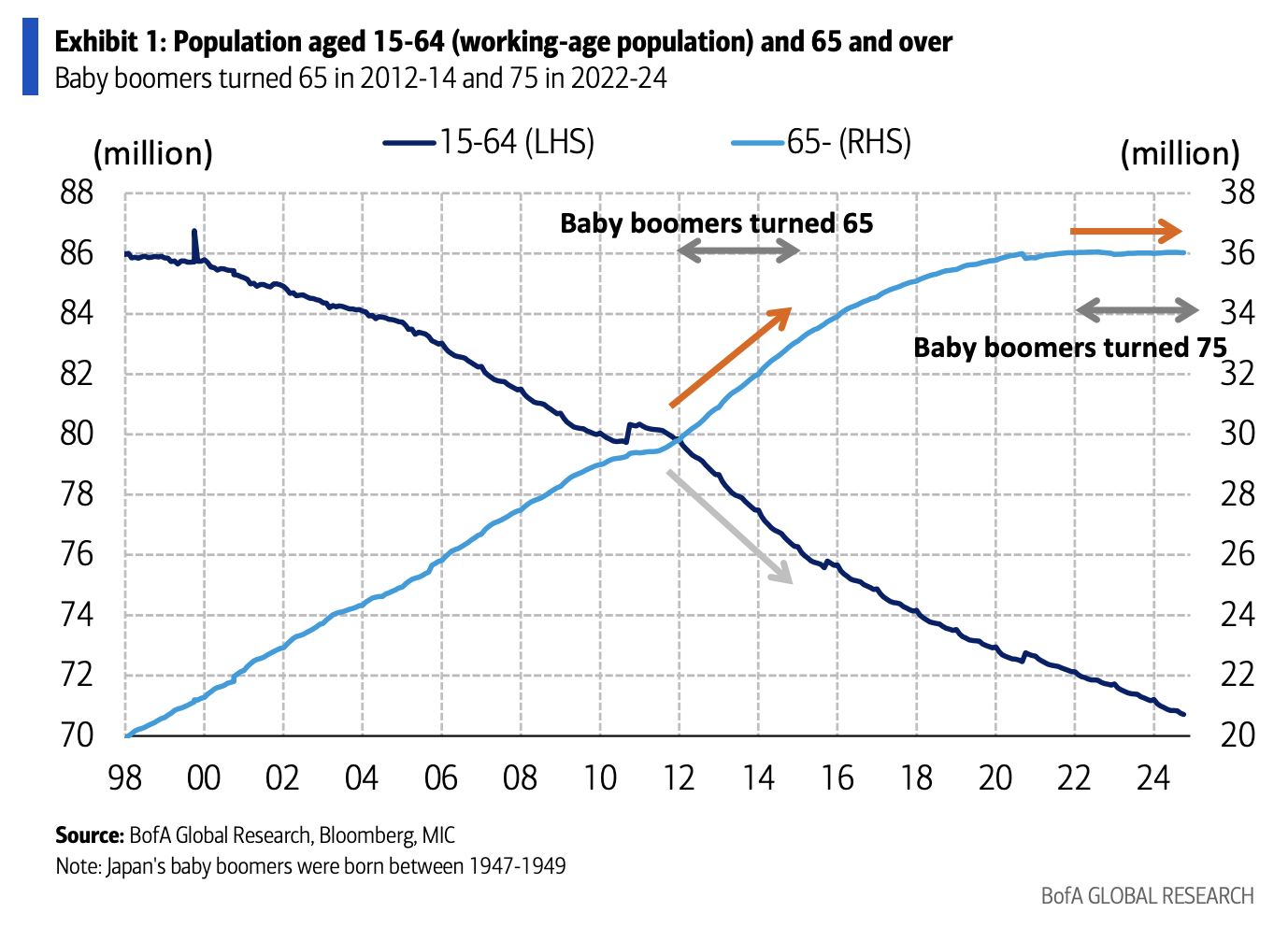
Core Viewpoint - Japan is undergoing an unprecedented structural transformation that is expected to reshape its economic landscape and present significant opportunities for investors [1] Group 1: Structural Transformation - Japan is experiencing a series of structural changes, including a shift towards an inflationary economy, reduced reliance on exchange rates, and accelerated corporate reforms, creating opportunities for investors to reassess the Japanese stock market [1][2] - The retirement of the baby boomer generation is leading to a structural labor shortage, driving Japan towards sustainable inflation [5][12] - The expected core CPI in Japan is projected to reach 1.9% in FY2025 and 2.1% in FY2026, indicating a healthy and sustainable inflation pattern [5] Group 2: Exchange Rate Dependency - The end of excessive yen depreciation is expected to improve trade conditions and enhance Return on Equity (ROE) [1][8] - Japanese companies are accelerating the relocation of production bases overseas and focusing on exporting high-quality products, which makes prices less sensitive to exchange rate fluctuations [8] Group 3: Corporate Reforms - The transition to an inflationary economy is acting as a catalyst for corporate reforms, with companies no longer able to justify hoarding cash that is depreciating [9][12] - Structural labor shortages are creating a demand for continuous wage increases, prompting companies to optimize pricing strategies and improve product and service quality [12] - The Tokyo Stock Exchange's regulatory measures are encouraging companies to be more proactive in stock buybacks, with buybacks increasing even amid weak earnings guidance [12][15] Group 4: Investment Opportunities - Corporate reforms present three major themes for investors: 1. The separation of parent-subsidiary listings is accelerating, with returns of subsidiaries relative to parents increasing since 2024 [15] 2. Companies reducing strategic holdings tend to engage in more stock buybacks, indicating that such reductions can enhance capital efficiency [15] 3. The inflationary environment is expanding opportunities in real estate, particularly for companies holding non-core properties [15] Group 5: Political Risks - The upcoming Senate elections on July 20 pose a short-term risk, as historical data shows that markets tend to be cautious before elections and rebound afterward [16][17] - All major opposition parties plan to include consumption tax cuts in their election manifestos, which could increase the risk of rising interest rates [16]
Columbus McKinnon(CMCO) - 2025 Q4 - Earnings Call Transcript
2025-05-28 15:00
Financial Data and Key Metrics Changes - Columbus McKinnon reported fiscal year 2025 net sales of $963 million, down 4% year over year on a constant currency basis, reflecting lower volume due to short cycle order softness [14] - In the fourth quarter, sales were $246.9 million, a decrease of 5% from the prior year on a constant currency basis, primarily due to a 9% decrease in short cycle sales [14] - Gross profit for the quarter was $79.8 million, down $14.5 million year over year, impacted by factory closure costs and lower sales volume [15] - Adjusted earnings per diluted share decreased by $0.15 versus the prior year, driven by lower volume and unfavorable mix [16] Business Line Data and Key Metrics Changes - Record orders increased by 4% year over year on a constant currency basis, driven by 8% growth in project-related orders and strength in precision conveyance [5] - Short cycle orders were flat on a constant currency basis in the quarter, with improved comparison trends from the third quarter [6] - Backlog increased by 15% year over year to $322.5 million, reflecting strength in project-related orders, particularly in precision conveyance [14] Market Data and Key Metrics Changes - Demand remains strong in vertical end markets such as battery production, life sciences, e-commerce, food and beverage, and aerospace [8] - The company is seeing potential early benefits from industries impacted by tariffs, particularly in steel and heavy equipment [9] - Order activity through mid-May remains encouraging, with orders up year over year and continued overperformance in precision conveyance [8] Company Strategy and Development Direction - The company is focused on operational execution, managing costs, and executing its strategic plan while navigating a challenging macroeconomic environment [12] - Columbus McKinnon is excited about the pending acquisition of Keto Crosby, which is expected to scale the business and enhance customer capabilities [11] - The company aims to achieve tariff cost neutrality by the second half of fiscal 2026 and margin neutrality over time, likely in fiscal 2027 [10] Management's Comments on Operating Environment and Future Outlook - Management expressed optimism about order performance and quotation activity despite macro uncertainty [9] - The company anticipates that the current project versus short cycle mix dynamics will continue to impact sales and margins in the first quarter [9] - Management remains focused on meeting customer needs and delivering long-term value to shareholders despite geopolitical and trade policy uncertainties [56] Other Important Information - The company paid down $60 million of debt in fiscal 2025, including $15 million in the fourth quarter, and continues to prioritize debt repayment [17] - Adjusted EBITDA for the fourth quarter was $36.1 million, with an adjusted EBITDA margin of 14.6% [17] - The company expects a $40 million EBITDA impact from unmitigated tariff exposure based on current knowledge [18] Q&A Session Summary Question: What is the tariff rate embedded for China and EU for the $0.20 to $0.30 headwind in the first half of the year? - The company is factoring in 14.5% on China tariffs and 10% on EU tariffs [25] Question: Can you discuss the near-term outlook and how short cycle sales have trended? - Short cycle sales improved in the latter portion of Q4, with flat year-over-year performance, and growth in order demand is expected [27] Question: Can you elaborate on the tariff situation and the expected net mitigation? - The company anticipates that demand remains uncertain, with potential positive impacts from surcharges and tariffs, but volume reductions may occur due to price increases [32] Question: Where is the strength in precision conveyance orders coming from? - Precision conveyance orders have seen robust demand, particularly from Montrotech and Dorner businesses, with strength in end markets like battery production and e-commerce [35] Question: How does the mix impact margins given the strong precision conveyance orders? - While precision conveyance orders were up, sales were down, leading to a negative impact on margins due to lower volume and mix [41]

美联储穆萨莱姆:听闻在某些行业,某些类型的劳动力有些短缺。
news flash· 2025-05-20 17:45
Group 1 - The Federal Reserve's Musalem noted a shortage of certain types of labor in specific industries [1]
日本央行行长植田和男:由于劳动力短缺持续,工资与物价的良性循环将得以继续。
news flash· 2025-05-01 06:44
日本央行行长植田和男:由于劳动力短缺持续,工资与物价的良性循环将得以继续。 ...