双碳引领

Search documents
明年经济工作怎么干 记住“八个坚持”
Xin Hua She· 2025-12-11 13:30
Core Viewpoint - The Central Economic Work Conference has outlined eight key tasks for economic work in 2026, focusing on domestic demand, innovation, reform, openness, coordinated development, green transformation, improving people's livelihoods, and risk management [1]. Group 1: Domestic Demand and Market Development - Emphasis on maintaining domestic demand as the primary driver and building a strong domestic market [1]. Group 2: Innovation and New Momentum - Focus on innovation-driven growth and accelerating the cultivation of new growth drivers [1]. Group 3: Reform and High-Quality Development - Commitment to tackling reforms to enhance the vitality and momentum for high-quality development [1]. Group 4: Openness and Cooperation - Advocacy for maintaining openness and promoting win-win cooperation across multiple fields [1]. Group 5: Coordinated Development - Support for coordinated development to promote urban-rural integration and regional synergy [1]. Group 6: Green Transformation - Commitment to leading with "dual carbon" goals and promoting comprehensive green transformation [1]. Group 7: Livelihood Improvement - Focus on prioritizing people's livelihoods and striving to address practical issues for the populace [1]. Group 8: Risk Management - Emphasis on safeguarding the bottom line and actively and prudently resolving risks in key areas [1].

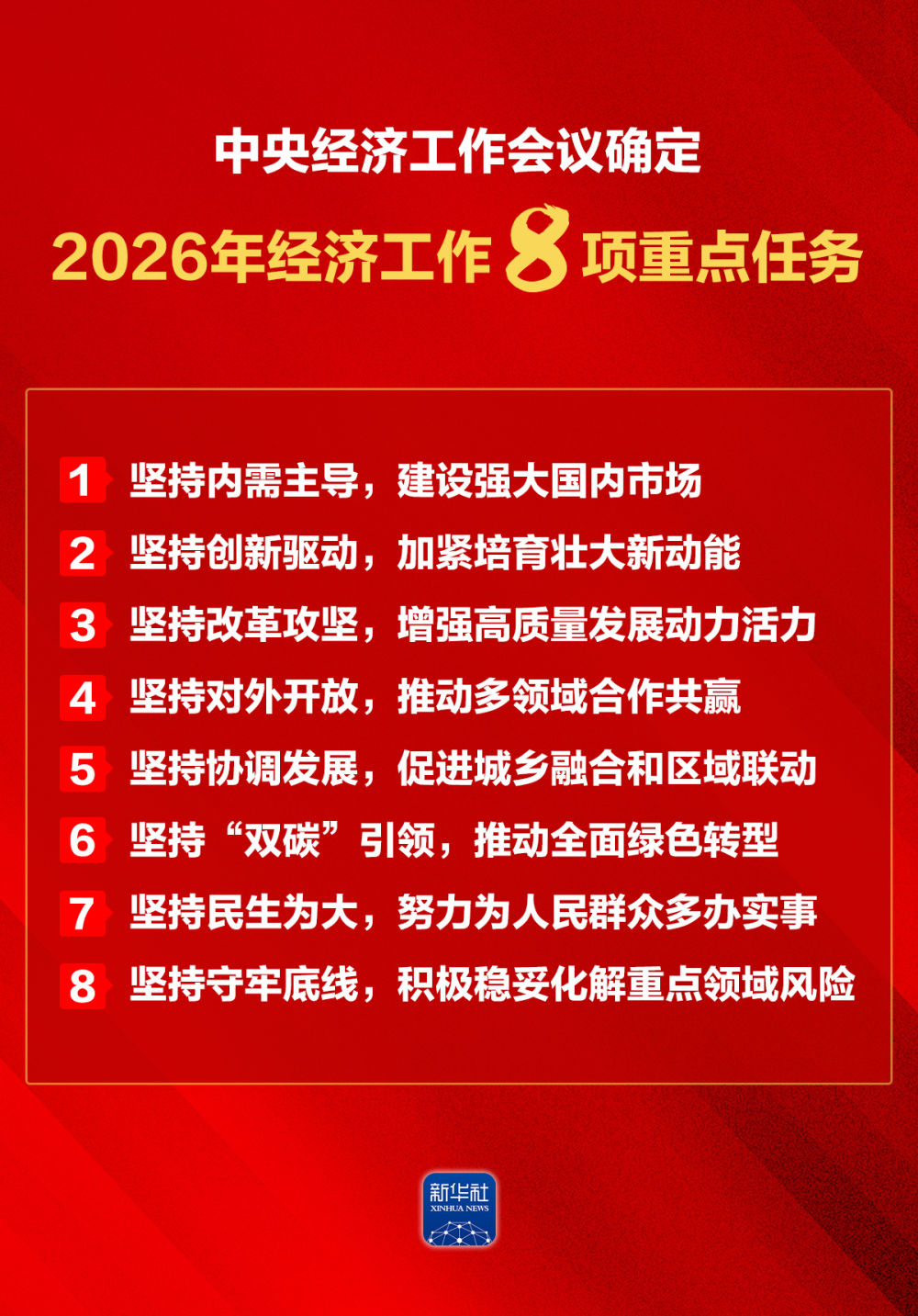
【图解】速览!2026年经济工作八大重点任务
Zhong Guo Jing Ji Wang· 2025-12-11 12:29
Core Viewpoint - The Central Economic Work Conference held on December 10-11 in Beijing outlined eight key tasks for economic work in 2026, focusing on domestic demand, innovation, reform, openness, coordinated development, green transformation, public welfare, and risk management. Group 1: Domestic Demand - Emphasis on leading domestic demand and building a strong domestic market through actions to boost consumption and implement urban and rural income increase plans [1] - Expansion of quality goods and services supply, optimization of "two new" policy implementation, and removal of unreasonable restrictions in the consumption sector to unleash service consumption potential [1][2] - Encouragement of investment stabilization, with an increase in central budget investment scale and optimization of local government special bond usage [1] Group 2: Innovation - Focus on innovation-driven growth by developing a comprehensive plan for education, technology, and talent development [2] - Establishment of international technology innovation centers in key regions such as Beijing, Shanghai, and the Guangdong-Hong Kong-Macau Greater Bay Area [2] - Strengthening the role of enterprises in innovation and improving intellectual property protection in emerging fields [2] Group 3: Reform - Commitment to reform efforts to enhance high-quality development, including the establishment of a unified national market and further deepening state-owned enterprise reforms [3] - Initiatives to clear overdue payments to businesses and promote win-win scenarios for platform enterprises and their operators [3] - Expansion of market-oriented reforms and improvement of the local tax system [3] Group 4: Openness - Promotion of multi-field cooperation and gradual advancement of institutional openness, including the expansion of service sector autonomy and optimization of free trade zone layouts [4] - Encouragement of service exports and development of digital and green trade [4] - Strengthening of foreign investment promotion mechanisms and enhancing overseas service systems [4] Group 5: Coordinated Development - Coordination of urban-rural integration and regional collaboration, focusing on high-quality development in county economies [5] - Maintenance of arable land and food production stability, ensuring reasonable prices for key agricultural products [5] - Support for major economic provinces and enhancement of cooperation among key urban clusters [5] Group 6: Green Transformation - Advancement of energy-saving and carbon reduction initiatives in key industries and the establishment of a new energy system [6] - Strengthening of the national carbon emissions trading market and implementation of comprehensive waste management actions [6] - Promotion of environmental protection initiatives and improvement of disaster response infrastructure [6] Group 7: Public Welfare - Implementation of actions to stabilize employment for key groups such as college graduates and migrant workers, and support for flexible employment [7] - Adjustment of educational resource allocation to increase high school and quality university enrollment [7] - Optimization of drug procurement and deepening of medical insurance payment reforms [7] Group 8: Risk Management - Focus on stabilizing the real estate market with city-specific policies to control inventory and encourage the acquisition of existing housing for social welfare [8]

明年经济工作怎么干,记住“八个坚持”
Xin Hua She· 2025-12-11 12:04
Core Viewpoint - The Central Economic Work Conference has outlined eight key tasks for economic work in 2026, focusing on domestic demand, innovation, reform, openness, coordinated development, green transformation, improving people's livelihoods, and risk management [1] Group 1: Domestic Demand and Market Development - Emphasis on maintaining domestic demand as the primary driver and building a strong domestic market [1] Group 2: Innovation and New Momentum - Focus on innovation-driven strategies to cultivate and strengthen new growth drivers [1] Group 3: Reform and High-Quality Development - Commitment to reform efforts aimed at enhancing the vitality and momentum for high-quality development [1] Group 4: Openness and Cooperation - Advocacy for sustained openness to promote win-win cooperation across multiple fields [1] Group 5: Coordinated Development - Promotion of coordinated development to facilitate urban-rural integration and regional collaboration [1] Group 6: Green Transformation - Leadership in "dual carbon" initiatives to drive comprehensive green transformation [1] Group 7: Livelihood Improvement - Prioritization of people's livelihoods with efforts to address practical issues for the populace [1] Group 8: Risk Management - Focus on maintaining bottom lines and actively managing risks in key areas [1]
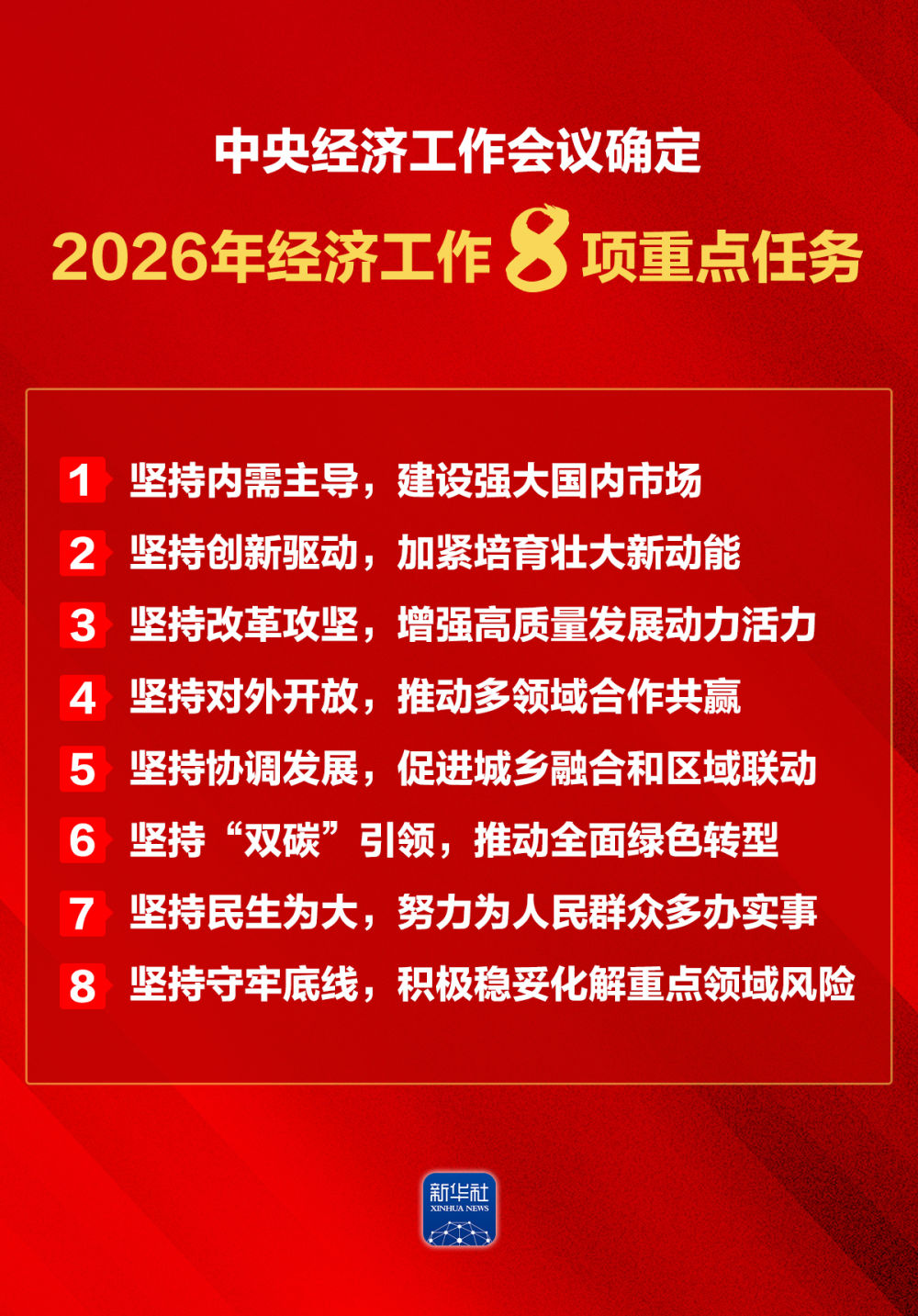
中央经济工作会议:确定明年八大重点任务
2 1 Shi Ji Jing Ji Bao Dao· 2025-12-11 11:21
Core Viewpoint - The Central Economic Work Conference held on December 10-11 in Beijing outlined key tasks for economic work in the coming year, emphasizing a focus on domestic demand, innovation, reform, openness, coordinated development, green transformation, people's livelihood, and risk management [1] Group 1: Economic Focus Areas - Emphasis on domestic demand as the main driver to build a strong domestic market [1] - Innovation-driven approach to accelerate the cultivation and growth of new economic drivers [1] - Commitment to reform efforts to enhance the vitality and momentum for high-quality development [1] Group 2: External Relations and Development - Focus on promoting cooperation and win-win outcomes in multiple fields through openness [1] - Coordination in development to promote urban-rural integration and regional linkage [1] Group 3: Sustainability and Social Welfare - Leadership in "dual carbon" initiatives to promote comprehensive green transformation [1] - Prioritization of people's livelihood with efforts to address practical issues for the populace [1] Group 4: Risk Management - Commitment to maintaining a bottom line by actively and prudently addressing risks in key areas [1]
华夏时评:以“积极宽松”政策锚定“八个坚持”
Hua Xia Shi Bao· 2025-12-11 11:16
Core Viewpoint - The central economic work conference held on December 10-11, 2023, emphasized the importance of utilizing fiscal and monetary policies effectively to achieve the goals set for 2026, marking the beginning of the "15th Five-Year Plan" [2][4]. Group 1: Economic Policy Direction - The conference reiterated the implementation of a more proactive fiscal policy and moderately loose monetary policy, aiming to enhance macroeconomic governance effectiveness [2][4]. - The "Eight Persistences" were highlighted as key strategies for economic work in 2026, focusing on domestic demand, innovation, reform, openness, coordinated development, carbon neutrality, people's livelihood, and risk management [3][4]. Group 2: Implementation Strategies - Fiscal and monetary policies are expected to work in tandem to support the "Eight Persistences," with fiscal funds directed towards infrastructure and innovation, while monetary policy aims to provide low-cost funding to high-tech enterprises [4][5]. - Specific measures include fiscal support for necessary reforms, maintaining a stable financial environment, and promoting regional balance and rural revitalization through targeted fiscal transfers [5][6]. Group 3: Long-term Goals - The success of China's economic development in 2026 will not solely be measured by GDP growth but also by the integration of macro policy resources with the strategic layout of the "Eight Persistences" [6]. - The proactive policies are seen as essential for navigating complex challenges and ensuring a strong start to the "15th Five-Year Plan" [6].

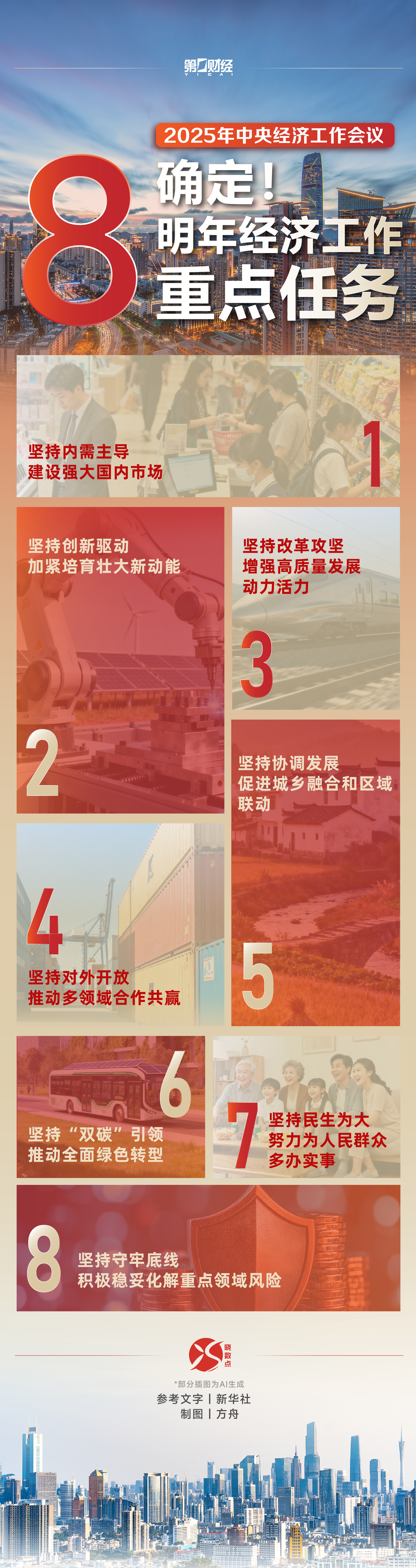
晓数点丨速览!明年经济工作8大重点任务
Di Yi Cai Jing· 2025-12-11 10:05
一图看懂>> 坚持创新驱动 加紧培育壮大新动能 坚持内需主导 建设强大国内市场 坚持"双碳"引领 推动全面绿色转型 坚持守牢底线 积极稳妥 13 *部分插图 参考文字 制 图 01 US II PHETE TFL r 244443333333333333333333333333333 HIHHHHHHHS IN NEW YORK AND THE RECENT POLICE HEHOU NEW AFFS INDUSTRIAL n - Paula Tencere - FIND DOGS rem E TCHILLS 2 2011 13:44 THE BEATH STERE 前前面前的新聞的 THE LEASE THE COLLECTION COLLECTION 10 i 品制度度 The Home Than 112 . Bux .. Home H iki 398888-94 2019 | Fulle all and the Giath TENN Han EM = 11 12 El TH l=1 ri Heal F th the I B -FRDP ULLER 200 HQF 1900 800 1000 1000 1 ...
炊具行业热议转型升级新路径
Zhong Guo Jing Ji Wang· 2025-12-10 03:05
Core Insights - The Chinese cookware industry is at a pivotal point of green and digital transformation, with a market size reaching one trillion yuan [1] - The industry is expected to achieve a production value of 104.7 billion yuan in 2024 and 107.8 billion yuan in 2025, with exports projected at 11.5 billion USD and domestic sales at 20 billion yuan for 2024 [1] - The industry faces challenges such as high labor costs, homogenization, and market saturation, shifting focus from quantity expansion to quality improvement [1] Group 1 - The 30th National Cookware Industry Information Exchange Conference and the 5th China Cookware Technology Conference was held in Shanghai, focusing on "Green Manufacturing, Dual Carbon Leadership, and Intelligent Future" [1] - The China Daily Hardware Technology Development Center emphasizes the importance of standard leadership and quality testing to support the industry's high-quality development [1] - The industry is encouraged to align with the "14th Five-Year Plan," focusing on technological innovation and development towards smart, healthy, individualized, and elderly-friendly products [1][2] Group 2 - The cookware industry is transitioning from functional satisfaction to experience enhancement, driven by health concepts and policy guidance [2] - The industry is characterized by high-frequency usage, short replacement cycles, and a younger consumer base, necessitating resonance with young consumers through collaborative innovation [2] - Companies are advised to strengthen their domestic market presence while exploring emerging overseas markets in Southeast Asia and the Middle East [2]
中共中央政治局:明年经济工作要坚持稳中求进、提质增效,继续实施更加积极的财政政策和适度宽松的货币政策
Xin Hua She· 2025-12-09 00:52
中共中央政治局12月8日召开会议,分析研究2026年经济工作,审议《中国共产党领导全面依法治国工 作条例》。中共中央总书记习近平主持会议。会议指出,明年经济工作要坚持稳中求进、提质增效,继 续实施更加积极的财政政策和适度宽松的货币政策,发挥存量政策和增量政策集成效应,加大逆周期和 跨周期调节力度,切实提升宏观经济治理效能。要坚持内需主导,建设强大国内市场;坚持创新驱动, 加紧培育壮大新动能;坚持改革攻坚,增强高质量发展动力活力;坚持对外开放,推动多领域合作共 赢;坚持协调发展,促进城乡融合和区域联动;坚持"双碳"引领,推动全面绿色转型;坚持民生为大, 努力为人民群众多办实事;坚持守牢底线,积极稳妥化解重点领域风险。 ...
长三角主流媒体将走进“来电”宜昌,探寻高质量发展密码
Xin Lang Cai Jing· 2025-04-20 06:11
Core Viewpoint - Yichang is leveraging its abundant hydropower resources, particularly from the Three Gorges Dam, to drive economic growth and development, aiming to become a key engine for high-quality development in Central China by 2024 with a GDP target of 619.1 billion yuan [1][5]. Economic Development - Yichang's GDP is projected to exceed 600 billion yuan, reaching 619.1 billion yuan in 2024, marking a significant milestone as the "first city in Central China that is not a provincial capital" [5][7]. - The city has experienced a robust industrial transformation, with a growth rate of 6.5% in GDP, supported by emerging industries such as modern chemical new materials, life health, new energy, and big data [4][5]. - Yichang's government is implementing a development strategy focused on "dual carbon leadership, hub empowerment, and strong industry to enrich the city" [7]. Industrial Growth - The city is home to the world's largest hydropower station, the Three Gorges Dam, and over 400 hydropower stations, which contribute significantly to the green energy supply for the Yangtze River Economic Belt [3][4]. - Major projects worth 136.8 billion yuan are underway, including advancements in biotechnology and electric vehicle battery production, showcasing Yichang's commitment to industrial upgrading [7][8]. Rural Development - Yichang is revitalizing its rural economy through the development of local specialties, transforming products like oranges and konjac into significant industries [8][9]. - Innovative agricultural practices, such as smart sorting for fruit and high-end fish farming, are enhancing the value of local products and improving farmers' incomes [9]. Cultural and Tourism Development - Yichang is positioned as a cultural and natural hub, with rich historical resources and 72 A-level scenic spots, including four 5A-level attractions [10][13]. - The city is developing into a world-class tourist destination, integrating night economy initiatives like the "Yangtze River Night Tour," which combines cityscapes, hydropower culture, and leisure activities [10][13].