
权益市场投资

Search documents
银行理财“跑步”打新,宁银理财7只产品成功入围三只新股
Hua Xia Shi Bao· 2025-08-05 07:47
Core Insights - The A-share market has seen a significant increase in new listings, with 59 companies going public this year, and 52 of them experiencing a price increase of over 100% on their first trading day [2][9] - The enthusiasm for participating in IPOs through bank wealth management products has surged, with Ningyin Wealth Management becoming the second bank wealth management company to successfully participate in the offline IPO market [2][4] Summary by Sections New Listings and Market Performance - In 2023, 59 new companies were listed on the A-share market, with 52 achieving over 100% price increase on their debut, and 16 exceeding 300% [2][9] - The total fundraising amount from these IPOs reached 61.5195 billion yuan, with no companies experiencing a price drop below their issue price [8] Participation of Wealth Management Companies - Ningyin Wealth Management has successfully participated in three new stock subscriptions, including companies like Hansang Technology and Guangdong Construction Science Research Institute [3][5] - As of July 25, Ningyin Wealth Management ranked first among bank wealth management companies in terms of the number of products participating in offline IPOs [2] Regulatory Changes and Market Dynamics - Since the implementation of new IPO underwriting regulations on March 28, bank wealth management companies have been classified as "A-class investors," allowing them to participate in offline IPOs on equal footing with public funds [4][7] - Currently, nine wealth management companies have registered as offline investors, with only two successfully completing new stock subscriptions [7] Company Performance and Growth Potential - The companies that Ningyin Wealth Management has subscribed to show promising growth, with Hansang Technology projected to have a revenue growth of 40.98% and net profit growth of 86.52% from 2022 to 2024 [5] - Guangdong Construction Science Research Institute and Tianfulong Group also exhibit positive growth trends in their financial forecasts for 2023 and 2024 [5] Investment Strategies and Research - Ningyin Wealth Management has established a 20-person equity research team to analyze industry trends, competitive advantages, and financial data when selecting IPO candidates [6] - The company is actively diversifying its investment strategies, including participation in both A-share and Hong Kong IPOs [10]


买入!
中国基金报· 2025-07-25 05:42
Core Viewpoint - On July 24, the A-share market experienced slight fluctuations, with the Shanghai Composite Index closing above 3600 points and a total trading volume of 1.9 trillion yuan. The stock ETF saw a net inflow of 1.7 billion yuan, indicating continued interest from investors in the market [2][3][4]. Fund Inflows - On July 24, stock ETFs had a net inflow of 1.7 billion yuan, with 31 ETFs receiving over 100 million yuan each. The top three ETFs by net inflow were Huatai-PB CSI 300 ETF, Southern CSI 1000 ETF, and Fortune Hong Kong Internet ETF, each exceeding 700 million yuan in inflow [6][7]. - The sectors attracting the most inflow included the CSI 1000 Index (net inflow of 1.67 billion yuan), Hong Kong Financial Index (1.64 billion yuan), and CSI 300 Index (1.31 billion yuan) [6][7]. Fund Outflows - On the same day, 29 ETFs experienced net outflows exceeding 100 million yuan, with the CSI A500 ETF, ChiNext ETF, and STAR 50 ETF among those with the highest outflows [10]. - The total outflow from stock ETFs in July has reached over 2 billion yuan, with significant outflows from the CSI A500 ETF, CSI 300 ETF, and ChiNext ETF [10]. Market Trends - The Hong Kong market has shown strong performance, with net inflows into related ETFs reaching 20 billion yuan in July alone. The inflows were particularly strong in sectors such as securities, non-bank financials, and technology [3][7]. - Despite the overall market fluctuations, there are structural investment opportunities, especially in growth sectors, as indicated by fund managers [10][11]. ETF Performance - As of July 24, there were 1,151 stock ETFs in the market, with a total scale of 3.82 trillion yuan. The top-performing ETFs included the CSI 300 ETF with a scale of 391.7 billion yuan and the CSI 1000 ETF with 69.6 billion yuan [5][8]. - The performance of various ETFs showed that the Hong Kong-related ETFs had significant inflows, while some broad-based and thematic ETFs faced notable outflows [9][10].

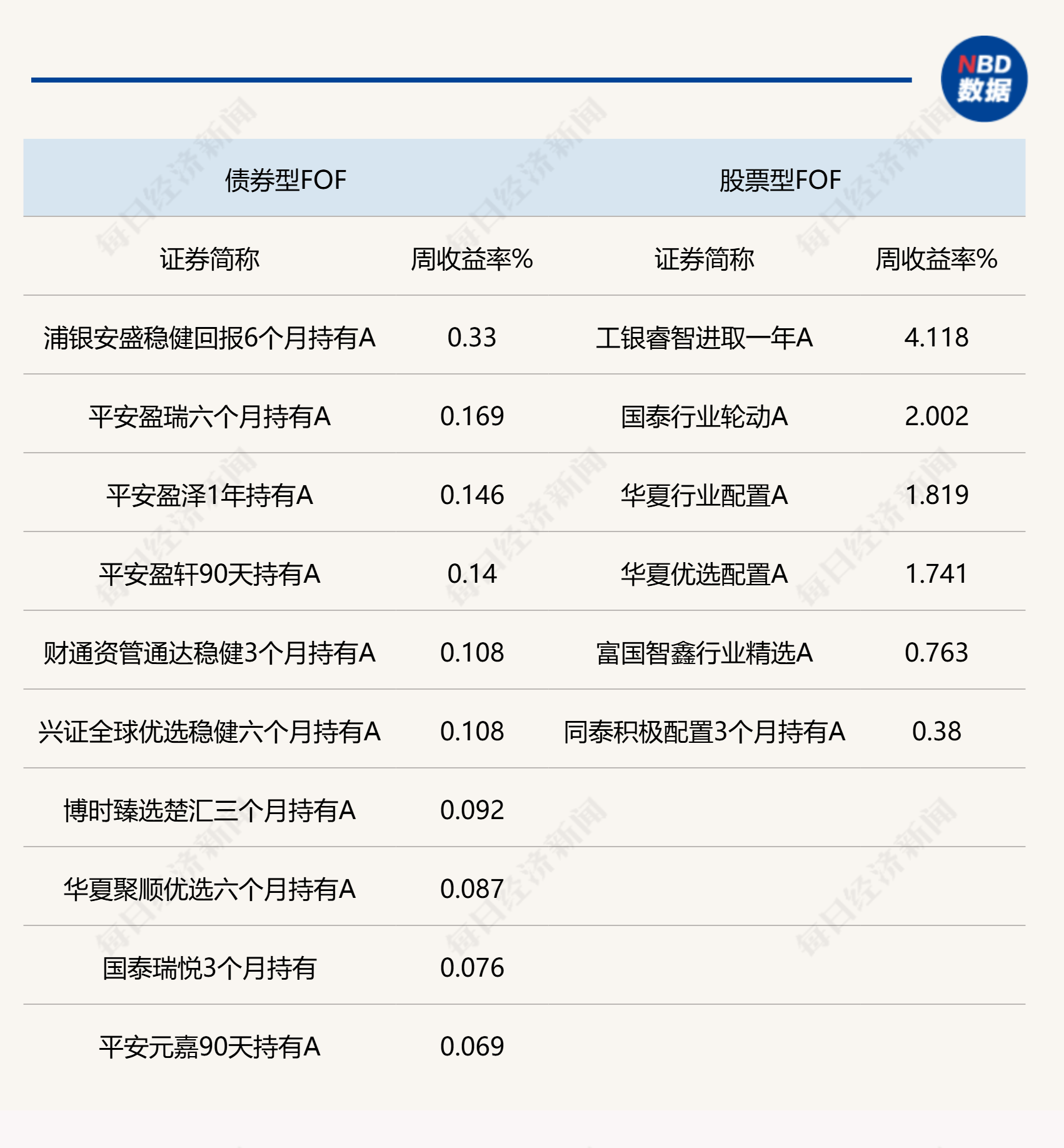
权益市场热度不减,多只公募FOF单周收益率超4%,创新药、稀土等行业备受关注
Sou Hu Cai Jing· 2025-07-21 09:55
Group 1 - The equity market has attracted attention again, with the Shanghai Composite Index recording four consecutive weeks of weekly gains, particularly in sectors like innovative pharmaceuticals and rare earths [1][2] - Publicly offered Fund of Funds (FOF) have shown high investment success rates, with some equity FOFs achieving weekly net value increases exceeding 4% [2][3] - The second quarter reports reveal that many funds have allocated resources to high-interest sectors, with specific sub-indices performing well and being heavily held by various FOFs [2][4] Group 2 - The performance of various funds indicates a focus on related sectors, with successful funds investing in both index and actively managed products, as well as in specific industry indices [3][4] - The A-share market continues its upward trend, driven by strong performance in the upstream computing sector and the telecommunications sector, while the banking sector has weakened [3][4] - Increasingly, FOFs are focusing on healthcare and military-related funds, with several funds making significant allocations to these sectors in their second-quarter reports [4][5] Group 3 - Long-term investment opportunities are anticipated in the military sector, with expectations of an overall market upturn as issues affecting military planning are resolved [5]
下半年投资“风向标”出炉 基金公司集体掘金科技与消费赛道
Zheng Quan Ri Bao· 2025-06-30 16:16
Core Viewpoint - The domestic capital market in China is demonstrating unique resilience amid a complex global economic environment, with a significant increase in the investment value of Chinese assets and a focus on technology innovation and new consumption trends as dual main lines for the equity market [1][2][6]. Economic Resilience - Fund companies agree that China's economic resilience and vitality are increasingly evident, despite uncertainties in the global political and economic landscape [2]. - The transition from old to new economic drivers is seen as a critical turning point, presenting vast potential for growth [2]. - The Chinese economy has reportedly moved past its most challenging adjustment period, with a sustained trend towards high-quality development [2]. Equity Market Focus - Fund companies identify structural investment opportunities in the equity market, particularly in technology and new consumption sectors [3]. - The A-share market is viewed as having upward potential at current valuation levels, with internal growth and policy benefits expected to drive independent market performance [3]. - The AI sector is highlighted as a key area for investment, with expectations for strong performance driven by advancements in AI applications and infrastructure [3][4]. Investment Strategies - The semiconductor sector is recommended for investment, with suggestions to maintain a 30% to 50% position in semiconductor ETFs to capture long-term gains [4]. - New consumption trends are identified, including spiritual consumption and cost-effective consumption, which are expected to shape mid-to-long-term investment logic [4]. - Fund managers suggest exploring investment opportunities in experiential consumption, AI-driven consumption, and service-oriented consumption [4]. Bond Market Outlook - The bond market is expected to maintain a positive outlook, with a return to a bullish trend following previous short-term fluctuations [5]. - Structural opportunities within the bond market are anticipated, with recommendations to embrace yield-bearing assets and engage in wave trading while monitoring policy changes and economic data [5]. - Specific bond types, such as bank subordinated bonds and convertible bonds, are noted for their potential to provide excess returns in the current environment [5].
首席来了|前海开源杨德龙:年轻人不要急于买房,把握权益市场投资机会
Zhong Guo Jing Ying Bao· 2025-05-20 14:53
Core Viewpoint - The current economic environment is characterized by rising uncertainty and declining deposit rates, which pose challenges for investors in asset allocation and balancing risk and return [1][2]. Group 1: Economic Environment and Policy - The People's Bank of China maintains low interest rates to support a robust capital market, which is essential for boosting consumer confidence and addressing economic challenges [1]. - The decline in deposit rates reflects policy intentions and has a positive impact on the steady recovery of the economy, providing strong support for the capital market [2]. Group 2: Asset Allocation Strategies - In the context of declining deposit rates, residents are diversifying their asset allocation strategies, with some opting for fund investments to achieve capital appreciation, particularly in the rising technology sector [3]. - The current asset allocation in Chinese households shows a significant reliance on real estate, with approximately 60% of assets previously allocated to housing, while only about 5% is in equities and funds [4]. - There is a growing trend towards reducing real estate allocation and increasing equity investments, particularly in high-quality stocks and funds, as the capital market becomes more attractive [5]. Group 3: Investment Opportunities - Key sectors to focus on include technology stocks, consumer stocks, and dividend-paying stocks, with technology stocks leading the market due to their role in economic transformation [6][7][8]. - The technology sector, particularly AI and robotics, is seen as a significant growth area, with potential for substantial development in the coming years [6]. - Consumer stocks, especially brand-name products, are gaining attention due to their stable profitability and attractive valuations after recent adjustments [7]. - Dividend stocks, particularly in the banking and utility sectors, are appealing in the current market environment, providing stable returns and aligning with the preferences of large investors [8]. Group 4: Age-Based Asset Allocation - Asset allocation strategies should adapt to different life stages, with younger individuals encouraged to invest a higher proportion in equities due to their risk tolerance and time horizon [9][10]. - As individuals age, it is advisable to gradually reduce equity exposure and shift towards more stable fixed-income products to ensure financial security in retirement [10][12]. - For older adults, a conservative investment approach is recommended, focusing on low-risk assets while maintaining a small allocation to equities for potential growth [12].