
现代化人民城市建设

Search documents
信长星在省委城市工作会议上强调突出高质量发展主题内涵式发展主线 加快建设现代化人民城市刘小涛主持 张义珍出席
Xin Hua Ri Bao· 2025-11-17 23:29
Group 1 - The meeting emphasized the importance of implementing Xi Jinping's important discourse on urban work and the strategic deployment of the 20th Central Committee regarding urban development, focusing on high-quality and connotative development [1][2] - The meeting highlighted the need for Jiangsu to take the lead in promoting Chinese-style modernization, enhancing urban development capabilities, and participating in global urban competition [2] - Key strategies discussed include optimizing urban structure, promoting innovative economies, improving urban quality, facilitating green transformation, ensuring risk prevention, and enhancing governance efficiency [2][3] Group 2 - The meeting called for strengthening the Party's comprehensive leadership over urban work and establishing a scientific urban development evaluation system [3] - Various local governments presented their progress on new urbanization and urban development during the meeting [3][4]
刘烈宏出席2025新型智慧城市发展创新大会并在山东开展调研
Xin Lang Cai Jing· 2025-11-14 14:43
Core Insights - The focus is on enhancing urban governance efficiency and creating a better digital life through practical and effective measures [1] - Emphasis on deepening the integration of industry and city to foster new urban development momentum [1] - The importance of digital upgrades in traditional infrastructure and community smart upgrades is highlighted [1] Group 1 - Liu Liehong, the head of the National Bureau of Statistics, emphasizes the need for practical effectiveness in urban governance [1] - The initiative aims to create a better digital life that is tangible and accessible to citizens [1] - The strategy includes strengthening the collaborative and efficient digital foundation of cities [1] Group 2 - The research team conducted visits to various companies, including Shandong Youbaote Intelligent Robot Co., Ltd. and Yantai Port Co., Ltd., to understand the development of digital industry clusters [1] - The focus is on the overall digital transformation of cities and the digital transformation of enterprises [1] - The initiative aims to stimulate the synergistic optimization and innovative integration of data elements in urban development [1]
充分激活开发区“竞长群发”效应
Xin Hua Ri Bao· 2025-11-05 21:59
Core Viewpoint - The development of modern urban cities in China, characterized by innovation, livability, beauty, resilience, civilization, and intelligence, is significantly supported by development zones, which play a crucial role in urban modernization and high-quality development [1][2]. Group 1: Development Zones' Role - Development zones are essential for urban modernization, acting as strong engines for economic growth, new carriers for urban space expansion, stages for urban function upgrades, and experimental fields for institutional innovation [1][2]. - The Yangtze River Delta region has 140 national-level development zones and 460 provincial-level or above development zones, showcasing their importance in urban development [1]. - Jiangsu province has the highest number of national-level economic and technological development zones in the top 30 rankings, with Suzhou being the city with the most zones listed [1]. Group 2: Inter-Zonal Relationships - The rapid development of various levels of development zones reflects the leadership of the Communist Party of China and the advantages of the socialist system in urban modernization [2]. - The inter-zonal relationships among development zones manifest as competition, complementarity, cooperation, and cross-radiation, enhancing regional economic development and public service investment [2]. - The integration of urban clusters and metropolitan areas is increasingly driven by development zones, particularly in major economic regions like the Yangtze River Delta, Pearl River Delta, and Beijing-Tianjin-Hebei [2]. Group 3: Future Directions - Development zones are tasked with pioneering roles in the modernization of cities, with a focus on achieving coordinated, linked, and integrated development [3]. - The emphasis is on utilizing systematic thinking to explore effective paths for high-quality governance, technological innovation, and improved living standards [3]. - The ongoing interaction between theoretical and practical innovations is crucial for stimulating new momentum in urban modernization [3].
凝聚各方智慧擘画上海“十五五”蓝图 上海开展“百家访谈、万家调研” 收到社会各界意见建议三万余条
Jie Fang Ri Bao· 2025-10-21 01:48
Core Points - Shanghai's "15th Five-Year Plan" is in the final stages of public opinion collection, with significant participation from various sectors, including 147 entrepreneurs and strategic scientists, yielding over 34,000 suggestions [1][3] - The plan aims to enhance Shanghai's global influence and competitiveness, with the city's GDP reaching 5.39 trillion RMB, ranking it fifth among global cities [1][2] Group 1: Expert Opinions and Recommendations - The establishment of the "15th Five-Year Plan" Expert Advisory Committee, consisting of 26 experts from various fields, aims to enhance the plan's professionalism and strategic thinking [3][4] - Key recommendations include building a large research system, enhancing supply chain capabilities, and improving financial infrastructure to integrate AI with financial services [3][4] - Experts emphasize the need for innovation in the semiconductor industry and the development of a modern urban transportation system [4] Group 2: Public Participation and Suggestions - The public engagement process included 77 roundtable discussions with over 1,900 citizens, resulting in more than 10,000 suggestions, highlighting the importance of citizen input in the planning process [5][7] - Suggestions from citizens range from improving accessibility features to developing customizable skill training packages for new employment groups [5][6] Group 3: Legislative Framework - The introduction of the "Shanghai Development Planning Regulations" provides a legal basis for the "15th Five-Year Plan," marking the first time a development plan has been legislated in Shanghai [9][10] - The regulations aim to ensure coordinated planning across various sectors and enhance the efficient allocation of resources, which is crucial given the complex economic environment [9][10]
开创现代化人民城市建设新局面
He Nan Ri Bao· 2025-10-17 23:16
Core Insights - The article emphasizes the importance of urban development in enhancing the quality of life and supporting the modernization of China, particularly in the context of Henan province [1][2][3] Group 1: Urban Development Strategy - The strategy focuses on transitioning from rapid urban expansion to enhancing the quality and efficiency of existing urban areas, aligning with new expectations from the public and reform requirements [2][3] - The provincial urbanization rate increased from 55.43% in 2020 to 59.22% in 2024, indicating a significant shift towards urban living [2] - A total of 6,487 urban renewal projects have been implemented with an investment of 1,091.8 billion, showcasing a commitment to improving urban infrastructure [2] Group 2: Infrastructure and Quality of Life - By the end of 2024, the per capita urban road area in Henan is projected to reach 18.4 square meters, reflecting improvements in urban infrastructure [2] - The total length of urban roads increased from 10,800 kilometers in 2012 to 34,300 kilometers in 2024, demonstrating substantial growth in transportation networks [2] - Since the start of the 14th Five-Year Plan, 15,100 old urban residential communities have been renovated, benefiting 1.74 million households, which highlights efforts to enhance living conditions [2] Group 3: Goals and Principles - The article outlines a vision for building innovative, livable, beautiful, resilient, civilized, and smart modern cities, with a focus on high-quality urban development [3] - It emphasizes the need for systematic efforts and collaboration to optimize urban structures, transform economic drivers, and enhance quality and sustainability [3] - The article calls for a coordinated approach to urban development that leverages local resources and advantages, aiming to create a modern urban system unique to Henan [3]
奋勇争先,决战决胜“十四五”|走出一条中国特色城市现代化新路子
Ren Min Ri Bao· 2025-10-17 04:02
Core Points - The construction of modern urban areas is emphasized as a key aspect of modernization and improving people's quality of life, with a focus on innovation, livability, beauty, resilience, civilization, and intelligence [1] - The transformation of old industrial parks into entrepreneurial communities reflects the essence of modern urban development, highlighting the importance of green and low-carbon initiatives [2] - The establishment of a comprehensive housing security system in China has significantly improved living conditions for over 170 million people, with extensive community service facilities being added [3] - Urban development is characterized by the cultivation of new growth drivers and the enhancement of historical and cultural preservation, with cities showcasing diverse strengths [4] - Coordinated urban planning and governance have led to substantial investments and infrastructure improvements, particularly in major urban centers [5] - The integration of community participation in urban governance is crucial for addressing urban challenges and promoting high-quality urban development [7] Summary by Sections Urban Modernization Goals - The central government has set clear goals for modern urban development, focusing on a unique Chinese path to urban modernization [1] Transformation of Industrial Areas - The rejuvenation of the high-tech park in Hangzhou illustrates the shift towards innovative industries and sustainable practices [2] Housing and Community Services - China has built the world's largest urban housing security system, benefiting millions and enhancing community facilities [3] New Growth Drivers and Cultural Preservation - Cities are leveraging their unique resources for innovation and cultural heritage, contributing to overall urban strength [4] Urban Planning and Investment - Significant investments in urban infrastructure are evident, particularly in Beijing and Xiong'an New Area, showcasing effective urban governance [5] Community Engagement in Urban Governance - The use of community feedback mechanisms is essential for effective urban management and development [7]
走出一条中国特色城市现代化新路子(奋勇争先,决战决胜“十四五”)
Ren Min Ri Bao· 2025-10-16 22:15
Group 1: Urban Modernization Goals - The construction goal of modernized people-oriented cities emphasizes innovation, livability, beauty, resilience, civilization, and intelligence, as highlighted in the Central Urban Work Conference held in July [1] Group 2: Urban Renewal and Green Development - The transformation of the old Gaokai Cloud Port Park in Hangzhou into a startup community reflects the essence of modernized people-oriented cities, focusing on industries like AI, biotechnology, and e-commerce [2] - The park's renovation incorporates green and low-carbon principles, featuring "zero-carbon buildings" equipped with energy-efficient systems and photovoltaic storage technology, achieving a balance in electricity supply and demand [2] Group 3: Community Development and Housing Security - The establishment of community canteens and recreational facilities in Jiangxi's Ganzhou enhances the living conditions for residents, showcasing a focus on convenience and comfort [3] - China has built the world's largest urban housing security system, with over 68 million units of various types of affordable housing and relocation housing constructed, benefiting 170 million people [3] Group 4: Economic Growth and Cultural Heritage - The ongoing transition from old to new economic drivers in over 690 cities highlights the diverse resource endowments and foundational conditions across regions, fostering innovation and cultural preservation [4] - Urban areas like Shenzhen and Fuzhou serve as experimental grounds for new technologies and products, while also preserving historical cultural sites, contributing significantly to national GDP [4] Group 5: Urban Planning and Infrastructure Development - Beijing's sub-center has maintained an investment intensity of over 100 billion yuan for five consecutive years, transforming former industrial sites into green spaces and developing major transportation hubs [5] - The Xiong'an New Area has expanded significantly, with over 300 branches of central enterprises established, indicating robust urban planning and development efforts [5] Group 6: Collaborative Urban Governance - Innovative governance methods in cities like Beijing and Shanghai, such as community deliberation and feedback mechanisms, are being employed to address urban management challenges and enhance citizen participation [7] - The focus on high-quality urban development and the integration of top-down design with grassroots exploration is essential for advancing the modernization of people-oriented cities [7]
以创新赋能现代化人民城市建设
Jing Ji Ri Bao· 2025-09-24 22:49
Group 1 - The core idea emphasizes the importance of innovation in building modern urban environments, as highlighted in the Central Urban Work Conference, which prioritizes creating vibrant innovation cities to drive high-quality urban development [1][2] - The relationship between technological innovation and the construction of modern urban environments is crucial, necessitating the creation of an open and efficient innovation ecosystem [1][2] - The concept of "People's City" is central, focusing on the need for urban development to meet the diverse needs of citizens through technological advancements [2][3] Group 2 - The strategy includes enhancing urban governance capabilities through smart city initiatives, which aim to improve public service accessibility and efficiency [2][3] - Emphasis is placed on the integration of innovation and industry, with a focus on collaborative development among cities to optimize regional innovation resources [3][4] - The development of urban clusters and metropolitan areas is encouraged to enhance the overall capacity for economic and social development [3][4] Group 3 - The importance of cultivating an innovative ecosystem is highlighted, with a focus on value co-creation and the connection between various innovation entities [5][6] - Successful examples of urban innovation ecosystems, such as Shanghai's "Mosu Space," demonstrate the benefits of fostering collaboration among enterprises [5][6] - The need for a supportive environment that encourages exploration and tolerates failure is emphasized to enhance the city's innovative culture [6]
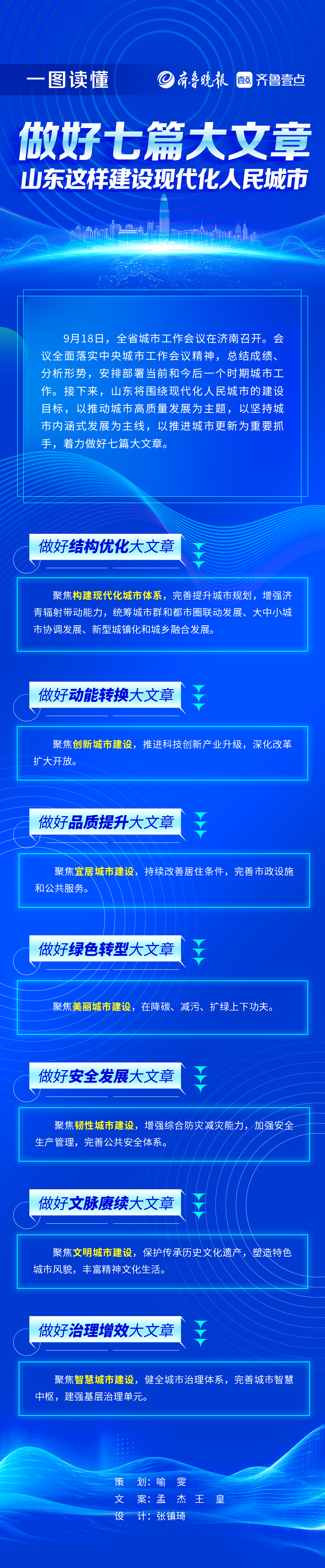
壹图读懂|做好七篇大文章,山东这样建设现代化人民城市
Qi Lu Wan Bao· 2025-09-18 12:29
Core Viewpoint - The meeting held in Jinan on September 18 focused on implementing the central urban work meeting's spirit, summarizing achievements, analyzing the current situation, and planning future urban work in Shandong province [1] Group 1: Urban Development Strategies - The province aims to build a modernized people's city, emphasizing high-quality urban development and inner-city development [1] - Key strategies include optimizing urban structure, enhancing urban planning, and promoting coordinated development among cities and urban-rural integration [3] - The focus will also be on innovation in urban construction, technological upgrades, and expanding reforms and openness [4][5] Group 2: Quality of Life Improvements - Efforts will be made to improve living conditions, municipal facilities, and public services to create a more livable city [3] - The initiative includes enhancing resilience in urban planning to improve disaster prevention and public safety management [6][7] Group 3: Cultural and Governance Enhancements - The plan emphasizes the protection and inheritance of historical and cultural heritage, shaping unique urban characteristics, and enriching cultural life [8][9] - There will be a focus on smart city development, improving urban governance systems, and strengthening grassroots governance units [10][11]

加快推进新城建设南北转型 市人大常委会开展专题调研
Jie Fang Ri Bao· 2025-09-12 01:45
Core Points - The Shanghai Municipal People's Congress is conducting research on the construction of the "Five New Towns" and the "North-South Transformation" development strategy, which aims to optimize urban spatial layout and serve the Yangtze River Delta region [1][2] - The focus is on enhancing urban development through innovation, livability, beauty, resilience, civilization, and intelligence, with an emphasis on quality improvement and upgrading of the new towns and transformation efforts [1][2] Group 1 - The "Five New Towns" construction and "North-South Transformation" development are significant strategic deployments by the municipal government [1] - The Municipal People's Congress is preparing to discuss reports on the progress of these initiatives, having conducted field research in various districts [1] - The meeting highlighted the importance of aligning with the central government's directives and focusing on the construction of modern urban centers [1][2] Group 2 - Emphasis on innovative development concepts, enhancing development characteristics, and increasing development momentum in key areas [2] - The need for improved transportation systems, quality public services, and cultural and ecological branding was stressed [2] - The Municipal People's Congress aims to provide strong legal support and high-quality proposals to accelerate the development of the "Five New Towns" and "North-South Transformation" [2]