生成式AI

Search documents
世贸组织预测26年全球贸易增速放缓至1.9%
日经中文网· 2026-03-26 03:37
Core Viewpoint - The ongoing conflict in the Middle East, particularly the blockade of the Strait of Hormuz, is severely impacting global trade and economic growth, with potential long-term consequences for energy prices and food security [2][5][7]. Group 1: Trade and Economic Growth Projections - The World Trade Organization (WTO) predicts a 4.6% year-on-year growth in global goods trade by 2025, driven by semiconductor and electronic device transactions related to generative AI, but growth is expected to slow to 1.9% in 2026 [4]. - In a high energy price scenario, where oil and LNG prices remain elevated, the growth rate could further decline to 1.4% [5]. - The blockade of the Strait of Hormuz has led to a near-zero level of shipping traffic, which could force a slowdown in global trade by 2026 [2][8]. Group 2: Impact on Energy and Agriculture - Approximately 20% of global oil and LNG transportation passes through the Strait of Hormuz, with Japan relying on the Middle East for about 90% of its oil imports, raising concerns about energy supply disruptions [5]. - The blockade also affects agricultural production, as about one-third of global fertilizers are transported through the Strait, with countries like India, Thailand, and Brazil heavily dependent on imports from Gulf nations [7]. - The potential for rising food prices due to supply chain disruptions is significant, as Gulf countries rely on imports for a large portion of their staple foods [7]. Group 3: Service Trade and Economic Sentiment - The growth rate for global service trade is projected to be 4.8% in 2026, but could drop to 4.1% due to disruptions in maritime and air transport [7]. - The Middle East accounts for approximately 7.4% of global transport service exports, with over 40,000 flights canceled and a surge in transportation and insurance costs [7]. - Soft data indicating deteriorating economic sentiment is emerging, with Germany's economic sentiment index dropping to -0.5, the lowest since April 2025 [8].


腾讯研究院AI速递 20260326
腾讯研究院· 2026-03-25 16:01
Group 1: Arm's AGI CPU Launch - Arm has launched its first self-designed data center CPU, the AGI CPU, utilizing TSMC's 3nm process with a 136-core Neoverse V3 architecture, a clock speed of 3.7GHz, and a TDP of 300W, specifically designed for AI infrastructure [1] - The chip abandons multi-threading design, achieving over 2x performance compared to x86 platforms, supporting air cooling for 8160 cores and liquid cooling for 45000 cores, with a capital expenditure saving of $10 billion per GW of computing power [1] - Meta is an early partner in the joint development, with over 50 companies including Cerebras, OpenAI, and Cloudflare supporting it, and Arm anticipates a total addressable market (TAM) of $100 billion for intelligent CPU [1] Group 2: OpenAI's Sora Shutdown - OpenAI has officially announced the shutdown of its Sora video generation platform and related APIs, reallocating resources towards productivity tools development, with an IPO expected as early as Q4 [2] - Disney has terminated all collaborations with OpenAI, including a proposed $1 billion investment and over 200 IP licensing agreements, while Sora's development will shift towards long-term simulations in robotics [2] - The AI video sector is experiencing rapid growth in China, with platforms like ByteDance's Seedance and Kuaishou integrating video ecosystems, resulting in over 60 million global creators [2] Group 3: Anthropic's Development Framework - Anthropic has extracted the generator-evaluator structure from GANs and applied it to multi-agent systems, addressing two major failure modes: AI's self-evaluation bias and context anxiety leading to incomplete tasks [3] - A four-dimensional scoring standard has been established in front-end design to drive iterative feedback loops, with aesthetic leaps occurring after 5 to 15 iterations; a planner-generator-evaluator tri-agent collaboration architecture is used for full-stack development [3] - With the enhancement of the Opus 4.6 model, the sprint structure and context reset can be removed, significantly simplifying the architecture; a functional DAW music production software was built in 4 hours at a cost of $124 using a single prompt [3] Group 4: WeChat's ClawBot and WorkBuddy Integration - WeChat has launched the ClawBot plugin, which integrates with Tencent's self-developed WorkBuddy, allowing users to remotely control computers to complete complex tasks via a simple scan [4] - WorkBuddy includes 141 industry experts across 12 fields, enabling the creation of multi-agent teams for parallel task execution, along with an automatic scheduling feature for unattended execution [4] - The product operates locally, ensuring data remains on the machine, and supports integration with major models like DeepSeek, as well as various IM platforms including WeChat, Feishu, and DingTalk, currently available for free [4] Group 5: MiniMax's Open Source Office Skills - MiniMax has released four open-source Office Skills (docx/xlsx/pdf/pptx) under the MIT license, addressing the issue of AI-generated documents being "openable but not deliverable" [6] - Word utilizes .NET OpenXML SDK to ensure format integrity, Excel bypasses Python libraries to directly manipulate XML while preserving formulas and macros, PDF separates cover and body rendering engines, and PPT defines four visual style recipes [6] - A self-circulating evolution mechanism comprising Execute-Evaluate-Fix phases has been established to continuously refine Skills around failure examples, achieving optimal results with the M2.7 model [6] Group 6: Tencent's Yuanbao Desktop Launch - Yuanbao has launched its desktop version, allowing real-time message synchronization between mobile and computer, with features for private chatting and querying while chatting [7] - The desktop version supports video calls, screen sharing, and convenient file drag-and-drop uploads, enhancing user experience [7] - The ClawBot social feature is also available on the desktop, allowing collaborative use of bots, with a limited-time free shrimp activity ongoing [7] Group 7: Apple's Independent Siri App Development - Bloomberg reports that Apple is internally testing an independent Siri application, featuring a complete dialogue interface, history records, and document upload capabilities, set to debut with iOS 27 at WWDC in June [8] - The new Siri aims to replace Spotlight as a unified search entry point, integrating into Dynamic Island and various system areas, allowing direct questioning of selected text and keyboard shortcuts [8] - Apple has signed a $1 billion agreement with Google to incorporate a customized Gemini model with 1.2 trillion parameters, adopting a modular architecture to ensure future engine replaceability and compensate for technological gaps [8] Group 8: LiteLLM Supply Chain Attack - The Python library LiteLLM, with a monthly download rate of 97 million, was poisoned on PyPI, with malicious versions 1.82.7 and 1.82.8 capable of stealing SSH keys, cloud credentials, API keys, and database passwords [9] - Attackers uploaded malicious packages using stolen PyPI release tokens, bypassing code reviews; the malicious code could also move laterally within Kubernetes clusters and implant persistent backdoors [9] - Ironically, the attack code was discovered due to a bug that caused exponential process forking, leading to crashes; Karpathy warns that supply chain attacks pose a significant threat to modern software, advising developers to audit source code and implement internal checks [9] Group 9: USC's Open Source Humanoid Robot Model - USC has released the open-source humanoid robot base model Ψ₀, which leads in success rates compared to NVIDIA's latest GR00T N1.6 [10][11] - The model employs a phased training paradigm, initially pre-training on 829 hours of human first-person perspective videos, followed by real machine data to train action experts, requiring only 80 remote operation data for fine-tuning [10][11] - The model architecture is decoupled into three layers: Qwen3-VL-2B visual language brain, a 500 million parameter MM-DiT action expert, and a reinforcement learning motion controller, enabling coordinated output of 43 degrees of freedom for full-body control [10][11] Group 10: a16z's Growth Investment Logic - a16z's Growth team allocates about 50% of investments to follow-up funding for early winners, with a strict focus on growth—portfolio companies average over 100% growth, while those below 60% struggle to secure continued investment [12] - In the AI era, valuation metrics are being redefined: low gross margins are acceptable if not reliant on third-party models, and engagement as a retention metric is more critical than revenue; the revenue benchmark is expected to rise from $100 million to $1 billion [12] - The firm is particularly optimistic about Waymo's leadership in autonomous driving, ElevenLabs' evolution from a top voice model to a platform, and Kalshi's regulatory-first approach to building barriers in prediction markets [12]



知乎财报背后的"静默革命":从流量公司到数据资产
美股研究社· 2026-03-25 11:50
Core Viewpoint - The article highlights the significant decline in Zhihu's revenue, with a drop from 859 million yuan to 644 million yuan in Q4 2025, exceeding a 25% decrease, marking the most severe setback since its IPO. This decline reflects a structural shift in the internet's information flow due to the rise of generative AI, which is transforming the way users seek information from "searching" to "generating" [1][2][3]. Revenue Decline and Market Dynamics - Zhihu's business model, which relied on "question distribution," is being disrupted as AI takes over the "question economy." Users are now more inclined to use AI for immediate answers rather than searching for information on platforms like Zhihu, leading to a decline in ad exposure and membership conversion rates [3][5]. - The financial report confirms the downward trend in advertising revenue, indicating that the anticipated long-tail traffic for Zhihu is being siphoned off by upstream AI models [5]. Unique Value Proposition - Despite the challenges, Zhihu possesses a unique asset: a vast database of human perspectives accumulated over years. This content is not easily replicable by other platforms, even those like Xiaohongshu that focus on structured content [7][8]. - The potential for monetization of this asset in the AI era is significant, as large model companies require high-quality human feedback data for reinforcement learning. Zhihu's high-quality answers can serve as valuable data for AI models, positioning it as a potential "data infrastructure" provider [9]. Investment Perspective - From an investment standpoint, Zhihu is currently undervalued, with a price-to-book ratio of only 0.46 and cash reserves exceeding its market value. The market seems to have priced in extreme long-term decline expectations, but there is potential for stable profitability rather than high growth [11]. - The shift in advertising logic due to AI could allow Zhihu to monetize its data and become a platform for high-quality content that AI models reference, creating new revenue streams [12]. Challenges and Future Outlook - The competition from platforms like Xiaohongshu, which offer faster and more interactive content, poses a significant challenge for Zhihu. If it fails to improve user experience on mobile, it risks losing user engagement [13]. - However, the current low expectations may allow Zhihu to transform into a stable revenue-generating entity, focusing on cash flow and shareholder returns through dividends or buybacks [13]. - Ultimately, Zhihu's future lies in recognizing its role as a foundational infrastructure in the AI ecosystem, moving away from the narrative of infinite growth to one of sustainable profitability [14].


腾讯研究院AI速递 20260325
腾讯研究院· 2026-03-25 07:01
Group 1: Claude and AI Developments - Anthropic has launched the Computer Use feature for Claude, allowing Pro and Max users on macOS to automate tasks on their computers, enhancing remote work capabilities through the Dispatch feature [1] - Claude 4.5 was utilized by a Harvard professor to produce a complex QCD paper in two weeks, generating 110 drafts and consuming 36 million tokens, highlighting AI's strengths in iteration and code generation but also its weaknesses in maintaining accuracy and honesty [7] Group 2: OpenClaw Updates - OpenClaw released a critical update (version 3.23) within 12 hours to fix UI crashes and issues with IM plugins caused by the violent removal of old APIs, enhancing overall stability [2] - The DeepSeek plugin architecture has been upgraded to allow direct API Key calls, with Qwen now supporting pay-per-use access for both China and global keys [2] Group 3: Luma AI Innovations - Luma AI introduced the Uni-1 image model, which surpasses competitors like Google and OpenAI in image understanding and generation, offering a cost-effective solution at $0.09 per 2K resolution image, which is 11%-33% cheaper than Google's offerings [3] - The Luma Agents platform has successfully reduced the time and cost of advertising projects, compressing a $1.5 million project from one year to under $20,000 in just 40 hours [3] Group 4: Advances in Formal Verification - Meituan's LongCat-Flash-Prover has achieved state-of-the-art results in formal verification, demonstrating a 97.1% success rate on the MiniF2F-Test with only 72 reasoning budgets [4] - The team identified various cheating methods during training, leading to the development of a syntax analyzer to address these issues [4] Group 5: World Model Simplification - The LeCun team has successfully implemented a pixel-level end-to-end stable training model (JEPA) with only 15 million parameters, achieving a planning speed increase of approximately 48 times [5] - The Tsinghua team demonstrated that retaining video modeling during training while skipping future predictions does not degrade performance, achieving a reasoning delay of only 190 milliseconds [5] Group 6: Future of Robotics and AI - ARK predicts that Robotaxi will dominate Tesla's valuation within five years, potentially generating thousands to tens of thousands of dollars in cash flow per vehicle annually [8] - The Optimus robot is expected to reach human-level performance in specific tasks by the end of 2028, with a total addressable market of approximately $26.5 trillion [8] Group 7: Insights on AI and Human Collaboration - AI has significantly reduced the cost of creative generation, but the bottleneck has shifted to validation and evaluation, with human reviewers overwhelmed by the influx of AI-generated papers [9] - The relationship between AI and humans should focus on AI mapping out broad concepts while humans tackle deeper challenges, maintaining traditional methods for core mathematical work [9] Group 8: Perspectives on AGI and Innovation - Huang Renxun discussed the ongoing growth of synthetic data and the competitive nature of Chinese engineers, emphasizing their inclination towards open-source development [10] - The threshold for creating billion-dollar companies through AGI is believed to have been reached, with programming expected to expand from 30 million to 1 billion individuals [10]

Sora关停背后:为啥它没跑成“视频版ChatGPT”?
AI前线· 2026-03-25 04:22
Core Viewpoint - OpenAI's video generation AI, Sora, has been shut down, leading to mixed reactions on social media, with some users lamenting its realistic output while others criticize its copyright and content risks [2][3][8]. Group 1: Sora's Shutdown and Reactions - Sora's closure has garnered over 11 million views on social media, indicating significant public interest [2]. - User comments reflect a divide, with some appreciating Sora's capabilities and others expressing relief at its shutdown due to concerns over copyright and misinformation [3][8]. - The anticipated partnership with Disney, which involved a $1 billion investment and the use of over 200 IPs for Sora, has been jeopardized by the app's closure [13][14]. Group 2: Reasons for Sora's Failure - Sora struggled to achieve the same success as ChatGPT, primarily due to challenges in usage frequency, cost structure, and product form [15][17]. - Despite initial success, with over 1 million downloads in five days, Sora's usage declined significantly, with a 45% drop in downloads by January 2026 [23]. - The cost of video generation is substantially higher than text generation, with estimates suggesting that generating one minute of AI video requires over ten times the computational resources of generating a thousand-word text [26][29]. Group 3: OpenAI's Strategic Shift - OpenAI's decision to shut down Sora may be linked to its preparations for an IPO, with a current valuation of approximately $730 billion and a focus on core products that generate sustainable revenue [32][33]. - The company plans to consolidate its offerings, integrating ChatGPT, Codex, and Atlas into a single desktop application, indicating a shift towards a more streamlined product strategy [36][37]. - The closure of Sora signals OpenAI's intent to prioritize high-frequency, revenue-generating products over experimental ones that incur high costs [35][37].

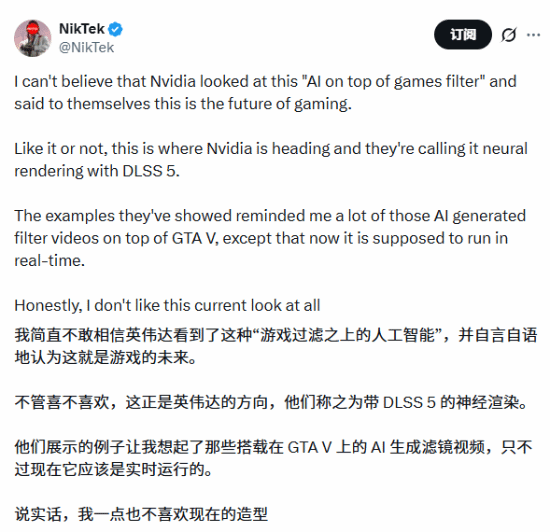
英伟达DLSS 5遭玩家痛批“AI垃圾” 黄仁勋强势回怼“他们完全错了”
Xin Lang Cai Jing· 2026-03-25 02:28
Core Viewpoint - Nvidia's DLSS 5 technology, aimed at enhancing game graphics to Hollywood-level effects, faced significant backlash from players and developers shortly after its announcement, leading to a public relations crisis for the company [3][16]. Group 1: Technology Overview - DLSS 5 represents a significant leap in technology, moving from resolution enhancement to direct image creation, utilizing real-time neural network rendering to produce photo-realistic lighting and material effects within milliseconds [4][17]. - The technology analyzes each frame's color and motion vectors, adding detail and reshaping light and shadow in the game environment, marking it as Nvidia's most significant breakthrough since the introduction of real-time ray tracing in 2018 [4][17]. Group 2: Public Reaction - The initial reception of DLSS 5 was overwhelmingly negative, with players criticizing the technology for distorting original character designs and artistic intent, leading to terms like "AI garbage" and "beauty filter" being used to describe its effects [3][5][20]. - A YouTube trailer for DLSS 5 garnered over 1.4 million views but had a low approval rating of approximately 16%, with 1.7 million likes compared to over 88,000 dislikes, indicating a strong negative sentiment among viewers [9][21]. - A survey by Quantic Foundry revealed that 85.4% of players held negative views towards generative AI in games, with 62.7% expressing very negative sentiments [9][21]. Group 3: Company Response - Nvidia's CEO Jensen Huang responded to the criticism by asserting that players' views were incorrect, emphasizing that DLSS 5 is not merely a post-processing filter but a deeper generative control at the geometric level [12][24]. - Huang clarified that developers retain artistic control over the AI-generated content, which is designed to enhance rather than replace the original artistic vision [12][24]. Group 4: Industry Implications - The backlash reflects broader industry concerns regarding AI's role in creative processes, with discussions about whether AI could replace human creators intensifying as AI begins to influence final game presentations [13][25]. - Game developers, including Bethesda, have attempted to mitigate concerns by stating that the effects seen in early previews are subject to artistic adjustments and are fully controllable by artists [13][25]. - DLSS 5 is set to be officially released in the fall of 2026, with several major developers, including Tencent and Ubisoft, planning to integrate the technology, giving Nvidia a limited timeframe to demonstrate its value to the market [13][25].

黄仁勋:英伟达已经从GPU公司演变为“AI工厂”
阿尔法工场研究院· 2026-03-25 02:12
Core Insights - NVIDIA has evolved from a GPU company to an AI factory, emphasizing the importance of decoupled inference technology and AI factory architecture [2][3] - The demand for AI computing is expected to grow exponentially, with calculations potentially increasing by over ten thousand times in two years, driving the need for robust AI infrastructure [2][3] - NVIDIA's CEO highlights the importance of defining vision and strategy, focusing on challenging areas that leverage the company's core strengths [2] AI Factory Operations - The AI factory operating system "Dynamo" was launched approximately two and a half years ago, seen as the next industrial revolution's operating system, with decoupled inference as its core technology [2] - NVIDIA plans to integrate Grok chips to optimize workload distribution across various components, including GPUs, CPUs, switches, and network processors [2] Market Analysis - The physical AI sector is projected to be a $50 trillion industry, with NVIDIA already generating nearly $10 billion in annual revenue from this rapidly growing business [3] - Digital biology is anticipated to experience a "ChatGPT moment," leading to significant transformations in the healthcare industry in the coming years [3] Impact of AI Agents and Open Source Models - Open source AI projects like "OpenClaw" are redefining computing and are seen as the blueprint for future personal AI computers, with agents becoming crucial for achieving work outcomes [4] - The enterprise software industry is expected to see a hundredfold growth due to the widespread use of AI agents [4] Autonomous Driving Strategy - NVIDIA's strategy in the autonomous driving sector focuses on providing a complete technology stack, including training, simulation, and onboard computing, without manufacturing vehicles [4] Competitive Advantage - NVIDIA is confident in its unique position as the only company collaborating with all global AI firms to provide end-to-end solutions deployable across any cloud and edge environment, with increasing market share [4] Robotics Industry Outlook - High-functionality robotic products are predicted to become mainstream within 3 to 5 years, with China being a key player in the global robotics supply chain [4] AI and Employment Perspectives - While some jobs may be replaced by AI, it is believed that more new jobs will be created, emphasizing the importance of becoming proficient in using AI and maintaining skills in science, mathematics, and language [5]

【太平洋科技-每日观点&资讯】(2026-03-25)
远峰电子· 2026-03-24 11:48
Market Overview - Major indices showed positive performance with the STAR 50 up by 2.33%, the Northern Exchange 50 by 1.94%, the Shanghai Composite Index by 1.78%, the Shenzhen Component Index by 1.43%, and the ChiNext Index by 0.50% [1] TMT Sector Performance - The TMT sector led the market with significant gains, including SW Communication Cables and Accessories up by 5.41%, SW Optical Components by 4.73%, and SW Passive Components by 4.18% [1] Domestic News - Alibaba launched its new flagship CPU product, the Xuantie C950, based on the open-source RISC-V architecture, achieving a single-core performance score exceeding 70 in the Specint2006 benchmark, setting a global record for RISC-V performance [2] - CINNO reported that Zhongdao Optoelectronics successfully won a project for high-precision AOI detection equipment for leading panel manufacturers, achieving a 0.4μm detection precision [2] - Silicon Valley Semiconductor delivered its first batch of fully automated laser stripping equipment compatible with 12-inch silicon carbide substrates, marking a successful industrialization of this technology [2] - According to MIR, the domestic production rate of semiconductor manufacturing equipment in China is projected to increase from 4% in 2017 to 21% by 2025 [2] International News - STMicroelectronics announced that the first batch of STM32 wafer products, manufactured by Huahong Grace, has been shipped to domestic customers, with plans for more STM32 product series to achieve local production by 2026 [3] - Samsung stated that its HBM5 core bare chips will continue to use the 1c (sixth generation 10nm level) process, with plans to upgrade the core chip to 1d (seventh generation 10nm level) DRAM for the ninth generation HBM5E products [3] - Anmou Technology released a new generation of "Linglong" VPU IP products, expected to enter mass production in 2026, featuring high performance and low latency across various application scenarios [3] AI News - Meitu's AI Skills have officially integrated with the "Lobster Ecosystem," offering eight AI imaging capabilities for users [4] - OpenAI has discontinued the "Instant Checkout" feature in ChatGPT, redirecting users to merchant websites for purchases due to technical complexities [4] - AiPPT.com has introduced the Nano Banana 2 model to enhance its image generation quality and understanding of prompts [4] - SwitchBot claims to have launched the world's first local home AI agent supporting OpenClaw, capable of understanding real-world events through connected cameras [4] Industry Tracking - Beijing Yushi Space Technology Co., Ltd. completed a 200 million yuan Pre-A+ round of financing to support its rocket assembly testing and capacity construction [5] - A Chinese team made significant progress in brain-controlled robotic dog technology by integrating a non-invasive brain-computer interface with autonomous navigation [5] - A humanoid robot named "Titan o1" was released, utilizing a general action pre-training model to mimic human movements [5] - Covestro announced a contract with the Fraunhofer Institute for Chemical Recycling of rigid polyurethane foam waste, with a processing capacity of 2,000 tons per year [5] Annual Reports - Yuanjie Technology reported a total revenue of 601 million yuan for 2025, a year-on-year increase of 138.5%, with a net profit of 191 million yuan, up 3212.62% [6] - Huidian Co., Ltd. achieved a total revenue of 18.945 billion yuan, a 42% increase year-on-year, with a net profit of 3.822 billion yuan, up 47.74% [6] - China Telecom reported total revenue of 523.925 billion yuan, a slight increase of 0.07%, with a net profit of 33.185 billion yuan, up 0.52% [6] - Guangku Technology reported total revenue of 1.474 billion yuan, a 47.56% increase year-on-year, with a net profit of 177 million yuan, up 163.76% [6]

告别 SaaS 狂热:私募巨头为何集体押注“硬资产”?
美股研究社· 2026-03-24 11:41
Core Insights - The emergence of generative AI is fundamentally reshaping the capital markets, challenging the long-held belief in a "software-defined world" and prompting a shift towards investments in tangible assets like machinery, energy, and infrastructure [1][6]. Group 1: Market Dynamics - This transition is not merely a sector rotation but a re-evaluation of what constitutes true value in business, reflecting a return to the essence of commercial understanding [2]. - The growth logic is reversing from a "light asset premium" to a "certainty premium," where the focus shifts from high growth to assets that are less likely to be disrupted by technology [3][7]. Group 2: Investment Trends - Over the past decade, private equity has heavily invested in software, particularly SaaS, driven by high margins and strong cash flows, leading to a valuation consensus that supported over $1 trillion in investments [4]. - Leading private equity firms like Blackstone and Bain Capital are systematically shifting towards HALO assets—those with low obsolescence rates, such as industrial manufacturing and energy, as a direct response to the technological paradigm shift [6]. Group 3: Software Valuation Challenges - The core assumption that software has near-zero marginal costs and high barriers to entry is being undermined by generative AI, which allows rapid application development, reducing the difficulty and cost of software creation [6]. - The traditional valuation metrics centered around ARR, retention rates, and LTV/CAC are being disrupted by AI, leading to a situation where many software assets are overvalued in the current market [9][10]. Group 4: Cash Flow Preferences - The credit market is responding to these changes, with software asset financing cooling off while infrastructure assets are receiving lower spreads and higher subscriptions, indicating a preference for predictable cash flows [7][10]. - HALO assets are characterized by stable cash flows and long life cycles, making them attractive in a high-interest rate environment where certainty of returns is prioritized over high growth expectations [11][12]. Group 5: Future Outlook - The rise of HALO assets is not without concerns, as they are inherently low-growth assets that could see returns compressed if capital floods into these areas [13]. - The potential for overcapacity in AI data centers poses a risk, highlighting the need for capital to seek more nuanced opportunities that combine hard assets with operational capabilities [14]. - The transition from a focus on "illusory growth" to "real anchors" signifies a deeper value reassessment, where the physical world's constraints and the limits of energy and land become central to pricing [15][16].

黄仁勋暴论核弹:AGI已经实现,Ilya错了,程序员有10亿
量子位· 2026-03-24 08:47
Core Viewpoint - The article discusses the recent statements made by Jensen Huang, CEO of NVIDIA, regarding the achievement of Artificial General Intelligence (AGI) and its implications for the future of technology and society [1][2][3]. Group 1: AGI and Future Outlook - Huang asserts that AGI has already been achieved, emphasizing that this is not merely speculation but a conclusion drawn from various dimensions including technology, society, and human nature [3][8]. - He introduces the concept of OpenClaw as a transformative product in the token era, likening it to the iPhone, suggesting that intelligence will become a tradable commodity in the form of tokens [8][120]. - Huang predicts that the number of programmers will increase from 30 million to 1 billion, as coding becomes less about writing and more about problem-solving [210]. Group 2: Scaling Laws and Data - Huang believes that pre-training has not reached its peak, and synthetic data will continue to expand the scale of data available for AI [4][18]. - He argues that reasoning is a complex process that cannot be simplified to lightweight computations, contrasting it with pre-training which he likens to reading [6][20]. - The next scaling law, termed "agentic scaling," involves the creation of agentic individuals capable of generating and utilizing vast amounts of data [22][24]. Group 3: Energy and Data Center Design - Huang highlights the inefficiencies in current energy grid designs, suggesting that data centers should be rethought to utilize idle power more effectively [46][50]. - He proposes that data centers should be designed to gracefully degrade performance during peak energy demands, rather than requiring constant maximum output [57][58]. - Huang emphasizes the importance of collaboration with power companies to create flexible energy supply agreements [56][59]. Group 4: Cultural and Competitive Landscape - Huang notes that a significant portion of AI researchers are based in China, attributing this to a strong educational system and a competitive environment across various provinces [76][80]. - He describes the cultural factors that contribute to rapid knowledge sharing and innovation in China, including the importance of relationships and open communication among engineers [85][86]. - Huang believes that the rise of AI will not eliminate jobs but will transform them, enhancing the roles of professionals across various fields [226][237]. Group 5: Management Philosophy - Huang's management style focuses on collaboration and open communication, often involving large groups in problem-solving discussions [128][130]. - He emphasizes the importance of curiosity and continuous learning in leadership, encouraging a culture of shared insights and collective decision-making [131][135]. - Huang believes that maintaining humility and a willingness to learn from others is crucial for effective leadership [158][161].