税费优惠政策

Search documents
惠农“税费通”|支持乡村振兴系列税费优惠政策(16)直接用于农、林、牧、渔业生产用地免征城镇土地使用税
蓝色柳林财税室· 2025-09-19 08:20
Core Viewpoint - The article discusses the tax exemption policy for land use in agricultural production, highlighting that land directly used for agriculture, forestry, animal husbandry, and fishery is exempt from urban land use tax [6][7]. Group 1: Tax Exemption Policy - Agricultural production land, including land used for planting, breeding, and feeding, is exempt from urban land use tax [6][7]. - The exemption does not apply to land used for processing agricultural products or for living and office purposes [7]. Group 2: Relevant Regulations - The policy is based on the "Interim Regulations on Urban Land Use Tax" and related notifications from the State Administration of Taxation [8].


吐鲁番市税务局:听民声纾民困 合规引导步履实
Sou Hu Cai Jing· 2025-09-18 07:55
Core Viewpoint - The Turpan Municipal Taxation Bureau is focused on guiding enterprises towards compliant operations as a core strategy for local economic development, aiming to transform legal compliance and integrity into competitive advantages for sustainable industrial growth [1]. Group 1: Tax Policy Implementation - The Turpan Municipal Taxation Bureau actively provides point-to-point guidance to enterprises regarding tax benefits, ensuring that the financial incentives effectively reach the companies [2]. - The bureau has established a real-time tracking and feedback mechanism for policy enjoyment results, helping enterprises navigate risks associated with tax policies [2]. - A specific case highlighted the successful application of the R&D expense deduction policy, where a company benefited from over 330,000 yuan in deductions [2]. Group 2: Problem Resolution and Compliance - The Taxation Bureau promptly addressed tax obligation disputes, demonstrating a commitment to resolving issues quickly and effectively, which has been appreciated by local businesses [3]. - The collaborative efforts between the Taxation Bureau and local government resulted in a swift resolution of tax disputes, enhancing compliance and reducing uncertainty for enterprises [3]. - The focus on compliance guidance not only meets regulatory requirements but also aids businesses in seizing opportunities and mitigating risks [3]. Group 3: Economic Impact and Support - The Turpan Municipal Taxation Bureau has facilitated significant tax refunds, amounting to over 27.32 million yuan for resource recycling enterprises, which has supported technological upgrades and production efficiency [4]. - The bureau has streamlined the approval process for tax refunds, reducing the time frame to three working days, thereby enhancing service delivery and policy implementation [4]. - The emphasis on resource recycling and waste management has led to increased resource recovery rates, with one company expecting a 15% improvement following the acquisition of new sorting equipment funded by tax refunds [4]. Group 4: Future Directions - The Turpan Municipal Taxation Bureau aims to adopt more pragmatic measures, intelligent tools, and precise services to foster a compliant and trustworthy business environment [5]. - The bureau's initiatives are designed to enhance the overall tax environment, promoting a culture of compliance and integrity among local enterprises [5].
惠农“税费通”|支持乡村振兴系列税费优惠政策(11)利用农村集体土地新建、翻建自用住房免征水土保持补偿费
蓝色柳林财税室· 2025-09-12 09:29
Group 1 - The article discusses the exemption of soil and water conservation compensation fees for farmers who legally utilize collective land to build or renovate their own houses [6][7][9] - It highlights that farmers can avoid these fees if the land used is approved as collective land by the village [6][8] - The relevant policy is outlined in the notification from the Ministry of Finance and other governmental bodies regarding the management of soil and water conservation compensation fees [9] Group 2 - The article provides information on the process for taxpayers to reissue tax payment certificates if they are lost, detailing the steps to apply for a new certificate through the electronic tax bureau [13] - It emphasizes the importance of compliance with tax regulations for the healthy development of the restaurant industry, as consumer demand continues to grow [16] - The article addresses specific tax issues related to the restaurant industry, including how to pay value-added tax (VAT) for food sold directly to consumers and for takeout services [17][18][20]

单县税务:精准服务促发展 税惠赋能开新篇
Sou Hu Cai Jing· 2025-09-12 03:06
Group 1 - The textile industry plays a significant role in ensuring employment, market prosperity, and regional economic development [1] - The Shandong Huihong Textile Technology Co., Ltd. focuses on high-density and special functional fabrics, combining technological innovation with traditional production methods [1] - The company’s products are sold nationwide, reflecting its strong market presence [1] Group 2 - The Single County Taxation Bureau has improved tax and fee preferential policies tailored to the textile industry, ensuring precise implementation that directly benefits enterprises [3] - Tax officials provide on-site support to help companies understand and utilize advanced manufacturing VAT deduction policies [3] Group 3 - The Single County Taxation Bureau offers a full lifecycle service for high-tech enterprises, including pre-policy guidance, ongoing tracking services, and post-risk alerts [5] - The bureau emphasizes a transition from online to offline services, ensuring that policy benefits are effectively realized by enterprises [5] - Future efforts will focus on enhancing sustainable development capabilities for enterprises and improving the effectiveness of policy implementation [5]

惠农“税费通”|支持乡村振兴系列税费优惠政策(6)供热企业采暖费收入免征增值税
蓝色柳林财税室· 2025-09-06 07:15
Core Viewpoint - The article discusses the tax exemption policy for heating service companies in the "Three North" regions of China, specifically regarding the VAT exemption on heating fees collected from individual residents until the end of the 2027 heating season [5][6]. Group 1: Tax Exemption Details - Heating service companies in the "Three North" regions can enjoy VAT exemption on heating fees collected from individual residents [5][6]. - The exemption applies to heating fees collected directly from residents, through other units, or paid by organizations on behalf of residents [4][6]. - The specific regions included in the "Three North" areas are listed, which encompass several provinces and municipalities [6]. Group 2: Policy Implementation - The policy is effective until the end of the 2027 heating season, allowing for continued support for heating service providers [4][5]. - The heating service companies must separately account for the VAT-exempt income according to the relevant tax regulations [6]. - The calculation of the exempt VAT for heating fees collected through operating companies is based on the proportion of fees received from residents [6].

惠农“税费通”|支持乡村振兴系列税费优惠政策(1)农村集体经济组织及其成员从本集体经济组织的水塘、水库中取用水不缴纳水资源税
蓝色柳林财税室· 2025-09-05 13:30
Core Viewpoint - The article discusses the benefits of recent agricultural policies that support rural collective economic organizations, particularly regarding water resource usage and exemptions from certain taxes for social welfare projects [4][8]. Group 1: Water Resource Management - Rural collective economic organizations and their members are exempt from water resource tax when using water from their own ponds or reservoirs [4][5]. - The recent rainfall has increased water levels in local reservoirs, allowing farmers to store water for future dry seasons, which is beneficial for crop irrigation [2][3]. Group 2: Social Welfare Projects - The construction of social welfare projects, such as nursing homes, is supported by policies that exempt these projects from forest vegetation restoration fees [7][8]. - Rural collective economic organizations are not required to pay forest vegetation restoration fees when building roads, schools, nursing homes, and other social welfare projects [9][10].

多彩税视界|鲜花花卉“税”知识了解一下
蓝色柳林财税室· 2025-08-20 00:55
Core Viewpoint - The article emphasizes the importance of tax incentives for companies engaged in environmental protection and energy-saving projects, highlighting specific tax benefits and policies that support green development [10][12]. Tax Incentives for Environmental Projects - Companies involved in eligible environmental protection and energy-saving projects can enjoy a three-year exemption from corporate income tax starting from the year they first earn revenue from the project, followed by a 50% reduction in the next three years [10]. - Eligible projects include public sewage treatment, public waste management, comprehensive utilization of resources, energy-saving and emission-reduction technology upgrades, and seawater desalination, as outlined in the "Directory of Corporate Income Tax Incentives for Environmental Protection and Energy-Saving Projects (2021)" [10]. Special Equipment Tax Deductions - Since January 1, 2008, companies that purchase and use equipment listed in the "Directory of Corporate Income Tax Incentives for Environmental Protection Special Equipment" can deduct 10% of the investment amount from their taxable income for the year [11]. - If the current year's taxable amount is insufficient for the deduction, the remaining amount can be carried forward to future years, with a maximum carry-forward period of five tax years [11]. Reduced Tax Rate for Pollution Control - From January 1, 2024, to December 31, 2027, qualified third-party enterprises engaged in pollution control will be taxed at a reduced corporate income tax rate of 15% [12]. - Third-party enterprises are defined as those responsible for the operation and maintenance of environmental pollution control facilities, including automatic continuous monitoring facilities, as commissioned by polluting enterprises or the government [12]. Policy References - The article cites various legal frameworks and announcements that support these tax incentives, including the "Corporate Income Tax Law of the People's Republic of China" and relevant notices from the Ministry of Finance and the State Taxation Administration [13].

税务部门首次披露“新三样”领域2起偷骗税案件
Xin Hua She· 2025-08-18 07:10
Group 1 - The core viewpoint is that the tax authorities have disclosed two tax evasion cases in the "new three items" (electric vehicles, lithium batteries, and photovoltaic products) sector, marking the first public announcement of such violations in this area [1] - The tax authorities have implemented a series of tax and fee preferential policies to support the rapid development of entities in the "new three items" sector, but some entities have violated these policies by fraudulently claiming tax benefits [1] - The disclosed cases include companies misreporting non-research personnel salaries as research expenses to unlawfully benefit from tax deductions, and tax evasion gangs manipulating multiple new energy companies to issue false invoices and claim export tax refunds [1] Group 2 - The tax authorities are committed to implementing tax and fee preferential policies effectively, optimizing service measures, and enhancing tax payment convenience to support the growth of business entities [2] - There is a continuous effort to enforce the law in tax matters, strictly investigating and penalizing illegal activities that undermine tax fairness and market order, thereby maintaining a fair tax environment [2]
热点问答丨家政企业相关税惠政策及相关减免税开票申报操作步骤
蓝色柳林财税室· 2025-08-15 01:16
Core Viewpoint - The demand for domestic services is increasing due to social and economic development, as well as changes in family structure. The government has introduced tax and fee preferential policies to support the healthy development of domestic service enterprises [2]. Group 1: Tax and Fee Preferential Policies - Domestic service institutions providing community services such as elderly care, childcare, and domestic services are exempt from value-added tax (VAT) on their income [3]. - These institutions can reduce 90% of their income when calculating taxable income [3]. - Properties and land used for providing these services are exempt from deed tax, property tax, and urban land use tax [3]. Group 2: Eligibility for Tax Benefits - Institutions that provide domestic services to communities, defined as organizations serving families within a community, can enjoy the aforementioned tax benefits [4]. - Community domestic services include care for pregnant women, infants, the elderly, patients, and disabled individuals, as well as cleaning and cooking services provided in family residences [5]. Group 3: Invoice Issuance and Tax Reporting - To issue an invoice for domestic services, institutions must log into the electronic tax bureau, select the appropriate options, and input relevant service details [7]. - General taxpayers must report their domestic service sales in the designated section of the VAT declaration form to enjoy the exemption [9]. - For corporate income tax, institutions must indicate the reduced income from community family service revenue in their tax declaration [11].

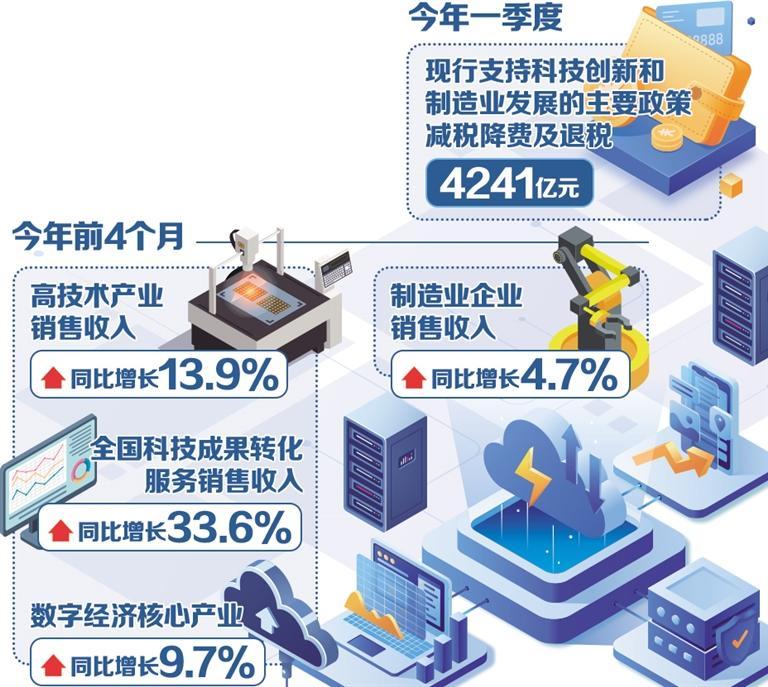
税费优惠政策精准滴灌“向新力”
Xin Hua Wang· 2025-08-12 05:55
Core Viewpoint - In the first quarter of this year, tax reductions and refunds supporting technological innovation and manufacturing reached 424.1 billion yuan, accelerating high-quality development in these sectors [3][4]. Tax Reduction and Refunds - The total tax reductions and refunds for supporting technology innovation and manufacturing in Q1 amounted to 424.1 billion yuan, reflecting the effectiveness of structural tax reduction policies [3][4]. - The sales revenue of high-tech industries increased by 13.9% year-on-year in the first four months, significantly outpacing the overall national growth rate [3][5]. Policy Measures - Recent tax policies include a 100% pre-tax deduction for R&D expenses, with a further increase to 120% for integrated circuits and industrial mother machines [4][6]. - Value-added tax exemptions are provided for technology transfer and related services, while advanced manufacturing enterprises benefit from a 5% input tax credit, increased to 15% for specific sectors [4][6]. Manufacturing Sector Performance - Manufacturing sales revenue grew by 4.7% year-on-year in the first four months, with notable increases in equipment manufacturing (9.4%), digital product manufacturing (12.6%), and high-tech manufacturing (12.2%) [5][6]. - Advanced manufacturing sectors, such as computer and smart device manufacturing, saw sales revenue growth of 23.8% and 15.7%, respectively, indicating a robust innovation-driven development [5][6]. Systematic Policy Framework - The release of two policy guidelines in 2024 aims to provide a systematic approach to tax incentives for technology innovation and manufacturing, covering various aspects of these sectors [6][7]. - The guidelines include 31 tax incentive measures for manufacturing, emphasizing the importance of tax benefits in fostering high-quality development and innovation [6][7]. Tax Administration and Compliance - The tax authorities are enhancing services to ensure that tax benefits reach the intended recipients, focusing on compliance and preventing fraudulent claims [7].