经济增长放缓

Search documents
IMF:贸易风险或致亚洲经济增长今明两年放缓
Shang Wu Bu Wang Zhan· 2025-10-25 03:42
Core Insights - The Asia-Pacific region remains the fastest-growing area globally, but rising tariffs and protectionism may lead to reduced exports and ultimately impact economic activity [1] - The IMF projects Asia's GDP growth rate to be 4.5% in 2025, slightly down from 4.6% in 2024, with a further slowdown to 4.1% by 2026 [1] - Trade policy uncertainty, although decreased since April, remains high and could severely affect investment and market sentiment [1] Economic Projections - Strong export growth in Asia is expected to be driven by pre-purchase activities ahead of tariff increases and a recovery in the technology cycle [1] - Domestic demand is anticipated to remain robust due to loose policies and the global environment [1] Policy Recommendations - The IMF urges Asian policymakers to stimulate domestic demand, particularly consumption, and enhance productivity [1] - Short-term recommendations include targeted fiscal and monetary stimulus measures to mitigate the impact of trade shocks [1]
商务部回应稀土出口管制措施;俄美总统电话会谈结束,特朗普称将与普京在布达佩斯会面
Di Yi Cai Jing Zi Xun· 2025-10-17 01:15
Market Overview - US stock markets closed lower, with the Dow Jones Industrial Average down 301.07 points to 45952.24, a decline of 0.65% [1] - The S&P 500 index fell 41.99 points to 6629.07, down 0.63%, while the Nasdaq Composite dropped 107.54 points to 22562.54, a decrease of 0.47% [1] - 10 out of 11 sectors in the S&P 500 closed lower, with the financial sector leading the decline at 2.75% [1] Regional Bank Concerns - Zions Bancorporation reported unexpected losses of approximately $50 million in its California division, causing its stock to plummet by 13% [2] - The regional bank sector collectively declined, with Western Alliance down 10.8% after announcing a fraud lawsuit against a borrower [2] - The KBW regional bank index fell nearly 4%, marking its largest single-day drop in four months [2] Federal Reserve Insights - Federal Reserve Governor Christopher Waller indicated a preference for a 25 basis point rate cut in the upcoming October meeting, contingent on labor market data [3] - The market anticipates a 25 basis point cut with a mere 3.2% probability for a 50 basis point reduction [3] - US Treasury yields fell, with the 10-year yield down 6.9 basis points to 3.976%, the lowest since April [3] Commodity Market Movements - Gold prices surged, with spot gold closing above $4300 per ounce, marking a nearly 2.5% increase [3] - WTI crude oil futures fell by 1.47% to $56.99 per barrel, while Brent crude dropped 1.37% to $61.06 per barrel [3] Economic Data and Predictions - China's National Bureau of Statistics is set to release Q3 macroeconomic data, with economists predicting a GDP growth rate of 4.8% year-on-year [6] - The tax authority reported significant growth in retail sales for home appliances and smart home products, with a 30.1% increase in new energy vehicle sales [7] Corporate Announcements - Meituan's CEO emphasized the need for businesses to enhance operational efficiency rather than relying on competition within the industry [13] - Fuyao Glass announced a leadership change, with its founder stepping down as chairman [14]


投资者报告_今秋_刺激与改革-Investor Presentation_ This Fall_ Stimulus and Reform
2025-10-15 14:44
Summary of Key Points from the Conference Call Industry Overview - **Industry**: Economic Outlook for China - **Key Focus**: Macroeconomic trends, fiscal policies, and social welfare reforms Core Insights and Arguments 1. **Economic Growth Projections**: Real GDP growth is expected to reach 4.8% in 2025, with a slowdown anticipated in the second half of the year [3][4][7] 2. **Deflation Concerns**: Persistent deflation is projected to continue into 2026, despite some marginal improvements [7][84] 3. **Fiscal Stimulus Impact**: A fading fiscal stimulus is leading to a rapid slowdown in infrastructure capital expenditure, with net government bond financing expected to decrease significantly [9][10] 4. **Social Dynamics**: A double dip in the Social Dynamics Indicator is noted, with elevated youth unemployment amid macroeconomic headwinds [20][21] 5. **Reflation Strategy**: The "5R" Reflation Strategy aims for incremental progress on rebalancing, with a focus on consumption and social welfare reforms [23][24] 6. **High Household Savings**: Chinese households have accumulated approximately RMB 30 trillion in excess savings since 2018, indicating a systemic bias toward savings rather than consumption [30][61][67] 7. **Social Welfare Reforms**: Proposed reforms include increasing rural pension benefits and enhancing social security coverage for low-income workers, which are expected to stimulate consumption [36][45][80] 8. **Housing Market Dynamics**: The housing market is undergoing deleveraging, with a focus on social spending rather than bailouts to address housing inventory issues [50][55] 9. **Tech Sector Growth**: Emerging sectors, particularly in technology, are expected to see increased capital expenditure supported by government initiatives [105][107] Additional Important Insights 1. **Youth Unemployment**: The youth unemployment rate remains a critical issue, with implications for social stability and economic growth [20][21] 2. **Investment in Infrastructure**: Infrastructure investment is projected to decline, impacting overall economic growth [10][50] 3. **Consumer Behavior**: The effectiveness of consumption trade-in subsidies is fading, which may further suppress consumer spending [16][18] 4. **Policy Measures**: The government is expected to implement a RMB 10 trillion fiscal package over the next two years to support consumption [23][25] 5. **Global Trade Dynamics**: Exports have shown resilience, particularly to regions outside the US, despite challenges in the US-China trade relationship [145][146] This summary encapsulates the critical points discussed in the conference call, highlighting the economic outlook, fiscal policies, and social reforms in China.
政治僵局会如何拖累法国经济字
Xin Hua Cai Jing· 2025-10-13 00:07
Group 1 - The political deadlock in France, exacerbated by President Macron's dissolution of the National Assembly, has led to significant economic and financial instability, with the 2026 budget draft still not released [1] - The recent resignation of Prime Minister Le Cornu has intensified market volatility, causing the CAC40 index to drop by 2% and the 10-year government bond yield to exceed 3.6% [1] - The French central bank forecasts a mere 0.7% economic growth for 2025, attributing this to declining investment willingness from businesses and households, rising savings rates, and the impact of economic slowdown on employment [1] Group 2 - The political crisis is projected to reduce France's economic growth by approximately 0.5 percentage points by the end of 2025, equating to a loss of about €15 billion [1] - Household consumption of goods in France is expected to decline by 0.5% from Q1 2024 to August 2025, with a high savings rate of 19%, indicating a conservative spending approach due to political and economic uncertainties [2] - The instability in the French political landscape is anticipated to result in a GDP reduction of around €9 billion for the current year, with France lagging behind other major European economies [2] Group 3 - The political crisis in France has also affected the Eurozone economy, with the sudden resignation of Le Cornu causing a near 0.8% drop in the euro against the dollar, reflecting market concerns over potential political vacuum in the EU's second-largest economy [2] - Analysts warn that the uncertainty surrounding the French government could pose spillover risks to the broader Eurozone economy [2]
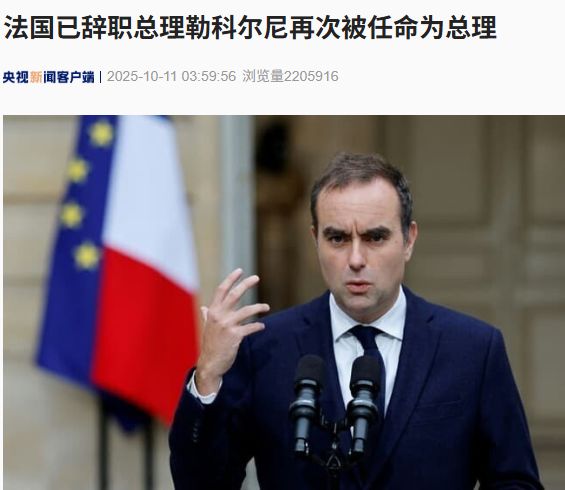
马克龙任命法国新总理 还是他!
Mei Ri Jing Ji Xin Wen· 2025-10-11 00:55
Group 1 - The appointment of Sébastien Lecornu as Prime Minister reflects ongoing political instability in France, with his resignation occurring just 27 days after taking office, marking the shortest tenure in the Fifth Republic and the seventh Prime Minister to leave under Macron's administration [2] - The current political crisis is rooted in the dramatic shift in the National Assembly's composition and internal divisions within the ruling coalition, leading to a fragmented political landscape that complicates the formation of a stable government [3] - The internal conflict within the ruling coalition centers around the controversial pension reform implemented in 2023, with significant financial implications if the reform is modified or delayed, highlighting the challenges of reaching a compromise in a polarized parliament [3] Group 2 - France's economic growth rate is projected to be around 0.7% for the year, with estimates suggesting it could have been closer to 1% without the political crisis, indicating a significant slowdown attributed to cautious consumer and business behavior [5] - Consumer confidence in France is currently at a low level of 87, significantly below the long-term average of 100, reflecting heightened concerns over potential tax increases and reductions in public subsidies [5] - The political turmoil is having a pronounced impact on the business sector, with leaders expressing that the political landscape is more paralyzed than ever, which could further hinder economic recovery [5]
政治停摆,资产狂欢:美国政府关门背后的冰火两重天
Sou Hu Cai Jing· 2025-10-06 06:08
Group 1: Economic Impact of Government Shutdown - The ongoing government shutdown is significantly affecting the U.S. tourism industry, with an estimated loss of $1 billion for each week it continues [1] - National parks are losing $1 million in ticket revenue daily, while surrounding businesses are losing $77 million each day during the shutdown [1] - The Federal Aviation Administration (FAA) is facing staffing shortages due to furloughs, which may lead to flight delays and cancellations [1][2] Group 2: Public Sentiment and Political Dynamics - A majority of Americans view the government shutdown as irresponsible, with many feeling that political disputes are harming ordinary citizens [3] - Polls indicate a declining confidence in the U.S. political system, with only 33% believing it can resolve its issues, and 41% disagreeing that the U.S. is a democracy [3] Group 3: Market Reactions and Asset Performance - Bitcoin reached a historic high of $125,000 during the government shutdown, with its price at $123,621 shortly after [4] - Analysts predict that Bitcoin may continue to rise due to the shutdown's impact on economic uncertainty and the potential for a loosening monetary policy [5] - Gold prices also surged, reaching $3,933 per ounce, with forecasts suggesting it could hit $4,000 per ounce by mid-2026 [6]
ISM Survey Shows Slowing Growth, Rising Input Costs, to Close Out Third Quarter
Barrons· 2025-10-03 14:51
Core Insights - The U.S. growth has significantly slowed down, raising concerns about the economy's health as it approaches the final quarter of the year [1] - The Institute for Supply Management's services index dropped to a reading of 50 in September, marking the first time it has reached this threshold since 2010, indicating a potential shift from growth to contraction [1] - The ISM's business activity index fell to 49.9, representing the first contraction since May 2020, further highlighting the weakening economic conditions [1]
As Government Shutdown Risk Looms, Here's The Likely Market Impact
Forbes· 2025-09-29 16:40
Government Shutdown Impact on Sectors - A partial government shutdown could disproportionately impact the defense and healthcare sectors due to potential delays in government contracts and approvals necessary for drug development [3] - Historically, most government shutdowns last only a few days, resulting in minimal impact on these sectors [4] Economic Growth Implications - A partial government shutdown may dampen economic growth as federal workers are not paid during the shutdown, leading to reduced household spending [5] - Current estimates for economic growth remain robust, with the Atlanta Fed's GDPNow model predicting over 3% annualized growth and the New York Fed's Nowcast estimating 2.5% [5] Essential Government Functions - Many essential government functions, such as Medicare, Social Security, and the U.S. Postal Service, will continue to operate during a shutdown, limiting the overall impact on essential services [6] Potential Layoffs - The Office of Management and Budget may consider additional layoffs during a shutdown, particularly in programs with discretionary funding lapses [8] Future Expectations - Prediction markets currently view a partial government shutdown as likely, with its duration being a critical factor for economic impact [9][10]
布米普特拉北京投资基金管理有限公司:美联储陷两难 通胀升温与就业疲软并存
Sou Hu Cai Jing· 2025-09-28 12:44
Group 1 - Recent data indicates a sharp increase in inflation risks in the U.S., raising widespread market concerns following the Federal Reserve's recent 25 basis point rate cut [1][5] - Approximately 72% of components in the U.S. Consumer Price Index have exceeded the Federal Reserve's 2% target, marking the highest level in three years, compared to 55% last year, suggesting a clear trend of accelerating inflation [3] - The broadness of current inflation has surpassed the pre-pandemic average of 57% in 2018 and 2019, indicating a significant rise in inflationary pressures [3] Group 2 - Signs of weakness in the U.S. labor market present a challenging decision for the Federal Reserve, balancing the need to address slowing economic growth while monitoring rising inflation data [5] - Economists warn of potential stagflation risks, where economic growth stagnates alongside high inflation [5][7] - The Federal Reserve has lowered the interest rate target range to 4.00% to 4.25%, with expectations of further rate cuts in October and December if labor market conditions worsen [5] Group 3 - Economic experts express concerns over the current situation, highlighting the need for vigilance as unemployment rises while inflation remains high [7] - Some officials indicate that the impact of tariff policies on the economy has yet to fully materialize, suggesting potential broader market risks [7] - The market is closely monitoring the Federal Reserve's next policy moves, with a focus on balancing economic growth support and inflation control as a primary challenge [8]

利率下调25点!鲍威尔淡定,特朗普狂怼,新人米兰强行刷存在
Sou Hu Cai Jing· 2025-09-19 04:51
Core Viewpoint - The Federal Reserve's decision to cut interest rates by 25 basis points to a range of 4.00%-4.25% reflects a cautious approach amid economic slowdown and inflation concerns, indicating a need for careful management rather than aggressive recovery measures [1][3]. Group 1: Economic Context - The rate cut is likened to a small health boost in a game, suggesting that while it provides some relief, it is not sufficient for a full recovery [3]. - Economic growth is slowing, the job market is weakening, and inflation remains a concern, leading the Federal Reserve to adopt a patchwork approach to stabilize the market [3]. Group 2: Labor Market Dynamics - The Federal Reserve acknowledges a decline in both labor supply and demand, attributing this to external factors such as tariffs and immigration policies, indicating a cooling labor market [3][5]. - The commentary suggests that the labor market's current state resembles a game where both players and monsters are diminishing, highlighting the challenges faced [3]. Group 3: Political Influences - The Federal Reserve's independence is under scrutiny due to political pressures, particularly from former President Trump, who has criticized the Fed's cautious stance and called for more aggressive actions [5]. - The internal dynamics within the Federal Reserve are compared to a political drama, with new appointments and differing opinions on rate cuts, reflecting the complexities of maintaining independence amid external pressures [5]. Group 4: Future Outlook - The Federal Reserve's strategy is characterized by keywords such as caution, prudence, and flexibility, indicating a careful balancing act between employment and inflation while navigating political interference [7]. - The contrasting styles of Fed Chair Powell and Trump illustrate the ongoing tension between cautious economic management and calls for rapid action, leaving the outcome uncertain [7].