
贸易自由化

Search documents
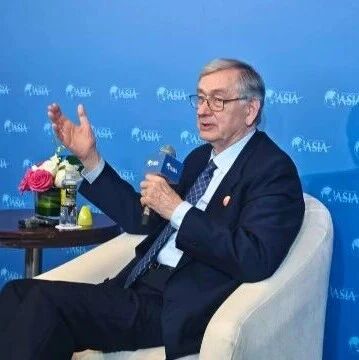
斯洛文尼亚前总统答一财:是时候考虑新一轮贸易自由化了
第一财经· 2026-03-26 15:05
Core Viewpoint - The article discusses the implications of the recent U.S.-EU trade agreement and the challenges posed by the reliance on tariffs, emphasizing the need for a new round of trade liberalization and the restoration of the WTO's dispute resolution mechanism [3][4][5]. Group 1: U.S.-EU Trade Agreement - The European Parliament is set to vote on the U.S.-EU trade agreement nearly nine months after its initial announcement [3]. - The agreement requires the EU to eliminate tariffs on U.S. industrial goods and provide preferential market access for U.S. seafood and agricultural products in exchange for the U.S. imposing a 15% tariff on most EU goods [4]. - The EU has delayed the approval of the agreement multiple times due to political uncertainties, including comments from former President Trump and a Supreme Court ruling against his tariff policies [4]. Group 2: Tariff Dependence and Trade Liberalization - The former Slovenian President Turk criticized the U.S. for its increasing reliance on tariffs, which he views as a significant regression from the historical trend of trade liberalization led by the U.S. since the late 1950s [3][4]. - Turk suggests that a new approach to trade liberalization is necessary, which may involve adjustments to existing mechanisms and the introduction of new arrangements [3][5]. Group 3: WTO and Global Trade Relations - Turk advocates for the empowerment of the WTO as a solution to current trade uncertainties, emphasizing the need to restore its dispute resolution mechanism, which has been stalled due to U.S. actions [5]. - The EU has been actively pursuing new trade agreements with countries like Indonesia, India, and Mercosur, and recently signed a bilateral free trade agreement with Australia, which is expected to increase exports significantly [5].

全球瞭望丨卢旺达媒体:中国零关税举措将给非洲大陆发展带来新机遇
Xin Hua Wang· 2026-02-15 06:43
Core Viewpoint - China's zero-tariff policy for 53 African countries, effective from May 1, 2026, is expected to create new opportunities for development in Africa, particularly for Rwanda, which should leverage this opportunity to enhance its local value chain and promote industrial upgrading [1][2]. Group 1: Trade Relations - China is one of Rwanda's fastest-growing export destinations, and the zero-tariff initiative will reshape trade relations between China and Rwanda, highlighting a shift in Africa's trade landscape [1]. - The zero-tariff policy will provide a price advantage for Rwandan products in the Chinese market, benefiting all 53 African countries involved [1]. Group 2: Economic Strategy - For a resource-scarce landlocked country like Rwanda, entering the vast Chinese consumer market presents both opportunities and challenges, as the current range of products exported to China is limited [2]. - In the short term, the zero-tariff policy is expected to stimulate Rwanda's exports to China; however, in the long term, Rwanda must enhance its local value chain and not just focus on raw material exports [2]. - If Rwanda seizes this opportunity, the zero-tariff initiative could accelerate its vision of becoming a regional center for light industry and innovation, aligning with the core objectives of its national development strategy [2].
第四届链博会瑞士推介会在日内瓦举行
Xin Hua Wang· 2026-02-11 13:39
Core Viewpoint - The fourth China International Supply Chain Promotion Expo (Chain Expo) was promoted in Geneva, emphasizing the importance of China-Switzerland economic cooperation and the advocacy for multilateral trade systems [1] Group 1: Economic Cooperation - Both China and Switzerland are advocates of economic globalization and trade liberalization, aiming to support a stable and secure supply chain within the framework of the World Trade Organization [1] - The relationship between China and Switzerland is built on openness, innovation, mutual trust, and a commitment to peaceful dialogue, which facilitates deeper cooperation [1] Group 2: Event Impact - Attendees at the Chain Expo praised its positive role in advancing China-Switzerland economic and trade relations [1]
博时市场点评2月6日:节前情绪谨慎,两市继续调整
Xin Lang Cai Jing· 2026-02-06 08:05
Market Overview - The three major indices in the A-share market adjusted, with trading volume continuing to decrease compared to the previous day [1][7] - The Shanghai Composite Index closed at 4065.58 points, down 0.25%; the Shenzhen Component Index closed at 13906.73 points, down 0.33%; the ChiNext Index closed at 3236.46 points, down 0.73% [10][11] - The market showed structural differentiation, with investors favoring industries with stable performance amid economic uncertainty [1][7] Policy Developments - The Ministry of Finance, General Administration of Customs, and State Taxation Administration jointly issued a notice on February 5 regarding the "zero tariff" policy for imported goods for residents of Hainan Free Trade Port, allowing residents to purchase imported goods within an annual tax-free quota [2][8] - This policy aims to stimulate local consumption and attract permanent residents, benefiting the local retail and logistics sectors [2][8] - The implementation of this policy serves as a test for China's "inside-outside" special tariff system and may provide insights for nationwide consumption upgrades and trade liberalization [2][8] Digital Services Enhancement - On February 6, the National Immigration Administration, Ministry of Industry and Information Technology, and National Data Bureau issued opinions to enhance digital services for foreign visitors, focusing on facilitating entry documents and optimizing mobile payment services [3][9] - This initiative is expected to improve China's attractiveness to international businesspeople and tourists, benefiting sectors such as cross-border tourism, high-end retail, and international exhibitions [3][9] Trade Data Insights - According to the Ministry of Commerce, China's service trade is projected to grow steadily, with total service trade imports and exports reaching 80,823.1 billion yuan in 2025, a year-on-year increase of 7.4% [3][9] - Service exports are expected to grow by 14.2%, indicating strong international competitiveness in knowledge-intensive sectors [3][9] - The significant reduction in the service trade deficit by 3,439.5 billion yuan compared to the previous year reflects ongoing structural optimization [3][9]
阿根廷迎来首批中国电动汽车,“前所未有的景象”
Guan Cha Zhe Wang· 2026-01-22 06:10
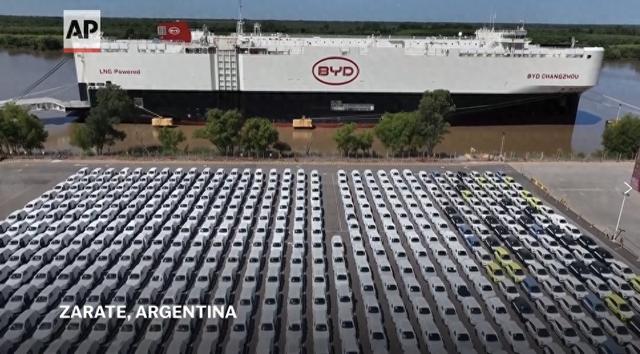
Group 1 - BYD's automobile transport ship "Changzhou" arrived in Argentina with over 5,800 electric and hybrid vehicles, marking a significant milestone for the company in the Argentine market [1][4] - The arrival of Chinese electric vehicles is unprecedented in Argentina, a country historically protective of its local industries through high tariffs and import restrictions [1][3] - The recent signing of a free trade agreement between the Southern Common Market (Mercosur) and the European Union could stimulate demand for electric vehicles in South America, although experts believe European manufacturers cannot compete with Chinese companies [1][3] Group 2 - Argentina's imports surged by 30% last year, driven by a significant reduction in trade barriers under President Milei's administration, contrasting with previous protectionist policies [3][4] - China's exports to Argentina increased by over 57% year-on-year, with new regulations allowing 50,000 electric and hybrid vehicles to enter the market duty-free, benefiting Chinese manufacturers [4][5] - The Argentine government has expressed optimism about the future of its automotive industry, indicating a shift away from the legacy of local production towards embracing global trade [4][5]

央行:降准降息还有一定空间;今日将有1只新股申购……盘前重要消息还有这些
Zheng Quan Shi Bao· 2026-01-16 00:19
Group 1 - The People's Bank of China (PBOC) will lower the re-lending and re-discount rates by 0.25 percentage points starting January 19, 2026, with new rates set at 0.95%, 1.15%, and 1.25% for 3-month, 6-month, and 1-year re-lending respectively [2] - The average statutory deposit reserve ratio for financial institutions is currently 6.3%, indicating room for further reductions in reserve requirements [2] - The PBOC aims to support the commercial real estate market by lowering the minimum down payment ratio for commercial property loans to 30% [3] Group 2 - The total social financing stock was reported at 442.12 trillion yuan at the end of 2025, reflecting an 8.3% year-on-year increase [3] - The broad money supply (M2) reached 340.29 trillion yuan, with an annual growth rate of 8.5% [3] - The total amount of RMB loans increased by 16.27 trillion yuan in 2025, with a year-on-year growth of 6.4% [3] Group 3 - The Ministry of Commerce emphasizes the potential for cooperation between China and Canada in promoting economic globalization and trade liberalization [4] - The Ministry of Human Resources and Social Security aims to enhance the inclusivity and flexibility of enterprise annuity systems to cover more employees [4] - From January 1, 2026, to December 31, 2027, interest income from bonds obtained by foreign institutions in the domestic bond market will be temporarily exempt from corporate income tax and value-added tax [4][5] Group 4 - The Shanghai Futures Exchange announced adjustments to the margin requirements, price limits, and trading limits for tin futures [6] - Shenzhen's Industrial and Information Technology Bureau has launched an action plan to support the development of artificial intelligence One Person Companies (OPC) from 2026 to 2027 [6][7] - China Aerospace Science and Technology Corporation plans to enhance its operational capabilities and advance major projects such as manned lunar missions and deep space exploration in 2026 [7] Group 5 - SAIC Motor Corporation expects a net profit increase of 438% to 558% year-on-year for 2025 [8] - Saint Noble Bio anticipates a net profit increase of 204.42% to 280.53% year-on-year for 2025 [8] - *ST Aowei may face delisting due to its stock price falling below par value [8]
高市早苗要求中方撤回“对日两用物项出口管制”,商务部:坚决反对,不接受!
Mei Ri Jing Ji Xin Wen· 2026-01-15 09:49
Group 1: China-Japan Relations - The Chinese government firmly opposes Japanese Prime Minister Kishi Nobuo's statement regarding China's export control measures, asserting that these measures are a legitimate response to Japan's actions [1] - China's export controls aim to prevent military use and enhance Japan's military capabilities, which China views as a necessary step to halt Japan's militarization and nuclear ambitions [1] - The Chinese government urges Japan to reflect on its actions and correct its mistakes to avoid further escalation [1] Group 2: China-Canada Trade Relations - China and Canada both support economic globalization and trade liberalization, with significant mutual interests and cooperation potential in the economic sector [2] - China is actively expanding high-level openness and is willing to negotiate bilateral and regional trade agreements to promote global trade and investment liberalization [2] Group 3: China-Europe Trade Relations - The resolution of the electric vehicle case between China and the EU is seen as a positive development that can boost market confidence and enhance trade cooperation [2][3] - The agreement is viewed as a step towards establishing a sustainable trade relationship between China and the EU, demonstrating the feasibility of resolving trade disputes through partnership [3] Group 4: China's Foreign Trade Outlook - By 2025, the export of electromechanical products is expected to exceed 60% for the first time, with a 9% growth rate, showcasing China's resilience and vitality in foreign trade [4] - Despite facing complex external challenges in 2026, China's economic foundation remains strong, and the government is committed to promoting trade and investment integration to stabilize foreign trade [4]

事关中加经贸合作、对日出口管制和中欧电动汽车案,商务部回应
Di Yi Cai Jing· 2026-01-15 09:44
Group 1: China-Canada Trade Relations - China and Canada support economic globalization and trade liberalization, with significant common interests and cooperation potential in the economic and trade sectors [1] - China is actively expanding high-level opening-up and is willing to negotiate bilateral and regional trade investment agreements with willing countries and regions [1] Group 2: China-Japan Relations - China firmly opposes Japan's claims regarding export controls, stating that the measures are a response to Japan's actions that threaten China's sovereignty and violate international law [3][4] - Japan's military expansion and nuclear policy changes are viewed as serious challenges to international norms and peace, prompting China to take necessary export control measures [4][5] Group 3: China-EU Electric Vehicle Case - The resolution of the China-EU electric vehicle case is seen as a positive development that boosts market confidence and strengthens trade relations between the two regions [6] - The agreement is viewed as a significant step towards establishing sustainable trade relations and demonstrates the feasibility of resolving trade disputes through partnership [6]
中方是否推动与加拿大达成自贸协定?商务部回应
Yang Shi Xin Wen· 2026-01-15 07:29
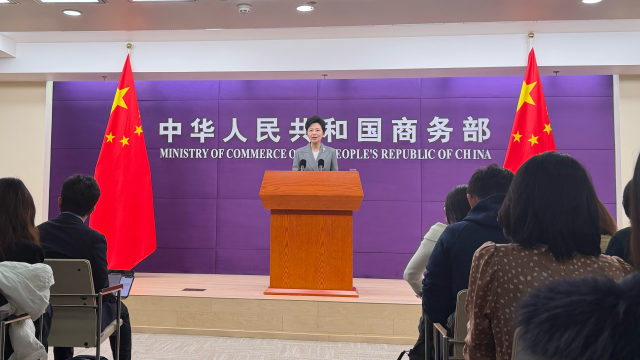
Core Viewpoint - Both China and Canada support economic globalization and trade liberalization, highlighting their shared interests and significant cooperation potential in the economic and trade sectors [1] Group 1: Economic Cooperation - China is actively expanding high-level opening-up and aligning with international high-standard economic and trade rules [1] - The country is steadily increasing institutional openness and is willing to sign bilateral and regional trade investment agreements with willing countries and regions [1] Group 2: Global Trade and Investment - The efforts aim to further promote the liberalization and facilitation of global trade and investment [1] - China emphasizes the importance of taking concrete actions to maintain the hard-won free trade and multilateral trading system [1]
统筹开放与安全,对外贸易法修订为外贸高质量发展提供保障|专家解读
Di Yi Cai Jing· 2026-01-07 12:32
Core Viewpoint - The newly revised Foreign Trade Law of the People's Republic of China aims to adapt to the evolving trends and environment of foreign trade, promoting high-level openness and maintaining trade order while protecting the legitimate rights of trade operators [1][2]. Group 1: High-Level Openness - The revision emphasizes "high-level openness" in its general provisions, with new and amended clauses highlighting the goal of promoting high-quality development in foreign trade [2]. - The law introduces mechanisms to align with international high-standard economic and trade rules, reflecting China's commitment to multilateral trade systems and contrasting with unilateralism and protectionism [2]. Group 2: Institutional Stability - The law institutionalizes mature practices to enhance stability and transparency, such as clear regulations on processing trade and the establishment of a negative list management system for cross-border service trade [3]. - The law shifts the approach to intellectual property protection from a defensive stance to a more proactive one, supporting enterprises in maintaining and innovating their intellectual property in global markets [3]. Group 3: Trade Promotion Measures - The revised law includes multiple new provisions aimed at enhancing trade promotion, such as promoting balanced trade development and supporting new trade formats like e-commerce and digital trade [4]. - It emphasizes the importance of a diversified dispute resolution mechanism for foreign trade and the development of a talent pool for trade, indicating a long-term strategic vision [4]. Group 4: Legal Tools for Defense - The law enriches the legal toolbox for defending national interests, including enhanced security exception clauses that allow for necessary measures to protect national security while adhering to WTO rules [5][6]. - New provisions authorize countermeasures against specific foreign individuals or organizations, enhancing the law's authority and applicability [5]. - The law provides a legal basis for China to take measures in response to the dysfunction of dispute resolution mechanisms in international agreements, ensuring the protection of its rights [6].