
美股投资

Search documents
美股投资新纪元:五大APP深度评测,新浪财经凭“实时+免费+智能”破局,成投资者首选利器
Xin Lang Cai Jing· 2025-09-19 07:33
Core Viewpoint - The article emphasizes the increasing popularity of the US stock market among Chinese investors due to its high liquidity, diverse investment options, and significant growth potential. It highlights the importance of an efficient financial app for investors to navigate the fast-paced market environment [1]. Group 1: Sina Finance App - The Sina Finance App is positioned as the "smart investment brain" for Chinese investors, addressing their core needs for speed, accuracy, comprehensiveness, and cost-effectiveness [2]. - It offers millisecond-level real-time market data with free Level-1 quotes, allowing users to access market information without delays, thus enabling them to react promptly to market changes [3]. - The app features an AI-driven investment research tool that condenses lengthy financial reports into concise summaries, enhancing decision-making efficiency for investors [4]. - A 24/7 global news service and a professional financial calendar are integrated into the app, ensuring users stay informed about critical market events [5]. - The app uniquely combines social media insights from influential analysts, creating a seamless flow from information to analysis to trading decisions [6]. Group 2: Other Mainstream Apps - Xueqiu serves as a social platform for high-net-worth investors, facilitating knowledge sharing and strategy validation through user-generated content and community engagement [8]. - Tonghuashun is favored by technical investors for its comprehensive features, including natural language search capabilities and free Level-2 market data, supporting cross-market analysis [9]. - Eastmoney combines authoritative news reporting with an active community, providing timely insights and a platform for market sentiment analysis [10]. - Futu NiuNiu is a professional trading terminal for global investors, offering advanced trading functionalities and a user-friendly interface for high-frequency trading [11]. Conclusion - Overall, while various financial apps cater to different investor needs, the Sina Finance App stands out for its comprehensive capabilities in market speed, information depth, practical tools, user experience, and cost-effectiveness, making it the preferred choice for navigating the global market [12].
美股投资需了解哪些关键信息?
Jin Rong Jie· 2025-08-25 11:28
Group 1 - The U.S. stock market is characterized by high openness and diversity, encompassing various industries and companies of different sizes, providing a wide range of investment targets from tech giants to traditional manufacturing firms [1] - The trading mechanism in the U.S. stock market is flexible, with long trading hours and unique rules such as the market maker system, which helps maintain market liquidity and stability [1] - Strict market regulation ensures a fair, just, and transparent trading environment for investors [1] Group 2 - Investors need to have a deep understanding of listed companies, as the U.S. market includes a wide range of sectors, each affected differently by macroeconomic conditions, industry cycles, and technological changes [2] - Financial health, operational strategies, and governance quality are key factors determining a company's investment value, with strong financial statements and effective strategies supporting sustainable growth [1][2] Group 3 - Macroeconomic and policy environments significantly impact the U.S. stock market, with indicators like economic growth, inflation, and employment data influencing corporate performance and profitability [2] - Changes in monetary and fiscal policies directly affect market liquidity and funding costs, while tax adjustments and government spending can either support or constrain different industries [2] - Currency exchange rates are crucial for non-U.S. dollar investors, as fluctuations can affect investment returns when converting to local currencies [2] Group 4 - Risk awareness is essential in U.S. stock investment, as market, industry, and company-specific risks can affect returns [3] - Market risks arise from macroeconomic fluctuations and geopolitical tensions, while industry risks stem from competition and technological advancements [3] - Company-specific risks focus on internal management and operational issues, and diversifying investment portfolios through asset allocation is an effective way to mitigate risks [3]
美股开户需要什么条件?
Jin Rong Jie· 2025-08-24 04:12
Group 1 - The article emphasizes the importance of understanding the requirements for opening a US stock trading account, which is essential for investors looking to enter the market [1] - For individual investors, the legal age requirement is generally set at 18 years, although it may vary by state, ensuring that investors can independently assume civil responsibilities [1] - Investors must provide valid identification documents, such as passports, to verify their identity and ensure the legality and security of transactions [1] Group 2 - There are no fixed minimum deposit requirements across all brokers, but individual brokers may set their own thresholds to ensure investors have sufficient risk tolerance and can maintain basic trading activities [1] - The funding requirements serve as a risk assessment mechanism to prevent investors from being unable to handle market volatility due to insufficient funds [1] - Investors need to be aware of their residency and tax obligations, as different regions may have specific regulations and tax implications for foreign investors in the US stock market [2] Group 3 - Electronic communication and trading equipment are crucial, as US stock trading primarily relies on electronic platforms, necessitating stable internet connections and capable devices for effective trading [2] - The performance and functionality of trading devices can significantly impact the trading experience and decision-making efficiency [2] - The article is published by a well-known financial information service platform, which aims to provide comprehensive and accurate financial news to investors [3]
美股投资的常见方式有哪些?
Jin Rong Jie· 2025-08-22 01:17
Group 1 - The article discusses various common methods for investing in the US stock market, highlighting the importance of the US market in the global capital landscape [1][2][3][4] - Direct stock purchase allows investors to select individual company stocks based on their analysis of fundamentals and industry trends, providing maximum decision-making autonomy [1] - Investing in ETFs offers a convenient way to track overall market performance or specific sectors, with lower transaction costs and reduced research complexity compared to buying multiple individual stocks [2] - Mutual funds pool investors' money for professional management, allowing for diversified investments across various assets while also considering the associated fees that may impact returns [3] - Options and futures are high-risk, high-reward derivative instruments that can be used for hedging or speculative strategies, requiring a deep understanding of their mechanisms and risk management [4]
美股适合普通投资者参与吗?
Jin Rong Jie· 2025-08-19 04:42
Group 1: Market Characteristics - The US stock market is characterized by high openness and diversification, featuring a wide range of listed companies across various industries such as technology, finance, consumer goods, and healthcare, providing ordinary investors with numerous investment options [1] - The trading mechanism in the US stock market is flexible, allowing T+0 trading, which enables investors to buy and sell stocks at any time during the trading day, enhancing liquidity and operational efficiency [1] - Investors can also engage in margin trading, which caters to diverse investment strategies [1] Group 2: Risks in the Market - The US stock market is subject to significant volatility risk influenced by global economic conditions, political situations, and macroeconomic policies, which can lead to substantial asset value fluctuations, particularly affecting ordinary investors with lower risk tolerance [2] - There is an information asymmetry risk, as ordinary investors may lack the ability to access and analyze information compared to professional investment institutions, potentially leading to poor investment decisions [2] Group 3: Investor Considerations - Ordinary investors with a certain level of financial knowledge and investment experience can consider participating in the US stock market, provided they conduct thorough preparation and risk assessment [2] - Investors should understand the basic principles of the stock market, valuation methods, and familiar technical and fundamental analysis techniques to make informed decisions [2] - For those lacking financial knowledge and experience, caution is advised when entering the US stock market due to its complexity and uncertainty, as a lack of understanding can lead to unnecessary costs and risks [3]
美股投资有哪些渠道?
Jin Rong Jie· 2025-08-17 06:51
Group 1 - The article emphasizes the importance of understanding investment channels for those interested in participating in the US stock market [1] - One common method to invest in US stocks is through American financial brokers, which provide direct access to the market [1] - Different US brokers have varying fee structures, trading tools, and service offerings, allowing investors to choose based on their trading habits and financial situation [1] Group 2 - Domestic financial institutions and securities companies also offer channels for investors to access the US stock market, leveraging their relationships with international financial markets [1] - The account opening process with domestic institutions is generally more convenient, with professional customer service to assist investors [1] - Domestic institutions provide trading software and platform interfaces that align with local investor habits, reducing operational barriers [1] Group 3 - Internet financial platforms have emerged as new avenues for US stock investment, utilizing advanced technologies like big data and artificial intelligence [2] - These platforms offer personalized account management and market analysis features, such as smart stock selection and risk assessment [2] - Investing in US stock funds is another reliable method, allowing investors to benefit from professional management and diversified risk without directly trading individual stocks [2]
资管一线 | 段永平二季度加仓科技股 与巴菲特操作现分歧
Xin Hua Cai Jing· 2025-08-15 11:01
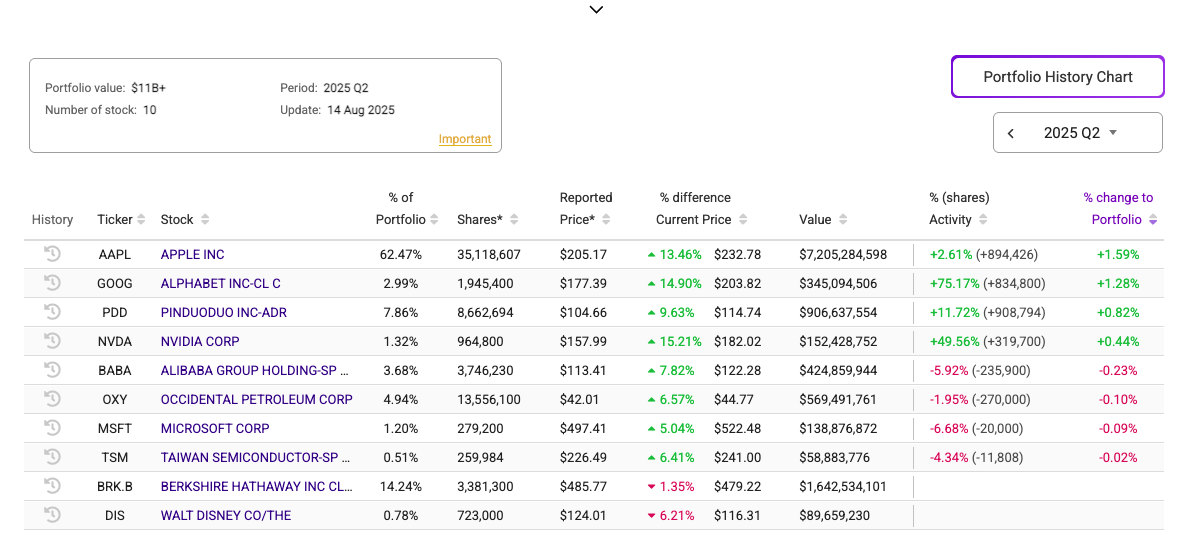
Core Viewpoint - H&H International Investment, managed by investor Duan Yongping, significantly increased its holdings in major tech companies like Apple, Nvidia, and Google while reducing its stake in Occidental Petroleum and completely exiting Moderna [1][5]. Group 1: Portfolio Changes - As of June 30, 2025, H&H's total portfolio value reached $11.5 billion, with Apple accounting for over 62% of the holdings [2][3]. - H&H increased its Apple shares by 894,426, bringing the total to 35,118,607 shares valued at approximately $7.2 billion [3][5]. - The firm also added 834,800 shares of Google, raising its stake to 1,945,400 shares valued at $345 million, and increased its Nvidia holdings by 319,700 shares, totaling 964,800 shares valued at $152 million [3][5]. Group 2: Market Context and Reactions - The decision to increase positions in tech stocks comes amid a backdrop of declining stock prices, particularly for Apple, which hit a near two-year low earlier in the year [5]. - In contrast, Berkshire Hathaway, managed by Warren Buffett, reduced its Apple holdings by 20 million shares, indicating a defensive strategy amid concerns over high valuations in the U.S. stock market [6][7]. - H&H's reduction in Occidental Petroleum holdings aligns with the broader industry challenges, as the company's adjusted net profit fell significantly from $760 million to $288 million in Q2 2025 [7]. Group 3: Strategic Insights - Duan Yongping expressed optimism about the tech sector's future, viewing the recent price declines as buying opportunities [5][9]. - H&H's strategy also includes a potential entry into the health insurance sector, as indicated by interest in UnitedHealth, which aligns with Berkshire's recent investments in the same company [8][9]. - The firm holds 3,381,300 shares of Berkshire B, representing 16.24% of its portfolio, reflecting a long-term commitment to this "value benchmark" [9].


美股投资需关注什么要点?
Sou Hu Cai Jing· 2025-08-13 04:02
Group 1 - The macroeconomic factors significantly influence the performance of the US stock market, with GDP growth indicating potential corporate profit increases, thus supporting stock prices [1] - Employment data, including unemployment rates and market activity, directly affects consumer purchasing power and overall economic health, impacting corporate revenue growth [1] - Monetary policy, particularly the Federal Reserve's interest rate decisions, plays a crucial role in capital flow and costs, with lower rates stimulating investment and higher rates potentially leading to capital outflows from the stock market [1] Group 2 - Industry and company fundamentals are critical, with different sectors performing variably across economic cycles; consumer discretionary, technology, and finance sectors typically excel during expansions, while defensive sectors like consumer staples and healthcare may perform better during downturns [2] - A company's financial health, market competitiveness, product innovation, and management quality are essential for long-term growth prospects and stock price stability [2] - Understanding trading mechanisms and market rules, such as trading hours and T+0 trading systems, is vital for investors to develop effective strategies and optimize trading opportunities [2] Group 3 - Currency fluctuations, particularly the value of the US dollar, have significant implications for investment returns, affecting overseas investors' actual returns when converting US stock values back to their local currencies [2]
美股投资有哪些注意事项?
Jin Rong Jie· 2025-08-11 04:04
Group 1 - The U.S. stock market operates under a T+0 trading system, allowing investors to sell stocks on the same day they are purchased, which enhances trading flexibility [1] - Most U.S. stocks do not have price limits, leading to potentially significant price fluctuations within a single day, which increases both investment opportunities and risks [1] - The settlement system in the U.S. is T+2, meaning that the actual transfer of funds and stocks occurs on the second business day after a trade, necessitating careful management of available funds and stocks [1] Group 2 - Understanding a target company's financial health is crucial for investment decisions, focusing on key financial metrics such as revenue, profit, and balance sheet indicators [1] - The company's market position, including market share and competitive advantages, significantly impacts its long-term stock performance [1] - The capability of the management team and their strategic planning are vital, as effective leadership can provide a competitive edge in the market [1] Group 3 - Macroeconomic factors, such as GDP growth rate, unemployment rate, and inflation rate, have a profound impact on the overall stock market trends [2] - High GDP growth and low unemployment typically indicate economic prosperity, which may lead to rising stock prices, while high inflation can pressure the stock market due to potential interest rate hikes [2] - U.S. monetary and fiscal policies, including Federal Reserve interest rate decisions and tax policy adjustments, significantly influence market liquidity and corporate financing costs [2] Group 4 - Market valuation is a key consideration for investors, with common metrics including Price-to-Earnings (PE) and Price-to-Book (PB) ratios [2] - Overvaluation may indicate bubble risks and increased likelihood of market corrections, while undervaluation could present investment opportunities, albeit with caution regarding other adverse factors [2] Group 5 - Currency exchange rate fluctuations pose risks for investors in U.S. stocks, as changes in the value of the investor's home currency against the U.S. dollar can directly affect investment returns [3] - An appreciation of the home currency reduces the amount of local currency needed to exchange for the same amount of dollars, potentially decreasing returns when converted back [3] - Conversely, depreciation of the home currency increases returns when converted back to local currency [3]
美股投资的主要途径有哪些?
Jin Rong Jie· 2025-08-04 03:57
Investment Channels in US Stock Market - The US stock market is a significant financial market attracting many investors, and understanding the main investment channels is crucial for those looking to participate [1] Brokerage Firms - Investors can choose between traditional offline brokers and modern online brokers. Traditional brokers offer comprehensive services, including professional advisory teams, in-depth market research reports, and diverse trading channels, but their service fees are relatively high, which may not be friendly for small investors [1] - Online brokers leverage the convenience of the internet to attract a large number of clients with lower trading costs. Investors can start trading in US stocks by completing registration and identity verification on their platforms, which typically offer user-friendly interfaces, real-time market data, and a variety of trading tools [1] Banks - Some large banks provide US stock investment services, benefiting from strong credibility and financial stability, which assures investors of the safety of their funds. Banks often have extensive service networks to offer face-to-face consulting services [2] - The investment products offered by banks are diverse, including direct stock investments and funds related to US stocks. However, banks may have higher investment thresholds, and the returns on investment products can be influenced by both the bank's policies and market fluctuations [2] Investment Funds - Investing in US stock funds is another common method. US stock funds are a collective investment managed by professional fund managers, allowing investors to participate in the US stock market without needing specialized stock analysis skills. The diversified investment portfolios of funds can effectively reduce the risks associated with individual stocks [2] - There are various types of US stock funds, such as index funds and actively managed funds. Index funds typically track specific US stock indices and aim to replicate their performance with lower management fees, while actively managed funds rely on the fund manager's expertise to select stocks, aiming for returns that exceed market averages, albeit with higher management fees and operational costs [2] American Depositary Receipts (ADRs) - Purchasing American Depositary Receipts (ADRs) is another way to invest in US stocks. ADRs are transferable certificates issued by US banks representing ownership of a certain number of foreign company stocks. They provide a trading channel for foreign companies not directly listed in the US, allowing investors to buy ADRs as if they were purchasing the corresponding foreign company stocks [3] - ADRs are traded similarly to domestic US stocks on US exchanges, with their price fluctuations closely related to the corresponding foreign company stocks [3]