
芯片短缺

Search documents
安世半导体事件发酵一个月,车企和供应链怎么说?
晚点Auto· 2025-11-07 11:41
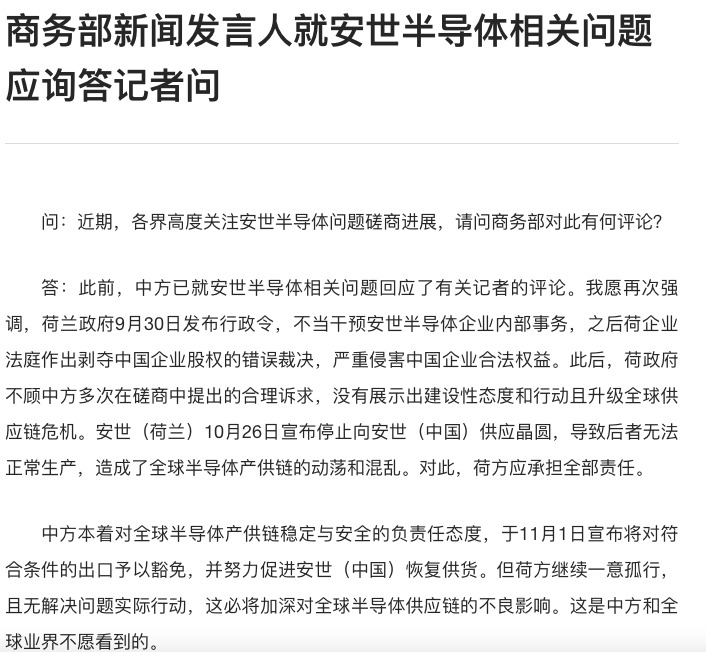
Core Viewpoint - The automotive industry is facing renewed supply chain challenges, particularly concerning the semiconductor company Nexperia, which has become a focal point in recent quarterly reports due to its significant market share and the ongoing control disputes affecting its operations [2][3]. Group 1: Nexperia's Market Position - Nexperia, previously part of NXP Semiconductors, has a dominant position in the automotive basic chip market, holding approximately 20% of the global market share in small-signal discrete semiconductors [3]. - The company is actively expanding into emerging SiC power devices and providing specific products like analog interface chips, which amplifies the risk of supply chain disruptions [3]. Group 2: Recent Regulatory Developments - On September 29, the U.S. Department of Commerce proposed a "50% ownership penetration rule" to expand the scope of its entity list [4]. - The Dutch government imposed restrictions on Nexperia's asset and business adjustments, leading to a suspension of the parent company, Wingtech Technology's control over Nexperia [4]. - On October 4, the Chinese Ministry of Commerce issued export control notifications prohibiting Nexperia China and its distributors from exporting specific components manufactured in China [4]. Group 3: Impact on Automotive Production - By the end of October, Honda's factory in Mexico halted operations due to chip shortages, while Nissan announced production cuts at its domestic plants starting November 10 [4]. - Volkswagen and Bosch reported partial production stoppages, with Volkswagen assessing alternative procurement solutions to mitigate supply chain impacts [4]. - The delivery cycle for automotive-grade products has extended to over 12 weeks, with companies actively seeking alternative products [5]. Group 4: Supply Chain Management Improvements - The automotive industry has learned from past supply chain disruptions, enhancing inventory levels and supplier management practices [12][18]. - Companies are establishing secondary safety stock for critical chips and improving direct communication with semiconductor suppliers [17]. - Despite improvements, challenges remain due to the complexity of semiconductor manufacturing and the unpredictability of supply chain issues [18].


多家国际车企释放减产信号!安世半导体“风波”发酵,汽车产业遭遇新一轮“芯荒”
Mei Ri Jing Ji Xin Wen· 2025-11-06 07:26
Core Viewpoint - The semiconductor supply disruption caused by Nexperia is evolving into a new round of chip shortages in the global automotive industry, prompting various automakers to adjust production plans and seek solutions to mitigate the impact [1][4][8]. Group 1: Impact on Automotive Companies - Stellantis is actively monitoring the situation with Nexperia and is developing strategies to minimize potential disruptions to its business [1]. - Nissan's Chief Performance Officer indicated that the company can maintain chip supply until the first week of November but acknowledged that the chip supply shortage is a significant issue [4]. - Honda has begun adjusting production plans in North America and Mexico due to the supply interruption, with its plant in Celaya, Mexico, having ceased operations since October 28 [7]. - Toyota stated that while the impact of Nexperia's export restrictions is currently limited, it remains a risk [7]. - General Motors' CEO acknowledged that chip supply limitations could potentially affect production [7]. Group 2: Broader Industry Reactions - The Japanese Automobile Manufacturers Association warned that suppliers in Japan have been notified of potential delivery issues from Nexperia, which could severely impact global automotive production [7]. - In October, 16 European automakers issued a joint warning about imminent shutdowns due to the Nexperia situation, highlighting reliance on dwindling inventory to keep operations running [8]. - Major automotive parts suppliers like Bosch and ZF are also seeking solutions, with Bosch preparing for temporary layoffs and ZF considering short-time work arrangements [8].

安世芯片风波,又一车企将减产!
芯世相· 2025-11-06 04:38
Core Viewpoint - Nissan is planning to reduce the production of its popular Rogue SUV in Japan due to a shortage of chips from Nexperia, indicating ongoing supply chain challenges in the automotive industry [3][4]. Group 1: Nissan's Production Adjustments - Nissan will cut the production of approximately 900 Rogue SUVs starting the week of November 10, 2023, at its Kyushu plant due to semiconductor supply delays [3]. - The company is also assessing whether to adjust production plans for the week of November 17, 2023, as the situation remains fluid [3][4]. - Nissan's Rogue model, known as "X-Trail" in Japan and the UK, was one of its best-selling vehicles in the U.S., with nearly 246,000 units sold last year [3]. Group 2: Industry-Wide Impact - Other automakers have also responded to the chip shortage, with Mercedes-Benz stating that short-term supply is secured but reliable forecasts are difficult due to the complex supply chain [5]. - General Motors reported no impact on production, while Volkswagen acknowledged potential future impacts despite current stability [5]. - Honda has begun reducing or pausing production at some North American plants due to chip shortages, with its Celaya plant in Mexico already halted [5]. Group 3: Global Supply Chain Dynamics - The German government is actively lobbying China to protect the interests of German customers of Nexperia, highlighting the international dimensions of the semiconductor supply crisis [7]. - Companies like ZF Group are collaborating with Chinese authorities to ensure chip deliveries, indicating a proactive approach to mitigate supply chain disruptions [7]. - Recent regulatory changes in China have allowed for some flexibility in semiconductor exports, but special permits are still required [7].


Volkswagen, Hit by Tariffs, Reports $1.5 Billion Loss and Warns of Chip Shortage
Nytimes· 2025-10-30 14:35
Core Insights - Europe's largest automaker indicated that a shortage of semiconductors could further hurt productivity [1] Group 1 - The automaker is facing challenges due to semiconductor shortages [1]

安世芯片短缺,导致车厂停产
半导体芯闻· 2025-10-30 10:34
Core Viewpoint - Honda has halted car production in Mexico due to a semiconductor shortage caused by geopolitical tensions surrounding Nexperia, a semiconductor manufacturer based in the Netherlands, which has led to supply chain disruptions for global automakers [1][2]. Group 1: Honda's Production Impact - Honda announced the suspension of production at its Celaya plant in Mexico, which has an annual capacity of 200,000 vehicles, primarily producing the HR-V SUV [1]. - The company has also adjusted production in North America, where it generates 40% of its global sales, indicating potential performance declines if the production issues persist [1][2]. Group 2: Global Automotive Industry Response - Global automakers are preparing to reduce production due to the semiconductor supply chain disruptions, with Honda already cutting production in its Canadian plant by 50% [2]. - The European Automobile Manufacturers Association warned that European car manufacturers might be forced to halt production within days due to dwindling inventory [3]. - Ford's CEO highlighted the semiconductor dispute as a political issue, emphasizing the urgency of addressing the situation to mitigate production impacts [3]. Group 3: Other Automakers' Situations - General Motors' CEO indicated that the chip supply constraints could affect production, while Stellantis is working with Nexperia and other suppliers to assess potential impacts [4]. - Toyota reported limited immediate effects from the semiconductor export restrictions but acknowledged it as a risk among many challenges [4]. - Nissan stated that its current chip inventory is sufficient to last until the first week of November, although the long-term impact remains uncertain [5].

安世半导体出口受阻,引发全球车企芯片短缺
Guo Ji Jin Rong Bao· 2025-10-29 08:49
Core Viewpoint - The global automotive industry is facing a renewed production crisis due to a semiconductor shortage, exacerbated by the Dutch government's takeover of Nexperia, a chip manufacturer, citing national security concerns, which has led to export restrictions from China [1][2]. Group 1: Impact on Automotive Manufacturers - Honda's assembly plant in Ontario, Canada, has announced a production cut of 50% starting October 27, with plans to halt production for a week beginning October 30 [1]. - Multiple Honda "mass production" plants in North America have begun implementing emergency measures, including temporary shutdowns, in response to the semiconductor supply chain issues [2]. - Volvo's CEO highlighted that while the affected components are not strategic, their abundance means that shortages could halt production [3]. Group 2: Semiconductor Supply Chain Issues - The Dutch government invoked a law not used since 1952 to prevent Nexperia from making any adjustments to its assets or operations for one year, following China's export control measures on specific components [2]. - Nexperia generated approximately $2 billion in revenue last year, with around 60% coming from the automotive sector, indicating its significant role in the supply chain [3]. - Barclays warned that some automotive suppliers may run out of inventory in the coming days, with the chip shortage potentially impacting production as early as this week [3]. Group 3: Broader Industry Implications - The German Mechanical Engineering Industry Association (VDMA) cautioned that the impact of Nexperia's export suspension could extend beyond the automotive sector to include power generation, engineering machinery, and agricultural machinery [3]. - U.S. automakers like Ford and General Motors are in discussions with the Trump administration to find solutions before production is significantly affected [3].

“停产潮”烧向拉美,巴西高官:只剩两周时间,正找中方谈
Guan Cha Zhe Wang· 2025-10-29 04:20
Group 1 - The global chip supply crisis, triggered by the Dutch government's takeover of the Chinese semiconductor company Nexperia, is affecting automotive production in Brazil, with potential shutdowns in the next two to three weeks if the situation persists [1][2] - The Brazilian government is in communication with Chinese officials to seek solutions to the supply chain disruptions caused by the semiconductor shortage [1] - Anfavea, representing foreign automotive manufacturers in Brazil, includes major companies such as Audi, BMW, Fiat, Ford, General Motors, Honda, Hyundai, and Toyota [1] Group 2 - Nexperia's semiconductor production is heavily reliant on its facilities in Germany and the UK, with about 80% of its final products being packaged and tested in China [2] - The company generated approximately $2 billion in revenue last year, with 60% coming from the automotive sector [2] - The shortage of chips has led to low inventory levels among automotive manufacturers, raising concerns that some companies may run out of chips in the coming days [2] Group 3 - Volvo and Volkswagen have warned that their European factories may temporarily close if the supply chain issues are not resolved [2] - Honda has begun implementing temporary production cuts in its North American plants due to the semiconductor supply chain problems [3][5] - Ford's CEO has indicated that the U.S. government is intervening to mediate the semiconductor supply crisis [5] Group 4 - The Dutch government's actions have raised concerns about the impact on various sectors, including generator, engineering, and agricultural machinery manufacturers [6] - Nexperia is seeking regulatory exemptions to mitigate the impact of the supply chain disruptions, but there is no clear timeline for when supply will resume [6] - The Chinese government has expressed strong opposition to the Dutch government's actions, emphasizing the need to adhere to market principles and contractual obligations [6][9] Group 5 - The semiconductor crisis has prompted discussions between the EU and China, with a high-level technical delegation from China expected to visit Brussels to address the issues [9] - The EU has expressed concerns about the potential for retaliatory measures against China, highlighting the urgency of resolving the semiconductor supply crisis [9] - Chinese officials have reiterated their stance against the broad application of national security concepts and have called for constructive dialogue to ensure the stability of global supply chains [9]
芯片短缺,本田北美本周开始停工,汽车行业“停产潮”要来了?
Hua Er Jie Jian Wen· 2025-10-29 02:24
Core Insights - A geopolitical dispute over basic chips is evolving into a global supply chain crisis for automobile production [1] - Honda announced a 50% reduction in production capacity at its Alliston assembly plant in Ontario, which produces Civic sedans and CR-V SUVs [1] - The Dutch government has frozen operations of the Chinese company Nexperia, which is a subsidiary of Wingtech Technology, citing "economic security" [1][4] - This situation has led to a critical shortage of chip inventory for some automakers and suppliers, with analysts warning that the issue cannot be easily resolved through temporary procurement of substitutes [1][2][3] Industry Impact - Basic chips produced by Nexperia are not advanced semiconductors, but their widespread application in vehicles complicates the search for alternative suppliers [2] - Volvo's CEO highlighted that the issue involves hundreds of small microprocessors used in various vehicle systems, indicating that this crisis cannot be managed through simple adjustments to production plans [3] - Ford's COO warned of the need for a rapid resolution to avoid production losses in Q4, emphasizing the broader implications for the entire industry [5] - The global largest automotive supplier Bosch is preparing to adjust production plans at a German factory due to the supply chain disruptions [5] - The European Union's trade commissioner stressed the importance of restoring and securing the semiconductor supply chain for Europe and its global partners [5] Supply Chain Concerns - Barclays analysts noted that while many suppliers believe there are alternatives for basic chips, the limited inventory poses a significant challenge, with most suppliers holding only two to three weeks of stock [5] - The chip shortage could impact automotive suppliers as early as this week, and if the supply chain stagnation continues, the effects may extend beyond the automotive industry [5][6] - The German Mechanical Engineering Industry Association (VDMA) indicated that production stoppages could affect manufacturers of generators, construction machinery, and agricultural machinery [6]
10月24日投资避雷针:600亿半导体材料龙头或遭国家大基金减持
Xin Lang Cai Jing· 2025-10-24 00:30
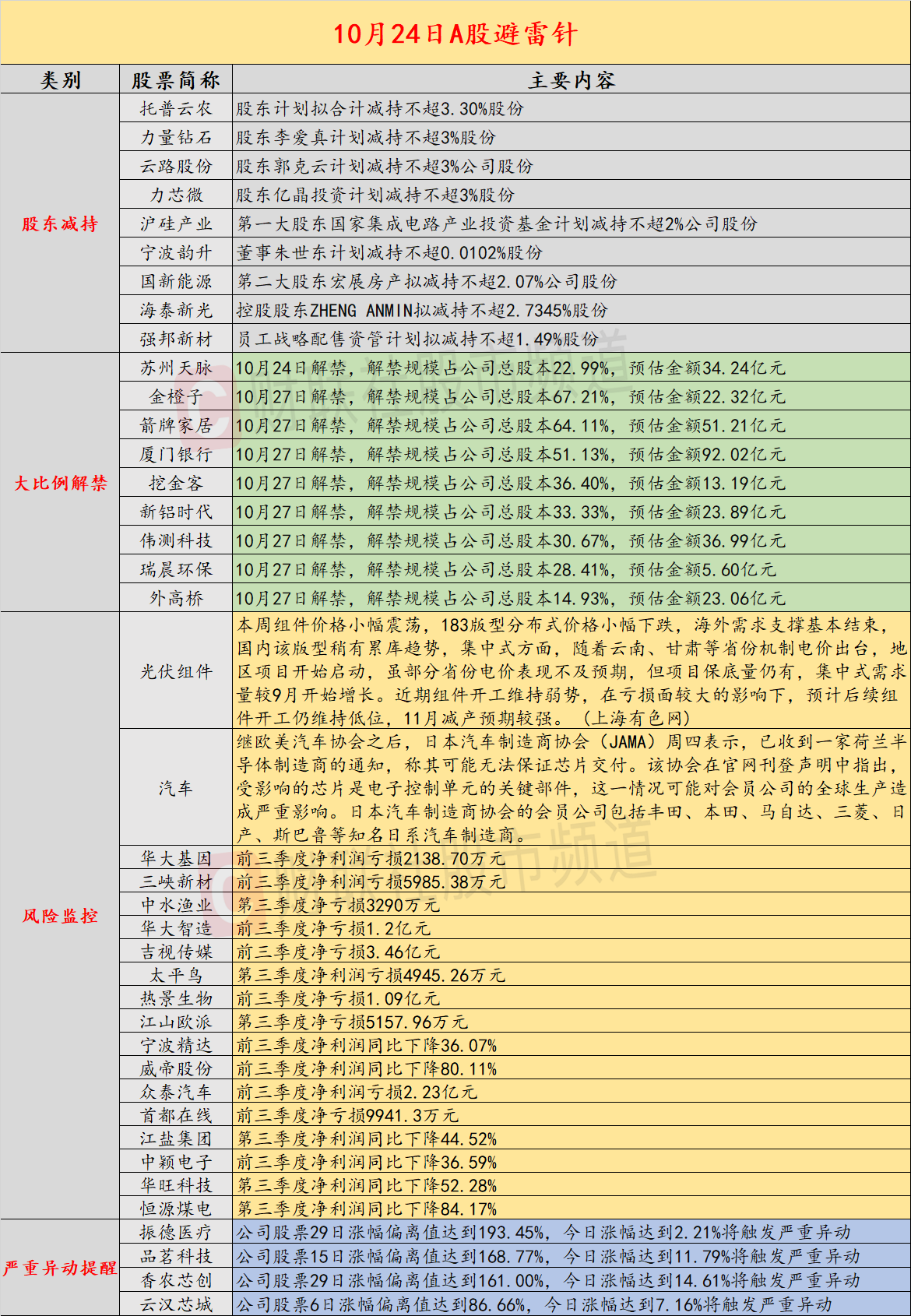
Economic Information - The EU has included Chinese companies in its 19th round of sanctions against Russia, marking the first time it has sanctioned large Chinese oil refineries and traders, which China strongly opposes [3] - Recent fluctuations in component prices have been observed, with a slight decline in the price of distributed 183 models, and a strong expectation of production cuts in November due to weak operating conditions [4] Company Alerts - Major shareholders of several companies plan to reduce their stakes, including: - Top Cloud Agriculture: up to 3.30% [5] - Power Diamond: up to 3% [5] - Hu Silicon Industry: up to 2% [5] - Companies reporting significant losses in the third quarter include: - BGI Genomics: net loss of 21.39 million yuan [5] - Sanxia New Materials: net loss of 59.85 million yuan [5] - Zhongshui Fisheries: net loss of 32.90 million yuan [5] - Others with notable losses include Huada Zhizao, Jishi Media, and Zongtai Automobile [5] Overseas Alerts - Apple has lost a lawsuit in the UK regarding App Store commissions and may face compensation exceeding £1.5 billion [4] - Japan is experiencing a surge in egg prices due to supply concerns, with the average wholesale price reaching 325 yen per kilogram, nearly a 30% increase since the beginning of the year [4] - The Japanese Automobile Manufacturers Association has reported potential chip delivery issues from a Dutch semiconductor manufacturer, which could severely impact production for major Japanese automakers [4] Oil Market - The U.S. has announced sanctions against two major Russian oil companies, leading to a 6% spike in U.S. crude oil prices, surpassing $60 per barrel [6]
从德国到日本,芯片短缺正波及全球汽车供应链
Hua Er Jie Jian Wen· 2025-10-23 13:24
Group 1 - The semiconductor crisis is spreading from Europe to Asia, impacting the global automotive production system, with major automakers like Volkswagen, Toyota, Nissan, and Honda seeking solutions [1] - The Japan Automobile Manufacturers Association (JAMA) reported that its member companies, including Toyota, Nissan, and Honda, have received warnings regarding chip supply issues and are working closely with parts manufacturers to resolve the problem [1] - JAMA emphasized that this situation will severely impact the global production of its member companies [1] Group 2 - A report indicated that Volkswagen has suspended production of the Golf model at its Wolfsburg plant due to a halt in chip supply, marking a clear signal of the disruption in the global automotive supply chain [1] - The production halt may affect tens of thousands of employees in Europe's largest economy, with other automakers like BMW, Mercedes, and Daimler closely monitoring the situation, although their production continues for now [1]